

A rack that closes is not automatically a flat result. A folding dish rack folds flat claim should be frozen to a measured closed envelope, with a named latch state, named outside dimensions, and a wait for spring-back, before the listing is approved. Do not treat latch-material, hinge-rust, or open-stability files as a substitute, and do not write this page for roll-up racks or for a laundry drying rack.
This guide is for importers and private-label teams specifying folding metal dish racks, the kind that stand to dry dishes and then fold for storage. It does not invent a universal thickness, and it does not close latch alloy, hinge corrosion, or tip-over questions. Koitor Hardware, a family-owned China OEM manufacturer of bathroom and home-storage metal hardware, can review a folded-envelope brief with a drawing or a sample; the buyer still has to name the state, the envelope, and the words that may appear on the artwork.
Why latch, rust, and stability files do not clear a folds-flat claim
Latch-material work, when it exists, asks what the catch is made of and whether it holds after a named cycle. Hinge-rust work asks whether a pivot stains or seizes in a wet kitchen. Stability work asks whether the rack stands when it is open. None of those files answers how large the closed rack is, or whether it stays in that size after the latch is closed and a wait has passed.
A shopper can have a latch that still clicks and a hinge that is still bright, and still find that the folded rack is too thick for a named drawer or too bowed to stack. After-sales then sounds like it does not fold flat, even when the neighbor files were accepted. That complaint belongs to an envelope file, not to a quietly rewritten latch page.
Roll-up dish mats are a different architecture. They do not use the same folding joints, and they should not inherit a metal folding-rack envelope. Open-and-fold laundry drying racks are also a different product. Folding laundry drying rack open capacity and pack size can remind a team that open use and packed size are separate decisions, but it is not a dish-rack method. Do not copy a laundry-rack carton number onto a dish rack and call the claim closed.
Kitchen sink dish rack drainage design can matter if a wet tray or a cup left in place prevents a clean fold, but do not turn this page into a drainage redesign. Empty the rack as the brief requires, then measure the closed envelope.
Worked example: first-article photos show the latch engaged on a newly folded sample. A week later, a buyer measures the same sample in a drawer and finds a residual bow at mid-frame, so the drawer will not close. The latch file was not wrong. The envelope and the wait were never written.
Worked example: artwork says folds flat with no length, width, thickness, and no latch state. Those two words will be read as a storage promise. Either bound them with a measured envelope, or remove them.
How should the latch state and the folded envelope be named?
Name the closed state first. Say whether the latch is fully engaged, whether both ends are caught on a two-latch frame, and whether feet, cups, and boards have been removed or folded to the position the listing shows. A photograph of a loosely stacked frame is not the same as a latched envelope. If the rack can be folded without the latch, write whether that unlatched state is allowed in the claim. If it is not, say that the claim applies only when the latch is closed.
Name the envelope next. Write the outside length, width, and thickness, or height in the stored attitude, and say where each is read: overall, including feet and latch bosses, or to a named body only. A dimension taken on a drawing of the wire frame alone can miss a protruding foot or a hook. This article does not invent a universal millimeter; the project writes the band it will accept, or it writes the measured values that may appear on the listing.
Record the attitude. A rack lying on its side on a table, a rack standing on its folded feet, and a rack in a named drawer or sleeve are not automatically the same thickness. Say which attitude is the claim, and photograph that attitude. If the carton inner size is part of the program, write the envelope against that carton as a separate line, not as a silent substitute for the product envelope.
Worked example: the brief says the rack is empty, both latches are engaged, the cup is stored in the named folded pocket, and the envelope is the overall length, width, and thickness including feet, measured on a table after a stated wait. The listing may repeat those three figures, or it may stay silent and keep folds flat off the title. Folds away to nothing cannot be repeated as a method.
Spring-back is part of the state, not an afterthought. Tines, side wings, and a center joint can open slightly after the latch is closed. Write the wait before the measuring photograph, and take a second reading if the project cares about a later drawer fit. A measurement taken at the instant of latching can miss a slow opening that a shopper finds in a cupboard.
If a collection includes a short rack and a long rack that share one latch drawing, do not inherit the short envelope. The long frame can bow more, and the latch may close while the mid-span stays thick. Run the method on each length that will carry the same claim.
Do not use shopping-volume slogans as a substitute for the envelope. Words that only praise compact storage, without a measured closed size or a named state, are merchandising, not a folds-flat file. Keep this brief on the measured envelope.
How should residual bow, protruding parts, and carton fit be split?
Residual bow is a lasting gap or curve after the latch is closed and the wait is over. Protruding parts are feet, hooks, cup pins, or latch levers that stand outside the main frame. Carton fit is whether the closed rack, in the named state, enters the planned inner carton or sleeve without forcing. These three can fail independently.
A frame can be acceptably thin at the latch and still bow at mid-span so a drawer front will not close. A frame can be flat and still fail a carton because a foot stands proud of the drawing. Write which of these the project will reject, and do not hide a carton fail inside a folds-flat adjective.
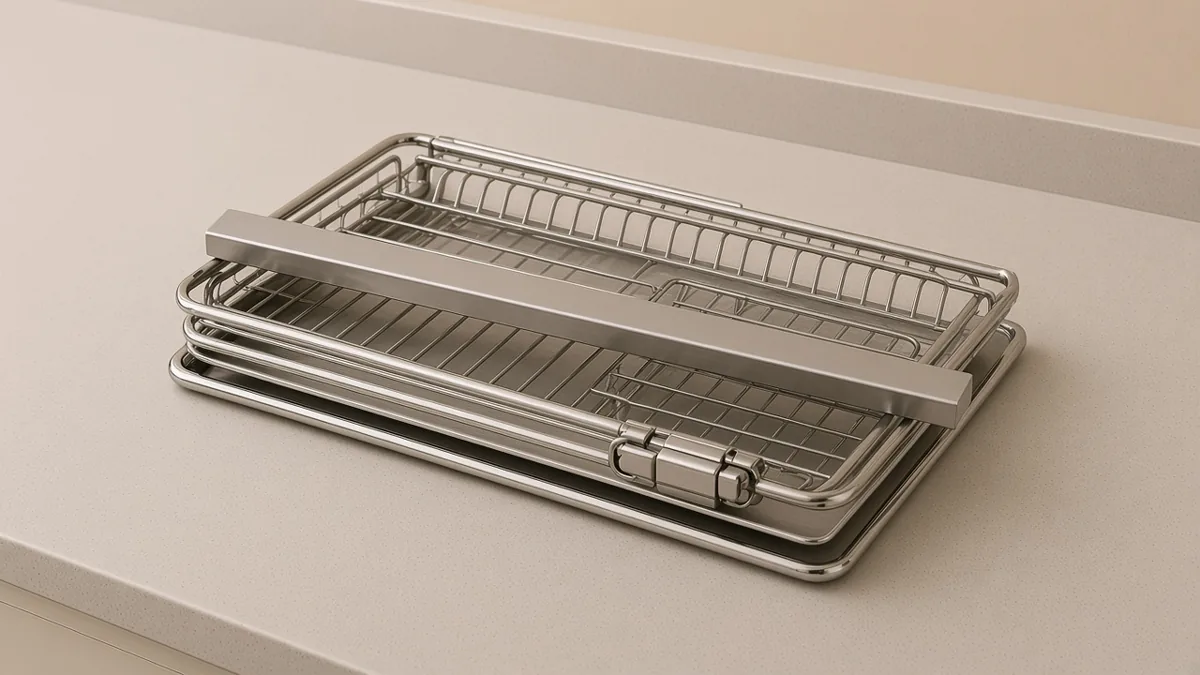
Worked example: the latched sample meets the project thickness at both ends, but a mid-frame bow remains after the wait. The listing photograph was taken with a hand pressing the middle. The honest file records the free-standing envelope, not the pressed photograph, and the claim is withheld until the bow is inside the project band or the words are changed.
Worked example: the product envelope is inside the project band, but the inner carton was drawn from an early sketch that omitted folded feet. The carton is a packaging fail. It does not automatically make the product claim false, and a product fail does not automatically mean the carton drawing was right. Split the two records.
Open capacity is out of scope. How many plates the rack holds when standing is a different decision. The laundry-rack neighbor treats open capacity and pack size as a pair for a different product; on this dish-rack page, keep open capacity out of the folds-flat method so the claim cannot be traded against a plate count.
Hinge binding that prevents a full close should be recorded, then sent in part to a hinge or latch neighbor if corrosion or latch material is the cause. If the joint simply is not designed to bring the wings parallel, that is an envelope and construction issue in this file, not a rust story.
What must stay off the listing until the envelope is frozen?
Do not print folds flat, folds paper-thin, or stores in any drawer unless the named state was measured and the words are bounded to the measured envelope. Those phrases will be read as a storage promise. If the envelope is not named, stay silent on flatness.
Lifestyle photos that show the rack pressed under a book, or held shut by a hand just out of frame, are not evidence. If the latch cannot hold the photographed thickness, either change the photo or change the claim. A shopper will treat the photo as the stored size.
If a folding dish rack folds flat line appears in a title or a bullet, the same listing should be able to show the three outside figures, or a clearly bounded qualitative rule the project has actually used. Prefer the figures the sample produced over a slogan that cannot be repeated in a warehouse.
Worked example: a retailer wants folds completely flat in the title. There is no latch state, no wait, and no thickness. The honest options are to write the envelope method, to drop the line, or to run a project measurement whose figures are owned by the buyer, not invented here as a universal thickness.
Worked example: a team wants to reuse a laundry-rack pack-size number because both products fold. The joints, the feet, and the stored attitude are different. Take the dish rack through its own envelope method.
Retail copywriters sometimes turn silence on millimeters into space saving or compact fold. Those words are still envelope claims if a shopper can reasonably read them as a folds-flat promise. If the brief has no state and no result, keep those adjectives off the storage sentence.
What should the importer freeze before artwork is approved?
This list is specific to the closed envelope of a folding metal dish rack. It is not a latch-material list, not a hinge-rust list, not an open-stability list, and not a laundry-rack pack-size list.

- The architecture: folding metal dish rack, not a roll-up mat, not a laundry drying rack, unless a different brief is written.
- The closed state: latch engagement, removable cups or boards, and the stored attitude.
- The envelope: where length, width, and thickness are read, including or excluding feet and bosses, with no universal millimeter invented here.
- The wait, and how residual bow or spring-back is judged against a project band or a retained photo standard.
- Whether carton or sleeve inner size is a separate packaging line.
- An explicit ban on an unbounded folds-flat slogan unless the measured envelope is stated or the claim is removed.
- What belongs on latch-material, hinge-rust, or open-stability files instead of this page.
- How later lot observation will be sampled, written separately from the envelope method.
If those lines are missing, a folding dish rack folds flat complaint will have no envelope to stand on. A request that only says it must fold flat is not yet an envelope file.
| Question | What to freeze | What the closed sample should show | What to keep off artwork until then |
|---|---|---|---|
| Latch state | Engaged or not, and whether unlatched fold is in scope | The same state used in the photograph and the measurement | A hand-pressed or unlatched photo used as the claim |
| Envelope | Length, width, and thickness datums, including feet if they sit outside | Readings after the agreed wait, in the named attitude | Folds flat with no figures and no state |
| Residual bow | Mid-span or wing opening after the wait | Bow inside the project band, or a written reject | A mid-frame press hidden just out of the photo |
| Carton or sleeve | A separate inner-size line, if packaging is in the program | The closed rack entering without forcing, or a packaging fail | A carton number borrowed from a laundry rack |
| Exclusions | Latch material, hinge rust, and open stability as separate files | Those results, if needed, in their own packs | A single folds-flat line used to close every neighbor |
First-article records should keep the open reference photograph, the latched photograph after the wait, and the three outside measurements in one pack. A single pretty folded shot, especially one taken under pressure, does not replace that set. If a latch will not engage until a wing is forced, record the force as a method problem; do not treat a forced close as the envelope the shopper will see.
If a program will sell several lengths or a two-tier folding SKU under one collection name, do not inherit an envelope from the shortest single-tier rack. Repeat the method on the revision that will actually carry the claim, and give the SKUs different item numbers if their closed sizes are not the same.
After-sales comments that the rack will not fit the drawer, or that it springs open in the cupboard, are the reason this file exists. Classify those comments as envelope and state until a latch-material or rust issue has also been checked, and do not close the complaint on a click of the latch alone.
Removable utensil cups deserve an explicit line. If the listing shows the cup stored in a folded pocket, measure with the cup in that pocket. If the cup must be packed beside the rack, the product envelope and the set of parts in the carton are different numbers. Do not let a cup-off measurement defend a cup-in photograph.
Coating thickness and end caps can change a tight envelope after a drawing was approved in bare wire. If the project will compare a drawing to a finished sample, say whether the coated and capped state is the one that must meet the band. Do not hide that difference inside a finish-only conversation.
Inbound shipping can close a rack more tightly than a latch will hold in later use, or it can bend a wing so the latch no longer meets. Photograph the sample as received, then after a documented fold from the open position. Do not use a carton-compressed thickness as the only first-article figure.
Two-tier folding racks can meet a length and width band and still fail thickness because the upper tier stacks beside or on top of the lower frame instead of nesting inside it. Write the stored stack as part of the state. A single-tier photograph used to defend a two-tier SKU is not an envelope check, even when the latch drawing is shared.
Worked example: a factory offers a one-tier weekday rack and a two-tier weekend rack under one folds-flat collection line. The two-tier unit latches, but the upper frame sits proud and the thickness exceeds the drawer the listing mentions. Split the claim, or drop folds-flat from the two-tier SKU, rather than inheriting the one-tier envelope.
How can a family-owned OEM review the envelope brief?
Koitor Hardware can review a drawing or a sample together with the latch state, the envelope datums, and the intended listing phrase. The useful conversation is construction and acceptance: whether the joints, feet, and latch locations can be made as drawn, and whether the words on the listing are broader than the brief. That is not a promise of a universal folded thickness.
Small-batch customization is often where a wing is lengthened or a cup is added without a new closed measurement. If the frame, the feet, or the stored parts change, repeat the method on the new revision. Do not carry a previous collection photo forward as proof.
MOQ can start from about 100 pcs depending on the product. Samples usually take 5–7 working days after details are confirmed. Bulk production usually takes 4–6 weeks depending on the project, finish, quantity, and packaging. Those figures are planning ranges and do not, by themselves, include a folded-envelope study unless the brief asks for one.
When you send the envelope brief and a sample to Koitor, include the latch state, the datums, the wait, and the listing phrase or an explicit decision to stay silent on folds-flat language. Koitor can then discuss custom kitchen storage rack manufacturing as a construction and acceptance review, not as a source of a pack thickness rating.
Frequently asked questions
Can a latch-material pass be used to say a folding dish rack folds flat?
No. A latch that holds is not a measured envelope. Mid-span bow, feet, and spring-back can still leave a thick closed pack. Run the envelope method even when the latch file has passed.
Is this the same as a folding laundry rack pack-size page?
No. That neighbor is a different product, and it also splits open capacity from pack size. This page is only the closed envelope of a folding metal dish rack, and it keeps open plate count out of the folds-flat claim.
Should we measure immediately after latching?
Take a reading then if you wish, but also write a wait and a second reading if drawer or cupboard fit matters. Spring-back after latching is a common reason a shopper says the rack did not stay flat.
Does carton inner size replace the product envelope?
No. Carton fit is a separate packaging line. A rack can meet a product band and miss a carton, or the reverse. Write both when both are in the program.
What if the listing photograph is thinner than the free latched sample?
Change the photograph or change the claim. A pressed or hand-held close is not the envelope the shopper will store.
Can Koitor publish a standard folded thickness for all folding dish racks?
No universal Koitor folded thickness is stated here. Koitor can review the joints and the state you specify, and can discuss a project method. The buyer still owns the listing words.
Work With Koitor Hardware
Need a folded-envelope brief reviewed?
Send Koitor your drawing or sample, the latch state, and the envelope datums you want used. Our team can review folding-rack construction and listing words as an acceptance brief before quotation, without inventing a pack thickness. MOQ can start from about 100 pcs depending on the product; samples usually take 5–7 working days after details are confirmed; bulk production usually takes 4–6 weeks depending on the project.
OEM / PRIVATE LABEL
Turn this sourcing guide into a product brief
Share your target product, size, finish, order quantity and packaging requirements. Your team receives a practical manufacturability review before quotation.


 English
 Español
 Português
 Français
 Deutsch
 العربية