
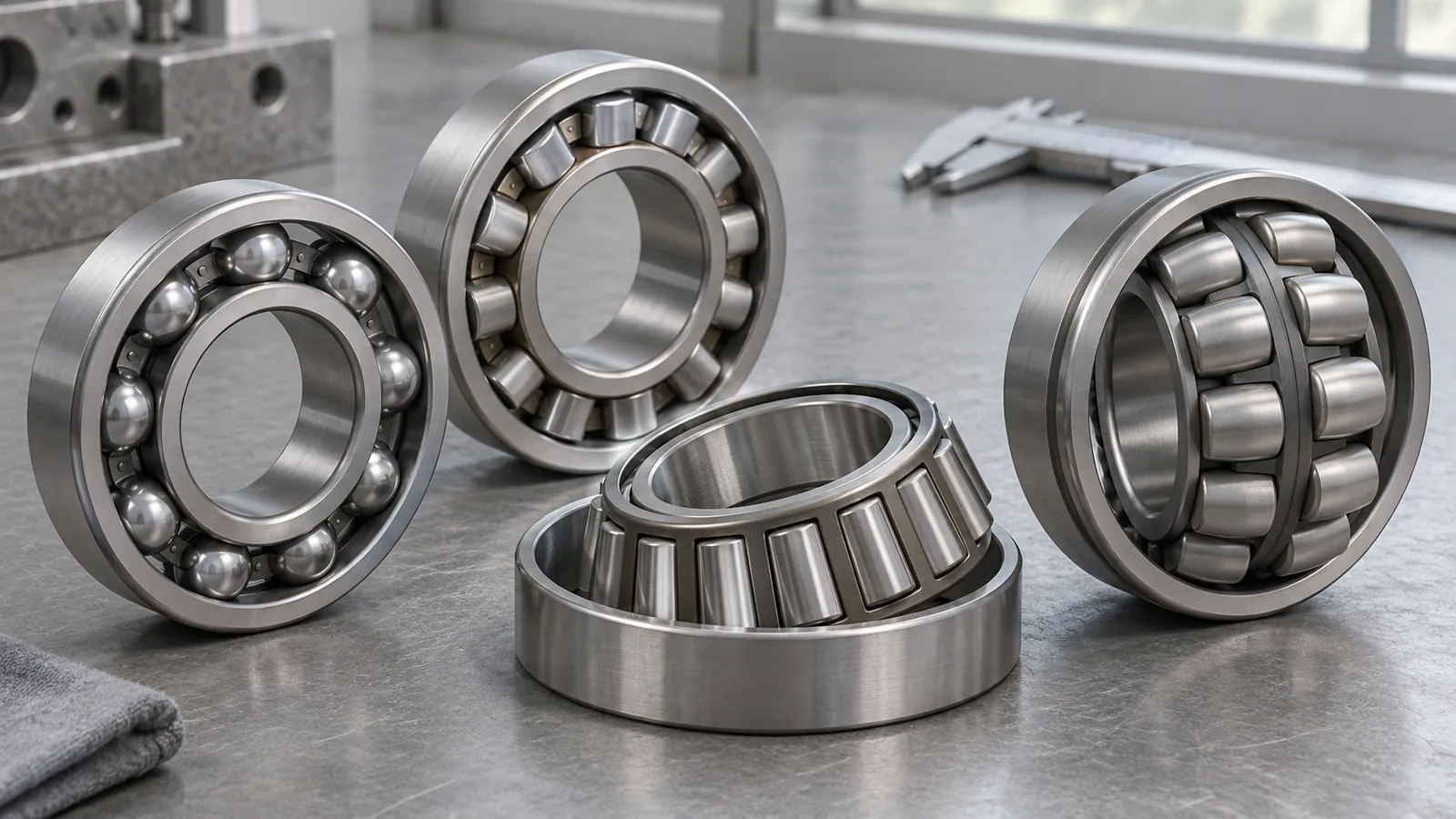
A useful overview of types of bearings starts with how the surfaces support motion: a plain bearing separates moving surfaces with a sliding interface, while a rolling-element bearing uses balls or rollers between raceways. Within rolling bearings, the element shape and raceway arrangement help identify a family and the directions it may be designed to accommodate. A family name is only a starting point. It does not establish a particular bearing’s load rating, speed limit, clearance, fit, lubrication, life, or suitability for a real assembly; those details depend on the exact maker, series, configuration, and operating conditions.
For an importer, product developer, or sourcing team, the practical task is often narrower than designing a bearing system. A team may need to identify a purchased component in a drawing, compare supplier quotations, replace a discontinued part, or ask a specialist to review a sample. The aim is to use the right vocabulary and provide enough information for a responsible comparison, while keeping unknown engineering properties visible. A label such as “ball bearing” can describe a broad family, but it does not uniquely identify the component or prove that two quoted parts are interchangeable.
What a bearing name tells a buyer
A bearing supports relative movement between components. In many mechanical assemblies it helps locate a rotating, oscillating, or translating member while managing contact between surfaces. The broad terms plain bearing and rolling-element bearing describe different contact approaches. A plain bearing, often called a sleeve or bushing in a particular construction, supports sliding contact through its bearing surface. A rolling-element bearing places rolling elements between inner and outer raceways, or between other raceway surfaces in a particular design.
“Rolling bearing” is not one geometry. A ball has a different contact shape from a cylindrical, tapered, spherical, or needle roller. Raceway shape, flange arrangement, cage, row count, and the way the rings are assembled also matter. Those features influence how a manufacturer designs a family for relative motion and load paths. They do not let a buyer infer the performance of an unidentified item from a photograph alone.
The two directions buyers most often need to distinguish are radial and axial. A radial load acts broadly across the shaft axis; an axial, or thrust, load acts along it. Real assemblies can combine these directions, and loads can change during use. A family may be intended for radial support, axial support, or a combination in a specified arrangement. That is a design description, not an assurance that any bearing in that family can handle every mixed load.
When a quotation says only “bearing,” ask for the manufacturer and complete part number, the drawing or catalog reference, dimensions, and the intended arrangement. If the supplier proposes an alternative, request the exact series and the manufacturer’s data for that alternative. Do not accept a family word as a substitute for component identity.
Common types of bearings by contact geometry
The following map helps with identification and conversation. It is not a bearing selection chart and it does not rank capacity, speed, precision, cost, or life. Manufacturers may offer variations within a family, and terminology can differ across catalogs. Use the exact manufacturer’s current documentation for the actual series.
| Bearing family | Contact or raceway clue | General identification context | What the name alone does not establish |
|---|---|---|---|
| Deep-groove ball | Balls run in deep, continuous raceway grooves | A common radial ball-bearing family; some designs can accommodate limited axial effects under their stated conditions | A universal combined-load rating, speed, seal arrangement, clearance, or life |
| Angular-contact ball | Raceways and contact geometry are arranged for an angular contact relationship | Often considered where a defined radial/axial load arrangement matters | A complete mounting arrangement, preload, paired configuration, or allowable load |
| Self-aligning ball | Spherical relationship between the ball rows and raceway arrangement | Can accommodate some misalignment characteristics in designs made for that purpose | The amount of misalignment permitted in a specific assembly or a cure for poor housing alignment |
| Thrust ball | Ball elements arranged around thrust raceways | An axial-support family in a specific orientation and configuration | Whether it can carry radial load, reverse thrust, or a specified speed in the proposed installation |
| Cylindrical roller | Cylindrical rolling elements and corresponding raceway geometry | A roller family used where the design and arrangement suit its intended load path | A blanket capacity comparison with all ball bearings or a complete axial-load conclusion |
| Tapered roller | Conical rollers and raceways form a tapered contact arrangement | Identification clue for a family whose arrangement and adjustment can be important | The required pair, adjustment, preload, lubrication, or performance of an unidentified set |
| Spherical roller | Barrel-shaped rollers operate with spherical raceway relationships in designs of this family | A family name associated with arrangements that address particular alignment and load considerations | A universal misalignment angle, load rating, or permission to ignore housing and shaft design |
| Needle roller | Long, relatively small-diameter rollers compared with their length | A compact geometry used in designs where radial space is a consideration | A numeric capacity advantage, edge-loading tolerance, or required raceway hardness |
The table is intentionally qualitative. NSK’s bearing education material describes these named rolling-bearing geometries, but the maker’s exact product documentation must control any technical selection. The taxonomy helps a buyer distinguish terms; it does not transfer a supplier’s catalog rating to another maker or prove that a component meets a project requirement.
How geometry relates to load direction
Geometry gives clues about the load path because contact occurs at particular locations and orientations between rolling elements and raceways. A radial arrangement is generally organized around forces crossing the shaft axis. A thrust arrangement is organized around forces along that axis. Angular-contact and tapered arrangements use geometry that makes the orientation of the contact relationship relevant to the assembly. These descriptions explain why bearing family names matter; they do not provide a substitute for an engineering calculation or the manufacturer’s rating for a specific item.
A buyer should avoid reducing the comparison to “balls are for light loads and rollers are for heavy loads.” That shortcut hides size, material, internal geometry, number of rows, mounting, lubrication, speed, stiffness, temperature, contamination, duty cycle, and the manufacturer’s design. A particular roller bearing and a particular ball bearing are not comparable merely because one uses rollers. Compare the actual part numbers under the same conditions and ask the bearing manufacturer or qualified designer to confirm the required performance.
Likewise, a family label does not mean the component can accept only one force direction. Some designs can accommodate more than one direction within defined limits or as part of a paired arrangement. Others are intended for a more specific direction. The word “thrust,” “angular contact,” or “self-aligning” gives a useful clue, but not the complete configuration. Ask for orientation, number of rows, paired or single arrangement, and the exact mounting recommendation when those details affect the assembly.
For a small mechanism such as a pivot, guide, or caster in a hypothetical storage product, the bearing could be a bought-in component whose identity and data come from a specialist supplier. The metal housing or surrounding hardware may be produced by another manufacturer. That example is illustrative only: it does not claim that Koitor makes bearings, calculates bearing ratings, or supplies every mechanism. Koitor’s confirmed positioning is as a family-owned custom metal bathroom and home-storage hardware factory. A project-specific discussion should stay within confirmed drawing, sample, fabrication, assembly, and packaging scope.
Identification is different from engineering selection
A buyer can use a short evidence sequence to move from a vague label to a checkable component record:
- Capture the visible marking, maker name, full part number, and any suffix exactly as shown. Do not silently normalize characters or omit seals, clearance, precision, cage, or configuration suffixes.
- Record the component’s measured envelope and interface only as an identification aid. Measurements do not replace the manufacturer’s tolerances or internal dimensions.
- Find the manufacturer’s current catalog or product page for that exact series. Confirm that dimensions and configuration correspond to the item in hand.
- State the assembly and motion: shaft or housing relationship, direction of movement, intended load directions, and whether load direction changes.
- Provide the operating context that the responsible designer considers relevant, such as speed, duty, temperature, environment, lubrication, mounting, and expected service interval. Avoid inventing values when the project has not established them.
- Ask the supplier to identify the proposed item and provide the manufacturer data supporting the proposal. Keep the original and alternative part numbers side by side.
- Confirm who owns the engineering decision and who approves any substitution. A quote comparison is not an engineering approval.
This sequence separates what can be seen from what must be documented. A sample can help identify size, markings, seals, and construction. It cannot by itself prove a load rating, operating life, internal clearance, material grade, or condition under a duty cycle. If no marking is present, document the uncertainty instead of assigning a family based on appearance alone.
Compare quotations without creating false equivalence
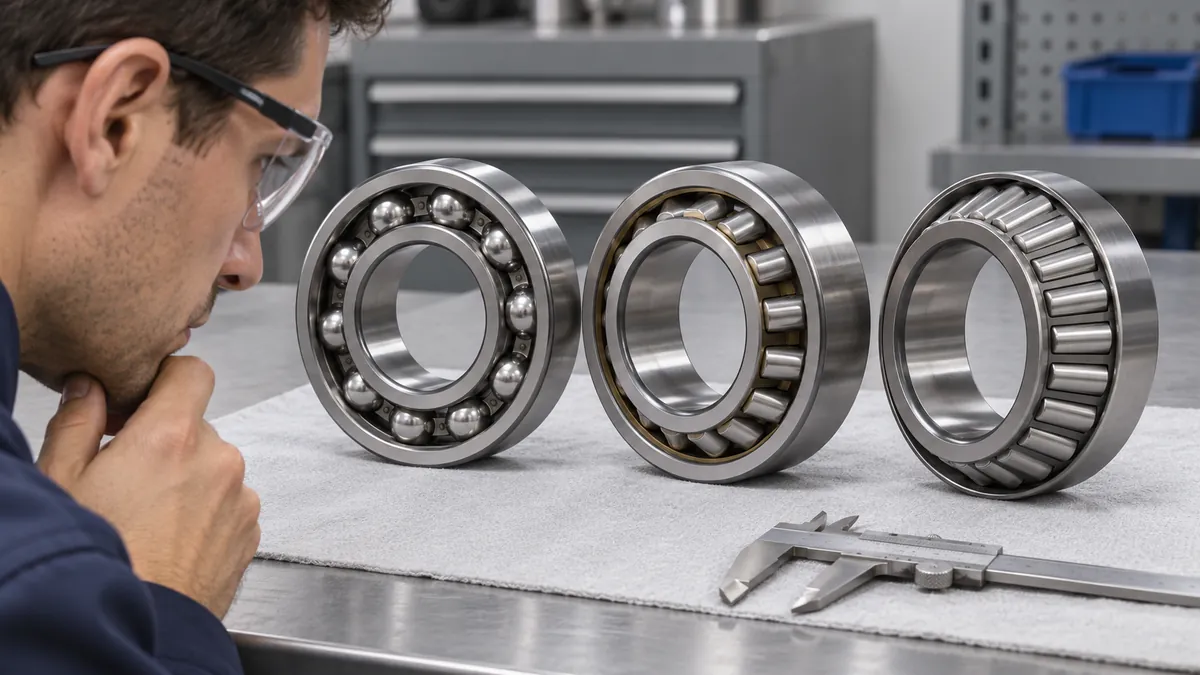
Sourcing teams often receive proposals that use different terminology. One supplier may list a complete manufacturer’s code; another may write only “6202 bearing”; a third may offer an alternative brand. To compare them, normalize the records before comparing price or lead time. A useful comparison sheet includes the supplier’s wording, exact maker and part number, dimensions, seals or shields, internal clearance or other suffixes when specified, quantity, pack format, offered substitute, supporting data, and open questions.
If two offers contain the same generic family but different part numbers, treat them as different until the responsible technical reviewer confirms interchangeability. If part numbers appear identical but the supplier source, manufacturing origin, or documentation differs, ask for traceable identification and the scope of any certificate or test record. Do not assume that a copied catalog screenshot proves the supplied goods match the reference.
A buyer may also need to distinguish the bearing from neighboring parts. A shaft, sleeve, housing, spacer, seal, retainer, fastener, or molded bushing can change the assembly behavior. The bearing’s identity is only one line in the bill of materials. For the related buyer handoff, see how to prepare drawings or samples for a custom hardware factory. For projects involving a drawer slide assembly, the existing drawer-slide corrosion testing guide addresses a separate corrosion question; it should not be treated as a bearing-family selection source.
If a polymer bushing or press-fit component is involved, the material and fit conditions require their own review. See bearing clearance and press-fit polymer bushings and filled-acetal wear and creep. Those pages cover related but distinct owners. This article does not replace their detailed fit, corrosion, or material discussions.
Common buyer mistakes
Treating a generic family as a complete specification
“Ball bearing” or “needle bearing” is too broad for many quotation and change-control decisions. Require a maker and full series reference or an approved project-specific specification. If the component is custom or lacks a traceable code, define the controlled drawing and acceptance evidence with the responsible engineer.
Choosing by an imagined universal ranking
There is no reliable universal list in which one bearing type is always stronger, faster, quieter, or longer lasting than another. A geometry has a design purpose, but a product’s performance depends on its detailed construction and conditions. Compare manufacturer data on a like-for-like basis and do not copy a headline rating without checking units, configuration, and conditions.
Assuming a photo reveals internal geometry
A photograph may reveal a seal, outer ring, or visible roller arrangement, but internal details may remain hidden. A sealed bearing may conceal the element shape. A cutaway illustration is useful for explanation but is not evidence that the delivered item matches it. Request the actual part code and current maker documentation.
Treating a sample as proof of service life
A sample confirms that a physical item was available for review. It does not reproduce the assembly, lubrication, contamination, alignment, loading, or time of use. If service life matters, define the application and obtain appropriate engineering evidence. Do not promise lifetime or failure rates based only on a sample inspection.
Accepting an unreviewed substitute to protect a schedule
A substitute can affect dimensions, mounting, seals, clearance, noise, supply continuity, or other project requirements. The fact that it fits into a box or shares a family name does not prove interchangeability. Use a documented change review, check the exact supplier data, and obtain approval from the designated technical owner before changing the bill of materials.
Mixing the bearing with the entire assembly’s capability
The complete product depends on the shaft, housing, support structure, fasteners, alignment, and service conditions as well as the bearing. Avoid saying “the bearing supports X” when that number is actually a system requirement or unsupported estimate. State which component’s documentation supports each claim.
What a responsible supplier exchange should include
A clear request for quotation or technical clarification can be short while still preserving the needed evidence. Attach the drawing revision or part number; label whether it is an existing reference or a proposed alternative; identify the application and movement; state the load directions known to the project; and list the operating requirements that have been approved. Ask the respondent to identify its manufacturer, exact code, data sheet, deviations, and assumptions. If the supplier cannot provide a detail, record it as unknown rather than filling the blank with a family-level assumption.
When the bearing belongs to a purchased mechanism, the metal product manufacturer may help clarify the interface drawing, housing dimensions, fastener access, or assembly constraints within its confirmed scope. The bearing maker or qualified engineering owner remains responsible for bearing ratings and detailed selection. This division prevents a fabrication quotation from being mistaken for a specialist bearing design review.
A change should be controlled even if the replacement seems equivalent. Record the old and new codes, reason for change, source of the alternative data, dimensional comparison, effects considered, reviewer, approval date, and the first order or lot affected. The appropriate records depend on the buyer’s own system; this article does not prescribe a universal quality procedure. For broader manufacturing and component interfaces, the exploded-view drawing guide explains how parts relate without treating an illustration as a complete dimensioned specification.
How a small-batch OEM factory can help
A custom metal hardware factory can support project discussion around the metal product that surrounds a purchased bearing: a bracket, housing interface, support, frame, mounting pattern, finish, assembly access, or packaging presentation, where those tasks fall within the factory’s confirmed capabilities. Koitor Hardware works as a family-owned specialized OEM manufacturer for bathroom and home-storage hardware, with customization based on buyer drawings or physical samples and direct factory communication. That positioning does not mean Koitor manufactures precision bearings, performs accredited bearing tests, or approves engineering ratings.
For a buyer developing a small product run, early drawing and sample discussion may reveal that the bearing interface is missing from the supplied information. The factory can ask the buyer to confirm the controlled drawing revision, the purchased-component identity, the mating dimensions that are relevant to the metal parts, and who approves any design change. Whether a particular manufacturing or assembly operation can be quoted must be confirmed for the actual project. No universal MOQ, lead time, price, tooling cost, or production capacity should be inferred from this general explanation.
The practical benefit of small-batch OEM communication is a chance to identify open scope before a quotation or sample review, not a guarantee that every design is manufacturable or that a bearing will perform as intended. Buyers should state their required sample stage, drawing status, finish, quantity range, packaging, labeling, and any private-label requirements. Keep the purchased bearing specification separate from the metal part specification so that each supplier answers for the part it controls.
Buyer checklist before requesting a quotation
- What is the exact bearing maker, full part number, and suffix, if known?
- Is the component a plain/sliding bearing or a rolling-element bearing?
- Which rolling-element geometry is documented: ball, cylindrical, tapered, spherical, needle, or another named design?
- What are the controlled drawing revision and relevant dimensions?
- What movement and load directions does the approved application define?
- Which operating conditions must the engineering owner consider?
- Is the offer an exact match or a proposed alternative?
- What manufacturer data supports the part identity and claimed characteristics?
- Who reviews technical substitutions and signs off the bill-of-material change?
- Which supplier owns the bearing, housing, shaft, metal fabrication, assembly, and packaging questions?
- What quantity, sample, labeling, private-label, and packaging requirements apply to the actual order?
- Which points remain unknown and need specialist review before approval?
Frequently asked questions
What are the main types of bearings?
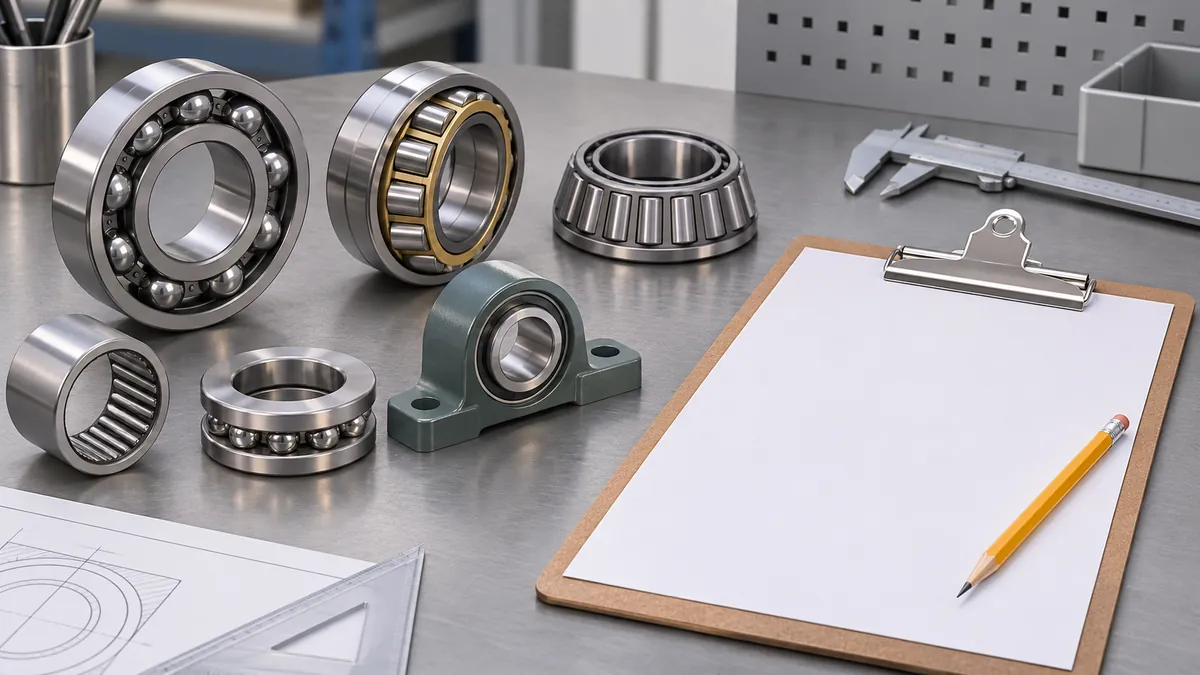
Broadly, buyers encounter plain or sliding bearings and rolling-element bearings. Common named rolling families include deep-groove, angular-contact, self-aligning and thrust ball bearings, as well as cylindrical, tapered, spherical and needle roller bearings. This is an introductory map, not an exhaustive catalog. Exact designs and terms vary by manufacturer.
Which bearing type handles radial and axial loads?
The answer depends on the exact design and arrangement. Some families are organized mainly around radial support, others around thrust, and some can accommodate defined combinations or use paired arrangements. Confirm the actual maker, series, orientation, mounting, and application conditions. A generic family name does not establish a safe load or permissible combination.
Are roller bearings always stronger than ball bearings?
No universal comparison is justified from the element shape alone. Dimensions, geometry, row count, material, internal design, mounting, speed, lubrication, operating environment, and manufacturer’s ratings all matter. Compare exact products using the same stated conditions and a qualified technical review where performance is critical.
Does a bearing family name prove the part is interchangeable?
No. Two bearings in the same broad family may differ in dimensions, seals, clearance, precision, internal geometry, mounting requirements, and documented ratings. Confirm exact part numbers and obtain approval from the responsible technical owner before substituting.
Can I identify a bearing from a photograph?
A photograph can provide clues about visible construction, but it may not show internal details or verify markings and performance. Use the maker’s part number, controlled drawing, supplier records, and actual product data. Mark any unidentified feature as unknown.
Is a bushing the same as a bearing?
“Bearing” is a broad functional term, and a bushing often refers to a plain or sliding bearing form. Usage varies by context. Compare the actual contact mechanism and component design rather than relying on the word alone. The dedicated bushing comparison linked above covers that distinction in more detail.
Should the metal product supplier select the bearing?
Only if that responsibility is explicitly within its verified expertise and agreed project scope. A metal hardware supplier can clarify its own interfaces and manufacturing constraints, while a bearing manufacturer or qualified engineer should support bearing selection and ratings. Define ownership in the project record.
What should I send when asking about a bearing substitution?
Send the old and proposed full part numbers, the controlled drawing revision, application and motion description, known load directions, relevant operating conditions, maker data, deviations, and the identity of the person who approves the change. Do not assume a catalog family label alone is enough.
Work With Koitor Hardware
When a purchased component meets a custom metal hardware interface, share the controlled drawing or sample, intended use, required quantity range, and unresolved interface questions. Koitor can review the metal product scope against its confirmed manufacturing capabilities; bearing selection and ratings must remain with the responsible specialist.
Discuss component and drawing scope with Koitor Hardware.
Send your drawing, sample, target quantity, finish, packaging, and project questions for a scope discussion.
OEM / PRIVATE LABEL
Turn this sourcing guide into a product brief
Share your target product, size, finish, order quantity and packaging requirements. Your team receives a practical manufacturability review before quotation.


 English
 Español
 Português
 Français
 Deutsch
 العربية