

Thread types are not distinguished by one label alone. A useful identification separates the thread profile or family, the size series and pitch convention, the thread’s geometry, and its intended function. Metric and Unified fastening systems, movement-thread forms, and pipe-thread families describe different contexts; coarse or fine, straight or tapered, and right- or left-hand describe other properties. For importers specifying a screw, insert, or threaded component, a similar diameter or a thread that appears to engage is not enough to prove compatibility. Confirm the full designation and the mating part before a drawing, sample, or purchase order is approved.
What does the phrase thread types include?
The broad phrase “thread types” groups several ways of naming helical features. It may refer to a profile family, a standards-based series, the intended job, or a physical feature such as pitch or taper. Articles and catalogs often place all of these names in one list, which can make different categories look interchangeable. A buyer gets a clearer result by first asking which property a label describes.
Consider four independent questions:
- Profile and family: What form does the thread have, and which established family or system does its designation belong to?
- Size series: What nominal size, pitch or threads-per-inch convention, and applicable designation identify it?
- Geometry: Is the thread straight or tapered, right-hand or left-hand, internal or external, and what usable length or engagement is specified?
- Function: Is it intended to clamp a joint, provide movement, connect a pipe, or perform another project-specific job?
A tooling guide’s overview of thread families groups examples by application, while a fastener supplier’s guide describes machine-screw threads in relation to matching nuts or threaded holes. These are useful terminology references, not exhaustive standards or compatibility approvals. These axes overlap. A fastener might use a Unified thread, be a fine series, be right-hand and straight, and serve a clamping function. A different feature may belong to a pipe-thread family, use a tapered geometry, and have a connection function. These combinations do not establish that the two parts are compatible or that either connection will seal. They simply show why one word rarely captures the whole design.
| Naming axis | What it describes | Examples of category labels | What remains to identify |
|---|---|---|---|
| Family or profile | Thread form and recognized designation family | Metric fastening, Unified, trapezoidal, pipe-thread family | Full designation and applicable specification |
| Size series | Nominal size and pitch convention within a family | Coarse/fine in a defined series; metric pitch; threads per inch | Exact size and pitch/TPI for the mating parts |
| Geometry | Direction and shape along the axis | Straight/tapered; right-hand/left-hand | Internal/external status, usable length, and reference |
| Function | Intended role in the assembly | Fastening, movement, pipe connection | Design conditions and compatible mating component |
| Component location | Which part contains the feature | Screw, nut, insert, bracket, fitting | Material, drawing revision, and how the thread is made or supplied |
The matrix is an explanatory map, not a replacement for a controlled fastener standard or engineering drawing. It deliberately does not give a dimension chart, interchange table, pressure rating, or fit class. When a project requires an established standard, the buyer’s technical authority should specify the relevant designation and edition or confirm which supplier specification governs.
How do common mechanical thread families differ?
Common thread-family names point to different design contexts, but a family name is only the start of a specification. Metric and Unified systems are widely encountered in mechanical fastening. Trapezoidal forms are associated with transmitting motion or force in some screw mechanisms. Pipe-thread families are associated with particular types of fluid or pipe connections, but the family name alone does not say whether a joint seals, what seal method applies, or whether a particular part is suitable for plumbing use.
The distinction that matters to a buyer is not simply “which family is best?” It is whether the selected family matches the mating part, expected function, required documentation, target market, and supplier’s actual scope. A storage rack screw kit, for example, may require a fastening thread identified in the supplied component specification. The buyer should not replace it with a similar-looking thread based only on nominal diameter or appearance.
Thread-family guides often group names in different ways. One technical tooling guide, for example, separates fastening threads from movement threads and lists metric, Unified, trapezoidal, and pipe-related families; a fastener distributor describes machine-screw threads by their mating nut or threaded hole and identifies coarse and fine series within the Unified system. These references help illustrate terminology, but each source has its own commercial and technical scope. A vendor’s list is not an exhaustive standards catalogue, and a family summary is not sufficient to select or approve the actual mating pair. Buyers should verify the source designation and applicable project specification rather than transfer an unrelated source’s detailed numerical claims or product advice.
Function is a useful first filter because it changes what a buyer needs to confirm. A fastening thread is evaluated as part of a connection between parts. A movement thread belongs to a mechanism where relative motion is central. A thread associated with a pipe connection involves a joint context that may include separate sealing requirements. The same apparent helix does not mean the same acceptance question. For hardware products, focus on the purchased component’s actual job: holding an assembly together, locating a part, enabling adjustment, or connecting a separately specified component. If the job is not clear, ask for the assembly drawing or BOM relationship before comparing thread names.
The distinction also prevents accidental scope creep. A broad educational article can explain that families exist without promising a supplier offers every family. If a drawing contains a specialty movement screw or a fluid connection, the buyer should verify who designs, sources, makes, and approves that component. An OEM manufacturer’s competence in metal bathroom and home-storage hardware does not automatically establish a capability in precision motion screws, pressure-bearing connections, or every fastener standard. Keep each claim tied to verified project facts.
A broad family list also should not be mistaken for an exhaustive classification. Thread names may identify profile, standardized series, product application, or a commercial category. Some names are tied to a standard; others describe a family or intended use more generally. Always inspect the full component description rather than infer the governing standard from a shortened label.
For a hardware RFQ, record the exact designation supplied by the engineering source, the part in which it appears, and the intended mating component. If the supplier is asked to source a separate screw or insert, clarify whether the buyer’s designation is mandatory or whether an equivalent may be proposed for review. An equivalence proposal needs the relevant technical comparison and written approval; “it fits” in a quick hand test is not proof of interchangeability.
Is metric the same thing as coarse or fine?
No. “Metric” identifies a thread system or designation convention, while “coarse” and “fine” distinguish series within an applicable family. A metric designation commonly includes nominal diameter and pitch, but a buyer must verify the actual specification for the component rather than interpret a size from the diameter alone. A coarse/fine label without its family and exact dimensions is incomplete.
Likewise, inch-based terminology can involve threads per inch and a Unified series designation. Metric pitch and threads per inch are different ways of expressing spacing; converting or comparing their numbers without the matching nominal diameter and family does not determine compatibility. The buyer should rely on the full designation printed on the drawing or supplier specification and the corresponding mating part.
Fine and coarse series are not universal substitutes. A bolt and nut must use matching specifications; parts may appear to start together while still being incompatible. Do not force engagement, rely on a partial turn, or use nominal diameter as the only check. The relevant owner pages for coarse versus fine metric threads and metric versus imperial thread compatibility cover those narrower comparisons. This article provides the larger family map, not a second compatibility guide.
Buyers who need to communicate pitch should follow the distinction between thread family and measured spacing. See Koitor’s existing guide to thread pitch for that separate subject. A pitch value does not identify every other property, and a thread-family name does not automatically provide a pitch measurement.
What is the difference between straight and tapered threads?
Straight and tapered describe whether the thread form maintains or changes its diameter along the axis. This geometric description does not by itself identify a thread family, size, pitch, or intended application. In particular, a tapered pipe-thread label should not be treated as a complete sealing instruction. The mating component, joint design, seal method, and project specification still matter.
A buyer should not infer a pressure rating or fluid-service suitability from the words “pipe thread.” Nor does apparent engagement confirm the correct connection. Where a project includes a pipe or fluid interface, the responsible engineer must define the applicable connection requirement and any governing standard. This article uses pipe-thread family names only to illustrate classification; it does not recommend a plumbing component or state that Koitor manufactures one.
Direction is another independent property. Right-hand is common in everyday fasteners, but a drawing can specify a different hand where the design requires it. A shortened description such as “left thread” should identify the part and the view/reference for determining direction. Never assume that a gender, orientation, or left/right label applies to the full assembly unless the drawing makes that clear.
For importers sourcing bathroom and home-storage hardware, the principal risk is often document mismatch: a drawing, screw-kit listing, sample and order record can use different shorthand. If one document says “metric,” another gives only a diameter, and a third shows a sample, the buyer should reconcile them before accepting the parts. The solution is a controlled, complete specification, not guessing from the appearance of the thread.
How should buyers identify a thread in a drawing or sample?
Start with the authoritative drawing or component specification. Record the exact thread designation, the component containing the internal or external thread, and the mating part. If the document is incomplete, mark the missing data as an open question rather than silently converting a visual observation into a formal specification.
A sample can help confirm context, but visual inspection alone is limited. A pitch gauge can support identification of spacing; calipers can help assess accessible dimensions; a compatible mating part may reveal obvious mismatch. These checks do not independently verify a complete standard designation, tolerance class, material, strength, or performance. Use the method and acceptance criteria agreed for the project, and involve the responsible technical reviewer for uncertain identification.
A useful identification record includes:
- Full designation as stated by the drawing or authoritative component supplier.
- Nominal size and pitch or TPI when applicable.
- Thread family or system and the governing specification when known.
- Internal or external location and the component part number.
- Straight or tapered form, handedness, and usable engagement as applicable.
- Mating part identity and whether the components are already approved as a pair.
- Drawing revision, sample status, and any assumption requiring written confirmation.
Avoid copying a thread label from a catalog image that might describe a different size or stock option. Keep the source document with the purchase record. If the thread belongs to a purchased screw, nut, insert, or accessory rather than the main metal component, identify who supplies it and which document controls the purchased part.
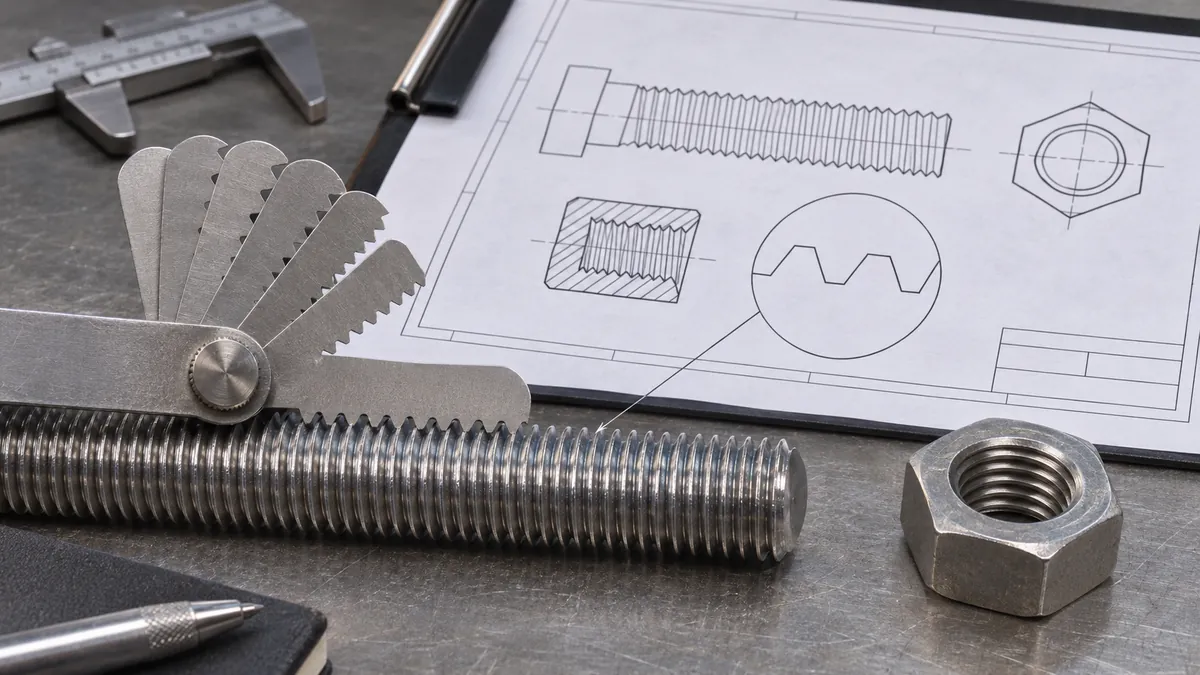
How to identify and specify a thread for sourcing
What should an importer confirm before sourcing threaded hardware?
A buyer should connect the thread designation to the business decision. For a screw kit, the purpose may be to ensure that supplied hardware mates with a bracket or insert. For a threaded insert, it may be to confirm both the insert’s internal thread and the receiving feature in the product. For a replacement component, it may be to preserve compatibility with an existing installed product. Each situation requires the exact mating information and a clear responsibility for approving any substitution.
Use this practical sequence:
- Identify which purchased component carries the thread and who supplies it.
- Copy the complete designation from the controlled source document.
- Name the intended mating component and reference its part number or approved drawing.
- Confirm whether the thread’s function is fastening, movement, connection, or another defined task.
- Check any series, geometry, direction, or engagement fields relevant to that task.
- Ask the supplier to disclose proposed substitutions or unresolved assumptions before quotation or sample release.
- Keep sample approval, BOM, inspection reference and purchase order aligned to the same revision.
The responsible buyer or engineering authority should decide which details are critical. Not every low-risk accessory needs a long technical specification, but every required mating relationship should be unambiguous. Excessively broad language can leave procurement unable to distinguish a true equivalent from an incompatible part; excess detail unrelated to function can also burden review. Write to the actual requirement.
When a supplier receives a component drawing without its mating part, the supplier may be able to identify missing information, but cannot reliably approve the buyer’s entire connection design from the thread label alone. Provide the screw or insert specification, the paired component drawing, and any relevant assembly context. If the hardware is a replacement for an installed product, include the original part reference and verify it against the revision or sample that actually controls the replacement. For a private-label kit, state whether the fastener is included and whether the buyer or supplier owns approval of its specification. These simple ownership details prevent the thread discussion from getting separated from the product-level purchase decision.
When reviewing an OEM proposal, keep the thread discussion within the verified product scope. Koitor Hardware is a family-owned custom metal hardware factory focused on bathroom and home-storage hardware. A buyer can share a relevant drawing or sample for a project-specific scope discussion through the custom bathroom hardware manufacturing page or the OEM home-storage hardware page. This does not imply that Koitor supplies every screw family or provides specialist pipe-thread components. Confirm the specific component and capability for each order.
What thread-type mistakes cause avoidable sourcing questions?
Several common mistakes come from mixing classification axes or assuming that one label supplies information it does not contain:
- Treating “metric” as a complete thread specification. Confirm the exact designation, size, pitch and applicable family details.
- Treating coarse and fine as universal fit categories. Those terms are meaningful within a defined family and series; they do not establish interchangeability across systems.
- Equating similar diameter with compatibility. A compatible connection depends on more than a rough outside-diameter comparison.
- Confusing a pipe-thread name with a sealing result. Joint design, seal method and governing requirements must be specified separately.
- Treating a movement thread as a standard fastening thread. The intended function and profile matter; do not select solely by visual resemblance.
- Assuming a catalog category is an engineering standard. Verify the full designation and its source.
- Using a gauge reading as a complete certificate of identity. Measurement supports a check; it does not establish every property or capability.
- Approving a substitution informally. Record the proposed alternative and obtain technical approval before the BOM or drawing changes.
- Leaving component ownership unclear. Identify whether the thread belongs to a fastener, insert, parent part or a separately purchased item.
- Letting files drift across revisions. The drawing, sample, BOM, quotation and order must refer to the same approved configuration.
These are communication and control issues, not claims that any particular supplier frequently makes such errors. If a mismatch is found, quarantine the decision, identify the controlling requirement, and have the responsible technical owner resolve it before assembly or shipment acceptance.
What checklist should accompany a threaded-component RFQ?
Use the checklist as a prompt. Mark each item as specified, not applicable, or awaiting confirmation rather than filling gaps with assumptions.
- [ ] Drawing and BOM revision identified.
- [ ] Component carrying the internal or external thread named.
- [ ] Exact thread designation copied from the authoritative source.
- [ ] Size series and pitch/TPI documented where applicable.
- [ ] Thread geometry and hand specified where relevant.
- [ ] Intended function and mating component identified.
- [ ] Usable thread length or engagement requirement stated if it is functional.
- [ ] Insert or separate fastener supplier and inclusion in the purchased scope clarified.
- [ ] Any alternative or equivalent requires documented approval.
- [ ] Inspection or sample evidence tied to the project’s acceptance criteria.
- [ ] Any pipe or fluid connection requirements reviewed by the responsible technical authority.
- [ ] Quotation, sample, BOM and purchase order reference the same specification and revision.

Frequently asked questions
Are metric and Unified threads the same type?
They are different thread systems. A metric marking does not identify a Unified designation, and a similar apparent size is not enough to establish compatibility. Use the full specification of both mating components and have the responsible technical reviewer approve any proposed substitution.
Does coarse or fine describe a thread’s profile?
Coarse and fine generally describe a series relationship within a particular thread system. These labels do not replace the complete size and pitch designation and should not be used as universal cross-system compatibility terms.
Do thread types include both fastening and pipe threads?
In broad educational usage, the phrase may include multiple families, including fastening and pipe-connection threads. Their names indicate different contexts, but a pipe-thread family name alone does not state the sealing method or suitability for a specific service.
Can a thread gauge identify every thread property?
No. A gauge may support an assessment of pitch or profile, depending on the tool and method, but it does not on its own establish the full designation, material, thread class, mating compatibility, or performance. Follow the project’s accepted identification and inspection method.
What should I do if the sample and drawing seem different?
Pause the approval decision and compare the sample with the current controlled drawing and BOM. Record the observed difference, identify the relevant component and mating part, and obtain a written resolution from the responsible design or technical owner before production release.
Does a thread name guarantee the supplier can provide the part?
No. A designation describes a requirement. It does not confirm a particular supplier’s sourcing, manufacturing, inspection or documentation capability. Confirm the exact project scope and evidence with the supplier before placing the order.
Work With Koitor Hardware
For a relevant bathroom or home-storage hardware project, send the current drawing or sample information, component identity, mating part and unresolved thread question. Koitor Hardware can discuss the project scope against the available documents; any specific component, process or capability must be confirmed for that order.
Clarify a threaded component before approving a hardware order.
OEM / PRIVATE LABEL
Turn this sourcing guide into a product brief
Share your target product, size, finish, order quantity and packaging requirements. Your team receives a practical manufacturability review before quotation.


 English
 Español
 Português
 Français
 Deutsch
 العربية