
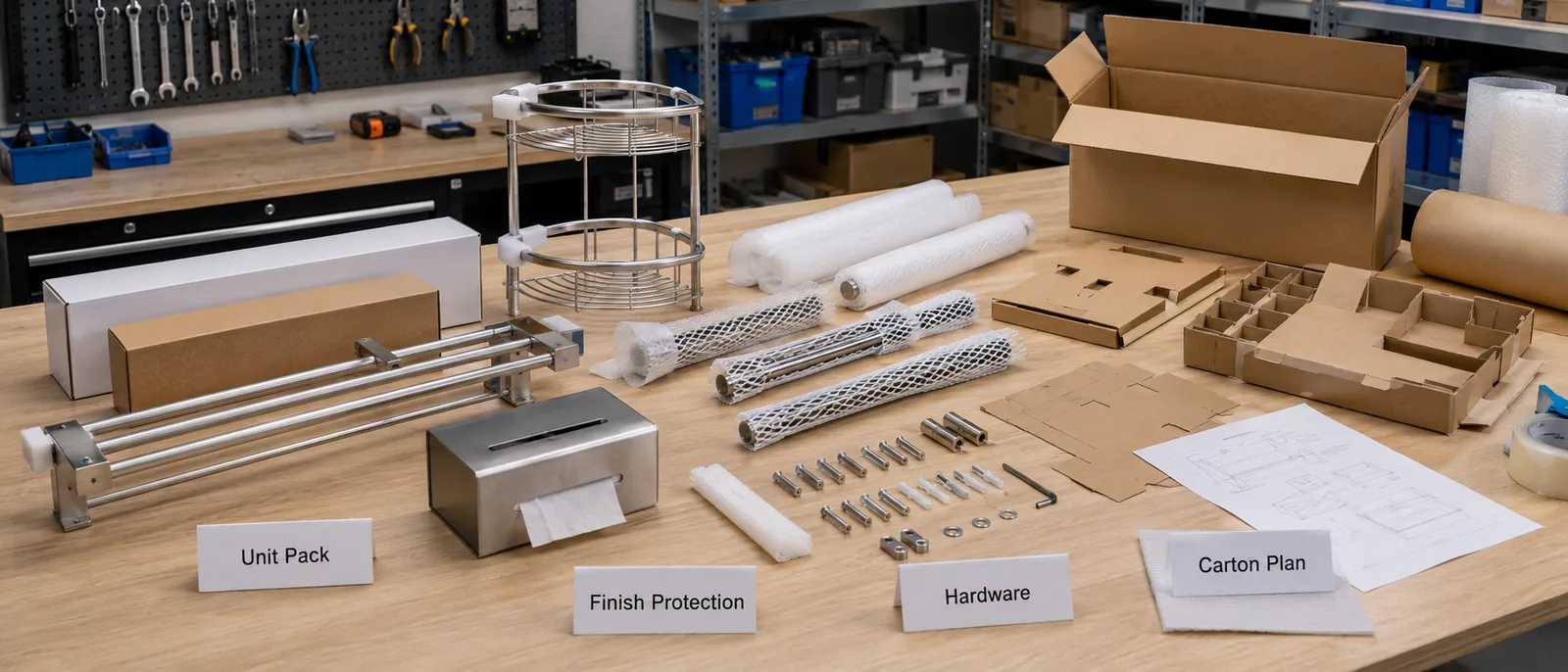
Amazon FBA bathroom hardware packaging should protect metal finishes, keep mounting components together, present one complete sellable unit, provide accessible identification and use carton space efficiently. Importers should design the packaging at the same time as the towel rack, shower caddy, tissue holder or wire basket, then inspect a complete packed sample before bulk production. The seller must also verify current marketplace and product-specific FBA requirements in Seller Central before every shipment.
Bathroom hardware creates e-commerce risks that a standard retail box may not solve. Projecting brackets can puncture cartons, screws can scratch coated surfaces, nested wire products can rub, and a customer may return an item if one small mounting part is missing. A controlled OEM packaging plan connects product geometry, assembly, finish, instructions, barcode placement, individual-unit protection and master-carton packing.
What Must FBA Packaging Achieve for Bathroom Hardware?
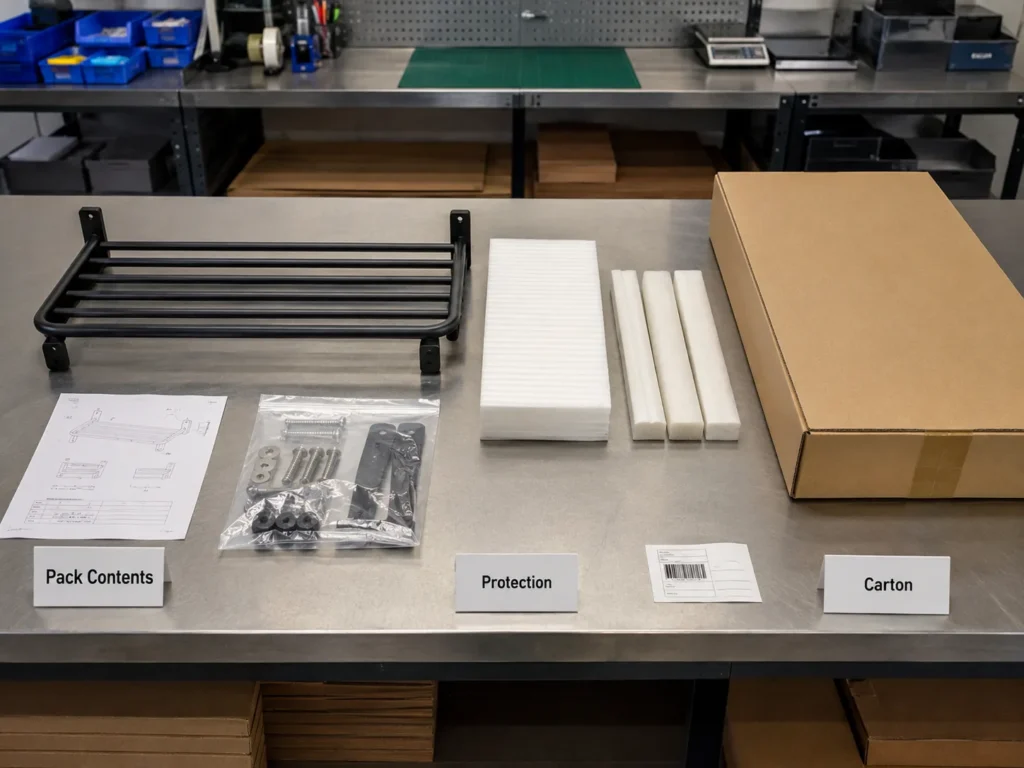
FBA packaging must keep each sellable unit complete, identifiable and protected through inbound shipment, fulfillment-center handling and delivery to the customer. The packaging should remain closed during normal handling and should not expose loose metal parts, sharp geometry or separate accessories.
The retail unit may pass through more handling stages than a store-delivery carton. It can be received, stored, picked, combined with other goods and shipped again. The inner protection therefore needs to work even when the product is no longer supported by the original master-carton arrangement.
Each unit should have the correct accessible barcode or required product label according to the seller’s current FBA workflow. Unwanted external barcodes may need to be covered or made unscannable to avoid identification errors. Products sold as a set should remain physically together and be clearly treated as one unit.
Amazon requirements can vary by marketplace, product type and fulfillment program, and policies may change. Sellers should confirm current packaging, prep, labeling, box-content and shipping requirements in Seller Central before production artwork is released and again before the shipment is created.
| Packaging objective | Bathroom hardware risk | Practical control | Approval evidence |
|---|---|---|---|
| Keep the sellable unit complete | Screws, anchors, caps or shelves separate | Sealed hardware bag, fixed compartments and pack list | Complete packed sample and component count |
| Protect customer-facing finish | Metal-to-metal rubbing and loose hardware | Sleeves, separators and immobilized parts | Unpacking inspection after handling simulation |
| Control projecting geometry | Hooks and brackets puncture or deform boxes | End protection, orientation and reinforced contact areas | Physical retail pack and carton review |
| Support identification | Wrong variation or unreadable label | Controlled artwork, smooth label area and revision check | Final printed pack and scan verification |
| Use carton space efficiently | Excess volume, movement or poor stacking | Flat pack, nesting or planned carton grid where suitable | Pack-out drawing, dimensions and physical carton |
| Create a clear customer experience | Confusing assembly or missing instructions | Simple steps, component diagram and item identification | Assembly trial using only packed contents |
How Does Product Structure Change the Packaging Design?
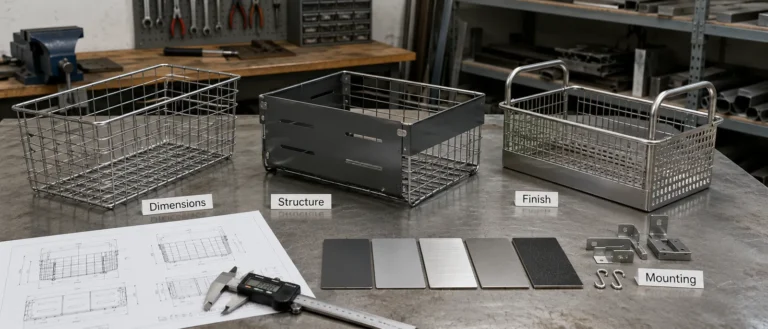
Product structure changes packaging because every bracket, hook, shelf, weld and removable component creates a different contact or movement risk. Packaging should follow the actual product geometry rather than forcing several unrelated bathroom accessories into one standard box.
A towel rack has long bars and projecting wall brackets. If the brackets face the carton wall, concentrated pressure may damage the box or bend the interface. If bars contact one another, chrome-style or powder-coated surfaces may show rubbing marks.
A shower caddy or wire basket has many intersections and open spaces. Nested products can save volume, but rims, hooks and weld points may lock together or scratch adjacent units. Separators should remain in position during handling, not merely look correct on the packing table.
A tissue holder may have a long open arm, cover or shelf. The arm needs support against bending, while a moving cover should not rub the visible finish. Small caps and mounting components need controlled locations inside the unit.
Freestanding racks can create a large dimensional-weight problem if shipped fully assembled. However, changing to a knock-down structure adds customer assembly, fasteners, interface tolerances and instruction requirements. Packaging optimization must be evaluated together with product design.
Buyers developing coordinated ranges can use Koitor’s private-label bathroom accessories development process to align product revisions, packaging artwork, instructions and pack contents before production.
When Is a Flat-Pack Bathroom Rack the Better Option?
A flat-pack bathroom rack is the better option when reduced parcel volume and carton efficiency outweigh the added assembly complexity. The decision should compare packed dimensions, component count, customer assembly steps, interface repeatability and damage risk.
Flat packing can work well for multi-tier racks, freestanding shelves and some wall-mounted products with removable brackets. It can reduce empty space and allow components to lie in protected layers. Shared box sizes may also simplify a related product range.
The product must be designed for repeatable assembly. Holes, threaded parts, brackets and shelves need suitable tolerances. Fasteners should be identifiable, and the customer should not need factory tools or judgment that the instruction does not explain.
More parts create more packing checks. A single missing washer, cap or screw can make the product unusable and trigger a return. Use a bill of pack contents, sealed hardware bag and component diagram. Where several fastener types are required, differentiate them clearly.
A fully assembled product may remain preferable when assembly is difficult, the structure depends on fixed alignment, the product is compact or the target customer expects immediate use. An assembled basket can also be more robust if disassembly would weaken the intended joints.
Compare both options using a physical pack-out. Measure the retail unit and master carton, record pack count, assemble products from packed stock and inspect finish after unpacking. Avoid choosing flat pack from carton volume alone.
Flat Pack vs Assembled Pack Decision Points
- Retail-unit and master-carton dimensions
- Number and type of customer assembly steps
- Fastener count and missing-part risk
- Alignment and stability after assembly
- Protection between metal components
- Instruction space and language requirements
- Customer expectations for the sales channel
- Estimated packing labor and inspection effort
How Should Finishes, Hardware and Instructions Be Protected?
Finishes, hardware and instructions should be separated, immobilized and identified so the customer receives one complete product without scratches or confusion. The protective method should be approved on actual production-representative parts.
Chrome-style reflective surfaces readily show fingerprints, scuffs and rubbing. Sleeves, films or soft separators may be appropriate, but the selected material should not leave residue or trap abrasive particles. Powder-coated products can scratch or chip at corners, brackets and high-pressure contacts.
Metal-to-metal contact is a primary risk. Bars, shelves and baskets should not move against each other. Cable ties, formed inserts, sleeves or compartmented cartons may help, depending on the product. Protection should not compress a thin wire structure into a distorted shape.
Mounting hardware belongs in a sealed bag or controlled compartment. The bag should not move freely against the product finish. If anchors, screws, caps and brackets look similar, a component diagram reduces assembly mistakes.
Instructions should match the approved product revision and mounting system. A no-drill accessory may need surface preparation and waiting steps, while a screw-mounted rack needs hole spacing and hardware identification. Unsupported universal installation or performance claims should not appear in the instructions.
Paper instructions also need protection from sharp parts, oil, moisture or abrasion. Place them where the customer sees them during unpacking without blocking the product barcode or becoming crumpled inside a hardware compartment.
Koitor Hardware can review structure, finish, assembly and packaging together for custom bathroom hardware manufacturing. This helps identify packaging contact points before the final retail box is ordered.
How Should Labels, Unit Packs and Master Cartons Be Controlled?
Labels, unit packs and master cartons should use one controlled item and artwork revision. The seller should provide current barcode and marketplace instructions, while the factory should verify placement, readability, product identity and carton contents before shipment.
Reserve a smooth, accessible label area on the exterior of the completed sellable unit. Avoid corners, folds, highly curved surfaces and locations hidden by final protective packaging. If additional wrapping is applied, the required identification should remain visible according to the seller’s workflow.
Each color, size or product variation must be packed and identified correctly. Similar black and chrome towel racks can be difficult to distinguish after boxing, so use controlled labels and an internal product-identification check before sealing.
Sets should remain together. A rack with two shelves, brackets and hardware must be packaged as one unit if sold as one unit. The exterior can use clear set identification where required by the seller’s current program rules.
Master-carton planning should record item code, unit quantity, carton dimensions, gross weight and outer labels supplied by the seller. Accurate physical measurements matter for logistics planning. Do not rely on early estimated carton data after the product or inner protection has changed.
Mixed-SKU or case-pack decisions belong to the seller’s shipment plan. The factory should receive clear carton instructions and should not improvise after production. A carton pack-out sheet with product orientation and count helps prevent variation between packing teams.
Before shipment, sellers should verify current FBA shipment, prep, barcode, box-content and routing requirements in Seller Central. This article provides packaging-development guidance and does not replace marketplace-specific instructions.
How Should an FBA Packaging Sample and Trial Order Be Approved?
An FBA packaging sample and trial order should be approved through pack-out review, assembly checks, handling simulation, barcode verification and representative production inspection. The buyer should approve both the sellable unit and the master-carton arrangement.
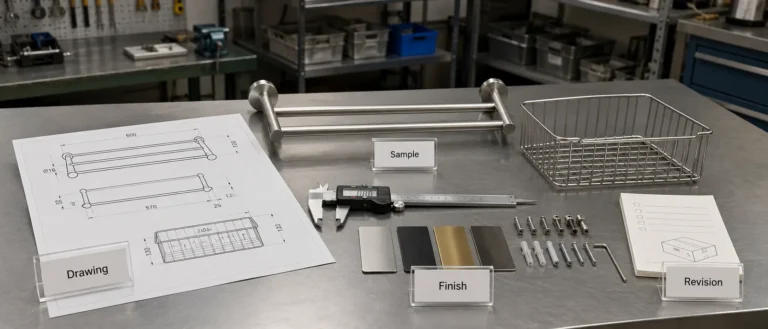
Begin with the final product drawing, bill of materials, finish reference, component list, instruction and artwork revision. Pack the actual or production-representative product, not a lightweight display sample. Photograph each packing layer and record orientation.
Unpack and assemble the product using only the contents and instructions provided. Count hardware, check fit, inspect finish and confirm that the correct variation is inside the correct box. A person unfamiliar with the design can reveal instruction gaps that the development team overlooks.
Use project-specific handling and package-evaluation methods based on the product, marketplace and shipping route. Record the method, sample condition and acceptance criteria. Do not turn one handling result into a universal delivery-performance claim without supporting evidence.
During a trial order, inspect units from different cartons. Check protective materials, hardware bags, instruction revision, label placement, barcode readability, box closure, carton count and visible damage after unpacking. Issues should be recorded by type and quantity.
Packaging changes after approval require review. A thinner separator, different bag, revised bracket, changed carton size or new label position can alter protection or processing. Update the pack-out drawing and artwork revision before bulk packing continues.
Koitor projects can start from around 100 pieces in some cases, depending on product structure, finish, mounting components and packaging. Samples usually take about 5-7 working days after details are confirmed, while bulk production often takes about 4-6 weeks depending on quantity, complexity, materials and approvals.
Amazon FBA Bathroom Hardware Packaging Checklist
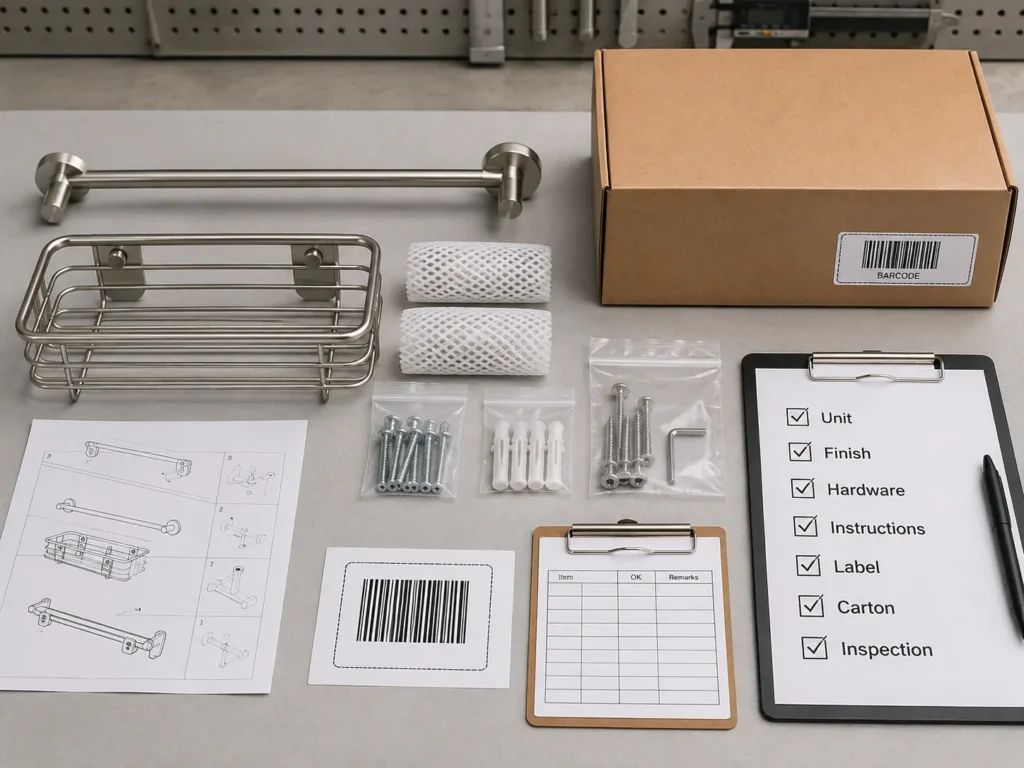
- Current marketplace and product-specific FBA requirements checked by the seller
- One complete sellable unit remains securely together
- Product, variation, barcode and artwork revisions match
- Customer-facing metal finishes have no rubbing contact
- Hooks, brackets, arms and edges cannot puncture the box
- Mounting hardware is sealed, counted and kept away from finishes
- Instructions match product and mounting-system revisions
- Flat-pack assembly uses clear parts and repeatable interfaces
- Barcode area remains accessible after final packaging
- Sets are contained and identified as one unit where required
- Retail-unit dimensions and weight are measured after approval
- Master-carton count, dimensions, weight and labels are controlled
- Physical pack-out and assembly trial are completed
- Trial-order units from different cartons are inspected
- Packaging substitutions require written buyer approval
The checklist should become part of the purchase order and inspection record. Packaging cannot be treated as a final warehouse decision because it affects product structure, finish protection, customer assembly, logistics cost and return risk.
An Amazon FBA bathroom hardware packaging plan should also record who owns each approval. The seller controls marketplace settings, barcode instructions and shipment creation; the factory controls production pack-out, artwork revision, component count and carton execution. Clear ownership prevents a current Seller Central requirement from being confused with a permanent factory specification.
Frequently Asked Questions
Does Amazon require every bathroom accessory to use the same packaging?
No. Requirements and practical protection depend on the product, marketplace and fulfillment workflow. The seller should check current Seller Central rules, while the packaging design should address the specific product geometry and risks.
Is flat-pack packaging always cheaper for bathroom racks?
No. Flat packing may reduce volume, but it adds fasteners, customer assembly, instructions, component checks and interface tolerances. Compare the complete product and fulfillment cost.
How can screws and anchors be prevented from scratching the rack?
Seal them in a durable identified bag, immobilize the bag in a compartment or fixed position and keep it away from customer-facing metal surfaces. Verify the arrangement after handling simulation.
Who should provide the FBA barcode and label instructions?
The seller should provide current marketplace-specific identification and shipment instructions. The factory can apply controlled artwork and labels, then verify product variation, placement and readability.
What should buyers approve before ordering printed boxes?
Approve the final product dimensions, pack contents, protective arrangement, instruction, barcode area, artwork, box construction, unit weight and master-carton plan using a physical packaging sample.
Work With Koitor Hardware
Planning E-Commerce Packaging for Bathroom Hardware?
Send Koitor your product drawing, packaging target, finish requirement, component list, instruction idea and expected quantity. Our team can review structure, flat-pack options, protective packing and small-batch production before quotation.
OEM / PRIVATE LABEL
Turn this sourcing guide into a product brief
Share your target product, size, finish, order quantity and packaging requirements. Your team receives a practical manufacturability review before quotation.
 English
  Español