
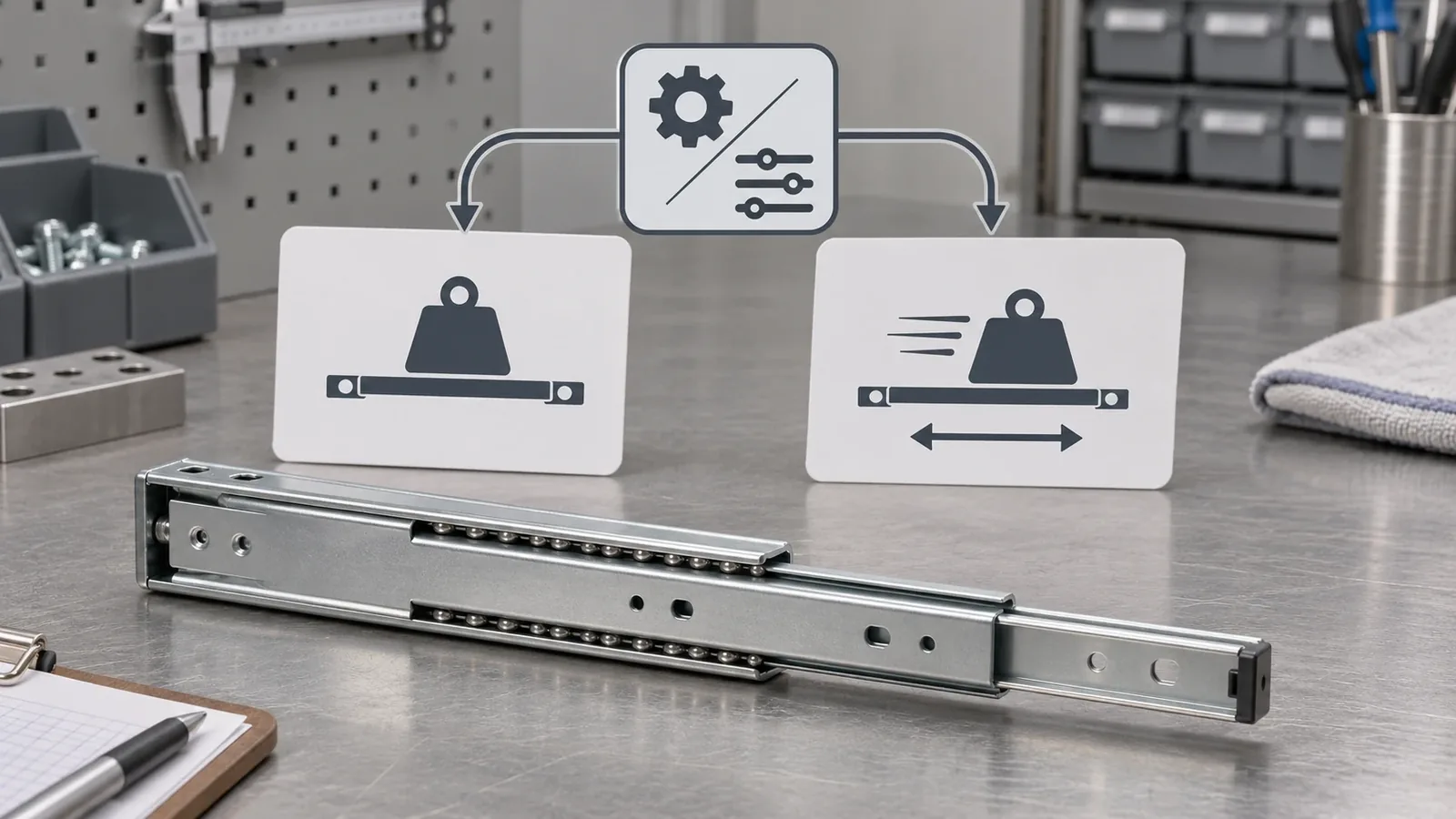
Static load vs dynamic load does not have one universal conversion or meaning. A maker may define a static value as a stationary holding condition, while a dynamic value for a bearing may be a parameter used in a theoretical life calculation rather than the maximum payload that can move. Buyers should keep the component, load direction, support, motion, test or calculation method, and stated units attached to every number. A storage slide, actuator, bearing, rack, or adhesive joint cannot inherit another product’s rating.
What Problem Does Static Load vs Dynamic Load Help Buyers Solve?
Buyers often receive data sheets, quotations, engineering drawings, and test notes that use the words “static” and “dynamic.” The words sound comparable across suppliers, but they do not define a complete measurement by themselves. One document may describe a force while a device is moving; another may describe a bearing rating connected to a life model. A buyer who compares the numbers without checking the definitions may treat unlike values as if they measured the same thing.
That mistake can travel through product development. A component may look acceptable in a spreadsheet but operate under a different motion, mounting, load direction, or duty cycle in the finished product. A rating copied into a catalog can also outlive the component or configuration that originally supported it. The first task is therefore not to choose the larger value. It is to identify what the number means for the exact component and condition.
The terms are useful only when their context is stated. Ask whether the value describes a force, a holding capacity, a maximum operating condition, a fatigue or life input, or the result of a named test. Ask which component and configuration the value applies to. If a document does not answer those questions, its number is not yet ready for a fair comparison.
Why Can the Same Words Describe Different Conditions?
A stationary load and a moving load are physically different situations, but manufacturers do not always use the labels in the same way. The product determines the rating framework. An actuator, a linear bearing, a rack, and an adhesive joint perform different functions; the same adjective does not turn their ratings into a common scale.
Thomson’s explanation distinguishes an actuator’s stationary holding condition from its powered push or pull condition. In that context, “static” and “dynamic” distinguish operating states of the actuator. Rollon’s discussion of linear-bearing ratings describes dynamic capacity in relation to a theoretical life calculation. That bearing rating is not simply a declaration of the largest payload that can move. These two examples are enough to show why a buyer should not assume a universal static-to-dynamic ratio.
The sources are device-specific:
- Thomson’s explanation of static and dynamic actuator load describes stationary holding versus powered push or pull.
- Rollon’s explanation of static and dynamic load ratings discusses a bearing rating used in a theoretical life calculation.
The following comparison is an interpretation map, not a rating table. It shows what a buyer must clarify before comparing any two numbers.
| Example context | What “static” can describe | What “dynamic” can describe | What the buyer must not infer |
|---|---|---|---|
| Actuator | A stationary holding condition | Powered push or pull while operating | That the dynamic figure is a universal moving payload limit |
| Linear bearing | A stationary rating condition defined by that maker | A capacity parameter associated with theoretical life | A guaranteed life, a payload for every speed, or a universal ratio |
| Storage assembly | A proposed stationary use condition, if documented | Repeated opening, closing, or movement, if documented | Any rating unless the complete assembly and method were evaluated |
The last row is deliberately cautious. It is an application question for a storage-product buyer, not an independent Koitor load rating. A drawer slide or moving rack may contain bought-in components, but its complete behavior also depends on its own geometry, mounting, fasteners, load distribution, installation, and operating pattern. A component datasheet alone cannot establish the rating of the finished assembly.


What Information Must Stay Attached to a Load Number?
A useful comparison record should preserve more than a value and a unit. Keep the product identity and the rating basis next to the figure so another team member can understand it without reopening a chain of emails.
Record these items whenever a supplier gives a static or dynamic figure:
- Exact component and model. Include the manufacturer, series, part number, configuration, and any suffix that changes the design.
- Rated quantity and unit. Preserve whether the document reports force, mass, moment, capacity, or another quantity. Do not silently convert one type into another.
- Load direction and point of application. A force applied along an axis is not automatically comparable with a force applied across a support or at an offset.
- Support and mounting arrangement. The installed orientation, supports, fasteners, and attachment surfaces can change the condition being described.
- Motion definition. State whether the part is stationary, starting, moving, stopping, cycling, or being held while powered.
- Rating method. Identify whether the value comes from a test, a calculation, a manufacturer’s catalogue convention, or another documented method.
- Life or duty assumptions. If a dynamic value feeds a theoretical calculation, retain the model’s assumptions and limits. Do not convert a calculated input into a service-life promise.
- Environmental and lubrication conditions. Record only the conditions the source actually specifies. A bathroom location alone does not establish a component’s corrosion or water-resistance rating.
- Revision and evidence source. Keep the dated document, applicable drawing revision, and the person or supplier who confirmed its meaning.
A purchasing comparison should be marked “not comparable yet” when the product model, rating definition, or condition is missing. That is a useful decision, not a failure to finish a spreadsheet. It tells the team exactly which question to send back to the supplier.
How Should Buyers Compare Ratings Without Inventing a Conversion?
Start by classifying each figure by what it represents. Is it an operating force, a stationary holding value, a component capacity, or a term used inside a model? Then line up the conditions. If the definitions differ, the figures should remain side by side with their own labels instead of being reduced to one winner.
A practical comparison workflow looks like this:
- Copy the source definition verbatim into the working record. Keep the manufacturer’s terminology and add a plain-language note separately.
- Separate component rating from application requirement. A bearing’s rating is not the same thing as the finished shelf’s allowable load.
- Compare like with like. Match the product family, direction, support, motion, calculation basis, and stated conditions.
- Ask for missing assumptions. If the data sheet does not state the test or calculation conditions, request the applicable technical note or written clarification.
- Keep uncertainty visible. Use “not specified” rather than filling a gap with an assumed conversion.
- Freeze the source revision. If the part number, supplier, or drawing changes, confirm whether the old value still applies.
For example, suppose a buyer sees an actuator’s stationary holding figure and a linear bearing’s dynamic rating in separate documents. Both may have force units, yet one refers to a powered actuator state and the other is an input to a theoretical bearing-life model. The shared unit does not make the quantities interchangeable. A good comparison table records the values in separate rows and adds a “definition / method” column. It does not calculate a ratio unless a documented method explicitly supports that calculation for those exact products.
The same discipline applies to a storage mechanism. A buyer can identify whether a drawer or rack is stationary in storage and moving during access, but that observation does not create a numerical rating. To specify a finished assembly, the responsible product maker or engineer must define the representative configuration and establish the applicable method and acceptance criteria. Where a buyer needs a project-specific requirement, it should be agreed before approval and verified with evidence appropriate to that requirement.
Which Mistakes Make Static and Dynamic Ratings Misleading?
The most common error is treating “dynamic” as a synonym for “maximum moving load.” That might not be what the source means. A second error is assuming that one rating is always a fixed percentage of another. A third is borrowing a value from an adjacent product because its name or units look similar.
Other avoidable problems include:
- Removing the product name from the figure. A number without its model and configuration can be reused outside its evidence.
- Mixing load, force, and mass. These terms are related in some calculations but are not interchangeable labels.
- Ignoring the load path. A bracket, slide, bearing, rail, and fastener may each carry different forces.
- Treating theoretical life as a guarantee. A life estimate depends on the model and conditions stated by the relevant manufacturer.
- Using a catalogue value as an assembled-product test result. A component rating does not automatically cover its mounting or surrounding structure.
- Assuming a static check predicts cycling behavior. A stationary observation does not establish performance under repeated movement.
- Ignoring direction and eccentricity. A centered axial load and an offset load can produce different effects.
- Leaving out the method. A test value and a calculation value need not answer the same question.
When teams find conflicting figures, they should first check whether they refer to different operating conditions or product revisions. If the definitions still do not align, the right action is to pause the comparison and request clarification. Selecting the largest number is not a technically defensible shortcut.
How Does This Apply to Bathroom and Home Storage Hardware?
Bathroom and home storage products can include moving interfaces such as drawer slides, sliding baskets, hinges, or adjustable assemblies. A buyer may receive data for a bought-in bearing or slide while also needing to understand the completed product. Keep those levels separate: component evidence describes the component under its stated conditions; an assembled product requirement describes a specific configuration and use.
For a storage project, the buyer’s request should state the product, intended load distribution, mounting surfaces, direction of use, movement pattern, and the acceptance method expected from the responsible supplier. If the buyer is reviewing an existing report, preserve its product and test setup. Do not turn an illustrative table in a blog article into an approval criterion or repeat a number as if it were a Koitor test result.
This distinction also helps teams route questions to the right page or specialist. Buyers asking about rack support and pallet conditions can review Koitor’s existing guide to static and dynamic ratings for pallet racking. That page owns the rack-specific question; it does not define actuator or bearing ratings. For a different motion mechanism, the existing bushing and bearing comparison explains the component distinction. Neither link supplies a universal load value for a custom storage assembly.
A buyer working with a metal hardware OEM can use the same paperwork discipline during quotation and sample review. Provide a drawing or physical sample, identify the moving components and target conditions, and ask what evidence the supplier can provide for the proposed scope. Koitor Hardware is a family-owned custom metal bathroom and home storage hardware factory; it can review drawings, samples, structure, finish, packaging, and small-batch OEM requirements. That positioning does not make Koitor an actuator manufacturer, bearing laboratory, or source of an unverified load rating. Project-specific component evidence must come from the responsible component maker or the qualified party carrying out the relevant evaluation.
What Should Buyers Ask Before Approving a Specification?
Use direct questions that connect the number to a decision:
- What exact product and configuration does this rating cover?
- Is the figure a force, holding value, capacity parameter, or another quantity?
- What does “static” mean in this manufacturer’s documentation?
- What does “dynamic” mean for this device and calculation?
- Which load direction, support, mounting, speed, or movement condition applies?
- Is the figure measured or calculated, and where is the method documented?
- If it is a life-model input, what assumptions and exclusions accompany it?
- Does the evidence apply to the component only or to the finished assembly?
- What drawing revision and model suffix were used?
- Which change would require a new review or confirmation?
The answers should be stored with the controlled specification, not only in a supplier chat. If a response changes the product family or rating basis, revise the comparison record and have the responsible person approve the new interpretation. Keep an older source available for traceability instead of silently replacing it.
Buyer Checklist Before Requesting a Quotation
Before asking for a quote or reviewing a component report, prepare:
- Product or assembly name and intended application.
- Drawing, photographs, or a physical sample where available.
- Component model and revision, if already selected.
- Load direction and the location where the load acts.
- Whether the requirement concerns stationary holding, operation, movement, or repeated use.
- Known mounting points, fasteners, and support conditions.
- Target market and environmental conditions relevant to the material or finish.
- The specific report or datasheet that needs interpretation.
- The result or evidence needed for a buyer decision.
- Packaging, label, and private-label requirements if the full product is being sourced.
- Target order quantity, sample request, and desired change-control process.
A buyer does not need to invent a complete engineering standard to start a useful conversation. The buyer does need to identify the decision and provide the information already available. A supplier can then clarify what falls within its scope and what evidence must come from a component manufacturer, test provider, or product engineer.
الأسئلة الشائعة
Is dynamic load always the maximum load a product can move?
No. The meaning depends on the product and the maker’s definition. For example, a bearing’s dynamic rating may be a parameter in a theoretical life calculation, while an actuator source may describe a powered push or pull condition. Read the actual data sheet before interpreting the number.
Can buyers convert a static rating to a dynamic rating with a fixed percentage?
Not safely as a universal rule. A conversion is valid only when a documented method applies to the exact component, configuration, and conditions. If no method is provided, keep the two values distinct and ask the responsible manufacturer to clarify them.
Does a component rating establish the load rating of a storage product?
No. A finished product includes the component, structure, attachment, support, and configuration. A component figure alone does not establish how the assembled item performs. The responsible party must define and substantiate the applicable assembly requirement.
What should I do when a supplier document says “dynamic” but gives no method?
Ask which product definition, test, calculation, and conditions support the figure. Request the relevant technical document and retain the answer with the model and revision. Until then, record the rating basis as unspecified instead of assuming a familiar meaning.
A Worked Comparison Record
Imagine a buyer reviewing two documents for a sliding storage component. One sheet describes a stationary load condition, while another gives a moving load value but omits travel, speed, cycle count, mounting orientation, and acceptance criteria. The useful conclusion is not that one number is larger. The records describe different test questions, so they cannot establish which option is suitable. The buyer should ask each supplier to identify the exact model, fixture, load direction, support points, operating condition, and failure or stop criterion behind the result. If the system includes a drawer, rail, bearing, bracket, and fasteners, the interface between those parts also matters. A component result should remain attached to the component and method that produced it.
For a fair comparison, put the candidate products in rows and the test conditions in columns. Mark every missing item as unknown rather than filling it with a presumed industry default. If one supplier can provide a method and the other cannot, the difference is evidence quality, not automatically product performance. Ask whether the reported number is a design limit, a test observation, a published rating, or a value calculated from another source. Ask who approved the method and whether the sample represents the revision being quoted. Keep the original document with the comparison so later engineering changes do not silently detach the result from its context.
Keep the Decision Traceable
When a buyer approves a rating basis, the approval should travel with the drawing revision, bill of materials, sample record, and purchase specification. A later change to rail length, mounting spacing, fastener, material, lubrication, or operating motion can change the relevant condition. The correct response is not to assume that an earlier number transfers; identify the changed feature and ask the responsible designer or component maker whether the old evidence still applies. This is particularly useful when sourcing teams compare quotations prepared from different assumptions. A short comparison note can state the selected model, intended use, test source, unresolved limits, and person responsible for technical acceptance. That record makes future supplier questions concrete without presenting an unverified rating as a guarantee.
A useful static load vs dynamic load review records the exact part, responsible supplier, source document, drawing revision, review owner, and unresolved limitation. Keep unknowns visible instead of substituting a generic assumption. When the requirement affects safety, fit, or regulated performance, obtain approval from the qualified design or technical owner. For repeat orders, connect the accepted sample and inspection evidence to the purchase specification so changes can be reviewed before production.
For a later static load vs dynamic load decision, retain the approved sample identification, applicable revision, supplier evidence, and the limits of what was checked. This gives procurement a traceable basis for comparing quotations and gives engineering a clear point for reviewing a proposed change. If a new condition falls outside the available evidence, request a targeted technical review rather than carrying forward an unsupported conclusion.
For this decision, keep the phrase static load vs dynamic load tied to the exact model, documented condition, and intended application.
اعمل مع شركة «كويتور» للأدوات
Need to Clarify a Moving-Component Requirement?
Share the product drawing, sample, component documents, finish requirement, packaging plan, and target quantity. Koitor can review the metal hardware structure and manufacturing scope while rating evidence stays tied to the responsible component or test source.
OEM / العلامة التجارية الخاصة
حوّل دليل التوريد هذا إلى موجز منتج
يرجى إطلاعنا على المنتج المستهدف، والحجم، والتشطيب، وكمية الطلب، ومتطلبات التغليف. وسيتلقى فريقك تقييمًا عمليًّا لإمكانية التصنيع قبل تقديم عرض الأسعار.


 English
 Español
 Português
 Français
 Deutsch
 العربية