
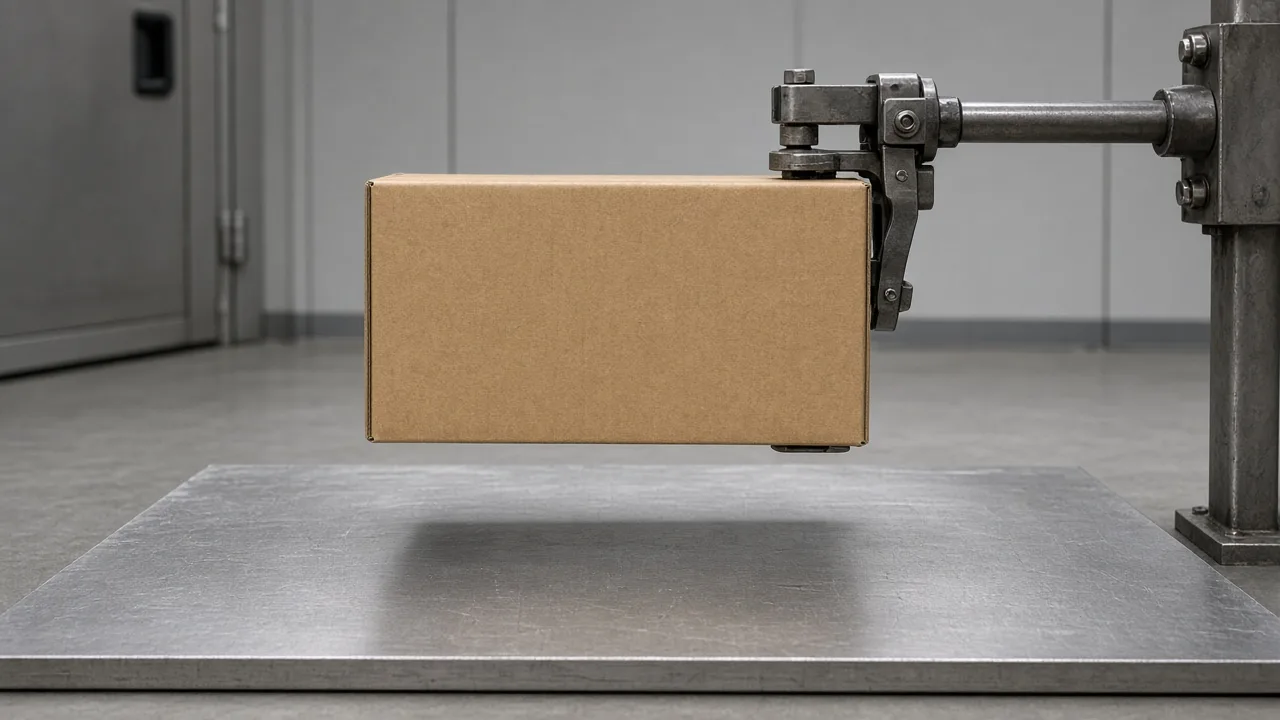
A package drop test checks how a packed carton and its contents survive free-fall impacts like those in handling and distribution. The carton is raised and released to strike a rigid surface on defined faces, edges and corners, then opened and inspected. The result shows whether the product and packing stay within agreed condition after those impacts.
A meaningful test depends on what is agreed before it starts: which procedure, which orientations and sequence, what the carton contains, how it is conditioned, and what counts as acceptable afterwards. Without those decisions, dropping a carton tells you little, and two people can drop the same carton and reach opposite conclusions.
This guide is for importers and product managers responsible for packing heavy or sharp metal hardware such as towel racks, shelving, storage baskets and brackets. Koitor Hardware is a family-owned China OEM manufacturer that prepares packaging for its products. We describe how drop testing works and what to agree; we do not claim to run a certified laboratory or that any carton passes automatically.
Free-fall drops are one form of impact testing. Incline and horizontal impacts are covered in the live guide on incline impact versus free-fall package testing. This page stays with free fall.
What is a package drop test?
A package drop test is a controlled free-fall impact on a packed shipping unit. A drop tester or a defined release method raises the package to a set height, orients it to strike on a specified face, edge or corner, and releases it without added velocity or spin. After the drop sequence, the package and product are inspected against acceptance criteria.
Free fall means the package falls under gravity alone. Throwing or pushing adds velocity and rotation that change the impact. A proper release method holds the package level and opens cleanly.
Orientation decides where the energy goes. Flat-face drops spread the load; edge and corner drops concentrate it. Corners are where cartons and products are often most vulnerable.
The impact surface should be rigid and flat. A soft or uneven floor absorbs energy and makes the test gentler than intended.
Height is set by the procedure, often based on package weight and the expected handling environment. This page does not list heights, which belong to the procedure being used.
Sequence matters because damage accumulates. A carton dropped on several orientations in order experiences cumulative damage, which better represents real handling than a single drop.
Why does metal hardware need special attention?
Metal hardware is dense and often has hard edges and corners. In a drop, a heavy tube or bracket keeps moving after the carton stops and can punch through inner packing or the carton wall. Powder-coated or polished surfaces scratch where parts rub. These traits make restraint and separation between parts more important than for lighter consumer goods.
Mixed contents add risk. A carton holding a heavy frame, a glass shelf and a bag of fasteners combines very different behaviours. Each needs its own protection, and the drop test should use the full mix as shipped.
What procedures define drop tests?
Standards bodies and industry groups publish drop test methods. ASTM D5276 is a standard test method for drop testing of loaded containers by free fall. The International Safe Transit Association test procedures include drops within sequences that also cover vibration, compression and other hazards.
Some procedures also define how the package is identified before testing, using a numbering scheme for faces, edges and corners. That makes the orientation of each drop unambiguous in records and photographs. Following the procedure’s identification system avoids confusion when results are reviewed later.
Why is a factory toss not a drop test?
Throwing a carton off a table or onto a warehouse floor lacks a defined height, orientation, release, surface, conditioning and acceptance rule. It may reveal gross weakness, but its result cannot be repeated, compared or used to accept a design. A drop test is defined by its method, not by the act of dropping.
Height is uncontrolled in a toss. The carton may fall from varying heights, and the person may add force.
Orientation is random. One toss might land flat, another on a corner. Results vary for reasons unrelated to the packing.
Surface varies. Concrete, wood and pallet decks absorb different amounts of energy.
Conditioning is ignored. Corrugated board loses strength in humidity; a carton tested in a dry room may behave differently after a humid sea voyage.
Records are missing. Without notes on height, orientation and result, nothing can be compared with a later redesign.
A toss can still be useful as an informal early check during development, as long as nobody treats it as evidence of compliance.
What role do development drops play?
During packaging development, quick drops on prototype cartons help compare designs before committing to a formal test. They should still be recorded, even informally, so the team can see which changes helped. When the design is settled, a formal test under the agreed procedure confirms performance. The two activities serve different purposes and should not be confused in reports.
Package weight and size should be recorded before testing. Many procedures relate drop height or other parameters to weight, and an accurate figure prevents testing at the wrong severity. Weighing the actual packed carton, rather than relying on a specification estimate, is a simple step that is often skipped.
Can a drop tester be improvised?
A simple, repeatable release over a rigid surface with measured height can work for internal development checks, provided it achieves free fall without spin. For tests that will be cited to a customer, the procedure’s equipment requirements should be followed, and the method should be recorded.
Does the order of drops matter?
Yes. The first impacts may weaken a carton so that later drops cause more damage. Procedures specify the sequence so that results are comparable. Changing the order, or testing each orientation on a fresh carton, produces a different and usually gentler test. Records should show the sequence actually used.
What should buyers agree before a package drop test?
Agree the procedure and edition, the drop height or how it is determined, the orientations and sequence, the test specimen and contents, conditioning, the number of packages tested, who performs and witnesses the test, and the acceptance criteria for product, inner packing and carton. These items make a test meaningful and its result defensible.
Procedure first. Naming a recognised method, and its edition, gives both parties the same rules. If the end customer requires a particular procedure, that requirement decides.
Height and sequence come from the procedure. Where the procedure allows choices, record them.
The specimen should be a real production package: actual product, actual inner packing, actual carton, closed the way it will ship. A prototype carton with substitute parts may not behave the same.
Conditioning brings corrugated board to a defined temperature and humidity before testing. Board strength changes with moisture.
Number of packages matters. One package can pass by chance. Testing several gives more confidence.
Witnessing and records should be agreed. The buyer may witness, accept video, or rely on a third party.
Acceptance criteria decide pass or fail. They should cover product damage, function, inner packing integrity and carton condition, each described clearly.
| Item to agree | Why it matters | Example decision |
|---|---|---|
| — | — | — |
| Procedure and edition | Defines the rules | Customer-named procedure |
| Height and sequence | Sets severity | As defined by the procedure |
| Specimen | Must represent shipments | Production product and packing |
| Conditioning | Board strength varies | Per procedure requirements |
| Quantity tested | Reduces chance results | Agreed number of packages |
| Witness and records | Makes results credible | Video and written log |
| Acceptance criteria | Decides pass or fail | Product, inner pack, carton |
Should the buyer witness the test?
Witnessing builds confidence but is not always practical. Alternatives include video recording of each drop with the package identification visible, photographs at each stage, and a signed log. Third-party laboratories or inspection agencies can also perform or witness tests. What matters is that the record lets someone who was not present follow what happened.
Criteria written before testing are far easier to apply than criteria agreed after seeing the damage.
Who should write the acceptance criteria?
The buyer, with input from the supplier, because the buyer knows what the end customer will accept. Criteria should describe product condition, such as no bending, no coating chips beyond a defined size, all parts present and functional, and packaging condition, such as no carton rupture exposing contents.
How do you inspect a carton after a drop test?
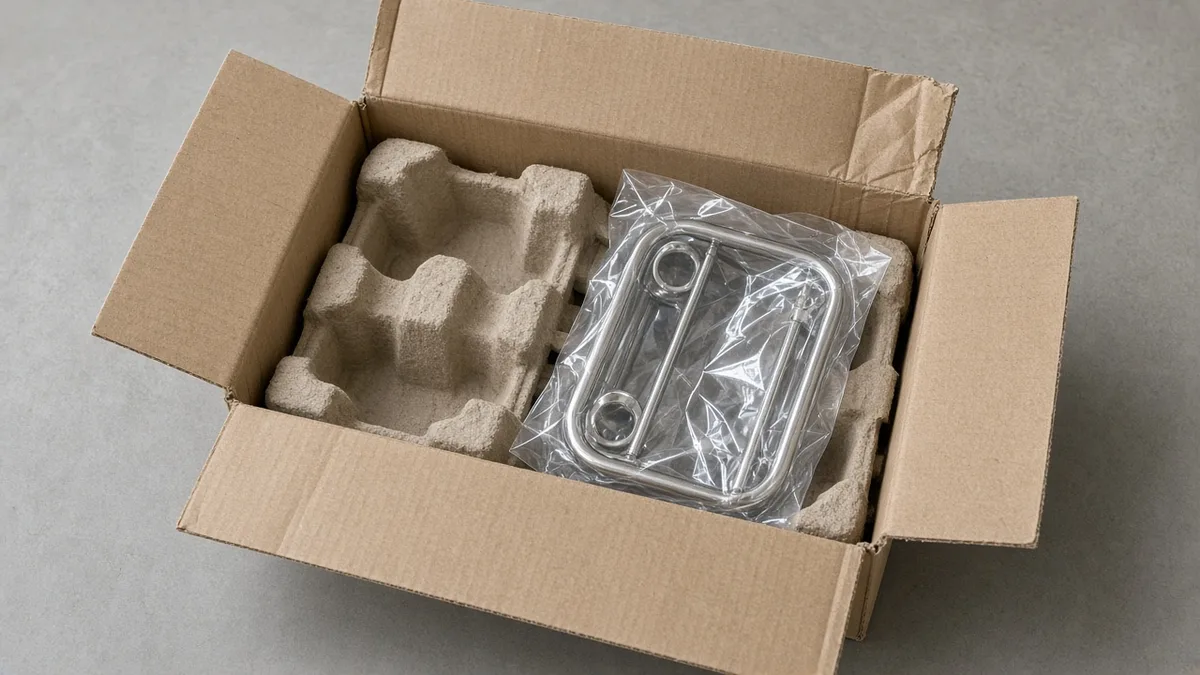
Open the package carefully, photograph the contents in place, then remove and inspect each item for damage and function, check inner packing for movement and breakage, inspect the carton for crushing, tearing and seam failure, and record every finding against the acceptance criteria. Inspection should follow a checklist so results are comparable across packages and tests.
Photograph before unpacking. The position of parts and inner packing after the drop shows how loads moved. A part that migrated to a corner suggests insufficient restraint.
Product inspection covers appearance and function. For metal hardware, look for bent tubes, dented panels, coating chips, broken welds and scratched finishes. Check that assembled parts still fit.
Count components. Fastener bags can burst, and small parts can escape. Missing parts are a failure even if large items are undamaged.
Inner packing shows how protection performed. Torn foam, crushed corners, broken dividers and displaced inserts indicate where the design can improve.
Carton condition matters for the next handling step. A carton that splits or bursts may lose contents in real distribution even if the product survived the test.
Record findings with photographs, part identification and a clear pass or fail against each criterion.
- Photographs in place before unpacking.
- Each part inspected for appearance and function.
- Components counted against the packing list.
- Inner packing condition recorded.
- Carton condition recorded.
- Pass or fail stated per criterion.
How should damage be described?
Use specific, measurable descriptions where possible: the location of a dent, its approximate size, whether a coating chip exposes bare metal, whether a part still assembles. Vague notes such as “some damage” cannot be compared between tests or used to judge acceptance. Photographs with a scale reference make descriptions clearer.
What does a good drop test report contain?
A good report names the procedure and edition, describes the specimens and contents, states the conditioning, lists each drop with orientation and height, includes photographs before and after, records findings against each acceptance criterion, and gives an overall result. It also identifies who performed the test and when. Reports missing these items are hard to rely on.
What if the product is fine but the carton is damaged?
That depends on the criteria. A carton that tears enough to expose contents usually fails, because real handling would continue after the first impact. Minor scuffs may be acceptable. The criteria should say which carton conditions are tolerated.
How does carton design affect drop test results?
Carton board grade, flute, construction, closure, inner packing, product restraint and weight distribution all affect drop performance. Heavy metal hardware concentrates mass, so restraint and corner protection often matter more than board strength alone. Changes to any of these after a test can change the result.
Board properties matter. The live guide on corrugated box edge crush versus burst strength explains two common board measures and what each says about performance.
Panel stiffness affects bulging and stacking. The live guide on corrugated bending stiffness and box compression panel bulging covers that.
Restraint stops parts moving. Heavy tubes and panels that slide inside a carton hit the walls with force during a drop. Inserts, dividers and wraps that hold parts in place reduce that.
Corner protection matters because corner drops concentrate load. Corner blocks or folded board corners can help.
Weight distribution affects how a carton lands. A carton with mass concentrated at one end may rotate during a drop. Balancing contents or marking orientation helps.
Fastener bags should be secured. Loose bags can burst on impact and scatter parts. Taping bags to an insert or placing them in a dedicated compartment helps.
Changes after testing need review. A new board supplier, a different insert or a heavier product version can change results. Significant changes may justify a retest.
How do inner packing materials compare?
Foam, moulded pulp, folded corrugated inserts, air pillows and paper wrap each absorb energy and restrain parts differently. Foam can cushion well but raises recycling questions. Moulded pulp and folded board can hold heavy parts securely if designed to fit. The best choice depends on the product shape, weight and the customer’s packaging policies, and should be confirmed by testing.
Should printed carton graphics be considered?
Graphics do not affect impact performance much, but print-heavy retail cartons can scuff badly. If retail-ready appearance matters, the criteria should include acceptable scuffing levels.
Climate along the shipping route matters for corrugated packaging. Long sea voyages through humid regions can soften board before the carton is ever dropped in a warehouse. Conditioning in the test is a way of reflecting that, and the conditions chosen should be realistic for the route.
What if a carton fails?
A failure is information for design improvement. The inspection record usually shows where the weak point is: a corner, a loose part, a seam. The team can change the design and retest. Repeating the same test on the same design until a pass occurs, without changes, does not demonstrate improvement and should not be reported as a pass.
Root cause thinking applies to packaging too. If parts moved, the restraint was insufficient. If the carton burst at a seam, closure or board may need attention. If coating chipped where parts touched, separation is needed. Each finding points to a specific change.
How do drop tests fit with other packaging tests?
Drops are one hazard among several in distribution. Compression from stacking, vibration in transit, temperature and humidity changes, and handling on pallets all affect packages. Procedures that combine these hazards give a broader picture, while a drop test alone checks impact resistance only. The choice depends on the shipping route and the customer’s requirements.
Compression matters for stacked cartons in containers and warehouses. Overhang and stacking patterns affect it, as explained in the live guide on pallet overhang and box compression damage.
Test series differ in scope. The live guide on ISTA 1 series versus 3 series for hardware packaging explains how simpler and more complete procedures compare.
Shipping mode affects handling. Consolidated shipments are handled more often than full containers. The live guide on hardware shipment LCL vs FCL handling and consolidation packaging discusses how that affects packing.
Parcel distribution involves more drops and sorting impacts than palletised freight. Retailers shipping single cartons to consumers often specify procedures designed for parcel delivery.
Field feedback complements testing. Damage reports from distribution centres and customers show whether test results reflect reality. Repeated damage at one point in the carton suggests a design change and a retest.
From the supplier side, packing design decisions are easier when the shipping route and the customer’s test procedure are known at the start. A carton designed for palletised full-container freight may need changes for parcel delivery to consumers. Sharing that information early avoids redesign after a failed test.

Packaging changes driven by cost deserve the same scrutiny as design changes. A thinner board, fewer inserts or a cheaper closure may look minor on a specification sheet but change drop performance. Agreeing in advance which changes trigger a retest prevents disagreements later.
Sustainability changes, such as replacing foam with paper-based inserts, are increasingly common in European and North American retail. They often perform differently in drops and should be validated rather than assumed equivalent.
Buyer checklist for a package drop test
- Procedure and edition named.
- Height and sequence taken from the procedure.
- Production specimens with real contents and closure.
- Conditioning agreed.
- Number of packages agreed.
- Witness and record method agreed.
- Acceptance criteria for product, inner packing and carton written down.
- Retest triggers defined for design changes.
Finally, keep the tested specimens or their photographs with the report until the design has been in distribution long enough to compare with field results. If damage patterns appear in the field that the test did not show, the stored evidence helps decide whether the test or the production packing differs.
FAQ
What is a package drop test?
It is a controlled free-fall impact test on a packed shipping unit. The package is dropped on specified orientations, then opened and inspected against agreed acceptance criteria.
What height should a carton drop test use?
Height depends on the procedure and often on package weight and handling environment. Use the height defined by the chosen procedure rather than a general figure.
Is throwing a box on the floor a drop test?
No. Without defined height, orientation, release, surface, conditioning and acceptance criteria, the result cannot be repeated or relied on. It may be an informal check, not a test.
Does passing a drop test mean no damage in shipping?
No. A test represents certain hazards under defined conditions. Real distribution can include other hazards and more severe events. Testing reduces risk; it does not eliminate it.
How many cartons should be drop tested?
The procedure or the agreement should state it. Testing more than one package gives more confidence than a single result.
Who should perform a drop test?
It can be done in-house with proper equipment and records, or by an external laboratory. If results will be presented to a customer, the method and any required laboratory qualifications should be agreed in advance.
اعمل مع شركة «كويتور» للأدوات
Review packaging test requirements for hardware cartons
Send the product, the carton specification, the shipping route and the test procedure your customer names. We can review packing design and how a drop test should be arranged and recorded for your metal hardware shipments. We do not claim to run a certified test laboratory.
OEM / العلامة التجارية الخاصة
حوّل دليل التوريد هذا إلى موجز منتج
يرجى إطلاعنا على المنتج المستهدف، والحجم، والتشطيب، وكمية الطلب، ومتطلبات التغليف. وسيتلقى فريقك تقييمًا عمليًّا لإمكانية التصنيع قبل تقديم عرض الأسعار.
 English
 Español
 Português
 Français
 Deutsch
 العربية