
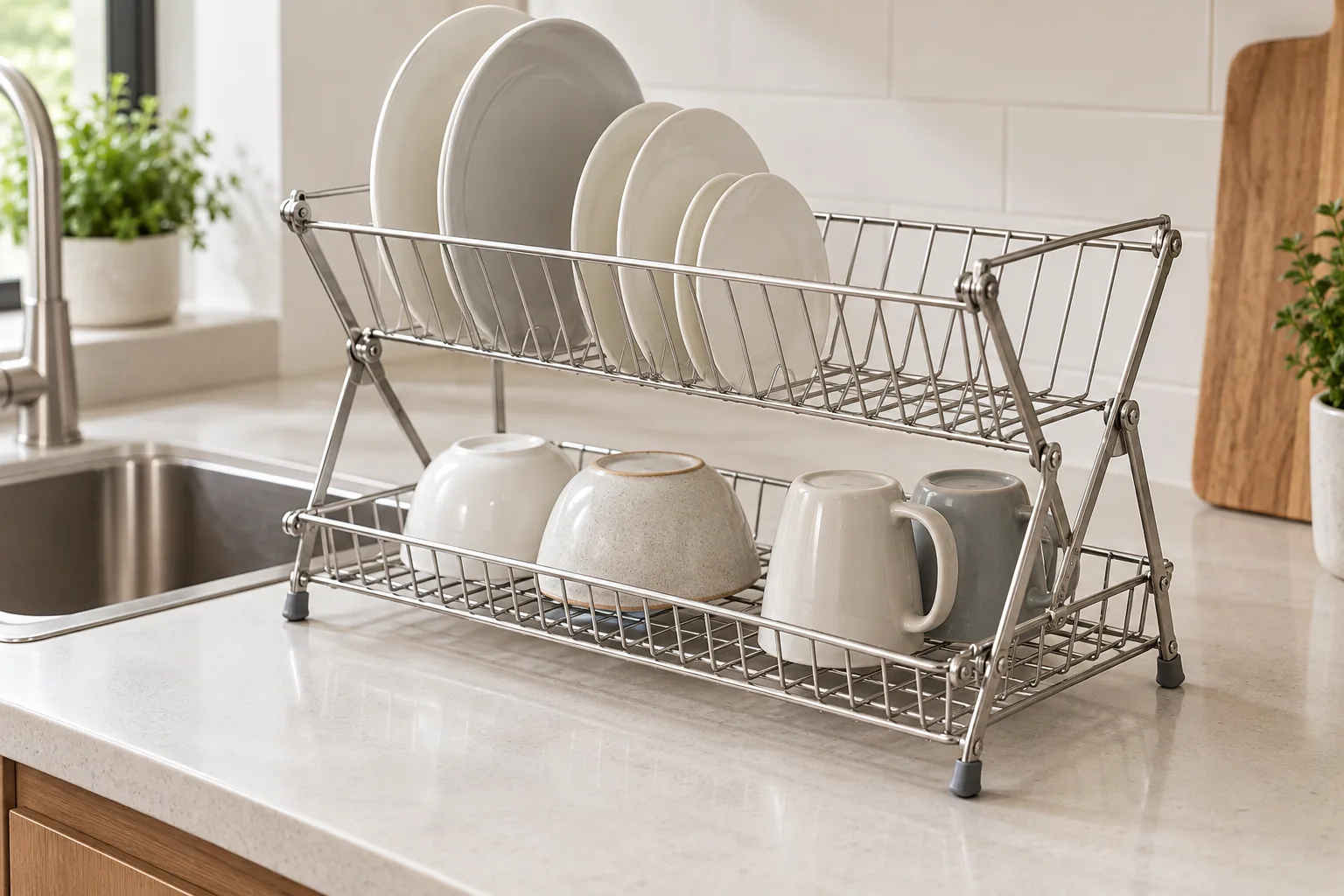
For a folding metal dish rack, collapsible dish rack hinge stability is a design-and-approval question: buyers need to define the open position, pivot interfaces, stops, contact points and intended loading sequence, then review those features on a representative sample. A rack should not be judged by its folded size alone because the joint must also support the rack’s usable open geometry.
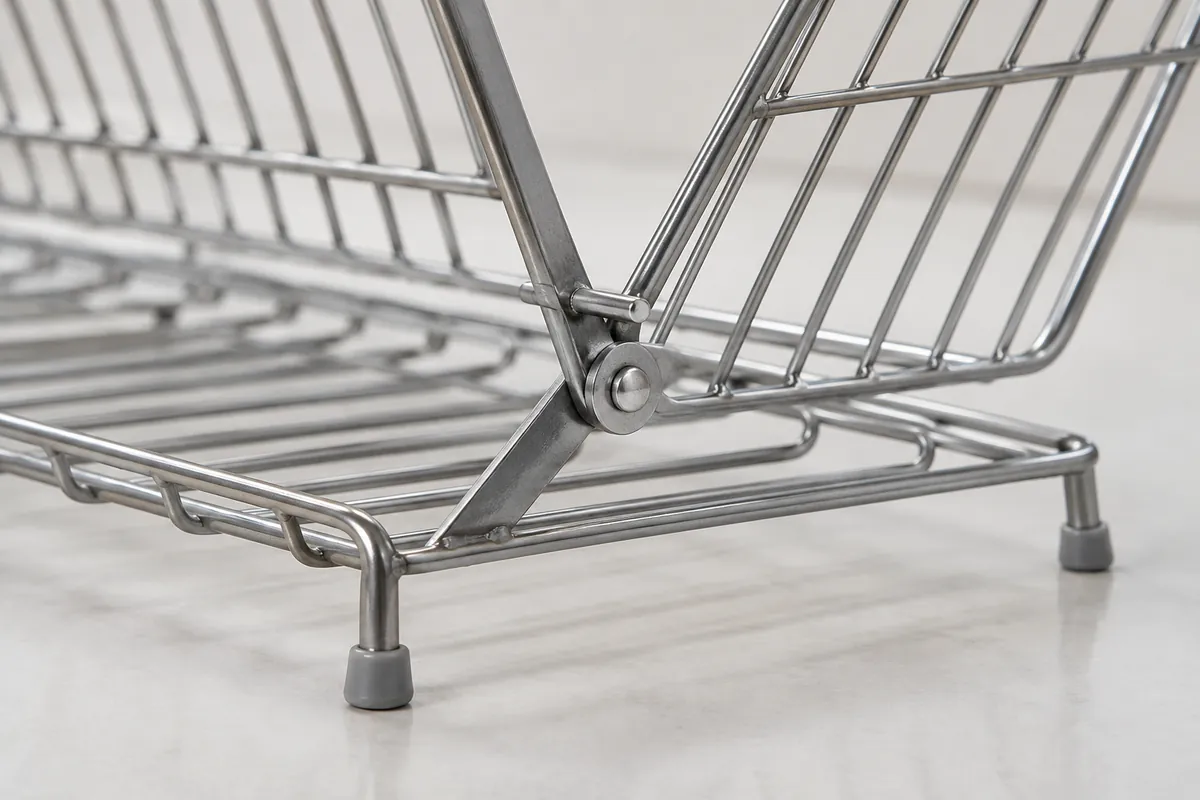
Why does a folding rack need more than a pivot?
A hinge makes movement possible, but movement alone does not define a stable open position. The frame may rely on a stop, brace, over-center relationship, detent, or another project-specific feature to keep the two sides in their intended position. If that feature is missing or poorly located, the rack can feel loose, shift during loading, or fold when a user handles dishes. Buyers should ask the supplier to identify what controls the open geometry rather than assume that a pin automatically locks the frame.
The pivot also changes where forces enter the wire frame. A side panel may twist when plates are placed unevenly, while a lower basket can pull the frame in a different direction. The design therefore needs to consider hinge alignment on both sides, the spacing between pivots, foot contact, and the way cross-members distribute movement. A visually symmetric rack can still behave differently from side to side if the assembly position or formed features vary.
Storage compactness introduces another constraint. When folded, panels and wires must nest without scraping finished surfaces, trapping water or creating a sharp pinch point. When opened, those same members must clear one another and settle into the intended stop. A product that folds neatly but needs excessive force, catches a towel, or leaves a loose panel is not necessarily a good buyer outcome. Define both states and the transition between them in the technical review.
What joint details belong in the specification?
The drawing should show pivot center locations, mating-part thickness or wire form where controlled, pin or fastener retention, stop surfaces, and the open and folded envelopes. It should identify which parts move and which remain fixed. If the design uses a replaceable pin or bushing, show its retention method and assembly orientation. The buyer need not dictate every manufacturing detail, but should agree the functional geometry and request the manufacturer to call out any dimensions that determine joint movement.
State how the rack is intended to be opened and closed. Is the user expected to hold both side frames, fold one side at a time, or move a linked assembly? How does the user know that it has reached the open position? These questions influence stop geometry and instructions. Avoid promising a universal cycle life or a particular operating force without project-specific evidence. Instead, define a practical sample review sequence and document the observed behavior for the chosen design.
Surface finishing can change the joint feel. Coating or plating at a pivot interface may increase friction, fill a small clearance, or create a cosmetic rub point. If the joint is masked, specify where and why; if it is finished assembled, inspect the complete movement. Ask the supplier to confirm the order of forming, welding, finishing and assembly for the actual concept, while leaving unverified material grades and process capabilities open until the project is confirmed.
| Joint concept | Possible advantage | Questions for sample review |
|---|---|---|
| Simple pivot plus stop | Fewer linked components | Does the stop engage clearly and stay aligned? |
| Pivot with brace | Can define a more controlled open geometry | Are brace joints clear, retained and accessible for cleaning? |
| Friction-based joint | Compact appearance | Does finish or assembly make movement inconsistent? |
| Removable lock component | Can support service or packout flexibility | Can it be lost, misassembled or pinched during folding? |
How can buyers compare hinge concepts?
A simple pivot can reduce part count and make the design visually clean, but it may depend on a separate stop or brace to resist movement. A linked brace can make open geometry more repeatable, but introduces another joint and potential pinch area. A removable locking part may be serviceable but could be lost during use or packing. A friction-based concept can feel compact but may change with wear or finish. Compare these approaches against use, cleaning, package and assembly requirements rather than treating one as inherently superior.
The folded envelope must include the largest projecting feet, handle, drain tray or accessory if one is part of the design. A product may be advertised as compact while the attached parts prevent it from lying flat in the target package. The buyer should also decide whether accessories remain attached during folding, are removed first, or travel separately. These choices influence how the hinge is protected and whether the instructions need a safe handling sequence.
Consider whether the rack is intended for wet use near a sink. If so, water collection and cleaning access around the hinge may matter to the concept. This does not establish corrosion performance or a material guarantee; it simply identifies a use condition that affects design review. The product-specific rationale can be connected to broader [تصنيع رفوف تخزين مخصصة للمطابخ](https://koitorhardware.com/custom-kitchen-storage-rack-manufacturer/) work without suggesting every mechanism is already in Koitor’s current catalog.
What should the open-and-close sample review include?
Begin with the unloaded sample on a level surface. Open it using the intended user motion and note whether both sides reach their stops together. Check whether all feet make contact without rocking, and observe whether the frame can be nudged out of its intended position. Close the rack slowly and watch for interference, scraping or points where a finger could be trapped. A written review should state the sample identity, finish and revision; it should not turn one informal observation into a broad durability claim.
Next, add a modest representative dish assortment in the positions shown in the product concept. Load and remove a plate, cup and bowl if the design is intended to support each. Confirm that ordinary handling does not cause the joint to shift unexpectedly and that the support points remain on the counter. The buyer should define any project-specific loading or observation protocol separately, based on use and claims requirements. Do not infer a numeric load rating from a photo or a single demonstration.
Repeat opening and closing for the agreed sample-review sequence, checking the same joint locations each time. Look for emerging looseness, pin migration, visible deformation, coating damage or noise that signals interference. If a concern appears, record its location and the movement state in which it occurs. A supplier can then review the drawing or assembly sequence. The number of cycles should be selected by the project team; this article does not prescribe a universal life test.
How should finishing, inspection and instructions align?
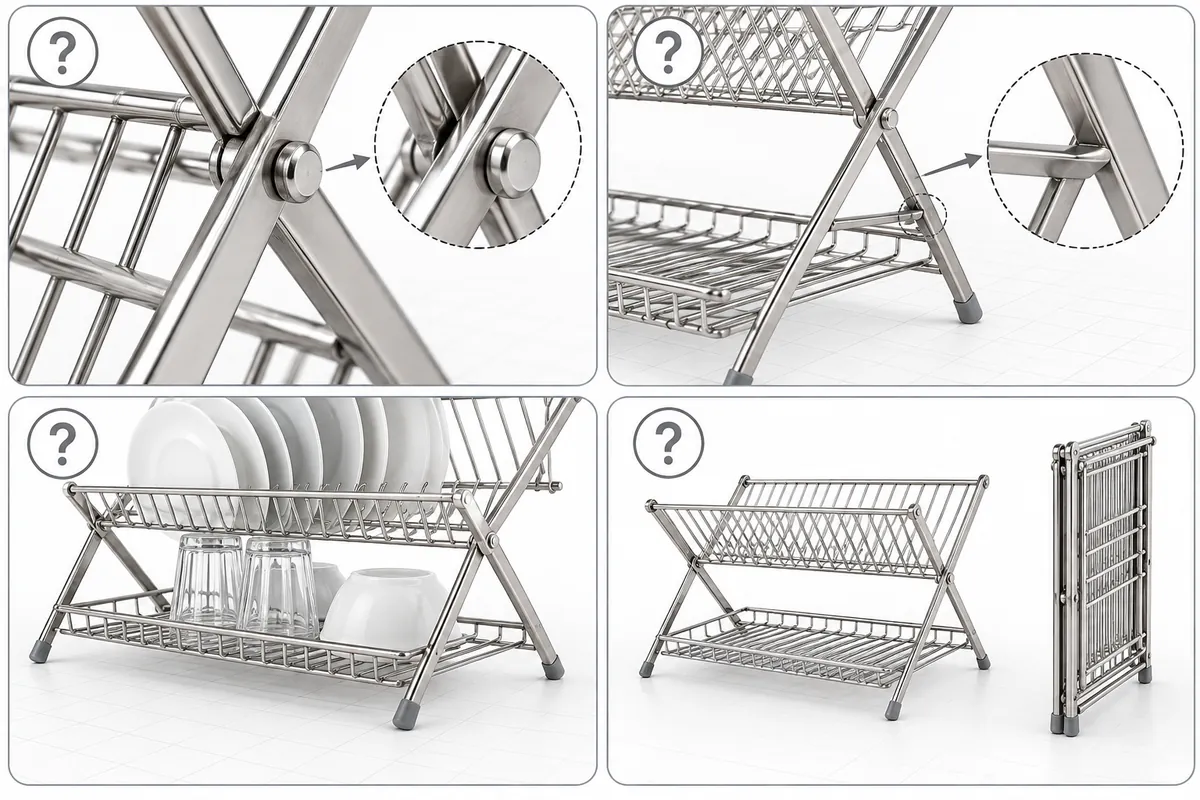
A moving joint should be reviewed after all planned finishing and assembly steps, because the delivered product is what the importer will sell. Identify visible areas where movement could expose substrate, rub adjacent parts or collect debris. Agree which surfaces are cosmetic, which are functional, and which require an inspection after the final operation. A simple visual standard or sample reference may be more practical than an unsupported numerical tolerance for every consumer-facing joint.
Inspection can be organized around observable checks: both pivots are present, retaining features are complete, stops contact in the intended location, feet sit as expected, and the rack folds without parts colliding. If the product includes detachable components, verify they are included and identified in the package. The buyer and supplier should decide whether these are 100-percent assembly checks, sample checks, or another plan appropriate to the order; do not imply a certified inspection service unless confirmed.
Instructions should reflect the approved product motion. They can identify the safe grip areas, explain how to reach the open stop, and describe accessory removal before folding if that is required. For repeat orders, retain the accepted sample and revision record. If a pivot, stop, finish or assembly fixture changes, determine whether open/closed behavior needs renewed review. Koitor’s [OEM home storage hardware](https://koitorhardware.com/oem-home-storage-hardware-manufacturer/) sourcing information can help begin a project conversation, but the exact folding mechanism remains subject to feasibility review.
The collapsible dish rack hinge stability review should end with an explicit disposition: accepted as shown, accepted with listed changes, or returned for another sample. Record the open and folded states, finish, joint revision and any accessories present. If the hinge or stop changes, identify whether the new version affects both motion and package size. This helps a buyer avoid comparing one supplier’s open-position concept with another supplier’s folded-only drawing. It also gives the inspection team a practical reference for recognizing missing pins, loose retaining parts or an incomplete stop. The review does not need to promise an unverified lifespan. It needs to define what the buyer saw, what configuration was approved and what must happen before a changed configuration can be released. A short documented decision is stronger than an informal note that the rack seemed stable in a photograph. Keep the collapsible dish rack hinge stability notes tied to the specific stop, finish and open-and-fold sequence demonstrated by the sample.
Before prototype approval, capture open and folded dimensions, pivot locations, the feature that defines the open position, foot locations, moving-part clearances, and any accessory-removal sequence. Identify the intended counter or mounting condition and representative dish arrangement. Ask the manufacturer to flag finish-sensitive areas and the reference surfaces used to check alignment. This gives both parties a shared frame for sample feedback without forcing an unverified performance number into the specification.
During the sample review, open and close the unit through the intended sequence. Confirm that the sides reach their intended stops, feet contact consistently, and no member obstructs the movement. Load the specified representative items and remove them through ordinary paths. Observe whether the rack unexpectedly folds, twists, rocks, or pinches. Document what happened and under which state, then attach the observations to the sample revision and photos.
Before release, agree on the final finish, the assembly method, included accessories, folded package envelope and instructions. Confirm which functional observations will be repeated during incoming or in-process review and how revisions will be communicated. If the product or packaging changes, revisit the fold path. These decisions make the mechanism easier to source and compare across suppliers, while preserving the distinction between a designed review and a verified product-life claim.
Buyer approval checklist
- Open and folded envelopes are shown with pivot and stop datums.
- The intended opening/closing sequence and grip points are defined.
- Feet, joints and stops are reviewed after final finish and assembly.
- A representative dish load is checked without inventing a rating.
- Packaging, accessory handling, instructions and change control match the sample.
Frequently asked questions
Does a pivot pin make a folding rack stable?
Not by itself. The overall frame, open stop, braces, contact points and intended load arrangement determine how the open geometry behaves.
Should buyers specify a cycle-life number?
Only when the project has a defined method and evidence basis. Agree on a sample observation or validated test protocol instead of adopting an unsupported universal cycle count.
Can a coating cause hinge binding?
It can affect fit or friction depending on joint design and finishing sequence. Review the production-intent finished assembly, not only an unfinished prototype.
How should a rack be checked when loaded?
Use the intended representative dishes and normal loading/removal motions, with a documented sample identity and agreed procedure. This is not automatically a certified load test.
Does Koitor currently make this exact folding dish rack?
The topic is adjacent sourcing education. Koitor can discuss related metal-frame and sample questions, but current capability for a specific folding mechanism must be confirmed.
Koitor is a family-owned custom metal hardware manufacturer focused on practical OEM communication. For adjacent product concepts, confirm exact process scope, specifications and sample expectations with the production team before making a sourcing decision.
Plan a buyer-ready product specification
Share your drawing, target assortment or physical sample so the project team can review the relevant geometry and questions.
OEM / العلامة التجارية الخاصة
حوّل دليل التوريد هذا إلى موجز منتج
يرجى إطلاعنا على المنتج المستهدف، والحجم، والتشطيب، وكمية الطلب، ومتطلبات التغليف. وسيتلقى فريقك تقييمًا عمليًّا لإمكانية التصنيع قبل تقديم عرض الأسعار.
 English
  Español
  Português
  Français
  Deutsch
  العربية