

A taper photograph and a packing photo do not settle wire basket nesting. A kitchen or bath basket may look as if it can stack, and still refuse a register, or nest to a height the listing cannot defend. Freeze the nest register, the nested height you will claim, and the coating protection between units, and exclude bird-nest products and industrial stacking volume.
This guide is for importers and private-label teams writing kitchen or bath wire-basket sets sold as nesting or space-saving stacks. It is not an export-packaging page, not a tapered inside-volume page, and not a mesh-opening page. The decision is whether the family actually nests or stacks to a measured register and height.
Koitor is a family-owned custom metal hardware factory. We can review the register features, the nested height method, coating contact, and the wording you want to print. We do not invent a nest height, a stacking volume, or a “nests for storage” promise for a set we have not agreed how to observe.
Why packaging and taper do not close a nesting claim
Export packaging may nest or separate units to survive a carton. That is a packing decision, and it often uses paper, foam, or bags that a household nest will not have. A basket that ships nested with protection is not automatically a clean-register kitchen nest.
Tapered inside dimensions answer usable volume, not whether one basket seats into another on a designed register. A taper can help nesting and still leave a rocking stack, or it can exist on a basket that is not meant to nest at all. Keep volume on the taper page. Keep the register here.
old and new wire-basket stacking compatibility answers whether a later generation still stacks with an earlier one. That is a compatibility decision across lots. This page is the register and nested-height claim for a current kitchen or bath family. You may need both files. Neither file replaces the other.
wire-basket lid fit and retention checks answers whether a lid fits and stays on. A lid can change whether a nest is even possible. If the set is sold with lids, say whether nesting is claimed with lids on, lids off, or both, and observe that condition.
Industrial stacking and shopping volume around warehouse baskets are out of scope. Bird-nest decorative products that appear on a nesting SERP are also out of scope. Stay on kitchen or bath wire baskets with a designed register.
How should the register and nested height be frozen?
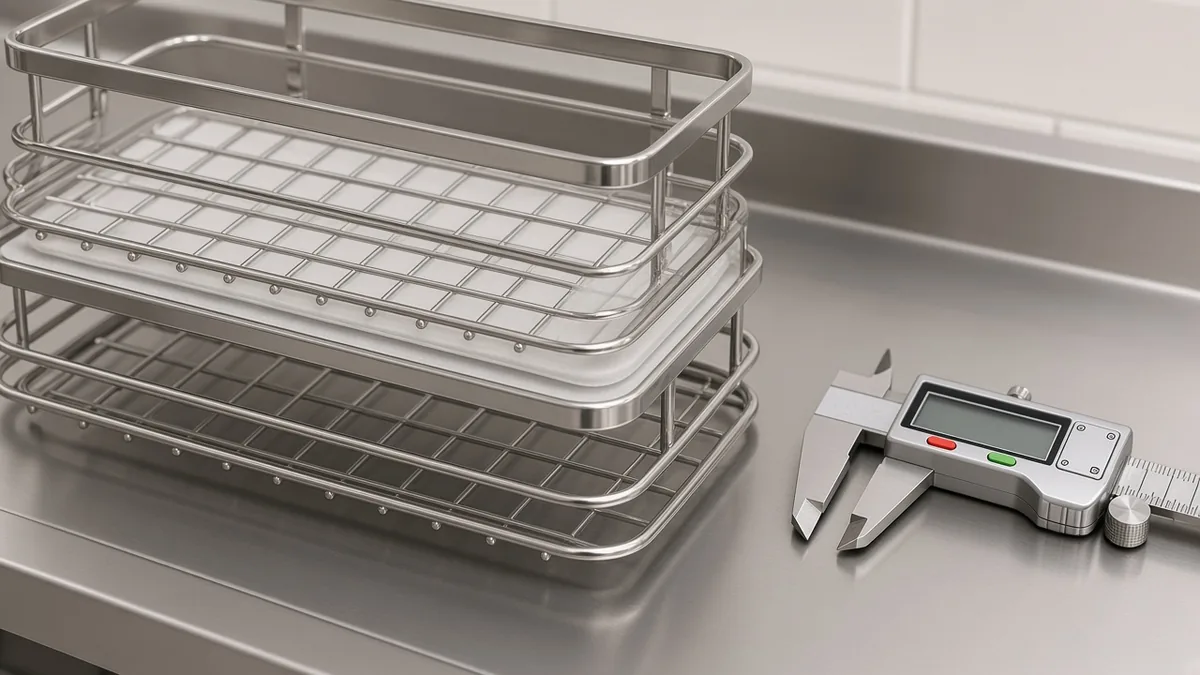
Name the register feature as it will be shipped: a stepped rim, a seating wire, a foot that locates in a mesh, a corner notch, or another specified geometry. “They stack” is not a register. A buyer needs to know what makes the upper basket sit true.
Name the set: how many units, whether they are the same size or a graduated set, and the order in which they nest. A three-piece graduated set is a different claim from two identical baskets. A photograph of two units cannot support a four-unit height line.
Agree a nested-height method. Typical project choices are overall height of the nested set on a flat table, measured at agreed corners, after an agreed seating. Do not invent a Koitor millimetre. If the project wants a stated height, measure it on the sample and write it as a project figure.
Photograph the register close-up and the full nested set. A beauty stack that hides a rock or a misaligned corner is not a register check. The upper unit should sit in the feature you named, not merely rest at an angle on a rim.
If some units in a graduated set nest and one does not, write the exception. A “nesting set” line that ignores a non-nesting open tote in the same SKU will create a return.
What coating protection belongs between nested units?
Name what, if anything, is meant to sit between coated or plated surfaces in storage, and what is meant to be used in a household nest. A packing foam is not automatically a household interlayer. If the listing shows a clean metal-on-metal nest, the observation should include coating contact, or the artwork should show the interlayer you actually require.
Record contact points: rim on rim, foot in mesh, or wire on wire. Those are the sites to inspect after the nested set has sat for the agreed wait. Do not invent a wait hour. Write a project wait, or judge the contact as a first-article sit only and say so.
A scuff at a contact point is not automatically a rust finding, and a rust finding at a contact is not automatically a packing abrasion finding. Sort those records. This page owns the nest contact, not the carton rub.
What exclusions should be written?
Exclude bird-nest decorative products in the brief so merchandising does not drift into that SERP meaning. Exclude industrial pallet stacking and warehouse dump fixtures. Exclude a mixed old-and-new generation claim unless that compatibility file has been run.
Do not print that the baskets nest perfectly, save a stated cabinet volume, or stack to an invented height. Safer language names the register, the set count, and the height method you used.
Mesh opening belongs on its own page and should not be rewritten here, even though a foot-in-mesh register may use the mesh as a locator. Write only the locator role, not a merchandising mesh-size story.
What should the importer freeze before artwork is approved?
Use a written nest-register file. The checklist and the matrix remind you which decisions to freeze. They do not replace the height photographs or the register close-up.
Do not approve a wire basket nesting line until the register, the set count, and the nested-height method are in the pack. A packing photo with kraft paper is not a household nest check.
If production later changes rim geometry, feet, mesh, or coating, the file needs a new observation. A copied nest-height sentence from a prior generation is not evidence for a new register, and it is not a substitute for the old-versus-new compatibility page.
A first-article pack should include the register feature, the nested set in the claimed count, the height method and photographs, and the contact-protection condition.
Instructions should show the nest order for a graduated set. A reversed stack can sit and still miss the register. If users can assemble the set backward, say what happens, or design a poke-yoke if the project wants one, without inventing that the factory already has one.
After-sales photos should show the register, not only a pile of baskets. Ask whether lids were on, whether an interlayer was used, and how many units were in the stack.
A finish-only change can often keep the prior register record if the seating geometry did not change. Confirm the rim, feet, and mesh first, then keep or retire the height sentence.
When the register, the set, and the height method agree, the listing can stay modest and still be useful. Name the set you observed and leave invented heights and industrial-stack slogans off the page.
Send the drawing, the set, and the intended sentence before the artwork is locked. A factory can quote the baskets while the nest observation is still being written, but a nesting headline should wait for a seated register and a recorded height method.
Retail shelf photographs should use the same count as the claim. A two-unit beauty stack cannot support a six-unit space-saving line.
Handles can block a nest even when the rims would seat. If a handle stands above the register, include it in the file or redesign the claim. A handle-out photograph can hide a handle-in conflict.
Wet or food-soiled baskets in household use are a different contact than a clean first-article set. If the listing implies everyday nested storage after washing, include a realistic surface condition or write that the check was on clean, dry samples.
Incoming inspection should include the register, not only appearance, if a nesting claim will be printed. A slightly closed rim from packing can destroy a register that looked fine on a protected factory sample.
If a later complaint is that new baskets will not nest with last year’s set, move that record to the old-and-new compatibility file. Do not try to finish it only with this page’s current-generation height claim.
A slightly sprung rim from packing can sit true on a padded factory table and refuse a household nest. Incoming inspection should include a seated register, not only a visual rim check, if a nesting line will be printed. A unit that has to be forced into the register is not a pass, even if the photograph can be staged.
Corner-to-corner height can differ if the upper basket rocks. Record height at the agreed corners and note a rock if you see one. A single centre-line figure can hide a high corner that will not fit a cabinet the listing named.
If merchandising shows a cupboard shelf with a stated clearance, the nested height record should be compared to that clearance, or the clearance line should be dropped. Do not invent a cabinet height. Use the buyer’s named shelf, or leave the cabinet line off.
A wire foot that locates in a mesh can wander if the mesh is slightly off pitch from unit to unit. If the register depends on that locator, inspect several units, not one hero stack. A single good nest does not prove the lot will register.
Chrome, powder, and plastisol contact do not scuff the same way. Write the finish family in the file. A powder contact photograph is not evidence for a later chrome revision, even if the rim geometry is unchanged, until the contact is re-checked.
Retail pallet photographs sometimes nest more units than the household SKU will show. Keep the artwork on the sold set count. A warehouse cube photograph belongs to a different claim and should not migrate into a kitchen listing.
A later coating-only change can often keep the prior register if the seating geometry is unchanged, but the contact-protection sentence should be re-checked. A thicker coating can lift a foot out of a shallow locator. Confirm the seat still happens before you keep the height line.
Instructions that only say “nests for storage” leave the order, the lids, and the interlayer to the user. Add the nest order, lid condition, and any required interlayer if those choices affect whether the register will succeed.
If a unit in a graduated set is sold separately as a refill, say whether that refill is expected to nest with the original set. A refill with a later rim can fail the register even when the factory-packed set nested cleanly.
First-article side photographs should show the seated rim or foot, not only the pretty stack from above. A top view can hide a rock. A close-up of the register is the evidence a later inspector will need.
If the project also wants a drainage, rust, or lid-fit sentence, keep those on their own files and only cross-check whether a lid or a coating change altered the register. A lid-fit pass is not a nest pass, and a drainage slot is not a seating feature unless the brief says it is.
When you write after-sales replies, ask for a photograph of the register, the set count, and whether lids or an interlayer were present. A complaint that “they do not stack” can be a backward graduated order, a lid-on attempt against a lids-off claim, or a true register miss. Split those causes before you change the drawing.
Keep the artwork inside the set and the register you actually observed. A modest sentence that names the three-piece nest and the seating wire is stronger than a borrowed cabinet-volume figure or a copied industrial-stack headline with no seated photograph behind it.
If a later review finds only a carton print or a colour change, the prior register record can stay, provided the rim, feet, mesh, and set count are unchanged and the contact sentence still matches the finish. Confirm those functional parts first. A new carton photograph is not, by itself, a new nest-height claim.
Send the pack with the drawing before the listing is locked. A factory can quote the baskets while the nest observation is still being written, but a space-saving headline should wait until the claimed count has been seated on the actual register and the height method has been recorded.
That is the standard this page is willing to support: a current kitchen or bath family, a named register, a counted stack, and a height method you can show, without borrowed industrial volume or a packing photo treated as a household nest.

| Claim impulse | What to freeze | What the sample should show | What to keep off artwork until then |
|---|---|---|---|
| Nests for storage | Register feature, set count, and height method | The upper unit seats in the named feature, and the height is recorded as agreed | A nests-for-storage line based only on a packing photo |
| Saves cabinet space | The nested height of the claimed count, as measured on the sample | The stated count was the count you stacked | An invented height or a two-unit photo used as a six-unit claim |
| Stacks with last year’s baskets | A split between this register file and old-versus-new compatibility | The current family nests as claimed, and any cross-generation claim has its own file | A current-lot height used as proof of mixed-generation stacking |
| Coating will be fine when nested | Contact points and any required interlayer | The contact is judged in the claimed storage condition | A clean packing foam used as proof of a bare-metal household nest |
| Looks tapered, so it must nest | A split between inside volume and a designed register | The taper file is separate, and the register was judged on this page | A taper photograph treated as a nest pass |
- Write the product as a kitchen or bath wire-basket family with a designed nest register, not as an industrial stack or a bird-nest decorative product.
- Name the register feature and the set count and order.
- Agree a nested-height method and photograph it, without inventing a factory height.
- Name coating contact points and any required interlayer, and distinguish packing protection from household nesting.
- If lids are in the set, say whether nesting is claimed with lids on or off.
- Keep packaging, taper/volume, mesh opening, and old-versus-new compatibility on their own files.
- If only one set count was observed, do not print a taller stack claim.
- Include handles in the register check if they can block a nest.
- Keep invented heights and industrial-stack slogans off the listing.
- Send the drawing, the set, and the intended sentence before the artwork is locked.
How can a family-owned OEM review the nest brief?
Koitor can review the rim and foot geometry, the register, the nested-height method, and the wording you want to use. That is a construction and acceptance discussion, not a volume certification. تصنيع سلال تخزين معدنية حسب الطلب is the usual starting point when the basket family itself still needs development.
If you already have a set and a height outline, attach them. If you only have a packing photograph, say that. We can help you tighten the register and the sentence, but we will not invent a height to fill a blank. For a nest-file review, send the nest-register brief to Koitor with the drawing and the intended claim.
MOQ, sample timing, and bulk lead time stay on the quotation path and depend on the product, the finish, and the order. They are not a substitute for the register observation.
الأسئلة الشائعة
Can wire basket nesting be cleared by a carton packing photo?
No. Packing often uses paper, foam, or bags a household nest will not have. Take the register and height record on the claimed set in the claimed storage condition.
Do we need a published nested height to sell the set?
Not from this article, and not as an invented Koitor figure. You need a register, a set count, and a written height method. If a later project wants a stated height, measure it on the sample and write it as project evidence.
How is this different from old-versus-new stacking compatibility?
That page asks whether a later generation still stacks with an earlier one. This page is the register and nested-height claim for the current kitchen or bath family. A current-lot height does not prove mixed-generation stacking.
What if the set includes lids?
Observe the lid-on or lid-off condition you will claim, or both. A lid can block a nest or change the height. Do not photograph lids off and write a lids-on storage line.
Can a tapered basket be assumed to nest?
No. Taper is a volume geometry. Nesting needs a designed register and a seated stack. Run this file, and keep the volume file for usable inside space.
Can Koitor write the nesting sentence for us?
Koitor can review a nest-height sentence against the register feature, the set count, and the seated photographs, as a construction and acceptance discussion. The buyer still owns what is printed. If the register observation is not there, the safer path is to narrow or drop the line.
اعمل مع شركة «كويتور» للأدوات
Need a nest-register brief reviewed?
Send Koitor your kitchen or bath wire-basket drawing or sample set, the nest register, and the height sentence you want to print. Our team can review the register, nested height method, and claim wording as a construction and acceptance brief before quotation. MOQ can start from about 100 pcs depending on the product; samples usually take 5–7 working days after details are confirmed; bulk production usually takes 4–6 weeks depending on the project.
OEM / العلامة التجارية الخاصة
حوّل دليل التوريد هذا إلى موجز منتج
يرجى إطلاعنا على المنتج المستهدف، والحجم، والتشطيب، وكمية الطلب، ومتطلبات التغليف. وسيتلقى فريقك تقييمًا عمليًّا لإمكانية التصنيع قبل تقديم عرض الأسعار.
 English
 Español
 Português
 Français
 Deutsch
 العربية