
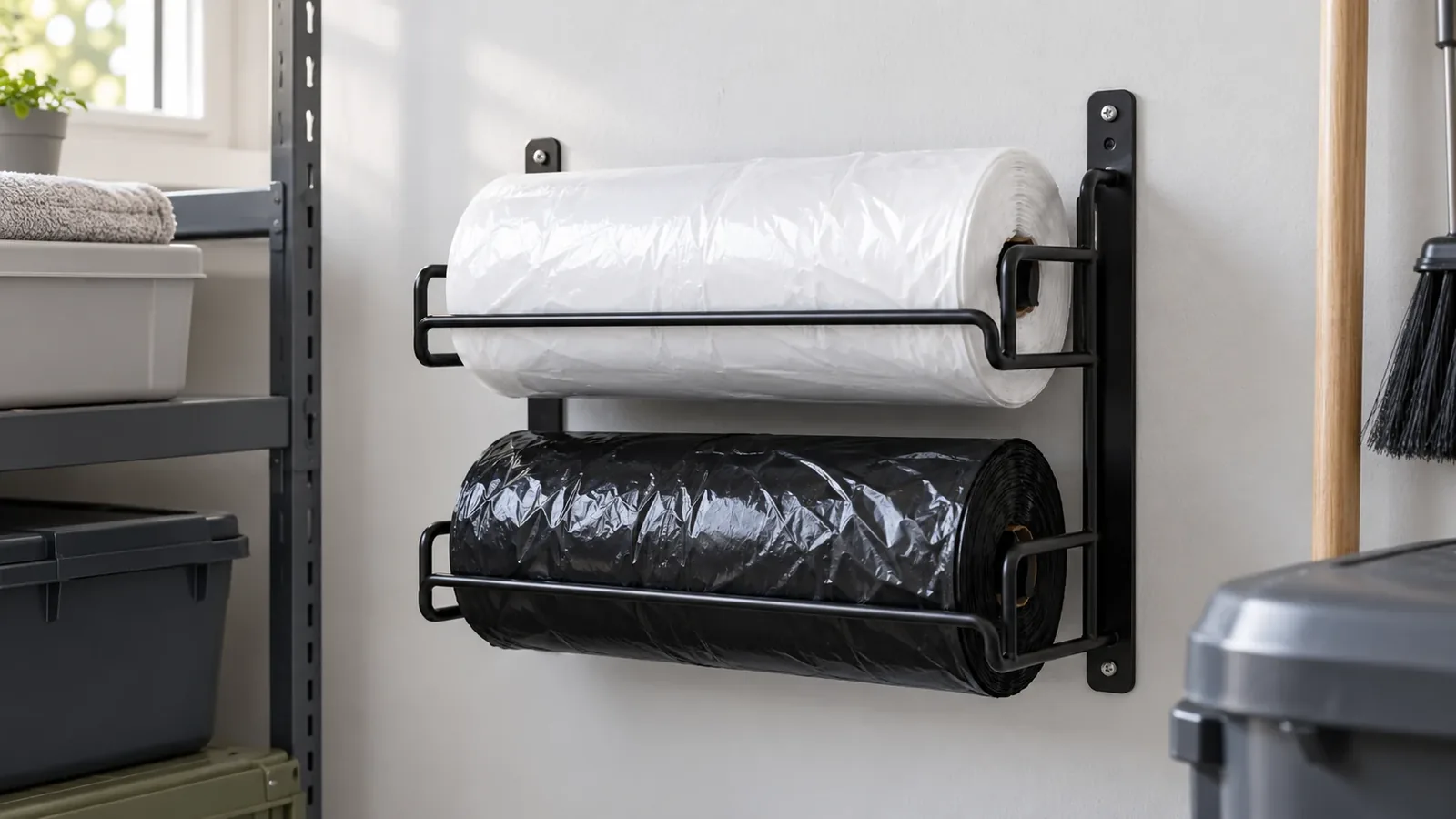
A metal trash bag dispenser should be specified around the actual roll that the buyer plans to sell, not around a vague label such as “standard size.” Roll diameter, width, core, bag material, perforation, and the way a user pulls one bag away can all affect fit and dispensing. For an importer, the practical sample question is whether the selected roll stays controlled from full to nearly empty, feeds without snagging, and can be replaced without removing the dispenser from its intended location. These are product-specific checks; no single holder can be assumed to fit every roll.
Start with the buyer’s roll assortment
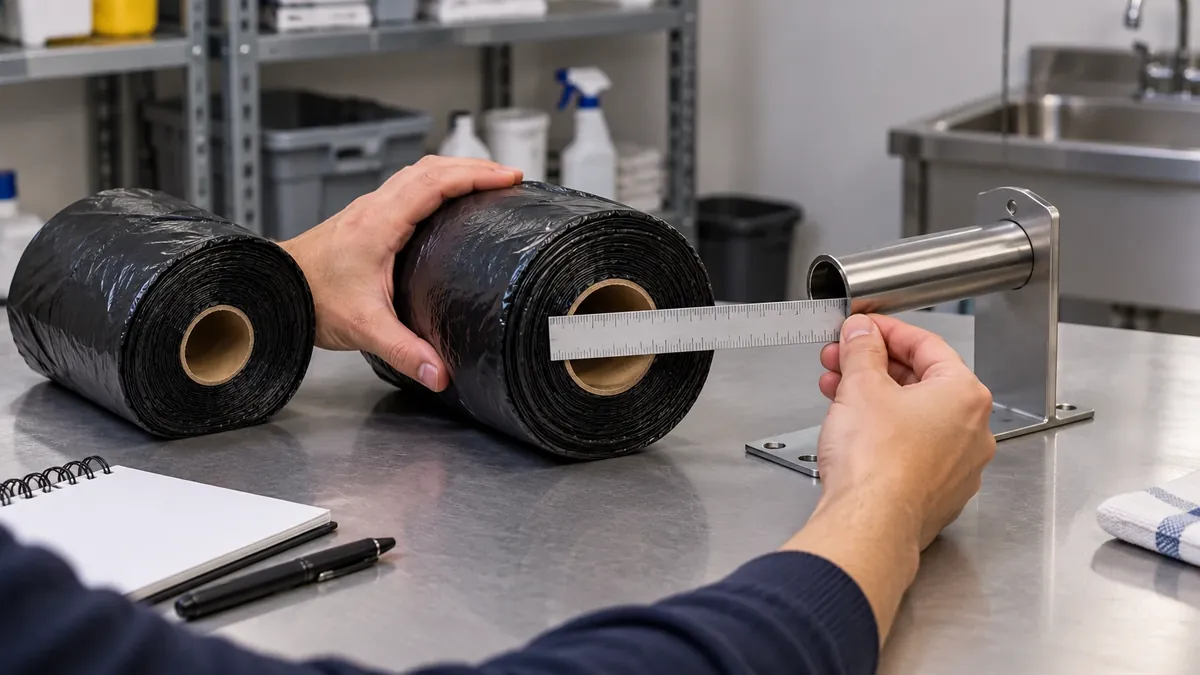
Before asking a supplier to quote a holder, define which bag SKU it will serve. A household assortment may include compact kitchen rolls, taller can liners, drawstring bags, or large utility bags. Even when two rolls contain the same number of bags, their outside diameters can differ because bag thickness, folding pattern, core size, and winding tension are different. The roll’s width and end geometry also matter if the holder supports it between side plates or on a central spindle.
Create a small roll specification sheet for every target SKU. Record the supplier or internal item number, bag dimensions when opened, roll width, maximum full-roll diameter, core diameter or coreless construction, roll length, bag count, perforation style, and whether the bags are folded or wound. Measure more than one production roll if possible. Manufacturing variation in winding can change the outside diameter even when the bag itself is nominally unchanged. A sample chosen only because it is the largest roll from one carton may not capture the normal range, so keep the measured samples and record how they were selected.
Avoid asking only for a holder’s “capacity.” That word can mean that a roll physically fits, that it can rotate, or that it dispenses reliably. Ask for the actual dimensional envelope and test conditions behind any capacity statement. If the product is meant to cover two roll sizes, list both sizes and verify each separately. A design that accommodates a large roll may leave a narrow roll loose; a design that controls a narrow roll may make a jumbo roll difficult to insert.
A useful initial matrix is:
| Buyer input | What to record | Why it matters |
|---|---|---|
| Roll width | Minimum and maximum measured width | Determines side clearance and alignment |
| Full-roll diameter | Maximum measured diameter, with sample count | Establishes insertion and enclosure clearance |
| Core | Inside diameter, material, or coreless | Affects spindle or support compatibility |
| Roll construction | Folded, wound, perforated, drawstring, or other | Changes the feed path and pull behavior |
| Intended location | Wall, cabinet door, under sink, freestanding | Sets access and clearance requirements |
| Refill method | Front, side, top, or removable support | Determines opening size and service access |
This matrix does not replace a production drawing. It makes the drawing and sample request more useful by connecting dimensions to the roll the buyer actually intends to sell.
Define how the roll is supported
A passive metal holder can support a roll in several ways: between side supports, on a rod or spindle, in a shallow cradle, or inside a partial enclosure. Each architecture creates different trade-offs. A rod can keep a core-based roll aligned, but the rod diameter and end retention need to match the core and refill method. Side supports can handle coreless rolls, but their contact surfaces and spacing can affect wobble. A cradle can be simple to load, but it must keep the roll from escaping when a bag is pulled at an angle.
The buyer should clarify what the holder is expected to do. Is it only a storage bracket that keeps a roll nearby? Should it guide the loose end? Should it resist the entire roll turning when the user pulls a single bag? Is a separate cutter included, supplied by another vendor, or absent? The research examples for this topic show both wall-mounted metal holders and other mounting forms, but they do not establish that every product includes a cutter or the same retention design. Specify components explicitly instead of assuming that the category name implies them.
Retention is a design balance. Too little restraint can allow the roll to spin freely and release more than one bag. Too much restraint can make the user tug hard, tear the perforation unpredictably, or deform the bag. The result depends on roll winding, film type, perforation strength, pull direction, support geometry, and friction. A buyer should not request a universal “one bag every time” guarantee without defining the bag sample and evaluation method.
Ask the supplier to show how the roll is retained and how it can be removed. If the retention feature is a spring, clip, friction pad, or purchased part, confirm its material, attachment, replaceability, and ownership of supply. Koitor’s current production of a bag-roll holder or any particular friction component is unconfirmed, so an OEM discussion should begin with drawings, samples, and capability confirmation rather than an assumed existing product range.
Test dispensing from full to nearly empty
A full roll is only one operating condition. As the roll’s diameter decreases, its center of mass, contact points, and tendency to move can change. A holder that seems stable with a full roll may let a nearly empty roll tilt or escape. Conversely, a large full roll can rub against an enclosure or nearby cabinet surface even though the smaller roll rotates freely.
Build a sample test with at least three states: full roll, approximately half-used roll, and near-empty roll. Use the actual bag construction and perforation intended for sale. Test straight pull, downward pull, and any realistic angled pull created by the installation location. Observe whether the roll stays in position, whether the loose edge remains reachable, whether the bag separates at the intended perforation, and whether adjacent bags unwind. Record the test setup and outcome instead of writing a broad claim such as “smooth dispensing.”
A practical sample protocol can include:
- Load the specified full roll using the intended refill sequence.
- Pull one bag using the normal hand position and direction.
- Repeat at a consistent pace, noting whether the roll shifts or spins.
- Check the perforation separation and whether the next bag remains controlled.
- Repeat with a partly used roll and a near-empty roll.
- Refill the holder several times to evaluate access and any sharp or snagging edges.
- Repeat after installation in the intended position, with nearby doors, pipes, or shelves present.
The buyer may decide to measure pull force if the user experience or bag construction makes it important. If so, define the force gauge, pull angle, pull speed, roll state, and acceptance range. A force value collected under one setup should not be treated as a general product rating under all conditions. If no instrumented test is required, a documented functional evaluation with named sample rolls can still help compare designs, provided the limits are clear.
Separate product behavior from bag quality. A bag may tear away because its perforation is weak or inconsistent; the holder may contribute if it catches the film or creates an unsuitable pull path. When a test fails, inspect both sides of the interaction before changing the holder. A stronger restraint is not automatically the answer: it may stop over-unwinding but increase pulling force or tear risk.
Plan for refill access and safe edges
The opening that lets a user replace a roll must be large enough for the maximum measured roll, while the support must still retain it during use. Consider how the user’s fingers reach the spindle or support, whether the roll can be loaded without bending the bag edge, and whether the holder can be refilled while mounted. If the intended installation is inside a cabinet, check whether a door or shelf blocks access to the refill opening.
Look for snag points along the user’s path. A bag edge can catch on a burr, exposed fastener, narrow gap, or sharp cut edge. For a metal product, review edges after forming and finishing, not only on the flat blank or early prototype. A coating can change how a gap feels or how tightly a moving roll fits. The finished sample is therefore the relevant sample for functional review.
If a removable rod or support is used, check whether it can be removed without tools, whether it can fall out during use, and whether the user can tell how it returns to its operating position. If a retainer or end cap is used, include it in the bill of materials and sample test. A drawing that shows the main metal body but omits a purchased retainer may not represent the final assembly.
Verify mounting and location clearances
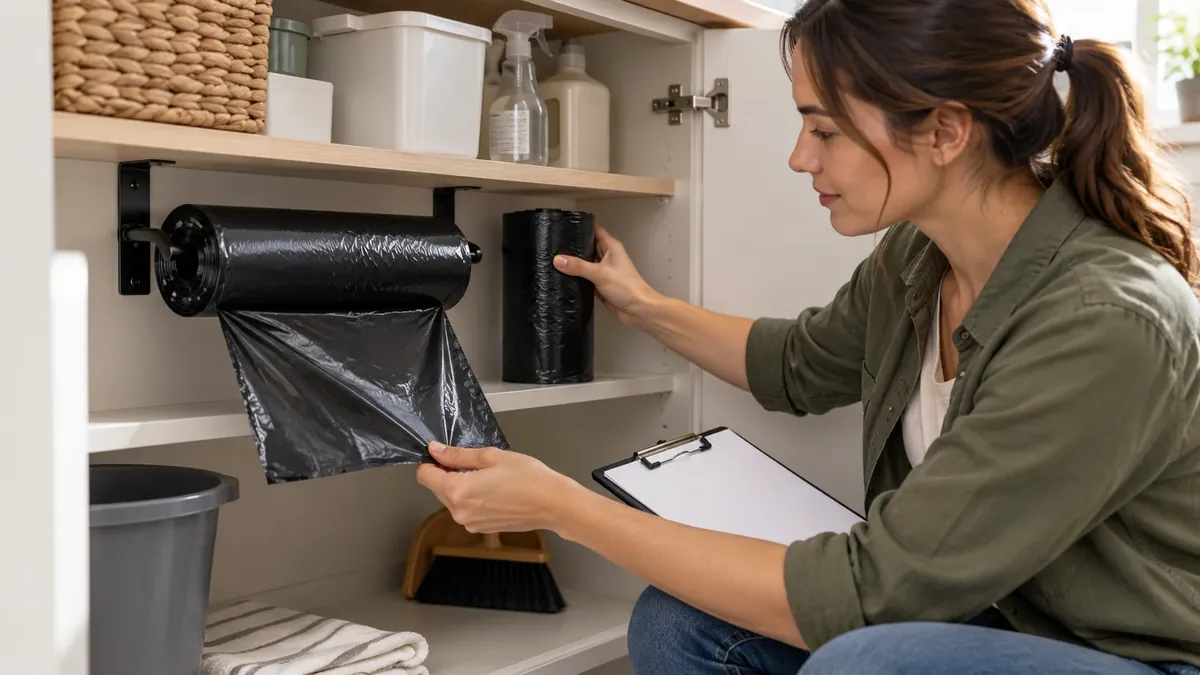
Mounting decisions are tied to the installation location. A wall-mounted dispenser needs a usable wall area and suitable fasteners for the substrate. A cabinet-door product needs clearance from shelves and nearby objects through the door’s full travel. An under-sink unit must avoid pipes, cleaning products, hinges, and stored items. A freestanding holder needs a stable footprint and a location where it will not be knocked over. These are different use conditions and should not be combined into one unqualified fit statement.
Measure the installed envelope, not just the body dimensions. Include the roll at maximum diameter, the space needed for a hand to pull a bag, the swing or removal path for a refill, screw heads, mounting plates, and any protruding support. For a cabinet, check the door closed and open, and consider the depth of the contents behind it. If the product is intended to fit under a sink, obtain a representative cabinet layout or dimensions; “fits under most sinks” is not a defensible specification without defined limits.
Fasteners require their own scope. A product listing may show a mounting kit, while another may sell the hardware separately. The buyer should state whether screws, anchors, adhesive, or another mounting component are included, and who supplies them. If supplied, identify the intended substrate and installation instructions. If not supplied, say so clearly in the packaging and product listing. Do not assume that a screw suitable for one wall or cabinet panel works for all surfaces.
For a prototype review, document the exact installation surface and fastener. Check whether the holder remains aligned during bag pulling, whether the mounting points are accessible, and whether the roll or user’s hand contacts nearby hardware. Any load or pull test should use the installed configuration that matches the intended instructions. A bench test of the metal body alone cannot establish that every wall, cabinet, or adhesive installation will perform the same way.
What to include in the RFQ
A well-formed RFQ tells a supplier what the buyer has already decided and what still needs engineering input. Include:
- Target roll SKUs and measured dimensional ranges.
- A physical roll sample, if available, plus a drawing or photographs with scale.
- Intended mounting type and installation location.
- Expected refill direction and user access.
- Whether the holder must guide the loose bag end or simply store the roll.
- Any cutter, retainer, spindle, pad, fastener, or purchased component expected.
- Material and finish requirements, or a request for the supplier to propose options.
- Critical dimensions and appearance surfaces.
- Packaging and retail-box requirements.
- Sample quantity, review criteria, and the number of roll states to test.
- Required documentation, labeling, barcode, and instructions.
- Target order quantities and any expected assortment variants.
Ask the supplier to identify assumptions in the quotation. For example, clarify whether the price includes fasteners, a purchased cutter, a protective pad, a finished surface, an individual bag, or a printed carton. If the supplier proposes an alternate construction, request the reason and the effect on roll compatibility, refill access, finish, assembly, and packing.
Do not compare quotations solely by the number at the bottom. Compare the included components, material description, finish, sample scope, tooling assumptions, packaging, and lead-time basis. If one quote excludes mounting hardware and another includes it, they do not describe equivalent products. A short assumption table can help the buyer make the scope comparable before choosing a supplier.
Approve the sample against a written checklist
A sample approval should record the roll SKU and lot used, dimensions measured, installed position, refill method, observed dispensing behavior, and any agreed changes. Photograph the loaded holder at full and near-empty states. Keep a retained reference sample if the project’s process allows it. Where drawings change, identify the revision and check whether the new dimensions affect the roll envelope or mounting clearance.
A useful acceptance checklist separates critical fit from preferences:
Fit: Does the largest intended roll load without forcing or damage? Does the narrowest roll remain aligned? Are the roll and holder clear of the cabinet, shelf, or wall?
Operation: Can the user find and pull the bag edge? Does the roll stay controlled in the defined test? Does the bag separate at its perforation under the agreed conditions?
Refill: Can the user remove and replace the roll without unmounting the product? Are supports and retainers easy to understand and secure?
البناء: Are finished edges acceptable? Are fasteners and purchased components present as specified? Does the finish cover the agreed surfaces without interference in moving clearances?
التغليف: Does the packed product protect exposed edges and finish? Are included fasteners, instructions, and SKU identification correct?
Record a failure as an observation, not an unsupported root-cause conclusion. “Roll rotated and released two bags during three downward pulls with SKU X” is more useful than “holder is poor quality.” The observation gives the supplier a repeatable condition to investigate and allows a revised sample to be compared fairly.
The metal trash bag dispenser should also be checked against the approved drawing and the final pack-out configuration.
Manage variants without confusing the user
If a product family supports several roll sizes, label the compatible SKU range precisely. A variant matrix can show the holder model, roll width and diameter range, mounting method, fastener inclusion, and refill direction. Avoid ambiguous terms such as “large roll” unless a measured maximum is provided. Packaging and online listings should explain which roll types were checked and whether the roll itself is included.
A buyer may choose one adjustable design or separate sizes. The adjustable version can reduce SKU count, but it may add parts, adjustment steps, or fit compromises. Separate versions may provide a simpler user experience but create more inventory and packaging work. Compare the options using actual roll dimensions, target markets, forecast assortment, and expected variation. Do not select a more complex design merely because it appears more versatile on a concept sketch.
A concise sourcing takeaway
A metal trash bag dispenser is best sourced as a system: the holder, the roll, the refill path, the mounting surface, and any included components. Start with measured bag-roll samples; state the full-to-near-empty conditions; test dispensing and refill access in the intended location; and approve the finished sample against written criteria. This approach gives importers a more defensible specification than “fits standard bags” and helps suppliers quote the same product scope.
For adjacent metal storage projects, buyers can review Koitor’s OEM home storage hardware manufacturing information and confirm the exact product, process, components, and order requirements directly with the factory.
Discuss Your Metal Trash-Bag Roll Holders Specification
OEM / العلامة التجارية الخاصة
حوّل دليل التوريد هذا إلى موجز منتج
يرجى إطلاعنا على المنتج المستهدف، والحجم، والتشطيب، وكمية الطلب، ومتطلبات التغليف. وسيتلقى فريقك تقييمًا عمليًّا لإمكانية التصنيع قبل تقديم عرض الأسعار.


 English
 Español
 Português
 Français
 Deutsch
 العربية