
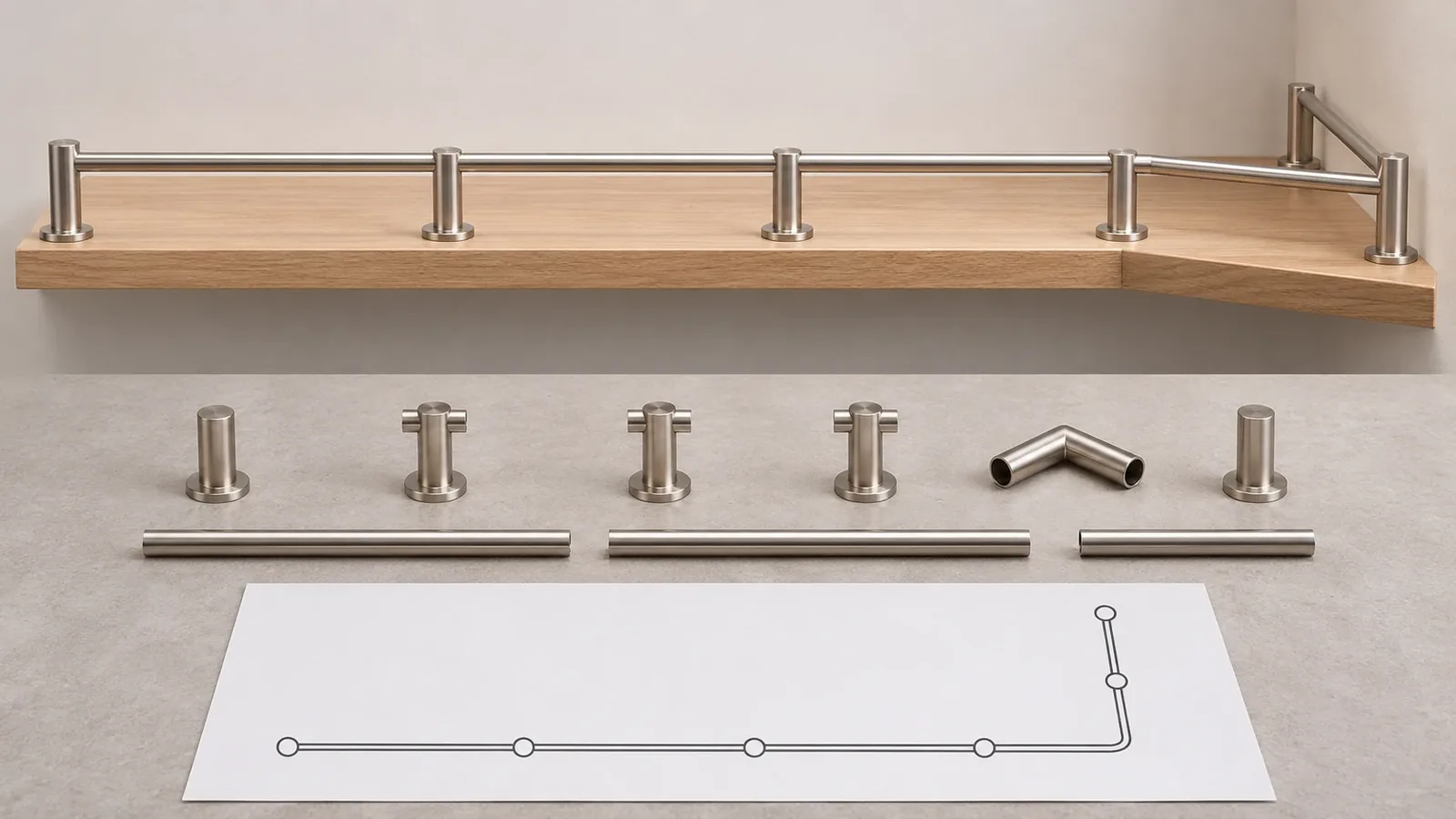
A shelf gallery rail schedule should connect each straight length and return to the named end, through-post and corner components for the same drawing revision. This prevents quantities from being inferred from a product photograph or from an unconfirmed spacing rule.
Short answer: Before ordering a shelf-edge rail, choose the exact component family and map each straight run, end, intermediate post, and return to the parts the supplier lists for that family. A finished shelf with an already selected rail and a modular rail system sold as loose components are different purchase scopes. Do not combine parts from separate product families or calculate post quantity from a universal spacing rule that the supplier has not provided.
A shelf gallery rail is often shown as a polished detail along the edge of a shelf, but the buyer may be ordering either a complete shelf assembly or a set of components to build a chosen run. That difference should be clear before a quotation, sample, or bill of materials is approved. A straight edge and a returning corner need a layout-linked schedule so that component roles, product references, finish, and quantities remain connected to the intended shelf arrangement.
This guide covers procurement coordination for a decorative shelf-edge rail. It does not specify a post spacing, cutting dimension, attachment method, load capacity, guardrail performance, or product safety claim. It also does not establish that Koitor currently manufactures gallery rails, brass castings, connectors, glass shelves, or wooden shelves. A specialist product supplier must confirm which family, components, instructions, and performance evidence apply to the buyer’s design.
How to plan a shelf gallery rail layout
Start with the shelf and its intended finished edge. Mark each straight rail segment, each termination, each intermediate support or pass-through role, and every return or corner. Label the layout with a drawing number and revision. A top-down plan is usually more useful than a close product photograph because it shows whether the run ends at a wall, continues across another edge, or returns to form a corner. The drawing should make the buyer’s intended topology visible without inventing a mechanical dimension.
Then select one supported product family. A traditional system may use dedicated end, center, and corner posts. A different contemporary arrangement may use single- or double-rail components with end and center posts plus a separate corner adapter. These are examples from reviewed product documentation, not categories that every supplier uses. The supplier’s current catalog and technical documents determine the role names and approved combinations for the actual offer.
Do not treat a center post from one family as interchangeable with a through post from another, even if the two appear similar in a photograph. Their relationship to the rail section, finish, shelf, connector, and corner component may differ. Likewise, a system that uses a corner post may not use the same corner part as a system that uses separate adapters. Keep product-family identity on every line of the schedule so procurement does not accidentally combine a familiar-looking part from a different system.
| Layout feature | Buyer should record | Supplier should confirm |
|---|---|---|
| Straight run | Location, drawing revision, selected rail family, and the maker’s length datum | How the supplier defines rail length and the selected components for that family |
| End termination | Which end is open, closed, or joined to another feature | Which end component and mating reference apply |
| Intermediate role | Where the rail continues and what support role the chosen system uses | The correct center, through, or other named post for that family |
| Return or corner | The direction and location of each return in the plan | Whether the family uses a corner post, adapter, or another approved component |
| Rail level | Single- or double-rail arrangement if offered | The matching rail, post, and connector references for the selected level |
| Finish and shelf interface | Buyer finish reference and shelf construction | The exact offered finish, component family, and approved shelf relationship |
| Quantity and pack | Required pieces by role and order unit | Supplier-confirmed counts and how each part is packed and identified |
The schedule is not an installation drawing. It is an order-control document that keeps the buyer’s layout and the supplier’s part references together. If the supplier needs a different drawing view or a specific measurement datum, request that information rather than deriving it from an illustration. Do not assume that a nominal rail or tube diameter establishes fit after finish, holes, connectors, or other features are considered.

Distinguish a complete shelf from a modular component order
A buyer may encounter both finished shelves with a factory-selected rail and catalogs that offer rails, posts, and connectors as separate pieces. Those offers are not directly comparable until the scope is normalized. A complete shelf may arrive with its edge treatment already chosen. A modular package may require the buyer to select a rail family, posts, returns, finish, and mounting details. The product title alone does not show which parts are included.
The distinction affects commercial records and product data. Ask whether the offered item includes the shelf surface, rail sections, end pieces, center or through posts, corner components, fasteners, and packaging. If a part is not included, identify whether it is optional, separately purchased, customer-supplied, or outside the seller’s scope. For multi-supplier programs, name the party responsible for confirming the mating interfaces and for resolving a missing component before the order is released.
The reviewed Brownwood/Designs of Distinction guide illustrates several rail architectures. Its pages distinguish a traditional system with end, center, and corner posts from contemporary single- and double-rail configurations with their own post and corner-adapter roles. The guide’s footer identifies revision REV0325 even though the saved filename includes “June2024.” Preserve the source identity and revision as shown; do not infer current stock, current pricing, or universal compatibility from the filename or images.
A separate Allied Brass QN-2TB-GAL product description presents an integrated glass-shelf/rail/towel-bar item. That is useful for distinguishing a complete product from an order composed of separately selected rail parts. Its product-specific safety, lifetime, warranty, glass, or load statements do not establish general engineering facts for another shelf or for Koitor. Use each source only for the product it actually describes.
Before comparing offers, align the requested deliverable. One supplier’s complete shelf should not be compared against another supplier’s rail-only kit as though the items were equivalent. Write the requested scope in plain terms, then map the supplier’s quote and sample against it. If the shelf surface, mounting hardware, or finish is not part of the quote, show it as a separate line rather than hiding it in a broad “gallery rail set” description.
Select one family and preserve part references
Once the buyer’s layout is clear, ask the supplier to nominate the current family and the exact components for each role. Record the product code and reference exactly as provided. If a category page, end-component page, and corner-component page use inconsistent references, keep the conflict visible and ask the supplier to resolve it. Do not “correct” a reference because one value seems more logical or because another seller uses a similar code.
In one reviewed Gallery Metalworks category and its linked component descriptions, the center reference shown on the category and end pages differed from the reference appearing on a corner page. This is an unresolved source discrepancy. It does not demonstrate interchangeability, a catalogue error, or which reference is correct. The purchasing response is to ask the responsible supplier for a current part schedule or written confirmation tied to the requested family and drawing revision before placing an order.
The buyer’s layout-to-BOM record can use the following fields:
- Approved shelf layout drawing and revision.
- Selected supplier system, family, and current revision.
- Rail profile or tube reference and the supplier’s length datum.
- Single- or double-rail arrangement, if applicable to that family.
- Part role and location: end, intermediate/center, return/corner, or other supplier-defined role.
- Supplier part number and source page or document for every listed component.
- Shelf interface and finish reference, each confirmed for the selected family.
- Quantity by role, packaging unit, and carton group where applicable.
- Missing parts, conflicting references, and unresolved questions.
- Responsible supplier contact and the disposition of each conflict.
Quantities should come from the approved layout and the supplier’s component schedule, not a universal formula. A diagram with a long straight run does not authorize the buyer to calculate center-post spacing unless the supplier has provided the applicable rule. Similarly, do not infer a maximum run length, attachment method, or safety function from a catalog image. If the supplier’s schedule depends on a dimension or datum, ask them to specify exactly where it is measured and which revision applies.
This documentation supports repeat orders. When a buyer changes a return, shelf thickness, rail family, finish, or component supplier, the schedule provides a place to identify the affected parts and request confirmation. Preserve the old approved revision as a record, and mark the updated revision clearly. Do not send a mixture of old and new part numbers under a single unqualified layout name.
Verify fit and scope on the sample and package
The sample should represent the part family and shelf arrangement the buyer intends to order. Record the supplier, model, revision, finish, rail role, and layout reference with the sample images. If a sample uses a temporary or substitute component, label that substitution and do not treat it as proof that the final configuration has been verified.
During sample review, compare visible component roles against the schedule. Confirm that the intended straight segment, end role, intermediate post, and return component are present in the same combination the supplier confirmed. If the sample is a complete shelf, record which portions are factory-assembled and which loose parts are included. If it is a modular kit, check that every quoted role appears in the pack list and that the identification labels map to the intended layout. These are procurement checks, not a structural test or performance certification.
Keep the shelf and support question separate from the decorative rail question. A shelf-edge rail is not automatically a wall support or suspension rail. It should not be presented as a load-bearing cabinet attachment, safety guard, or bottle-retention system unless the maker supplies evidence for that exact use. If the buyer needs support hardware, structural shelf clips, or a suspension rail, identify that as another product system with its own supplier and documentation.
For comparison, Koitor’s picture-hanging hardware assortment guide discusses wall-mounted picture rails, cords, ends, and hooks; the shared word “rail” does not make it the same system as a shelf-edge gallery rail. The cabinet suspension hardware guide covers a separate cabinet-hanging assembly. Keep those ownership boundaries intact when selecting internal links or writing product descriptions.
The package should identify what the buyer receives and the exact layout to which those components belong. Use the same family name and part references as the approved drawing and quotation. If the buyer’s product data lists multiple corner options, state which one is included with the selected configuration and which alternatives are separate SKUs. Do not claim that all modular layouts can be assembled from any combination of the same named pieces.
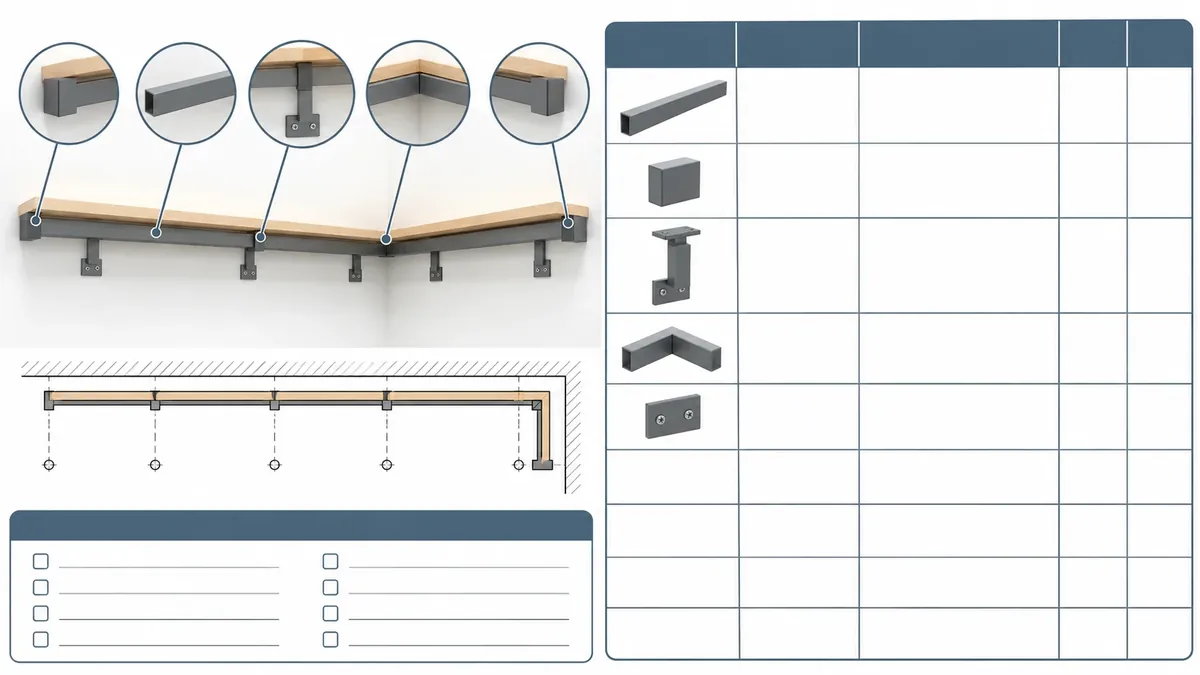
Keep the schedule usable through quotation and reorder
The schedule should connect the buyer’s drawing to the supplier’s quotation and to the item labels that arrive with the order. Use a unique layout reference and drawing revision, then identify the corresponding family and part references in the supplier’s reply. If an order includes more than one shelf or more than one return condition, make separate schedule lines for each location. Avoid relying on an email attachment named only “final” because a later change can make it difficult to tell which configuration purchasing approved.
Before order placement, read the response back against the original layout. Confirm that every open end has a defined treatment, every return has a supplier-confirmed component, every intermediate support role is mapped, and each rail level belongs to the selected family. If the supplier supplies a preassembled shelf, identify which components are factory fitted and which loose items are in the carton. If the supplier offers a modular package, check that the BOM contains each role needed by the drawing and that no unapproved alternate part is inserted to fill a gap.
This reconciliation is especially useful when the product combines components from multiple sources. One supplier may provide a shelf substrate while another supplies the rail and posts. In that case, identify who is responsible for confirming the shelf-to-post interface, finish match, pack grouping, and any required mounting parts. A purchase order can repeat the agreed part references, but it should not invent engineering values that the product source has not supplied. Where no party accepts responsibility for a compatibility statement, leave the configuration unresolved instead of assuming it is covered by the visual design.
For receiving, keep the schedule available to the people who count and identify incoming parts. A carton that contains several small components may be easy to misread if a part code is not linked to a role and layout location. Use a packing list or internal checklist that shows the supplier reference, description, role, quantity, and drawing revision. If components arrive in multiple cartons, record how the rail, posts, adapters, fasteners, and shelf map to the complete SKU. This is a logistics identification step, not a claim about transit performance or package strength.
If a mismatch appears, separate what is known from what needs correction. The receiving team can record that a particular reference or quantity differs from the approved schedule and hold the affected item for supplier review. Do not substitute a visually similar part merely to complete the sample; it may belong to another family. Ask the supplier to identify the correct item and update the schedule or quotation if a confirmed substitution is needed. Preserve the original approved version so that the change can be traced.
The same approach helps with reorders. A buyer may modify the shelf size, return direction, number of levels, or finish while keeping a familiar family name. Those changes can affect selected components or counts. Start from the updated layout and ask the supplier to reconfirm the schedule rather than copying an old parts list. Record the new revision and identify whether any existing parts remain approved for the changed arrangement. This prevents a previously correct schedule from becoming an unexamined assumption.
Questions buyers ask about gallery rail parts
Does a matching tube diameter prove that the parts fit?
No. A nominal diameter is only one possible input. Finish, connection details, hole locations, post geometry, and the supplier’s family may affect the intended interface. Ask the supplier to confirm the exact combination against the drawing and current part references.
Does every corner need a separate corner adapter?
Not necessarily. The reviewed documents show different family architectures: one may use a dedicated corner post while another uses a separate adapter with its own posts. The selected supplier’s current family and drawing determine the applicable role; do not transfer one family’s solution to another.
Is a double rail just two single-rail kits?
Do not assume that. The product documentation may define its own posts, ends, or adapters for a double configuration. Confirm the exact kit or component schedule with the supplier rather than multiplying a single-rail list.
Can I use a catalog image to count posts?
Only if the image is a controlled representation of the exact model and layout, and the supplier confirms the shown parts. Illustrations may omit parts, may depict a different family, or may not be drawn to scale. Use the supplier’s current BOM or confirmed schedule for ordering quantities.
How should a buyer handle conflicting part numbers?
Record the page, role, code, date, and family where each reference appears, then request written confirmation from the responsible supplier. Do not silently select one or assume that two references are aliases.
What belongs in the RFQ?
Send the shelf drawing and revision, straight and return layout, selected or requested family, finish reference, shelf construction, intended rail level, component supply scope, packaging needs, and any supplier codes already under consideration. Ask the supplier to identify the length datum, correct component roles, quantities, and unresolved references.
Does the rail keep objects from falling off the shelf?
This guide does not establish that performance. A rail’s appearance or height is not evidence of a tested retention function. Use the product-specific evidence owner and avoid claims about safety or containment unless the relevant performance has been substantiated for the exact configuration.
Sourcing takeaway
Translate the shelf drawing into a role-by-role schedule before quoting. Mark straight runs, terminations, intermediate posts, returns, rail level, family, finish, part references, quantities, and packaging. Keep a complete-shelf offer distinct from a modular component package. If a supplier source shows conflicting part references, preserve the discrepancy until it is resolved. The schedule can control an order, but it is not an engineering design rule or a performance certificate.
Koitor’s custom kitchen storage rack manufacturing page supports project inquiries for confirmed kitchen storage hardware scope; it does not claim current gallery-rail production or proprietary connector manufacture. Send the shelf layout, intended rail family, finish reference, and package requirements through the Contact page so feasible metal scope and specialist responsibilities can be confirmed before a quote.
Sources and scope notes
- Designs of Distinction / Brownwood gallery rail guide: four-page family and component examples; page footers identify REV0325. No dimensions, spacing, cutting, attachment, or load values are transferred.
- Gallery Metalworks component category: category and linked part roles; one reviewed part-reference inconsistency remains unresolved and requires supplier confirmation.
- Allied Brass QN-2TB-GAL: an integrated glass-shelf/rail/towel-bar product, not evidence of a modular rail system or general performance.
- Current Koitor production of gallery rails, brass casting or turning, glass or wood shelves, and rated safety testing is unconfirmed and is not claimed.
The sources support distinguishing named component families and the buyer’s schedule process. They do not prove common buyer confusion, universal part interchangeability, or a Koitor gallery-rail product.
اعمل مع شركة «كويتور» للأدوات
Discuss a Shelf Hardware Project
Share the shelf layout, drawing revision, intended component family, finish and package scope. Koitor can first confirm whether the defined metal-hardware work fits current capabilities.
OEM / العلامة التجارية الخاصة
حوّل دليل التوريد هذا إلى موجز منتج
يرجى إطلاعنا على المنتج المستهدف، والحجم، والتشطيب، وكمية الطلب، ومتطلبات التغليف. وسيتلقى فريقك تقييمًا عمليًّا لإمكانية التصنيع قبل تقديم عرض الأسعار.

 English
 Español
 Português
 Français
 Deutsch
 العربية