

A pull down spice rack review should use the nominated cabinet and representative jars at stowed, intermediate and lowered positions. Record the fixed supports, hinge and door envelope, shelf edges and nearby filler. Confirm how the maker defines the loaded configuration and what components the quotation includes. The result is a model-specific fit record; it does not establish a universal clearance, load rating or installation method.
Short answer: Approve a pull-down spice rack against the exact cabinet support and the full movement of the jars the buyer intends to use. Empty outside dimensions do not show whether the rack, jars, door, hinge, cabinet lip, or fixed mounting surface interact as the frame moves. Review the selected mechanism in the stowed, transition, and lowered positions with nominated jars and model-specific instructions.
The buying question behind a pull down spice rack is not simply whether the basket fits inside a cabinet opening. The buyer must identify how the frame attaches, which cabinet surface or fixed shelf supports that attachment, what path the rack follows, and how the nominated jars occupy that path. A product can look compact while stowed yet need a different envelope as the frame moves down or forward. The geometry and instructions belong to the exact manufacturer model under review.
This article focuses on a passive cabinet-mounted wire organizer with named brackets and support arms. It does not describe a door-hung rack, a horizontal drawer pullout, a pull-and-rotate unit, or a whole-cabinet lift. It does not prescribe universal clearances, load, fasteners, accessibility, cycle life, or an installation procedure. Confirm those matters through the supplier responsible for the exact product and cabinet.
What a pull down spice rack fit check has to cover
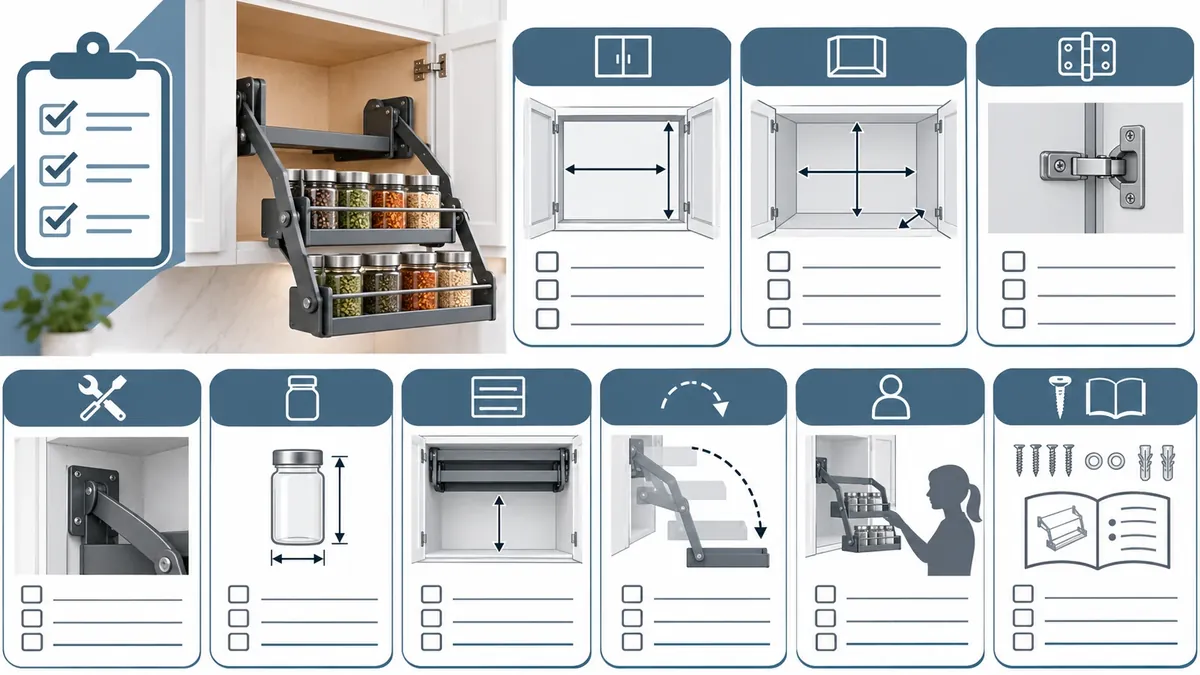
A static measurement describes the product in one position. A movement check asks where the rack travels and what occupies that space. A useful buyer review therefore considers at least three states: stowed, moving, and lowered. The transition matters because a door edge, hinge, cabinet lip, shelf underside, or jar top may enter the path only partway through movement. Checking the rack only when closed or fully lowered can miss an interference that appears between those states.
The second part of the review is the load configuration. The product may be designed to hold spice jars, but “jar” is not one uniform size. Height, diameter, cap shape, label position, and how the buyer expects users to grip each container can affect clearances and retrieval. A set of short jars may present a different envelope from a nominated package with taller caps. The buyer should use representative packaging from the intended assortment, not an abstract jar count or a generic drawing that omits cap height.
The third part is the fixed attachment. Hardware Resources’ named TTSPD-R product page describes a steel three-tier organizer with mounting to a cabinet bottom or a fixed shelf. That particular attachment description is product-specific. A moving shelf panel or another surface should not be assumed equivalent. Identify the exact mounting surface and ask the responsible supplier or cabinet designer whether the selected support and instructions apply to it.
Together, these are separate approval questions:
- Is the correct mechanism being considered for the cabinet?
- What fixed surface and bracket arrangement does the maker specify?
- What is the frame’s path from stowed through transition to lowered?
- Which nominated jars and caps occupy the rack during that movement?
- What door, hinge, lip, adjacent shelf, or cabinet part might meet that path?
- Which model-specific document and revision controls the sample and installation notes?
Do not reduce these questions to “will it fit?” without naming the state and configuration. The supplier needs the cabinet reference, drawing or sample, nominated jars, support arrangement, and the product model to give a meaningful answer. If any of those inputs is missing, record the gap rather than silently assume a standard cabinet or jar.

Identify the mechanism and fixed attachment first
Search results and product descriptions can use similar terms for different mechanisms. A horizontal pullout slides along cabinet-mounted runners. A door-carried organizer follows the door as it swings. A pull-and-rotate product has a different motion and support. A pull-down frame moves on its own arms or supports from a fixed mounting arrangement. These product types may all appear in spice-organization searches, but their cabinet interfaces and movement paths are not interchangeable.
Confirm the actual model number and the manufacturer’s product page before reviewing details. For the Hardware Resources TTSPD-R, the canonical product page identifies a three-tier steel organizer and its stated mounting to a cabinet bottom or fixed shelf. Its linked drawing set shows distinct components and several positions for that named model. Those documents help identify a base bracket, basket, support rod, and changing envelope. They do not provide a universal clearance rule or a specification for another product.
The selected attachment should be recorded with the product. Identify the cabinet model, opening, fixed shelf or bottom surface, any applicable door or hinge references, and the exact support or bracket shown in the maker’s document. If a cabinet component is adjustable or moves, ask the cabinet supplier whether the proposed mounting surface is still treated as fixed for the intended use. Do not silently substitute a shelf panel that moves or a different substrate because it appears close to the illustrated location.
Clarify who owns each interface. The organizer manufacturer may provide a bracket and instructions for a named cabinet surface; the cabinet maker may own the cabinet construction; the buyer may supply fasteners or nominate the jars. Put those responsibilities in the RFQ or project record. This guide does not set screw type, spacing, substrate strength, installation torque, or any acceptance value. Those details must come from the current documents for the exact system and the responsible design source.
Check the occupied movement envelope
An empty rack test can help a reviewer see the frame’s motion, but it does not show how the intended containers occupy the moving assembly. Use jars or dimensional representatives that match the proposed assortment. Record the model or package reference, cap, overall height, outside diameter, label orientation if visibility matters, and which rack position each jar occupies. The point is not to invent a capacity or load claim; it is to make the sample configuration reproducible.
Review the rack in distinct positions. In the stowed state, note how the frame sits in relation to the cabinet bottom or fixed shelf, door, hinge, and cabinet lip. In the transition state, observe whether the support arms or moving frame approach another cabinet part and whether jars change orientation or come near an edge. In the lowered state, consider whether the intended jars remain accessible and whether the door or surrounding space affects the user’s access. The supplier’s own instructions govern any actual movement or installation procedure.
Use a state worksheet to keep observations organized:
| State | Record | Questions for the responsible supplier |
|---|---|---|
| Stowed | Model and revision; fixed support; cabinet lip, door, and hinge references; nominated jar set | Does the exact document show this mounting surface and product version? |
| Transition | Observed movement path; positions of support arms and jars; any contact or interference seen | Is the sample configured as intended, and is the instruction applicable to this SKU? |
| Lowered | Final position of frame and jars; access and neighboring cabinet boundary | What does the supplier say about the intended end position and supplied contents? |
| Change or exception | Missing jars, alternate shelf, different hinge, substituted bracket, or unresolved contact | Who must approve the changed configuration and which drawing revision will control? |
Write down the actual observation, not a conclusion beyond the evidence. “The cap contacts the cabinet lip during transition on this sample” is an observation. “All cabinets with this opening are incompatible” is a much broader claim and does not follow. If the contact is unclear, ask the supplier to review the same drawing and sample instead of modifying the part or cabinet based on guesswork.
Check more than one point in the motion if the maker’s instructions allow it. A system may move along a curved or linked path, so the lowest or highest position alone may not define the envelope. The drawing for a named model can help identify the states shown by its manufacturer, but it should not be redrawn as if it were a universal mechanism. Capture the buyer’s intended cabinet and jars with the controlled supplier reference.
Do not claim a product fits every cabinet based on one sample. A sample review is evidence for the configuration it represents. Cabinet dimensions, hinge models, shelf positions, door overlays, jar assortment, and product revisions can differ. Where a buyer intends to support more than one cabinet type, make each approved configuration explicit and have the responsible source identify any applicable conditions. Do not generalize a result beyond the reviewed set.
Use jar references without repeating an existing guide
Jar envelope and rack movement are related but distinct decisions. Koitor’s kitchen spice-rack jar clearance guide addresses how buyers define container envelopes and retrieval space for a spice rack. This guide adds the cabinet-mounted frame’s full motion, fixed support, and hinge boundary. Use the jar guide to define the container references; use the current product’s drawings and sample to review how those references move within the cabinet.
Do not transfer container counts, clearances, dimensions, or examples from one rack to another unless the source explicitly applies to the model being reviewed. A jar height from one assortment is not a universal input. A cabinet opening drawn without hinges or a door may omit an important obstruction. When a product page gives nominal product size, keep that source attached to its model and do not treat the size as proof of the complete occupied path.
If the assortment contains multiple jar profiles, identify which combination the product brief intends to support. A buyer can choose a representative set for each position, but the selected arrangement should be approved by the product source before it becomes a compatibility statement. A random collection of jars in a demonstration may not correspond to the planned SKU, and a visually successful sample does not establish a tested maximum configuration.
Record user-access needs as observations and product requirements rather than as unsubstantiated ergonomic claims. For example, the buyer can note that a selected jar label should face a specified direction or that a particular package needs to be removed from a named rack position. The supplier or product designer must confirm that the design and instructions support those requirements. Do not infer accessibility compliance or safe operation from an image of a lowered rack.
Control documents, sample identity, and package information
Use the manufacturer page, drawing, instruction sheet, quote, and sample as one model-specific document set. The Hardware Resources TTSPD-R drawing file reviewed for this guide contains multiple pages and depicts several positions and components. Its separate instruction file includes pages for more than one product: page one identifies TTSPD-R components and discusses a hinge-related condition, while page two covers a different SCPO-R cleaning caddy. Do not copy page two’s directions into a spice-rack procedure. Confirm document title, model, revision, and page applicability before using a number or instruction in buyer-facing material.
If the product page and instruction use different terms for a bracket, arm, or mounting surface, request a clarification and update the purchasing record. Do not guess which side of the interface the wording means. If the quoted model changes after sample review, ask whether the same drawing and instruction still apply. Changes to support, bracket, basket, finish, jar layout, or cabinet reference may affect what needs to be rechecked.
The carton and listing should also match the approved configuration. Identify which brackets, baskets, rods, fasteners, and instructions are supplied and whether any part is separately purchased. The user-facing description should not promise fit with all wall cabinets or all jar sizes unless the responsible supplier has evidence for those exact conditions. The package should identify the product model or SKU so that a customer can connect it to the right instructions and service parts.
Sample approval should preserve the boundary between observed behavior and manufacturer claims. Record which jars were used, which cabinet was represented, which model was sampled, what positions were reviewed, and what the supplier confirmed. Do not use the sample as a substitute for a test report or a verified load specification. If a buyer requires a performance claim, request the applicable evidence for the precise model and conditions before releasing that language.
The record should also preserve negative findings and unresolved conditions. If no interference was observed on the tested sample, write down the cabinet, hinge, door, shelf, and jar references that were present. Do not shorten that result to a broad claim that the rack fits standard cabinets. If a transition position was not reviewed, state that it remains unconfirmed. If representative containers were used instead of final packaging, identify the substitutes and review the actual jar references before approving customer-facing fit language.
When the intended configuration changes, reopen the relevant part of the review. A different hinge, door overlay, shelf height, mounting bracket, jar cap, or product revision can change the movement context. The responsible product source should confirm whether the change affects the fixed support, path, packaging, or instructions. Record who assessed the change and which documents were updated so older samples or images are not mistaken for the current version.
For a multi-SKU program, keep one configuration sheet per approved cabinet and product family rather than merging several samples into a broad range statement. List the cabinet identifier, organizer model, support surface, jar set, door and hinge references, drawing revision, and package identity. If two variants share components, record the supplier confirmation that establishes the shared scope; do not infer it solely from similar dimensions.
Make sure the sales image and listing reflect the reviewed state. A product photograph can show a lowered rack without proving that a different jar set or hinge was checked. If marketing depicts a typical arrangement, identify it as an illustration and avoid implying universal fit. Product descriptions should name verified mounting surfaces or model limitations and should not suggest that a buyer can substitute another bracket or shelf without the supplier approval.
Questions buyers ask about pull-down spice racks
Is nominal cabinet width enough to approve fit?
No. Width alone does not describe the support location, hinge and door boundary, cabinet lip, jar envelope, or the product’s transition path. Review the exact mechanism in the intended cabinet configuration with nominated jars and supplier documentation.
Does an empty sample prove the rack works with our jars?
No. It may show a portion of the mechanism’s movement, but it does not establish the occupied envelope or how the selected jars interact with the frame. Use the buyer’s actual container references and ask the supplier to confirm the proposed arrangement.
Can any fixed shelf support the rack?
Do not assume that it can. The named Hardware Resources page describes its own mounting arrangement to a cabinet bottom or fixed shelf. The exact model, surface, bracket, and current instructions need confirmation. A moving or differently constructed panel is not automatically equivalent.
Can I apply the instruction sheet’s later pages to the spice rack?
Not if those pages identify a different product. The instructions reviewed for TTSPD-R include a second page for an SCPO-R cleaning caddy. Use only the page and steps confirmed for the selected SKU and revision.
Is a pull-down rack the same as a door-mounted organizer?
No. A door-mounted design follows the door swing. A pull-down rack has its own movement relative to its fixed support. The two architectures have different interfaces and clearance questions, so a buyer should identify the selected mechanism before applying an existing fit guide.
What should a buyer send with an RFQ?
Send the cabinet model or drawing, the exact mounting surface, hinge and door references, nominated jars and caps, intended product SKU, package requirements, and any sample or instruction already supplied. Ask the supplier to identify the applicable drawing revision and to respond to each unresolved interface.
Does one successful sample approve every cabinet version?
No. It establishes only the configuration represented by that sample and the evidence reviewed. A different cabinet, hinge, shelf, jar set, support, or product revision needs the applicable supplier confirmation.
Sourcing takeaway
Treat a pull-down spice rack as a moving product assembly within a particular cabinet, not as a static basket measured only when closed. Identify the fixed support, exact rack model, cabinet hinge and door boundary, nominated jars, and stowed/transition/lowered positions. Use the correct manufacturer pages and instructions, preserve sample identity, and record the supplier’s answers. If a configuration is not represented in the source documents, leave it open until the responsible product source confirms it.
Koitor’s custom kitchen storage rack manufacturing page supports project inquiries within confirmed metal storage scope. It does not claim that Koitor currently makes the TTSPD-R or a proprietary pull-down assist mechanism. For jar envelope guidance, use the existing spice-rack jar clearance article; the present guide adds the cabinet-mounted motion and support review. Share a drawing, sample, cabinet reference, and intended metal scope through the Contact page so capability and specialist responsibilities can be confirmed before quotation.
Sources and scope notes
- Hardware Resources TTSPD-R product page: named product and support description; size, installation, or marketing statements are not transferred to another product.
- TTSPD-R drawing set: five-page model-specific views; not a universal clearance, load, or movement standard.
- TTSPD-R instruction file: page-one applicability must be confirmed to the selected model and revision; the following page covers another product and is excluded here.
- Koitor capabilities follow the approved brand profile; no current pull-down rack line, test result, load rating, accessibility claim, or guaranteed cabinet fit is asserted.
اعمل مع شركة «كويتور» للأدوات
Discuss a Kitchen Storage Project
Share the cabinet drawing, nominated jars, product sample, mounting reference and packaging scope. Koitor can first confirm which metal components fit its current manufacturing scope.
OEM / العلامة التجارية الخاصة
حوّل دليل التوريد هذا إلى موجز منتج
يرجى إطلاعنا على المنتج المستهدف، والحجم، والتشطيب، وكمية الطلب، ومتطلبات التغليف. وسيتلقى فريقك تقييمًا عمليًّا لإمكانية التصنيع قبل تقديم عرض الأسعار.

 English
 Español
 Português
 Français
 Deutsch
 العربية