
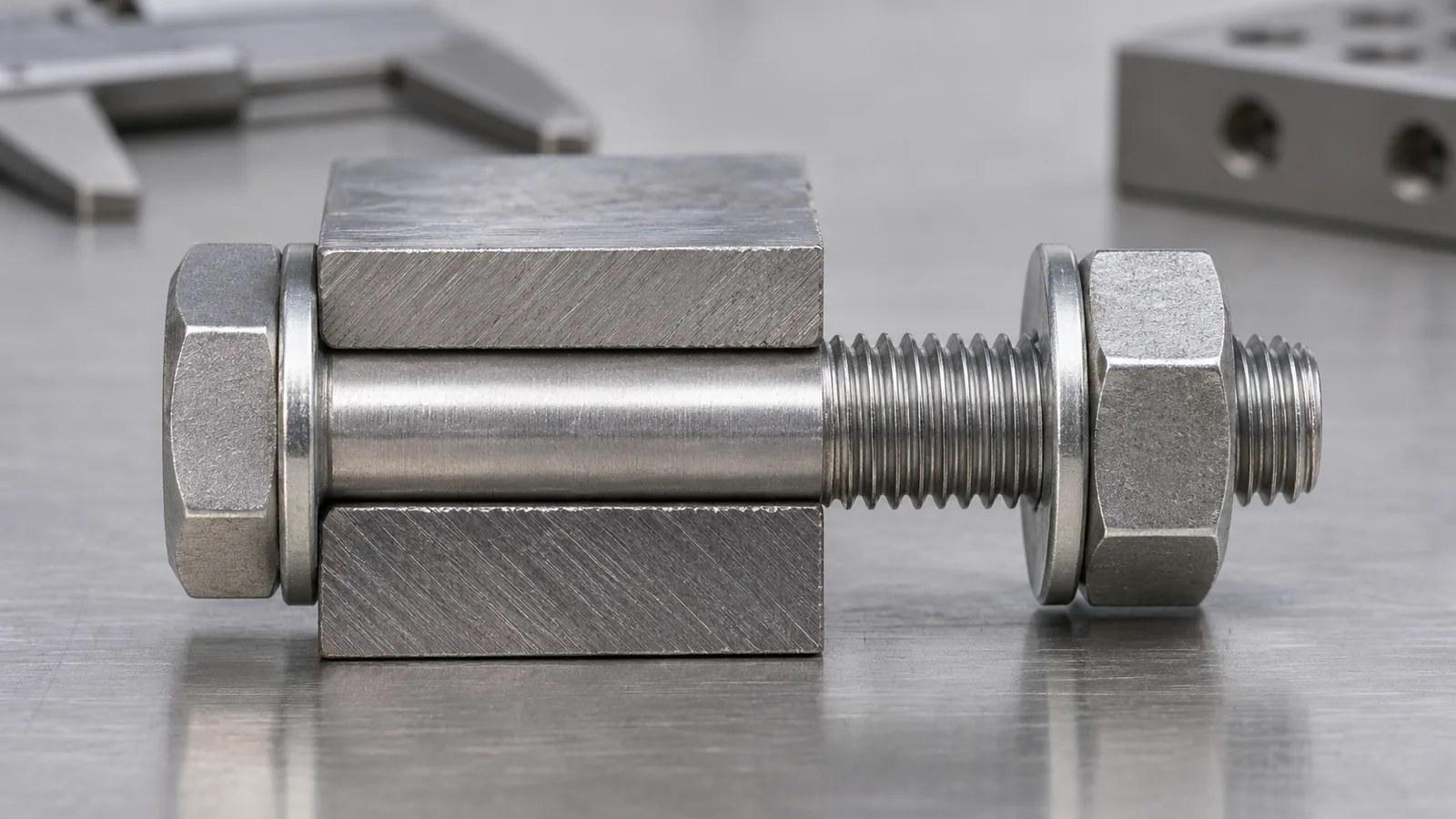
Bolt grip length can refer to more than one span, so identify what object is being measured and where the endpoints are. In a bolt product description, “grip” may name the unthreaded shank beneath the head. In a bolted-joint discussion, “grip” may name the stack of material clamped between the head-side and nut-side bearing regions. These spans need not be the same. A drawing should label the bolt-body span and the joint span separately, state how washers are treated, and keep thread length and overall bolt length as separate fields.
This distinction matters when an importer compares a catalog bolt with a bracket assembly or a buyer asks for a replacement. Changing the clamped stack can change the joint span while the bolt body stays the same. A different thread coverage can change the unthreaded body even when nominal overall length is unchanged. Do not assume that one grip value tells you the other, or derive an approved bolt design from a generic definition.
What Does “Grip Length” Mean?
The term is used in more than one context. A bolt supplier may use grip length for the unthreaded section under the head. A bolted-joint explanation may use grip for the combined material thickness held between bearing surfaces. When a document uses the word without naming its endpoints, the buyer should ask which meaning applies.
Define two spans:
- Bolt-body span: from the specified under-head bearing datum to the defined end of the unthreaded body.
- Joint span: between the defined clamping or bearing planes of the assembled parts.
The joint span may include washers if the controlling drawing says to include them. If washers are excluded, say so. The endpoint and inclusion rule are part of the measurement definition; a bare number is not enough.
| Term in the record | Object measured | Typical endpoints to state |
|---|---|---|
| Unthreaded shank/body length | The bolt itself | Under-head bearing datum to specified end of unthreaded body |
| Joint grip or clamped stack | The assembly stack | Head-side and nut-side bearing planes as defined |
| Overall bolt length | The bolt itself | The endpoints defined by the bolt type or governing source |
| Thread length | Threaded portion | Supplier or drawing-defined start and end |
| Thread engagement | Mating interface | Defined engaged thread region in the assembled joint |
These terms answer different questions. A product listing may have a “grip” field that describes the bolt’s unthreaded body, while a drawing note may describe the material stack. Preserve the source’s terminology and ask the supplier or engineer to clarify ambiguous use.
Why Can the Two Grip Spans Differ?
The bolt-body span belongs to the bolt. The joint span belongs to the assembled stack. If the stack thickness changes but the same bolt is used, the joint span changes while the bolt’s unthreaded body dimension remains unchanged. If the bolt design changes its thread coverage but keeps the same nominal overall length, the unthreaded body can change while the stack remains constant.
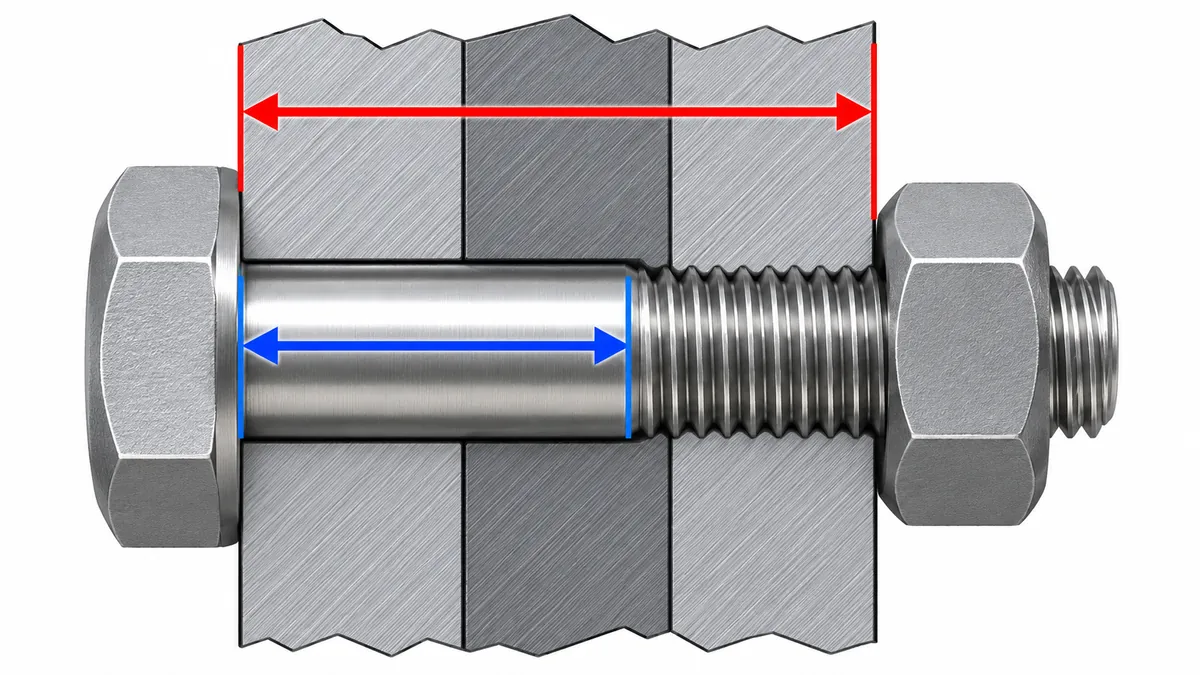
A two-change thought experiment illustrates the distinction:
| Change | Bolt-body span | Joint span |
|---|---|---|
| Add a layer to the clamped stack, keep the bolt unchanged | May remain the same | Changes because the assembly stack changed |
| Change the bolt’s thread coverage but keep its nominal overall length | May change | Can remain the same if the assembled stack is unchanged |
This table is a dimensional explanation only. It is not a fastener selection rule or a load design. It does not specify allowable runout, nut position, engagement, torque, shear plane or strength. Those choices require the actual design data and approval.
The two spans can be numerically equal in a particular assembly, but equality should not be assumed. The measurement endpoints may differ, and the assembly may include washers, spacers or other interfaces. A drawing that says “grip = X” without identifying the bolt-body or joint meaning can create a purchasing misunderstanding even when every number is copied accurately.
A Worked Example: Same Bolt, Different Stack
Suppose a drawing identifies one bolt and separately lists three clamped layers. The bolt-body span is defined on the fastener from its under-head reference to the specified end of unthreaded body. The joint span is defined across the material between the agreed bearing planes. If the product team adds a spacer between two layers but leaves the bolt unchanged, the bolt’s own body measurement does not change. The joint stack does change because the spacer becomes part of the assembly dimension if the drawing includes it between those planes.
Now consider the reverse case. The assembly layers and bearing planes remain unchanged, but procurement proposes another bolt with a different thread coverage. The joint span may remain the same, while the unthreaded body measurement differs. A purchasing record that has only one field named “grip” would not make clear which span changed. This is why the comparison should name the object and endpoints each time.
| Scenario | Fastener change? | Stack change? | Measurement to recheck |
|---|---|---|---|
| New washer or spacer added | No | Yes | Joint span and included-layer definition |
| Alternate bolt with different thread coverage | Yes | No | Bolt-body span, thread length and other supplier dimensions |
| Both alternate bolt and revised bracket | Yes | Yes | Both spans and the complete assembly drawing |
These are relationship examples, not recommendations for a particular joint. They do not say that a spacer is allowed, that the alternate bolt fits, or that either assembly meets a load requirement. They simply show how two measurements can change independently.
How Do Supplier Terms Affect the Comparison?
Supplier and technical sources may use “grip” differently depending on whether they describe the fastener or the assembled joint. A bolt product page can use grip for the unthreaded shank; an engineering discussion can use grip for the clamped region from head to nut. The reader should retain the context in which each definition appears rather than declare one usage universally correct in every document.
A current Portland Bolt FAQ uses grip in reference to the unthreaded portion of a bolt. The Purdue/Industrial Fasteners Institute publication describes the head-to-nut assembly region as grip while distinguishing overall length and thread length. Those source definitions illustrate the vocabulary difference. This article does not adopt a numerical rule from either source or apply a normative standard that was not read. If the buyer needs a dimensional limit, use the controlling fastener drawing or governing document for the selected product.
A supplier quote should therefore identify its source field and the endpoints. If the quote says “grip length” and the drawing uses “grip” for the assembly stack, ask the supplier to restate the bolt dimension using an unambiguous name such as unthreaded body length. Keep the original supplier terminology in the source record for traceability. Do not silently rename it and lose the definition that was quoted.
This care is especially useful when several vendors contribute to one project. One vendor may supply the fastener, while another provides the bracket or assembled product. Each party can use shorthand that makes sense within its own catalog. The buyer’s job is to connect the fields to the same project drawing and verify that the supplier is responding to the intended measurement.
How Should a Drawing Show the Measurement Endpoints?
When specifying bolt grip length, a dimension should identify what it starts from and where it ends. For the bolt body, the drawing should name the under-head reference surface and the endpoint of the unthreaded portion. For the assembly stack, identify the two bearing planes and state whether washers, spacers or other parts are included.
A clear drawing note can separate these fields:
- Bolt overall length, with its measurement convention.
- Unthreaded body length, with the bolt-side endpoints.
- Thread length, according to the selected fastener supplier or controlled drawing.
- Joint stack or grip thickness, with bearing planes and included components.
- Mating thread and engagement requirements, if specified by the design.
- Bolt part number and drawing revision.
This list does not prescribe values. It is a way to keep terminology from crossing between the component record and the assembly drawing. The product owner or engineer must define which fields control the application.
Washers are a common source of ambiguity. A washer can sit between the bolt head and clamped member or between the nut and another member. Whether it belongs in a reported joint span depends on the drawing’s definition. Do not apply a universal inclusion rule. Label the bearing planes and list the layers between them, including each washer only as the project instructs.
An illustrated section can show the two spans separately, but a diagram should not replace the written field names. If a supplier receives only a picture, the supplier may not know which number is controlled or how the buyer defines the endpoint. Use a dimensioned drawing and the complete part specification for procurement.
Koitor’s screw-length measurement guide addresses the separate question of how screw length is measured for under-head and countersunk designs. The distinction is relevant because bolt and screw length conventions may depend on fastener geometry; do not assume one generic endpoint applies to every head type.
Why Is “Overall Length Minus Thread Length” Not a Safe Formula?
The unthreaded body should not be calculated automatically by subtracting a catalog thread length from an overall length. A thread runout or transition region, supplier-defined endpoints and fastener construction can affect the measurement. The controlling source must define what each field means.
A fully threaded catalog description does not always prove that a particular part has no unthreaded transition or that every usable thread begins at the exact same plane. Likewise, a published “grip” number may use a product-specific definition. Keep the supplier’s own definition attached to its item rather than normalizing all entries to a guessed formula.
For a product comparison, record the item number, manufacturer, overall-length convention, listed thread length, listed grip definition and drawing source. If two catalogs use different definitions, flag the mismatch and request clarification. Do not silently combine fields from one product’s page with another product’s drawing.
The article’s two-span map is a way to avoid a vocabulary error, not a replacement for a standard or supplier specification. The research supporting this article includes technical explanations of bolt-body and joint-grip usage, but it does not provide a normative current standard or a numerical fit/load table. No formula or dimensional rule from an unread standard is claimed here.
How Should Washers and Other Layers Be Shown?
A washer is a separate component in the stack. Whether it is included in a joint-grip value depends on the stated bearing planes and the project definition. If a washer sits between the bolt head and the first clamped member, the drawing should make the head-side plane and washer placement visible. If one is placed on the nut side, show that layer as well. Do not treat washers as an invisible default thickness.
The same discipline applies to spacers, plates, brackets and coatings when the drawing treats them as part of the dimension being measured. The article does not assign a universal rule for which layers count. It asks the design owner to identify the planes and list the included components so the supplier’s quote and the assembly drawing refer to the same span.
If the joint is a stack of several parts, a cross-section or exploded view can help the buyer verify the sequence. Each part should be named, and the measurement arrows should start and end at explicit surfaces. A note can then state, “joint stack measured between these bearing planes; washer inclusion per this drawing.” The exact wording should follow the project, but the definition should not be left to an assumption.
What Does Grip Length Have to Do with a Hardware Assembly?
A bolt can join rack sections, bracket components or other metal hardware. The buyer may need to communicate both the fastener’s dimensions and the actual joint stack. A change to a bracket, washer, spacer or mating part can alter the stack without changing the bolt itself. Conversely, a fastener alternate can have another threaded/unthreaded boundary even if its overall length appears similar.
This is a documentation issue that can affect sourcing coordination. If a buyer says “the grip is too long,” the supplier may need to know whether the buyer means too much unthreaded shank or too much material in the clamped stack. These are different observations and may point to different component or drawing questions. State the part and the endpoints.
Koitor’s metal storage rack joint-design guide covers a broader product-assembly topic. The separate types of bolts article addresses fastener categories. This article remains focused on the two meanings of grip and how to label them; it does not provide structural approval.
When a buyer reviews a proposed alternate, compare the actual bolt and joint separately:
- Does the bolt body match the source definition?
- Does the assembly stack match the approved drawing?
- Are washers or spacers included according to the drawing?
- Are the thread length and engagement fields from the same supplier item?
- Is the drawing revision current?
- Has the design owner approved any different component or stack?
Do not turn these questions into an implied load calculation. A correct dimension label does not by itself prove that a joint is safe or suitable.
What Should Buyers Avoid When Specifying Bolt Grip?
Do not use “grip length” without defining whether it means the unthreaded bolt body or the clamped joint span.
Do not assume the bolt-body span equals the joint stack. They are different objects and may have different endpoints.
Do not assume washers are always included or excluded. Follow the controlling drawing.
Do not infer the unthreaded length by subtracting thread length from overall length unless the exact source defines those endpoints and the design owner accepts the method.
Do not infer that a fully threaded label proves zero unthreaded transition or a certain engagement condition.
Do not set nut position, thread engagement, runout, torque or load requirements from this article. Those values require actual engineering data.
Do not approve a substitute by matching nominal overall length alone. Compare the bolt’s geometry and the assembled stack against the project documentation.
What If the Drawing and Quote Use Different Words?
Keep both source phrases, then request clarification before approving the order. A supplier can restate its catalog measurement with defined endpoints while the buyer retains the released drawing term. This makes the comparison traceable and prevents a quote label from silently changing the engineering meaning.
Buyer Checklist for Bolt Grip Review
- Identify whether “grip” means bolt-body span or joint stack.
- State the exact endpoints and reference planes.
- Identify the bolt part number and drawing revision.
- Keep overall length, unthreaded body, thread length and engagement in separate fields.
- List washers, spacers and interfaces in the joint stack.
- State whether those layers are included in the reported joint dimension.
- Compare the proposed fastener with the controlling supplier specification.
- Confirm the actual mating components and their revisions.
- Route any dimensional or structural change to the design authority.
- Do not infer torque, load or thread engagement from a generic grip value.
Why Do Technical References Use “Grip” Differently?
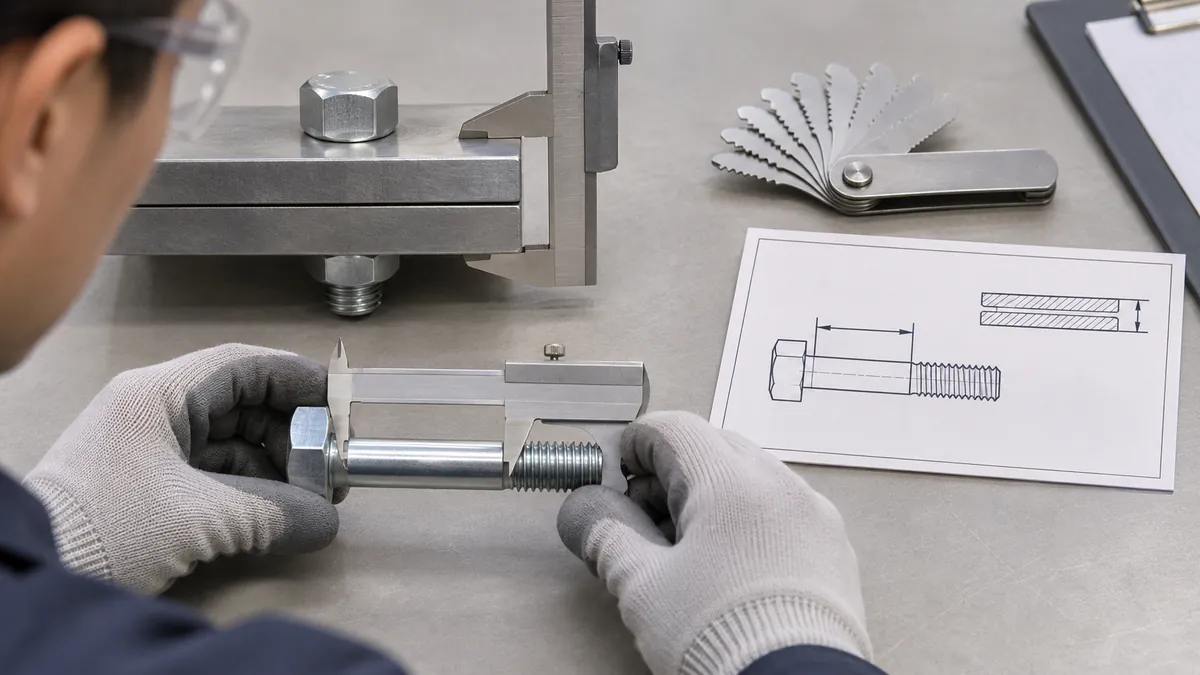
الـ Portland Bolt FAQ uses grip for the unthreaded shank portion in its discussion of fully threaded bolts. A Purdue University publication co-authored with the Industrial Fasteners Institute uses grip for the assembled region between the head and nut. The terminology can therefore refer to a component dimension or an assembly span, depending on context. This comparison explains why a drawing field labelled only “grip” can be ambiguous; it does not establish a universal bolt formula or a design rule.
On a supplier drawing, label the fastener’s unthreaded-body endpoints and the joint’s clamped bearing planes separately. State whether washers or spacers belong to the specified stack and identify the controlling revision. If the original record uses “grip length,” ask the designer or supplier which object and endpoints were intended before comparing a substitute. Do not calculate one span by subtracting thread length from nominal bolt length, and do not use either span alone to infer engagement, strength or load capacity. The cited references support the difference in terminology, while project-specific engineering approval remains necessary.
For adjacent fastener-stack topics, see Koitor’s washer types guide, ، و nut types guide, ، و rivet versus bolt guide.
الأسئلة الشائعة
Does bolt grip length mean the unthreaded shank?
It can. In a bolt product description, grip may name the unthreaded body beneath the head. In a joint discussion, it may mean the stack clamped between the bearing regions. Confirm which definition and endpoints the source uses.
Is joint grip the same as bolt-body length?
Not necessarily. The joint span measures the assembly stack, while the body span measures part of the bolt. They can differ and may use different endpoints.
Should washers be included in the grip measurement?
Follow the controlling drawing. It should state which bearing planes define the joint span and whether washers are included.
Can I calculate grip as overall length minus thread length?
Do not assume so. Transition or runout and supplier-defined endpoints may affect the result. Use the exact source definition.
Does a fully threaded bolt have no unthreaded region?
A catalog label alone may not establish the exact transition or measurement boundary. Confirm the selected item’s supplier drawing or specification.
Does grip length determine how much load a bolt can carry?
No. This article explains terminology and dimensional endpoints. It does not provide a load design, torque value or engineering approval.
What should I send a supplier when requesting a bolt replacement?
Send the controlled drawing, part number, revision, actual joint stack and the defined bolt and joint measurement endpoints. Identify any washers and mating components.
Why should the buyer distinguish bolt grip from joint grip?
It prevents a supplier from changing the wrong dimension. One describes the bolt body; the other describes the assembled material span.
Record the clarification in the purchase file and retain the supplier drawing that defines the bolt-body measurement. Keep the joint-stack dimension tied to the assembly revision.
If either source remains ambiguous, mark the field pending and ask the drawing owner to resolve it before release.
This keeps the component and assembly definitions separate for later purchasing reviews.
Remain distinct.
اعمل مع شركة «كويتور» للأدوات
Reviewing a Fastener or Metal Hardware Joint?
Share the current drawing, fastener part number, mating components and defined stack dimensions. Koitor can discuss the confirmed bathroom and home-storage hardware scope and the project inputs needed for a component review.
OEM / العلامة التجارية الخاصة
حوّل دليل التوريد هذا إلى موجز منتج
يرجى إطلاعنا على المنتج المستهدف، والحجم، والتشطيب، وكمية الطلب، ومتطلبات التغليف. وسيتلقى فريقك تقييمًا عمليًّا لإمكانية التصنيع قبل تقديم عرض الأسعار.


 English
 Español
 Português
 Français
 Deutsch
 العربية