
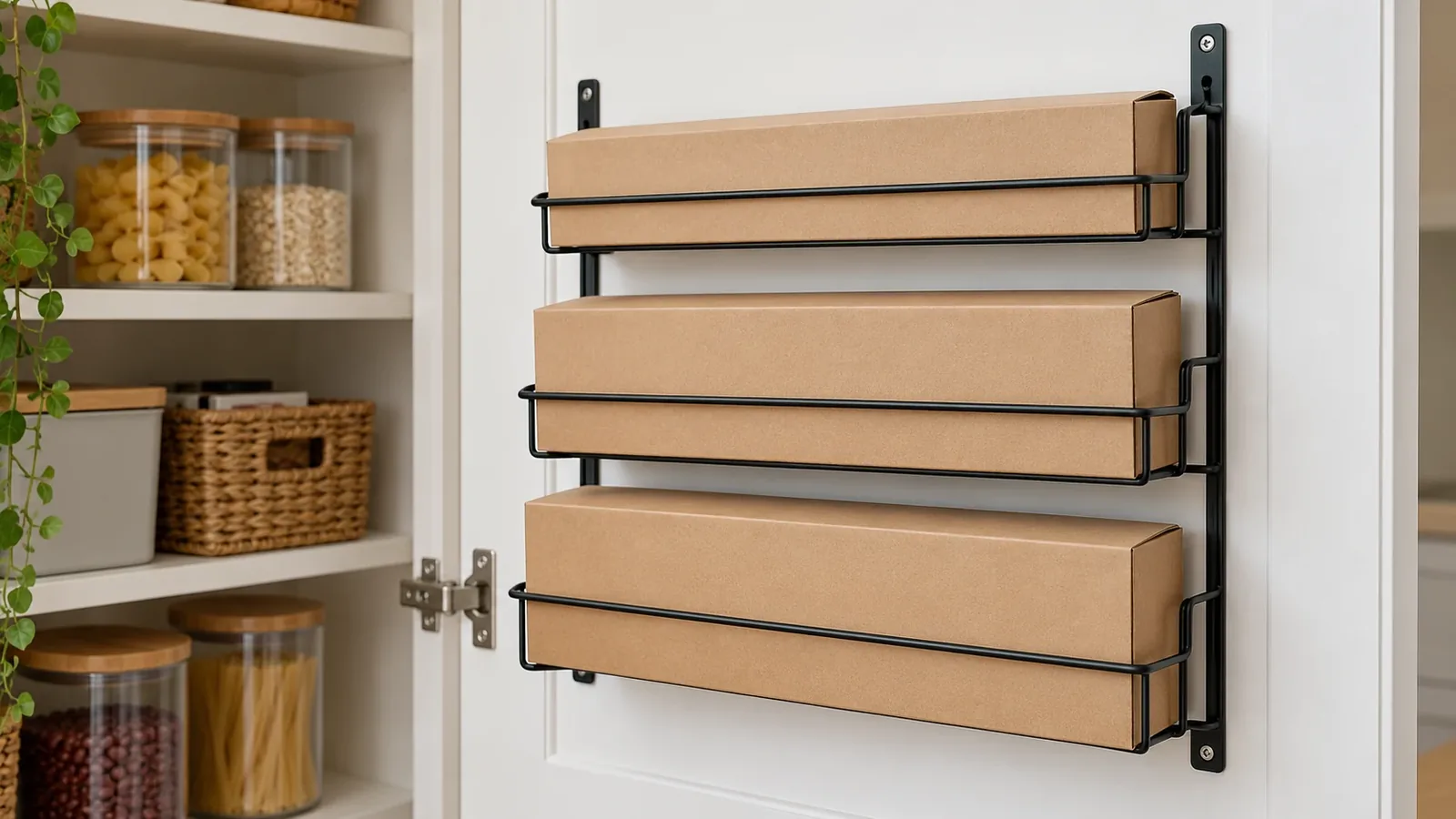
A kitchen wrap holder should be specified around the cartons buyers actually intend to sell with it, not around an assumed universal box size. Before requesting a quote, record each target carton’s outside width, height, depth, opening and cutter position, then confirm that the box can be loaded, retained, dispensed and replaced in the intended cabinet or pantry-door location. A sample that merely fits on a table has not yet passed the product-fit check.
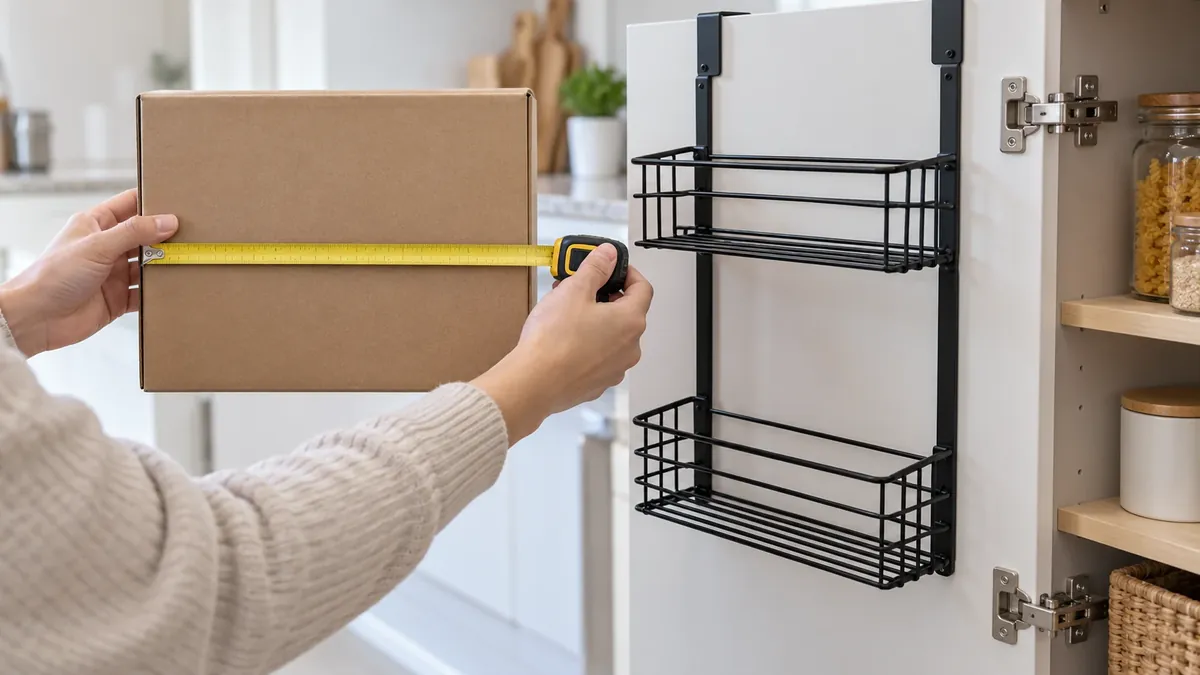
What problem does this guide help buyers solve?
Retail listings often make a wrap organizer look simple: a metal or wire holder keeps foil, cling film or freezer bags together. For an importer, the hard part is turning that broad concept into a defined product envelope that works with a particular assortment. Cartons differ by market, brand, roll length, family-size format and package design. The opening may be on a long face or short face; a cutter edge may project beyond the carton; and the box can become softer after repeated use.
The rack also has to work in context. A pantry shelf, cabinet interior and hanging door have different available depth and movement. A unit may hold a carton yet block a nearby shelf, interfere with a hinge, prevent the door from closing or make the cutting edge awkward to reach. Those are not cosmetic details. They determine whether a buyer can list the product confidently and whether a sample represents the final customer use.
A useful brief therefore names the carton set, installation location and intended dispensing direction. “Fits standard boxes” is not an acceptance criterion unless “standard” is defined by dimensions and a named reference set. Likewise, a generic maximum width does not establish that every carton with a smaller width will work: carton height, depth, opening location and cutter geometry can still cause interference.
The buyer’s aim is not to promise compatibility with every wrap product. It is to choose a sensible target range, test representative formats and state the fit boundaries clearly. That is a more defensible specification and a more useful retail promise.
Build a carton reference matrix before the RFQ
Collect real cartons from the intended target market. Include the formats that matter commercially, such as foil, plastic wrap, baking paper or freezer-bag cartons only if the design is meant to hold them. Do not infer that all boxes share one profile because their nominal widths look similar.
For every reference carton, record:
- Overall length, width and depth, including folded tabs and projecting cutter edges.
- The dispensing opening’s position and usable opening size.
- Cutter type and location, and the direction the user’s hand approaches it.
- Carton mass when new, plus any relevant mass change as a roll is consumed.
- Whether the package body is rigid, crushable or prone to opening at a glued seam.
- How the carton is inserted and removed from the holder.
- Which side should face outward when installed.
- A clear sample identifier, brand-independent where the information is shared externally.
Photograph the cartons next to a ruler and retain one physical reference of each format. A buyer should also measure more than one package when packaging variation is possible. A dimension copied from a web listing may omit a flap, handle or cutter lip that determines actual interference.
For an adjustable rack, define both the adjustment range and the usable limits. A range that is technically wide enough may still leave too little contact area or allow the carton to shift. For a fixed rack, state the supported envelope and identify the exact carton formats used for pass/fail approval. Include a tolerance or fit allowance only when the buyer and supplier agree how it will be measured.
The table below helps convert loose product language into sample criteria.
| Buyer requirement | What to check | Why it matters |
|---|---|---|
| Carton compatibility | Outside envelope and protrusions for each reference box | Nominal width alone misses depth, height and tabs |
| Dispensing access | Opening, cutter orientation and hand clearance | A retained carton may still be awkward or unusable |
| Retention | Carton movement during ordinary pull-off and replacement | Prevents the box sliding or tipping during use |
| Location fit | Door, hinge, shelf and adjacent-item clearance | The organizer must fit the actual installation envelope |
| Refill | Loading path and removal effort | Replacing an empty carton should not require dismantling nearby storage |
Specify rack geometry around loading and use
The rack’s width and depth should follow the carton matrix, while its rails, lips or stops should retain the box without covering the dispensing path. Buyers should identify which faces of the carton must remain accessible. If a user needs to slide the box forward to reach the cutter, specify the travel space and confirm the rack does not trap the box.
Ask the supplier to explain how the carton is supported. A design might use side rails, a base, a front stop, a retaining loop or another arrangement. The exact structure is a design choice; a buyer should avoid prescribing an unneeded geometry before the supplier reviews the intended function. Instead, provide a drawing, reference carton, installation limits and acceptance outcomes.
For a pantry-door concept, measure the panel thickness, usable flat area, hinge-side clearance and door swing. Check the organizer with the door open and closed, and consider nearby shelves or walls. A rack that mounts on a door may need a defined hook or bracket interface, but do not assume a particular attachment method without confirming the product design. For an in-cabinet product, record shelf position and the route by which the carton is inserted.
Cutter interaction deserves a separate sample check. A metal edge should not obstruct access to a carton’s built-in cutter, but the organizer itself should not be described as a cutting tool or as making cutting safer unless that has been specifically evaluated. Test the real carton in the intended orientation. Pull film or foil as intended, observe whether the carton remains in place and confirm that the packaging does not tear or collapse under the tested action. This is a usability observation on the sample, not proof of universal performance.
Evaluate the use cycle, not just first insertion
A new carton is often at its stiffest and fullest. A complete review should consider initial loading, repeated dispensing, near-empty use and replacement. The package can lose stiffness as material is used, and a loose core or damaged edge may change how the carton behaves. The buyer does not need to simulate every consumer’s technique; the goal is to identify foreseeable fit and retention issues with a repeatable check.
Agree on a basic sample protocol. For each named carton, load it using the intended route, check whether tabs snag on rails, dispense material in the expected direction and observe movement. Repeat the check enough times to expose obvious shifting or a blocked opening. Near-empty behavior can be reviewed with a used carton or an agreed representation. Record what was tested rather than making a broad claim that the rack works with all brands.
If the carton must be held snugly, clarify how snug is acceptable. Excessive pressure can deform a paperboard box or make replacement difficult; too much clearance can allow movement. Define pass criteria in practical terms: the opening remains accessible, the box can be removed and reinserted as intended, and it does not leave the rack during the agreed ordinary-use check. Avoid unsupported load ratings or durability claims.
A useful sample review includes both product and packaging. Confirm the rack’s finish and edges on the buyer-facing surfaces, then check that the carton can be packed without scratching or bending the rack. If the item has removable parts, document how they are protected and whether the buyer or end customer needs to assemble them. Any packaging test should match the distribution route and applicable packaging requirements; an image or a single bench drop is not evidence that transit damage cannot occur.
Common sourcing mistakes
Using “standard carton” without a reference. Suppliers and buyers may picture different market formats. Send dimensioned examples and label the boxes used during approval.
Checking width only. Width is just one axis. Height, depth, flaps, cutter projection and the opening face can control fit.
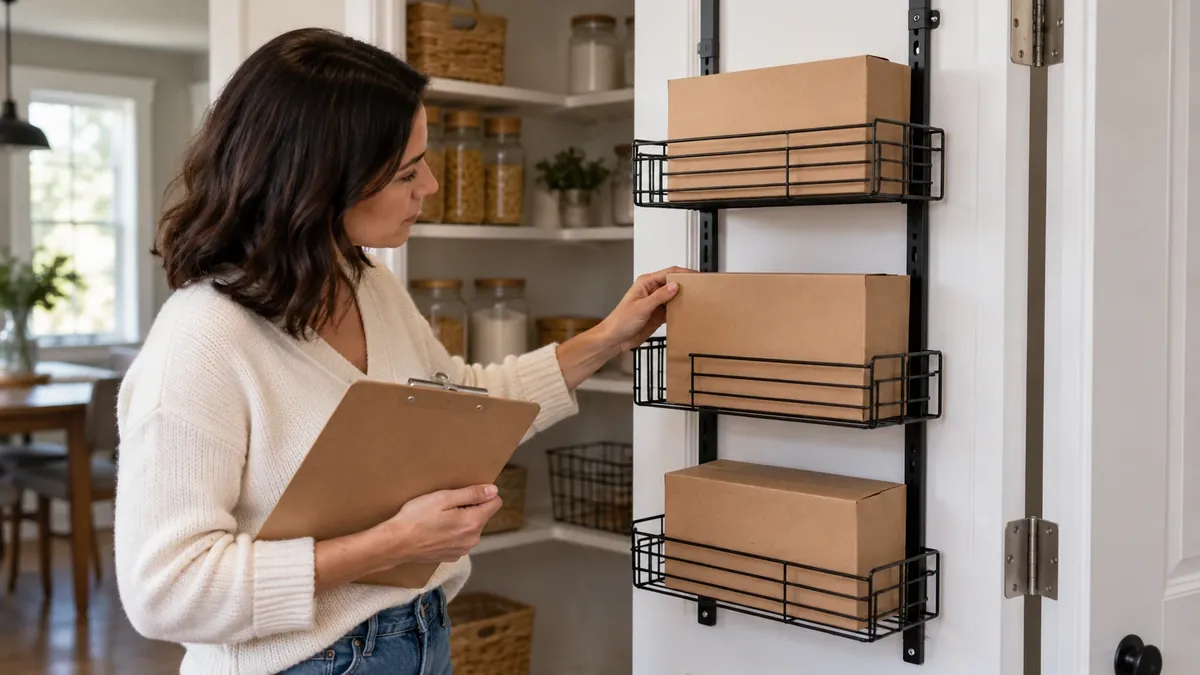
Approving a rack on a tabletop only. A rack that works in isolation may collide with a hinge, shelf, wall or cabinet frame. Review it in the intended installation position.
Ignoring the route of use. A carton can fit while its dispensing opening faces the wall or while a hand cannot reach the cutter. Approve the final orientation and access path.
Overconstraining the drawing too early. A buyer who specifies every wire location before discussing function may lock in a costly geometry that offers no customer benefit. State boundaries and performance observations first, then review the proposed construction.
Treating a competitor product as proof of compatibility. Another holder’s stated dimensions only describe that product and the formats its supplier documents. They do not establish that a different rack has the same usable envelope.
Assuming a metal frame solves every failure. The carton itself can crush, tear or open; mounting and installation can also affect use. Separate the rack’s role from the packaging’s behavior, and assign responsibility clearly.
What should the RFQ include?
A concise quotation request can still include the information needed for a meaningful response:
- Intended product type and mounting or placement method, if already selected.
- Dimensioned carton matrix with physical samples or clear photographs.
- Required supported range and any excluded formats.
- Installation envelope, including door thickness, available depth and nearby obstacles.
- Required material and finish, if known; otherwise ask the supplier to propose options for review.
- Expected quantity by version, target packaging and labeling needs.
- Sample quantity, sample timing assumptions and the approval sequence.
- Inspection points for carton fit, retention, cutter access, finish and packaging.
- Drawings or product references that the buyer has permission to share.
- Target market and any retailer-specific packaging or labeling requirements.
Ask the supplier to list assumptions and exclusions in the quotation. For example, does the quote include one fixed carton profile, an adjustable holder or more than one version? Does it include a sample using buyer-provided cartons? Which packaging details are provisional? Clear assumptions make supplier quotes more comparable than a price alone.
After quotation, compare the proposed design against the same carton matrix. If a supplier recommends changing rail spacing or the loading path, capture the revision in an updated drawing and sample record. The approved sample should identify the revision, finish, components and included hardware so that later production checks reference one controlled version.
How can an OEM factory support the review?
A specialized metal hardware manufacturer can review drawings or physical references and discuss how dimensions, bends, joints, finish access and packaging affect a proposed rack. This is useful when the buyer has a defined use case but wants feedback on whether the chosen structure can be produced and checked consistently. It does not mean the factory has an existing wrap-holder SKU or has validated every target carton.
Koitor’s documented position is as a family-owned custom metal hardware factory with experience in bathroom and home-storage hardware, drawing- and sample-based customization, and flexible small-batch production. For an adjacent product concept, the buyer should first confirm project fit, material and process scope, minimum order assumptions, purchased components, packaging responsibility and sample feasibility. Do not assume that a product category is already in production simply because the manufacturing processes appear related.
A practical development sequence is:
- Share the buyer question, installation context and carton matrix.
- Ask for an initial design and manufacturing review, including open assumptions.
- Confirm which features are critical to fit, retention and appearance.
- Review a sample against the named cartons and record observations.
- Resolve changes in a controlled drawing or specification.
- Agree the production-intent sample, packaging and inspection points before any order release.
The supplier can identify manufacturing trade-offs, but the buyer remains responsible for deciding what carton range to claim, which market formats matter and what retail promise is appropriate. A sample approval should record both what passed and what was outside the evaluation.
For broader context on product development, see OEM home storage hardware و تصنيع رفوف تخزين مخصصة للمطابخ.
The kitchen wrap holder should also be checked against the approved drawing and the final pack-out configuration.
Buyer checklist before requesting a quotation
- Have we named and measured each target carton, including protruding cutter parts?
- Do we know which carton face and direction should be presented to the user?
- Is the organizer fixed or adjustable, and what usable range is required?
- Have we defined the installation location and measured its clearances?
- Can the cartons be loaded, dispensed and replaced without interference?
- Have we agreed how retention will be observed on a sample?
- Are material, finish, color and appearance expectations documented?
- Are packaging, labels and any assembly steps assigned?
- Does the sample record identify the drawing revision and carton references?
- Are exclusions and untested formats stated clearly?
- Do the target buyer and retailer require any specific labeling or packaging review?
- Have we asked for an RFQ response that lists assumptions instead of relying on an unqualified “fits standard boxes” statement?
الأسئلة الشائعة
What measurements should I provide for a kitchen wrap holder?
Provide the carton’s overall length, width and depth, including tabs and cutter projections, plus the dispensing-opening location and preferred orientation. If the rack will be installed inside a cabinet or on a door, provide that available envelope and relevant clearance measurements as well.
Can one rack fit every foil and plastic-wrap box?
That should not be assumed. Carton dimensions and opening designs vary. Buyers should define a tested range using representative packages and clearly identify formats that were not evaluated.
Should the rack grip the carton tightly?
The design should retain the carton during the agreed use check while still allowing loading and replacement. A buyer should evaluate both movement and package deformation rather than specifying “tight” without a measurable or observable criterion.
Does a sample prove the production run will fit?
A sample confirms only the specific version and cartons tested. The buyer should record the drawing revision, materials, finish, carton references and acceptance observations, then agree how production will be checked against that approved version.
Work with Koitor Hardware
If you are developing a metal storage concept and have a defined carton set, share the dimensions, intended installation and sample requirements for a project-fit discussion. Koitor can review drawings or physical samples for a custom metal hardware project; current product scope and feasibility should be confirmed before assumptions are made.
Discuss Your Kitchen Wrap Box Racks Specification
OEM / العلامة التجارية الخاصة
حوّل دليل التوريد هذا إلى موجز منتج
يرجى إطلاعنا على المنتج المستهدف، والحجم، والتشطيب، وكمية الطلب، ومتطلبات التغليف. وسيتلقى فريقك تقييمًا عمليًّا لإمكانية التصنيع قبل تقديم عرض الأسعار.
 English
 Español
 Português
 Français
 Deutsch
 العربية