
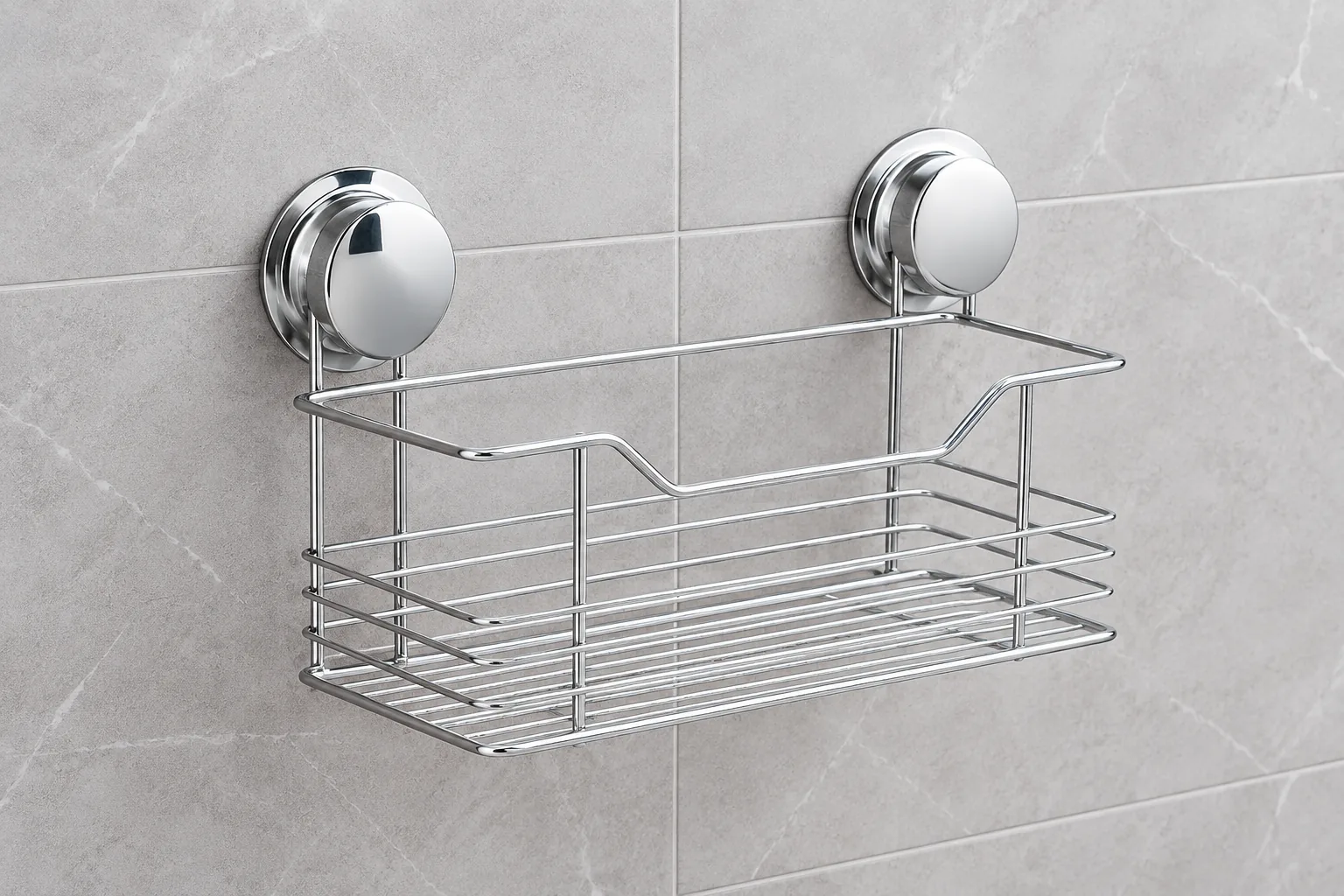
A suction cup bathroom accessory durability test plan should define the exact product, both mounting points, representative wall surfaces, installation method, use conditions and observations before anyone discusses a performance claim. For an importer, the useful outcome is not a dramatic demonstration; it is a repeatable way to decide whether a particular sample and specification are ready for a controlled OEM order. Agree the method and review criteria with the supplier, document deviations, and keep marketing statements separate from unverified test ideas.
This guide uses a dual-suction chrome wire basket as a concrete example. Its two circular mounts support one basket, so the review must consider left-to-right alignment, both cup interfaces and the complete metal frame. A single-cup illustration or inspection would describe a different product. The same planning logic can be adapted to other bathroom hardware only after its structure, mounting system and intended surfaces are defined.
What Should a Buyer Define Before Planning Durability Checks?
Start with a controlled product definition, not with a target number. A suction cup bathroom accessory durability test plan for a basket needs a drawing or approved sample, a component list, the intended installation surface and a record of what the buyer expects the product to do. Without those inputs, two teams can run apparently similar checks on materially different assemblies and produce conclusions that cannot be compared.
Describe the complete unit: basket dimensions, wire or tube sections, welded joints, finish, left and right mount locations, rubber suction components, bases, covers and any protective pack. Identify which dimensions affect fit and alignment. For a dual-mount basket, record the center-to-center mount spacing and the relationship between the mount centers and the basket frame. These are more useful controls than a generic statement that the unit “looks straight.”
Define the surface as carefully as the hardware. A smooth glazed ceramic tile sample may be one review surface, but that does not establish performance on textured tile, grout, painted plaster or stone. Keep the surface sample or its documented specification with the test record. Note visible texture, joints, cleanliness and whether the sample is flat. If a buyer intends to sell into several wall environments, make the planned review a matrix of specific surfaces rather than a single broad compatibility claim.
Installation is another input. Record cleaning and drying steps, how the cup is seated, whether a cover is tightened or pressed, any waiting period and how the basket is oriented. The exact steps must come from the intended product instruction, not from an improvised laboratory routine that consumers will never follow. A future instruction change should trigger a review of the earlier observations.
Finally, define the buyer decision. Is the concern cup retention after repeat installation, basket distortion in ordinary handling, corrosion appearance after damp use, component separation during cleaning, or packaging damage before installation? Those are different questions. Prioritize the few that matter to the SKU and its retail promise. The no-drill bathroom accessories manufacturing page provides a relevant product-development context for this discussion.
Which Conditions and Comparisons Belong in the Plan?
Use a test matrix that makes samples, conditions and observations visible. A matrix is a planning document, not evidence that any sample has passed. It helps a buyer and factory agree what to review before samples are prepared, and it prevents a later change in product or wall sample from being overlooked.
| Review dimension | What to specify | Why it matters |
|---|---|---|
| Product configuration | Drawing revision, component list, finish and packaging revision | Results must belong to an identifiable SKU |
| Dual-mount geometry | Left and right cup positions and frame alignment | Uneven seating can change how the basket meets the wall |
| Wall surface | Named sample, flatness and visible texture | One surface cannot stand for every bathroom wall |
| Preparation | Cleaning, drying and installation instruction used | Different preparation changes the condition being reviewed |
| Use sequence | Handling, removal, reinstallation and observation points | Durability concerns often appear after repeated handling |
| Recording | Photos, condition notes, component and sample identification | Buyer and factory can discuss the same observation |
Choose a representative sample range. A pristine prototype may be useful for early geometry, but an OEM decision should also consider production-intent material, finish, rubber component and packaging. If a component supplier or assembly detail changes, treat it as a new configuration. The earlier observation does not automatically transfer to the revised product.
Separate screening from approval. A quick internal comparison can expose a poor fit or obvious handling problem. A buyer-approved protocol, however, should state sample identification, preparation, observation timing, recording method and who decides whether the result is acceptable. Do not turn a convenient internal trial into a published load, lifetime or universal-surface claim.
For a dual-suction basket, inspect both mounting sites before and after each agreed handling sequence. Check whether one cup has a different seating condition, whether the frame twists, and whether a cover or connection changes position. Also inspect the basket itself: bent wires, rough joints or shifted rails may cause complaints even when both mounts remain in place. Durability is a system question, not just a rubber-cup question.
Make any proposed exposure condition explicit. Dampness, cleaning products, temperature changes and storage time may be relevant to a buyer’s intended market, but the plan should not assume that every chemical or extreme environment is representative. If the buyer needs a formal claim, a project-specific method and supporting evidence must be agreed separately. Koitor should not be described as a certified testing laboratory, and a blog image is not a test report.
How Should Samples Be Installed, Observed and Recorded?
A repeatable sequence is more valuable than an impressive-looking demonstration. Begin by checking the sample against its drawing and parts list. Confirm the two circular suction mounts, their left-to-right spacing, the basket frame, visible finish, and all supplied components. Record any difference before installation so that an assembly defect is not later mistaken for a surface issue.
- Identify the product revision, individual sample and wall sample in the record.
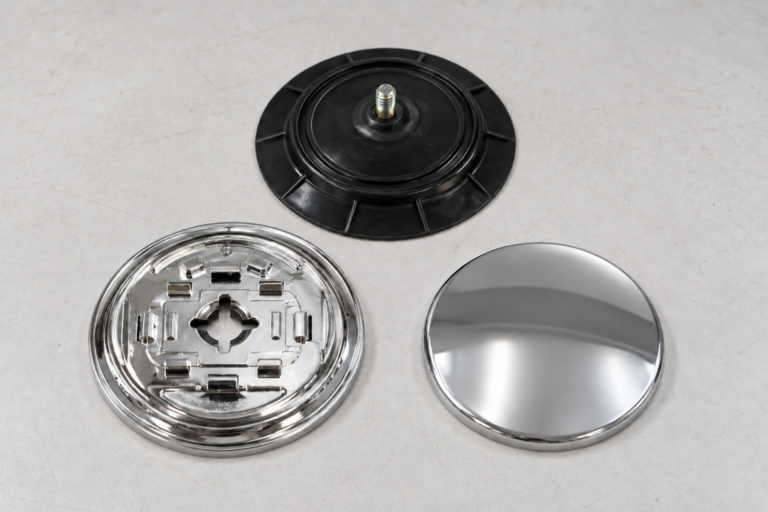
- Photograph the clean, uninstalled cup faces, bases, covers and basket connections.
- Prepare the wall using the intended buyer instruction and note any deviation.
- Install both mounts in the specified order, checking that the basket sits squarely.
- Observe the initial condition from the front, side and below; record gaps or tilt.
- Run only the handling or use sequence agreed for this project.
- At each planned point, record the condition of both cups and the basket frame.
- If removal and reinstallation are part of the use case, document the cleaning and reseating steps.
- Inspect the final parts and pack a retained sample with its record.
Describe observations in neutral terms. “Left cup edge lifted after reinstallation on sample tile A” is more useful than “failed badly.” A dated photograph with a scale or reference can help, but it should not replace a written explanation of the setup. If a sample is moved, cleaned or reassembled during review, mark that event. Otherwise a later reader may interpret two different states as one continuous test.
Record which parts were inspected together. The rubber cup, base, chrome front cover and basket connection can each influence the assembly. A loose cover, a mis-seated support wire or a damaged rubber edge may produce a similar outward symptom but require different corrective action. If the cause is unclear, preserve the sample for joint review rather than forcing an immediate conclusion.
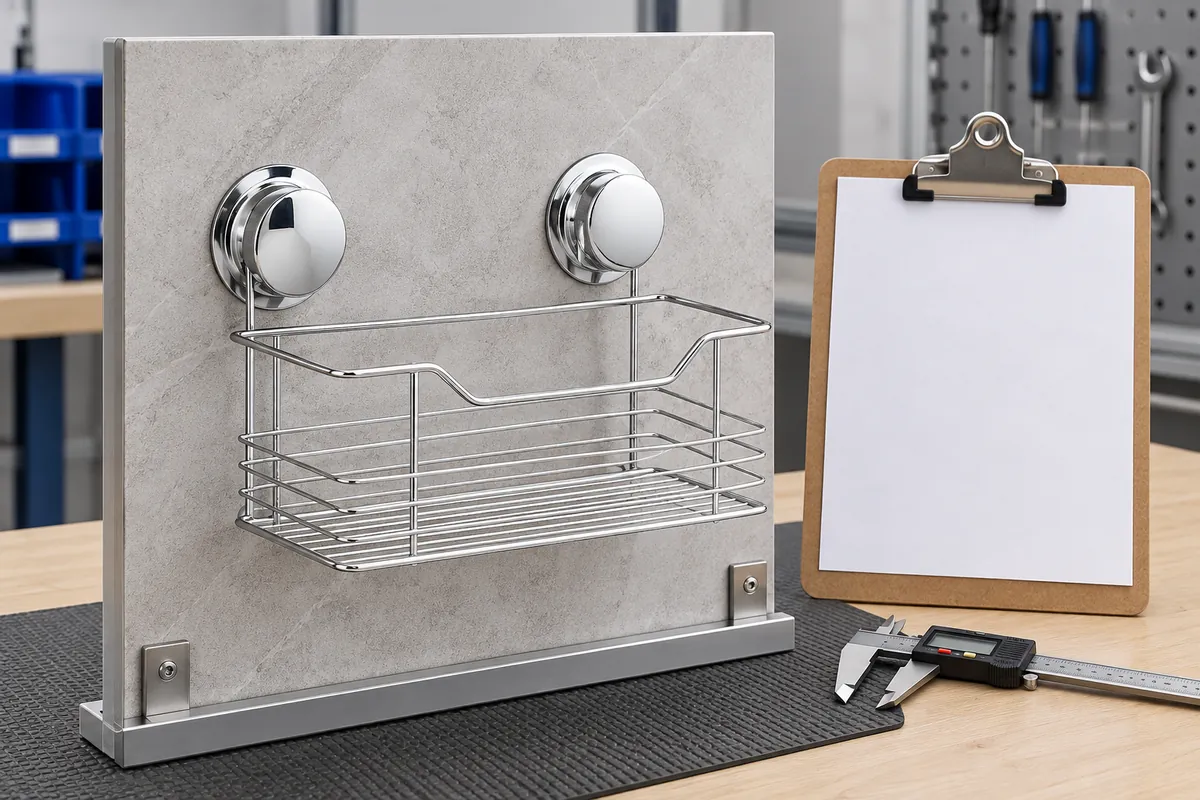
Do not let the photograph define an unapproved criterion. The pictured basket and inspection sheet illustrate a buyer workflow; they do not prove retention, load capacity or suitability for a particular surface. Actual acceptance criteria should be written in the buyer’s project specification and reviewed before any commercial claim is made.
What Are Common Mistakes in a Suction Durability Plan?
The most common mistake is starting with a marketing claim and designing a demonstration to match it. A sourcing decision should begin with the product’s intended use and credible failure modes. Marketing language can be considered only after the relevant method and evidence exist. This protects the importer from treating an attractive sample photograph as technical proof.
Another mistake is losing product identity. Testing a single-cup accessory does not verify a two-cup shower basket. The wider basket introduces mount spacing, frame alignment and load distribution questions. Even two baskets that look similar may use different cup materials or base interfaces. Put the drawing revision and component identifiers on every record.
Do not compare different wall samples without labeling them. A result on smooth glazed tile is not a general result for textured ceramic, natural stone, grout or painted walls. Likewise, a result after meticulous cleaning may not represent a consumer instruction that omits cleaning. Keep preparation and surface type visible in the review sheet.
A third error is mixing failure modes. A basket that tips because a support wire bends calls for a different response than a cup that loses seal. A polished cover that scratches in retail packing is a packaging issue, not a mounting result. Record the symptom and the part affected before choosing a corrective action.
Buyers also sometimes specify exact performance targets before they have agreed the use case. An arbitrary duration or load figure can drive the wrong product design and create a claim that is hard to defend. Decide first what the accessory is meant to hold, where it will be installed and how the buyer intends to describe it. Then agree a suitable review method with people responsible for product, quality and retail copy.
Finally, avoid approving a prototype and silently changing it for bulk production. A different rubber component, wire section, finish or packaging insert may alter the product being supplied. Revisit the relevant checks after a change; do not assume the earlier observation remains applicable. Document the reason for the change, the new revision and the person who approved it.
How Can Koitor Support an OEM Validation Workflow?
Koitor Hardware can help convert a buyer’s drawing or physical sample into a manufacturable bathroom storage accessory, then discuss which product features should be controlled during sampling and production. Koitor is a family-owned custom metal hardware factory, not a certified testing laboratory. Its practical contribution is direct discussion of the basket structure, welding points, finish, mounting-component fit, assembly and packaging preparation.
For a dual-suction chrome basket, begin with the basket and two-mount geometry. The wire frame should give both mounting points a consistent position relative to the back rail. During sample review, the buyer and factory can check whether the base connection seats as intended, whether both covers align visually and whether the basket remains square. Forming, welding, grinding, polishing and assembly decisions can be reviewed against those controlled features.
Ask for a production-intent sample after the drawing, components and finish are confirmed. Samples usually take 5–7 working days when design and materials are settled, but timing depends on the project. Bulk production often takes 4–6 weeks depending on quantity, complexity, materials, finish and packaging; neither figure should be treated as a guarantee. MOQ can start from 100 pieces for some structures, subject to the same project variables.
The buyer can supply a draft validation matrix and ask Koitor to identify manufacturing questions. Does the proposed basket allow consistent mount alignment? Could a wire joint obstruct inspection or cleaning? Will packaging protect the rubber faces and polished covers? Are the two cups the same specification? Those questions are within practical OEM development even when final performance criteria remain the buyer’s responsibility.
Use a controlled approval loop: drawing, sample, buyer observation, revised drawing if needed, and retained approved sample. Keep the suction cup bathroom accessory durability test plan and the تصنيع حاملات أدوات الاستحمام حسب الطلب discussion tied to the actual basket geometry rather than generic suction claims. A small-batch trial order can help a buyer check assembly and packing consistency before expanding an assortment, provided the approved specification is clear.
What Should Be in the Buyer Handoff Checklist?
The handoff pack should allow purchasing, quality and the factory to identify one exact product configuration. It should also say what remains unverified. A practical no drill hardware validation plan does not need to look like a formal laboratory report, but it must not hide open decisions.
- ☐ Product title, SKU, drawing revision and approved sample are identified.
- ☐ The basket has two specified suction mounts, left and right, with controlled spacing.
- ☐ Rubber cup, base, chrome cover and basket connection are listed separately.
- ☐ Material and finish descriptions match the approved sample.
- ☐ Each wall sample and its visible surface condition are recorded.
- ☐ Installation, cleaning and reinstallation instructions are attached.
- ☐ The observation sequence, record format and review owner are agreed.
- ☐ Basket and mount observations are recorded separately.
- ☐ Packaging keeps polished surfaces and rubber faces protected.
- ☐ Retail language is limited to what the available evidence supports.
- ☐ Any component substitution triggers a documented buyer review.
Before releasing a purchase order, compare this pack with the quotation. Confirm whether the quoted unit includes both mounts, covers, instructions, protective materials and the stated retail pack. A quotation missing one component is not comparable with a complete-unit quotation. Ask who supplies each part and which change procedure applies if a part becomes unavailable.
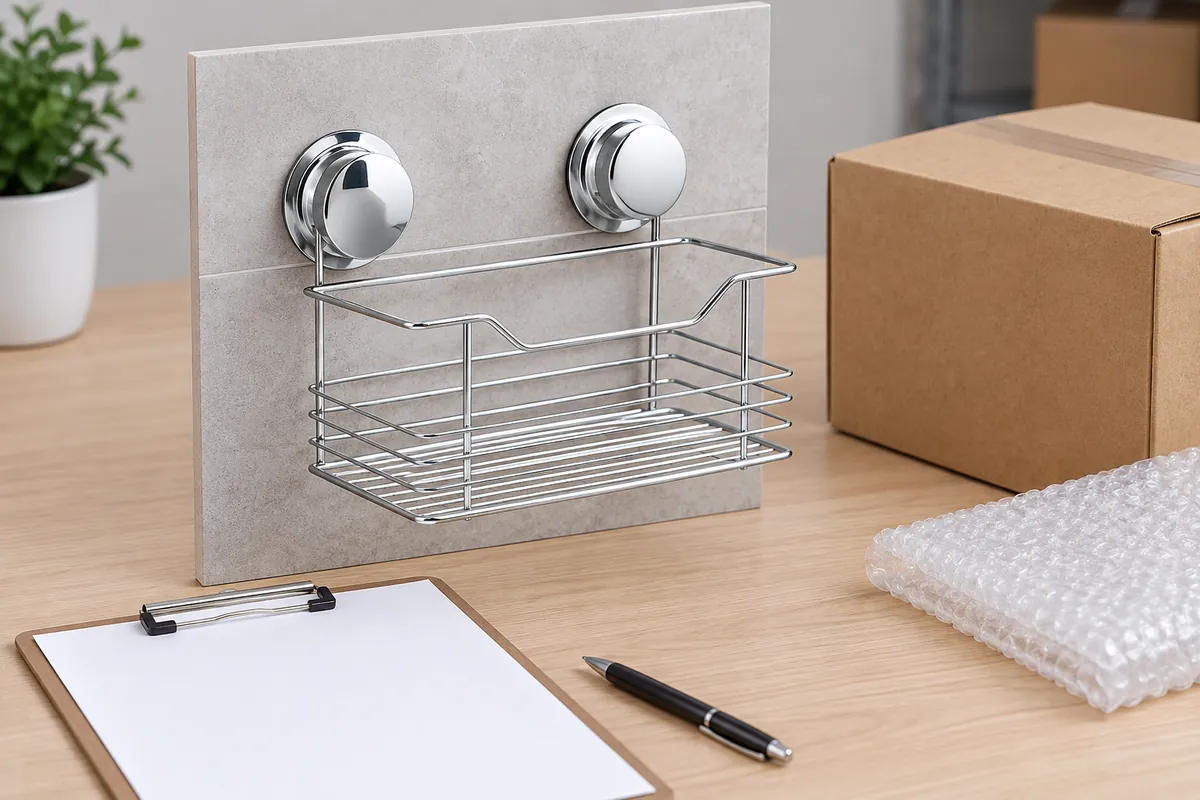
After the first shipment, retain feedback by production batch. Note installation questions, missing parts, damaged packages and any observed change in mount or basket condition. Do not immediately call every report a product defect; first compare the reported surface and use with the approved scope. Feed confirmed improvements into a revised drawing, instruction or pack specification so a repeat order is not based on memory alone.
الأسئلة الشائعة
Is a single suction-cup demonstration enough for a dual-mount basket?
No. Both mounts and the shared basket frame should be included in the same controlled sample and observation record. A different one-cup product is not a substitute.
Can one smooth tile test prove that the basket works on every wall?
No. Surface texture, flatness, joints, preparation and installation method can differ. Define representative surfaces and describe any verified scope narrowly.
Should buyers specify a load or lifetime claim in the RFQ?
Buyers may state the intended use and desired commercial claim, but a numerical claim needs an agreed project-specific method and supporting evidence before it is used.
What should a factory receive before making a validation sample?
Provide a drawing or physical sample, the complete two-mount parts list, intended surface and installation instruction, finish direction, packing concept and the buyer’s review questions.
When should a durability plan be repeated?
Review affected checks when a component, frame geometry, finish, installation instruction or packaging method changes. The scope depends on what changed and what the buyer needs to claim.
Plan a Dual-Suction Basket Sample With Koitor
Send your drawing, two-mount spacing, target wall samples, finish direction, packaging idea and planned order quantity. Koitor can review the basket structure and a practical small-batch OEM sample route before quotation.
OEM / العلامة التجارية الخاصة
حوّل دليل التوريد هذا إلى موجز منتج
يرجى إطلاعنا على المنتج المستهدف، والحجم، والتشطيب، وكمية الطلب، ومتطلبات التغليف. وسيتلقى فريقك تقييمًا عمليًّا لإمكانية التصنيع قبل تقديم عرض الأسعار.
 English
  Español
  Português
  Français
  Deutsch
  العربية