
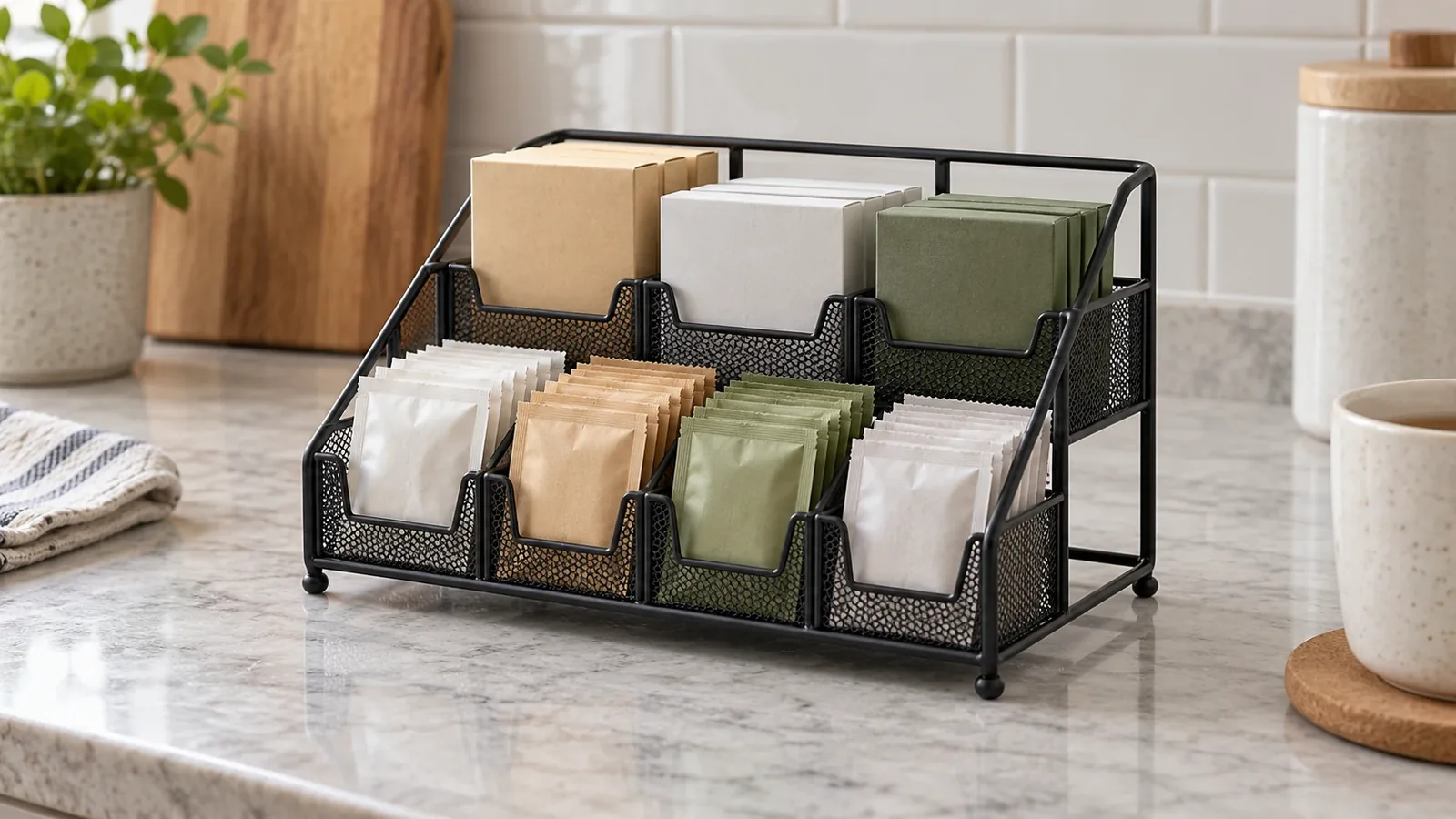
A tea bag organizer rack should be sized around the mix of tea packs a buyer expects customers to store, not around one familiar brand carton. Retail cartons, individually wrapped sachets, paper sleeves, and loose packets can differ in width, depth, height, stiffness, and how much space remains as the contents are used. For an importer, the useful approval question is whether the rack keeps those formats organized, visible, retrievable, and easy to reload under the intended assortment. A nominal “eight compartment” or “multi-pack” capacity does not answer that question by itself.
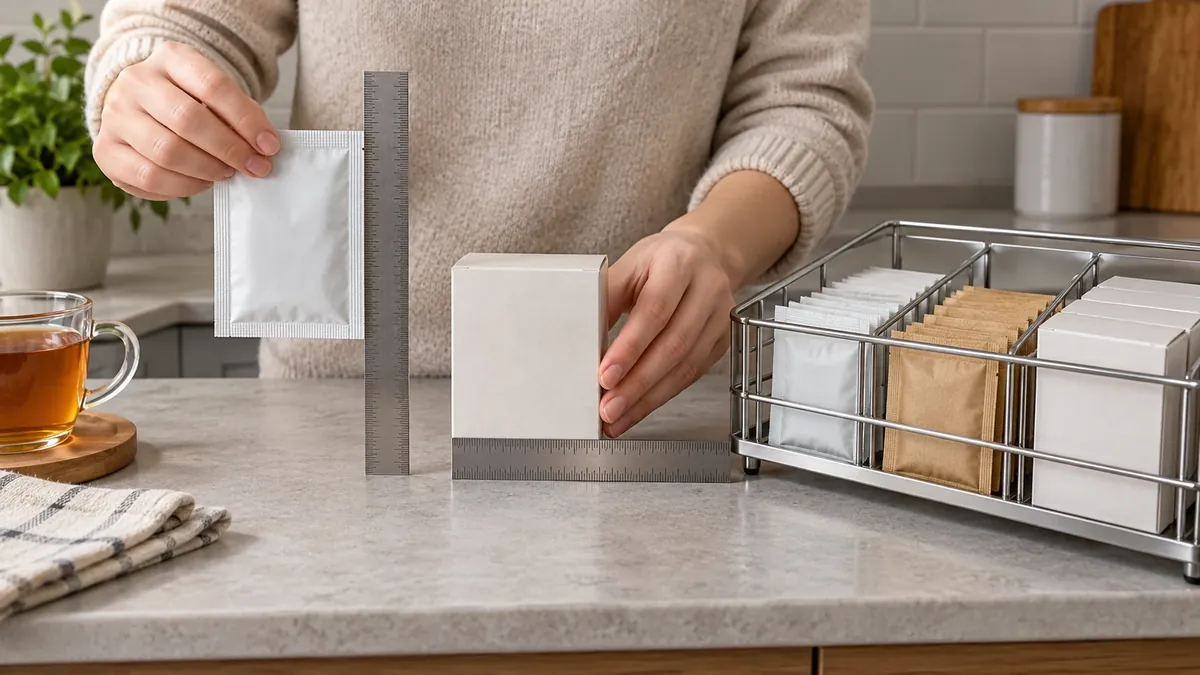
Start with the assortment, not the rack drawing
Before requesting a quote, define what a typical use case contains. A kitchen retailer might sell a rack for branded tea cartons; a hospitality buyer may want a selection of individually wrapped sachets; a private-label brand may want one product to accept both cartons and sachets. Each scenario creates a different fit problem. A fixed grid that presents cartons neatly can leave narrow sachets loose. Small cells that contain sachets can make wider cartons difficult to insert or remove.
Collect representative packs from the intended market. Include more than one supplier or package style when the product description promises broad compatibility. Record each pack’s outer width, depth, and height, and note whether it is rectangular, tapered, soft, or easy to crush. Measure a sealed pack and, where relevant, one that has been opened and partly depleted. A carton with a perforated dispensing opening can change shape as tea bags are removed; a soft sachet pack may collapse and become harder to grip. Those changes matter for retrieval and display.
A pack matrix helps identify the actual design envelope:
| Reference item | Measurements and observations | سؤال من المشتري |
|---|---|---|
| Retail tea carton | Width, depth, height, flap or opening position | Can the carton stand in the cell with its label visible? |
| Individually wrapped sachets | Packet width, thickness, surface friction | Does the rack contain a small group without trapping one? |
| Paper sleeve or envelope | Folded dimensions, stiffness, surface | Does it slump, catch, or slide through an opening? |
| Partly used carton | Remaining volume and opening condition | Can the user retrieve the last items without removing the carton? |
| Mixed assortment | Number and size of each format | Does the advertised capacity match a realistic mix? |
Avoid asking only how many “tea bags” the rack holds. That number depends on packet thickness, wrapper material, orientation, and whether the user loads loose sachets or whole boxes. A capacity claim should identify the exact pack format and loading pattern that were checked. If the assortment varies by country, create a regional reference set rather than treating one market’s tea packaging as universal.
Decide whether the rack stores cartons, packets, or both
A tea organizer can be designed as a carton display, a compartmented sachet holder, or a flexible hybrid. A first-party tea display rack can be built around a particular brand’s box dimensions and dispensing opening. That is a valid architecture for a specific assortment, but it does not establish fit for unrelated cartons. The buyer must decide whether a dedicated branded display or a more adaptable household organizer better serves the product strategy.
For carton storage, check how the box enters and exits the cell. Measure clearance at the widest point, including glued seams and flaps. Consider whether the carton sits upright, on its side, or at an angle, and how the user reads the flavor label. If the box has a perforated opening, verify that the rack does not cover it or force the user to remove the whole carton to dispense a sachet. A carton can fit dimensionally and still be inconvenient if the opening faces a divider or back panel.
For loose packets, evaluate both containment and selection. A wide open pocket can hold many sachets but may make flavors difficult to separate. A narrow slot can make categories legible but may not allow a hand to grasp the last packet. A buyer should determine whether the user will sort by flavor, brand, caffeine type, or household member. The organizer need not prescribe a particular system, but its geometry should support the intended one.
For a hybrid rack, sample testing is especially important. A cell that accepts a carton should not let individual wrappers disappear behind it or fall through an opening. A removable divider might provide flexibility, but it also adds a part, an orientation decision, and another feature to check during assembly and packing. Decide whether adjustability creates enough buyer value to justify those costs and possible user confusion.
Check labels and selection visibility
Organization is valuable only if the user can identify the contents. Place each representative pack in the proposed orientation and assess the information visible from a normal standing or seated position. Does the flavor name face forward? Is the brand obscured by a vertical wire? Does a top rail cover a carton’s product name? Can a small sachet group be labeled without adding an unplanned card or accessory?
Define the preferred facing direction in the drawing or sample brief. If a carton can be loaded in several orientations, identify which one is intended. If the product needs a divider to preserve label visibility, document its location. Do not assume that a clear finish or open wire construction automatically makes every package readable; the pack geometry and shelf position determine what a user sees.
A quick usability check can use people unfamiliar with the prototype. Give them a simple task, such as locating a particular tea type, removing one packet, and returning the remaining contents. Record whether they can identify the correct cell without assistance and whether another item is disturbed. This is not a broad consumer study and should not be presented as one. It is a practical way to spot blocked labels, overly deep cells, or confusing loading directions before retail packaging is finalized.
Measure cell geometry as a complete envelope
Cell width is only one part of fit. Depth controls how far a carton sits behind the front edge and whether a sachet can be grasped. Height and rail position determine whether items remain contained while keeping their labels visible. Openings, bends, welds, and dividers create local clearances that may differ from the nominal dimensions in a simple drawing.
List critical dimensions and identify how each will be measured. For a wire organizer, record the clear distance between finished wire surfaces, not only the spacing between centerlines. Include coatings or other finishes in the final sample check because they can affect clearance. Identify cosmetic faces and any edges that contact packaging. A drawing should distinguish overall dimensions from usable interior dimensions.
The buyer should provide a tolerance approach suited to the product. Not every dimension needs a tight tolerance; excessive precision can add cost without improving use. Focus on openings that determine whether a carton fits, spacing that controls sachet containment, and contact areas that affect stability. If a divider moves or can be removed, specify the intended positions and whether it should remain secure during ordinary handling.
A simple test uses minimum, nominal, and maximum reference packs. For example, choose the narrowest sachet group and the widest carton in the intended assortment, then check both in the same prototype. If the rack is sold for several markets, a buyer may need multiple regional pack sets. Document any pack that does not fit and decide whether to adjust the design, narrow the compatibility statement, or develop another size.
Test retrieval and refill through the product lifecycle
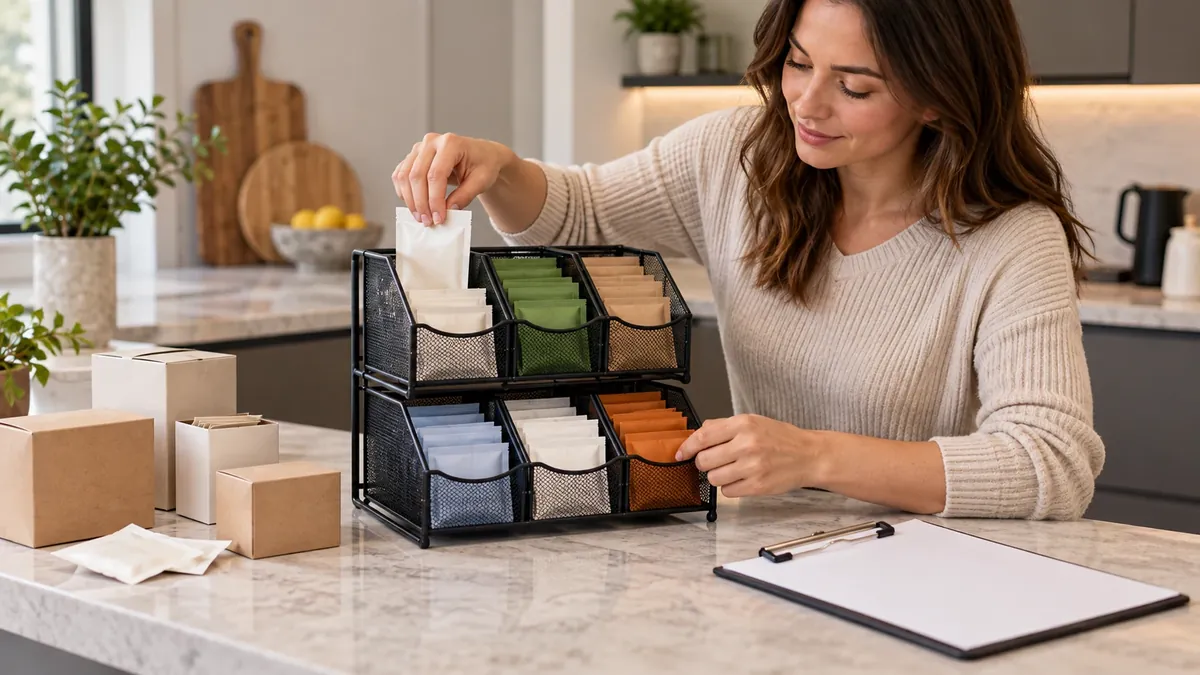
A newly loaded organizer can hide problems that appear after repeated use. Test it when full, partly depleted, and nearly empty. A tall stack of sachets may be easy to grasp when full but hard to retrieve when only two remain at the bottom. A carton’s dispensing hole may become wider or weaker as its contents are removed. The rack should be evaluated with the packaging it is meant to hold, not with generic blocks that happen to have similar dimensions.
A sample protocol can include:
- Load each reference carton in the specified orientation.
- Remove one sachet without lifting or tipping the entire carton.
- Repeat until the pack is partly depleted and then nearly empty.
- Load the agreed number of loose or wrapped sachets in each relevant cell.
- Remove a packet from the front, rear, and bottom of the group if the geometry allows those positions.
- Refill the rack and check whether the user must remove adjacent items.
- Repeat on the intended countertop, pantry shelf, cabinet shelf, or display surface.
Record whether items snag on a wire, catch beneath a divider, slide out, tip, or become difficult to distinguish. Use descriptive observations. “The smallest wrapped packet dropped through the lower gap during loading” is a repeatable finding; “not user-friendly” is too vague to guide a design change.
If the rack includes a removable tray or insert, check its placement, orientation, and removal path. If the design uses a coating or protective pad, confirm it is included in the sample under review. A bare-metal prototype may reveal dimensions but cannot fully represent the final feel, appearance, or clearance.
Review countertop stability and placement
Many tea organizers sit on a counter, pantry shelf, or break-room surface. Confirm where the buyer expects the product to be used and what contact area should remain clear. The base should sit as intended on the nominated surface; a product can rock because of unevenness or a geometry issue, and the buyer should distinguish the two. Add a check for nearby cabinet overhangs or wall edges if the rack’s height and loading direction make them relevant.
Do not infer tip resistance or load capacity from appearance. If a buyer has a defined stability concern, describe the test setup: surface, rack orientation, loaded configuration, and applied disturbance. The acceptance condition could be that the rack remains upright during a specified normal-use check, but a particular performance claim requires a defined method and supporting evidence. A weighted or overloaded demonstration does not automatically predict ordinary use.
For hospitality or shared spaces, cleaning and refill routines may matter. Ask who will restock the rack, how often it will be wiped, and whether a package is removed or placed directly in the organizer. These questions can affect open-wire spacing, accessible corners, and finish expectations. Do not make food-contact, hygiene, or tea-freshness claims unless the materials, use, and applicable requirements are verified. An organizer holding packaged tea does not itself establish those properties.
What an importer should put in the RFQ
A useful RFQ reduces hidden assumptions. Include:
- The intended buyer and channel: household retail, hospitality, office pantry, or another use.
- Representative cartons and sachets, with dimensions and photographs.
- The number of formats the product must accept.
- A desired orientation for carton display and label visibility.
- Cell count, usable dimensions, divider positions, and whether dividers are fixed or removable.
- The refill sequence and the access expected for partly used packs.
- Countertop, shelf, cabinet, or display placement conditions.
- Material, finish, color, and cosmetic-face expectations.
- Packaging method, retail presentation, barcode, and instructions.
- Sample quantity and the exact fit and retrieval checks required.
Ask suppliers to list assumptions in their quotation. Does the quoted scope include a liner, plastic tray, label, divider, or packaging insert? Are the dimensions based on a buyer’s physical sample, a supplied drawing, or a supplier’s assumption? Which finish is included? Are prototypes made in the proposed production material and finish, or are they preliminary appearance samples? A comparison of quotations is meaningful only when the scope is comparable.
Koitor’s currently documented metal fabrication and finishing knowledge may support discussion of a buyer’s metal storage concept, but current tea-organizer production, liners, or food-contact properties are unconfirmed. The buyer should provide a drawing or sample and ask the factory to confirm capability, materials, purchased parts, and production route before treating a concept as an established SKU.
The tea bag organizer rack should also be checked against the approved drawing and the final pack-out configuration.
Approve the finished sample with a pack-by-pack record
A sample approval should name the exact reference packs and date or revision of the drawings used. For each pack, record whether it loads, remains contained, shows the intended label, and can be retrieved at full and depleted states. Photograph the rack with the largest carton, the narrowest sachet group, and a mixed assortment. If the product will be sold in multiple regions, keep a separate compatibility table for each region.
Separate must-pass fit requirements from preferences. A must-pass requirement may be that a defined carton enters and exits without damage. A preference may be a particular angle or a slightly more open front. Distinguishing the two helps a supplier focus on issues that affect intended use and prevents later disagreement about what “approved” meant.
When a revision changes cell width, divider position, height, or finish, repeat the affected checks. Do not assume a previous approval transfers automatically to a changed design. Keep a retained reference sample where the project process permits it, and communicate changes before mass production. If assortment packs change later, recheck compatibility instead of relying on an old statement.
A practical sourcing conclusion
A tea bag organizer rack is not fully specified by its compartment count. Importers should define the intended mix of cartons and sachets, record their real dimensions, choose whether the product is dedicated or hybrid, and verify label visibility, retrieval, refill access, and stability using actual packs. The resulting specification can support clearer supplier quotations and a more accurate compatibility statement for retailers and users.
For related metal storage sourcing, review Koitor’s OEM home-storage hardware manufacturing information and confirm the exact product, construction, materials, components, and order scope directly.
Discuss Your Tea-Bag Organizer Racks Specification
OEM / العلامة التجارية الخاصة
حوّل دليل التوريد هذا إلى موجز منتج
يرجى إطلاعنا على المنتج المستهدف، والحجم، والتشطيب، وكمية الطلب، ومتطلبات التغليف. وسيتلقى فريقك تقييمًا عمليًّا لإمكانية التصنيع قبل تقديم عرض الأسعار.
 English
 Español
 Português
 Français
 Deutsch
 العربية