
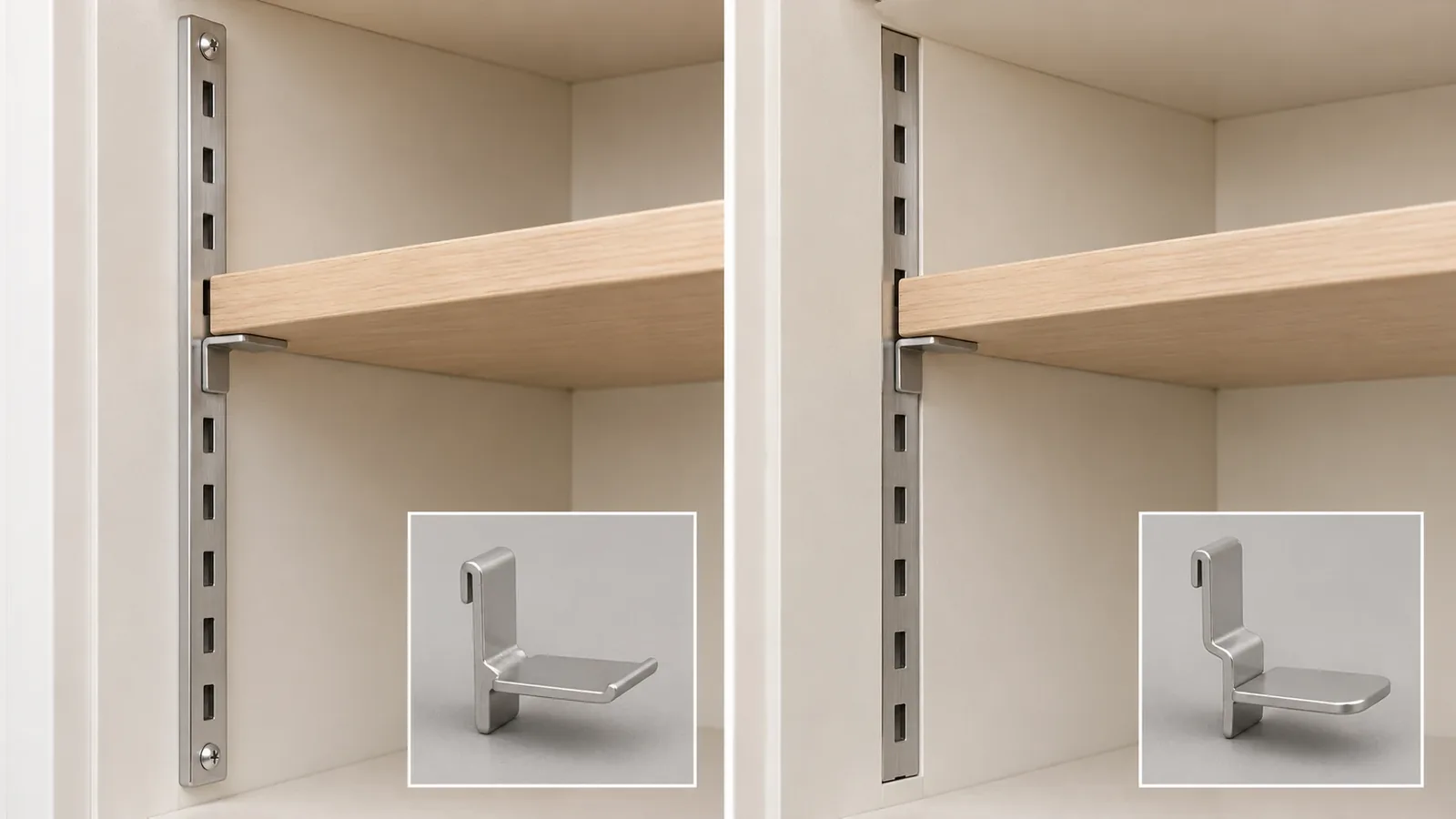
Shelf standards should be selected together with their permitted mounting mode and the shelf-support clip documented for that standard family. A label such as “surface mount” or “mortise mount” does not, by itself, answer which clip to buy or whether a recess is required in every listed application. Confirm the exact standard family, its current mounting instructions, the matching support, and the cabinet-preparation drawing before approving the system.
This is a new-system sourcing guide for cabinet and home-storage buyers. It is not a retrofit procedure, routing guide, universal compatibility chart, or load-selection recommendation. The named manufacturer examples below are specific to the cited product families; buyers should confirm current documents for their selected models.

What problem do shelf standards help buyers solve?
Shelf standards are vertical slotted tracks used with designated supports to create an adjustable shelf arrangement. A buyer selecting a new cabinet system must decide how the standard is mounted and which support family is documented for it before the cabinet or shelf preparation is finalized.
The main procurement challenge is that product families, clips, and mounting terms are sometimes described on different pages. A buyer can find a standard labelled for one mounting style, a clip with a related family name, and a technical sheet that describes an additional permitted mode. If those documents are read separately, the cabinet drawing may be committed before the whole system has been confirmed.
This article keeps two decisions distinct:
- Mounting mode: Which installation modes does the exact standard family currently permit, and which mode has the cabinet designer selected?
- Support pairing: Which shelf clip or bracket does the manufacturer document for that standard family and intended shelf construction?
One decision does not automatically answer the other. A mounting label does not identify every compatible support. A listed support does not prove that the standard is mounted in the selected cabinet in a particular way. The buyer should preserve the maker’s named model relationships and the cabinet designer’s preparation details.
Knape & Vogt’s current product descriptions provide specific examples. The maker identifies 237 as a surface-mount pilaster shelf-support clip for its 233 series and solid-shelf application. Its page for 256 identifies a mortise-mount support clip for the 255 series. A separate technical sheet, with an internal 2016 footer, describes the 255 standard as suitable for surface or flush mounting. That older sheet is useful evidence that the family name alone should not be treated as an exclusive installation rule, but it is not a current project instruction. Buyers must confirm today’s permitted mode and matching support with the maker before release.
The purchasing question is therefore not simply “Which shelf standard looks right?” It is: Which named track family, mounting mode, receiving preparation, and support clip are approved together for this cabinet and shelf?
What should buyers confirm before cabinet preparation?
Identify the standard family first, then obtain the maker’s current statement of permitted mounting modes and support pairings. Only after that should the cabinet designer finalize the receiving preparation for the selected system.
Use a two-axis selection record:
- Standard manufacturer and family: record the exact series, material or finish variant if relevant, SKU, and document revision.
- Mounting options: capture the modes that the current maker documentation expressly permits for that family.
- Project choice: state the mounting mode selected by the responsible cabinet designer for this cabinet.
- Preparation owner: identify who controls any surface, recess, or panel-preparation drawing and its revision.
- Shelf-support part: record the clip or bracket manufacturer and exact model documented for the selected standard.
- Shelf construction: identify the shelf type only to the extent that the maker documentation specifies compatibility.
- Open approvals: list any pairing, current availability, installation, or load question still awaiting maker confirmation.
The record prevents a product title from becoming a shortcut for a technical decision. It also gives purchasing and engineering teams a single place to record which standard and clip have been selected, and which source supports each statement.
| Selection axis | What to record | What it does not establish |
|---|---|---|
| Standard family | Maker, series, exact model or SKU, and current document | Universal fit with another maker’s support |
| Mounting mode | Modes explicitly documented for the family | That every mode is permitted by the cabinet’s design |
| Project mounting choice | Surface or flush/recessed mode selected for this cabinet | Cabinet preparation dimensions or a routing sequence |
| Shelf support | Named clip/bracket and standard family identified by maker | That a visually similar clip is interchangeable |
| Shelf type | The shelf construction named in the manufacturer’s application | Load capacity or performance beyond the current system data |
| Cabinet preparation | Drawing owner, document revision, and unresolved details | Approval when the responsible owner has not reviewed it |
How do mounting modes and clip families relate?
The standard family, mounting mode, and support pairing must be checked as a coordinated system. The manufacturer’s own documentation is the source for each relationship; the buyer should not infer one from another.
For example, Knape & Vogt’s product page for 237 surface-mount pilaster shelf-support clip states that it fits the 233 series surface-mount standards and identifies solid shelves in cabinets and built-in storage. This is a named product pairing, not evidence that every 233 accessory or every third-party clip is interchangeable.
The maker’s page for 256 mortise-mount pilaster shelf-support clips identifies a 255 standard family pairing. The older 2016 technical sheet reviewed for this article describes 255 as allowing surface or flush mounting and associates specific supports with standard families. Because the sheet is dated, treat it as a historical maker document and request current confirmation for a live procurement program.
These examples show why two-axis review matters. A buyer could read “mortise mount” in a clip title and assume that the standard can only be recessed. Yet the older source describes more than one mode for the 255 family. Conversely, a permitted surface mode does not automatically identify which support clip is correct. Model family, mounting choice, and clip have to be recorded separately.
| Buyer question | Evidence to use | Decision to keep separate |
|---|---|---|
| Which standard family is selected? | Current maker product page, catalog, and exact SKU | Do not substitute a similar-looking family |
| Which mounting modes are allowed? | Current model-specific instructions; note the revision | The chosen mode remains a cabinet-design decision |
| Which clip fits the standard family? | Maker’s named support-to-standard listing | Appearance alone does not establish interchangeability |
| Which shelf type is in scope? | Application statement for the selected clip | Fit language does not establish a load rating |
| What preparation does the cabinet require? | Current cabinet drawing from the responsible designer or maker | Do not create dimensions from an unreviewed illustration |
An old or incomplete technical sheet should not be silently blended with current web copy. Keep each source date visible, ask the manufacturer to resolve any conflict, and use the approved document set for the actual order. If the manufacturer changes a model or instruction, update the selected record and cabinet drawing before sample approval.
How should a buyer review the cabinet interface?
The cabinet preparation should be approved by the party that owns the cabinet drawing, using current instructions for the selected standard. A product article can define the questions but cannot supply a universal recess depth, fastener, routing sequence, or cabinet dimension.
Begin with the product configuration. Record whether the standard is intended to sit on a surface or be flush/recessed according to current model documentation. Then identify the receiving panel, wall, or cabinet member and the drawing revision that controls its preparation. If a recess, fastener, hole, or clearance is required, obtain that information from the responsible manufacturer or cabinet designer. The research documents for this article do not support a step-by-step machining instruction.
Next, identify the shelf support and shelf construction. The selected clip may be described for a specific standard family or shelf type. Do not assume that equal slot spacing, similar shape, or the same finish means two systems mate. Ask the manufacturer to identify the exact support part and any exclusions or prerequisites.
Then review the documentation as a set:
- Standard product page or current catalog identifying family and SKU.
- Current instructions describing mounting modes for that model.
- Support clip listing showing the named standard pairing.
- Cabinet-preparation drawing owned by the cabinet designer or system supplier.
- Shelf specification and any maker-required review of the intended application.
- Sample and purchase-order records showing the same approved component references.
If one document is missing or older than another, list that as an open item. Do not treat a supplier’s verbal shorthand, old catalog image, or search snippet as a substitute for a current written confirmation when the cabinet drawing depends on it.

How should buyers resolve conflicting product documents?
When a product page and technical sheet appear to describe different mounting options, compare their model scope, revision, and publication date, then ask the manufacturer to confirm the current rule for the exact SKU. Do not settle a conflict by choosing the interpretation that is easiest for the cabinet drawing.
Begin by recording what each document actually says. Separate the standard family from the support model: one document may describe the track, while another describes a clip. Note whether a source applies to all models in the family, a particular size or finish, or only one named SKU. If the product page links to a drawing or instruction sheet, confirm that the file is for the same model and is current. A shared family name does not guarantee that every document covers every variant.
The 2016 Knape & Vogt sheet reviewed for this guide describes the 255 family as surface- or flush-mounted. The current product page identifies a 256 mortise-mount support clip for the 255 family. Taken together, those sources show that mounting mode and support pairing should be recorded separately. They do not replace current project-specific confirmation. If a later instruction or current response narrows the permitted mode, use the current instruction and update the cabinet preparation record.
| Document condition | Buyer action | Approval state until resolved |
|---|---|---|
| Product page names a family, while a sheet describes a mode | Confirm whether the sheet applies to the exact current SKU | Open |
| Family name and clip name appear to match | Ask the maker to identify the approved standard-to-support pairing | Open until confirmed |
| Older sheet differs from a current page | Request a current written clarification and archive both versions | Do not rely on the older sheet alone |
| Cabinet drawing already uses a mode | Compare the drawing to the maker’s current permitted modes | Hold release if they conflict |
| Supplier proposes a model change after sample review | Recheck support pairing and panel preparation against the new model | Reapproval required |
Keep the source files with the RFQ, sample approval, and purchase order. The record should include document title, model reference, revision or date if shown, date reviewed, supplier response, and the person who accepted the project configuration. This makes later questions traceable without turning an informal catalog note into a permanent product claim.
How can buyers avoid a compatibility assumption?
Compatibility should be tied to exact model references and source documents. A product that appears to engage a slot in a sample is not automatically approved for the complete cabinet system or for every shelf type.
Do not infer mounting exclusivity from a label alone. A family name may describe its typical mode while another document lists an additional permitted use. Compare current manufacturer instructions for the exact model and resolve any contradiction before specifying preparation.
Do not infer clip compatibility from visual similarity. Two clips may look alike but differ in family, profile, engagement, material, or application. The only supported pairing is the one the responsible maker documents or confirms for the selected configuration.
Do not assume that equal slot spacing proves interchangeability. Slot spacing is only one aspect of a system. This article does not provide dimensions or a universal compatibility table. Obtain the current drawing and exact part reference from the system maker.
Do not equate a fitting sample with a load rating. A sample review may help confirm that the intended model is present and that the proposed components correspond to the approved record. It does not establish a rated capacity, long-term performance, installation quality, or compliance. Those require appropriate current documentation and project-specific review.
Do not turn an older source into a current instruction. The 2016 sheet is cited because it records a manufacturer’s architecture description. Its age means the buyer should check current availability and instructions for a real order. Search engine crawl date is not a replacement for the document’s internal date.
Do not convert the article into a retrofit recipe. The scope is selecting a new system before cabinet preparation. Existing cabinet repair, field modification, drilling, routing, or installation should follow the actual maker’s instructions and the responsible professional’s review.
Do not claim that Koitor supplies the named system. The Knape & Vogt examples illustrate third-party products. Koitor’s approved facts support metal hardware manufacturing and drawing/sample communication, not current pilaster, clip, cabinet, or wood-machining capability.
Buyer handoff and next steps
How can Koitor support a related metal-component project?
Koitor Hardware is a family-owned custom metal hardware manufacturer. Buyers can discuss a defined metal part, drawing, finish, basic assembly, and packaging within Koitor’s confirmed bathroom and home-storage scope. That capability boundary does not establish that Koitor manufactures the pilaster standards or shelf clips cited here, or that it machines cabinet panels.
For an adjacent home-storage inquiry, separate the metal part from the complete shelf system. Send the drawing or physical sample, describe the proposed function, identify the mating component and its maker, state the material and finish, and include quantity and packaging requirements. Koitor can then confirm whether the identified metal component is within current production capability before quotation.
If the project requires a cabinet recess, wood preparation, glass shelf, or system-specific support, ask the responsible cabinet or fitting manufacturer for the current preparation and pairing documentation. A metal supplier can review the interface information relevant to its scope, but that does not transfer system engineering or load approval from the cabinet designer.
Small-batch OEM production can help a buyer evaluate a clearly defined metal-storage concept or custom part. Koitor’s order guidance notes that MOQ can start from 100 pieces depending on the product, samples usually take 5–7 working days after details are confirmed, and bulk production usually takes 4–6 weeks depending on product, quantity, finish, and packaging. These conditional ranges are not promises for the cited pilaster system or any unconfirmed product family.
Review the OEM home-storage hardware scope when deciding whether a defined component brief is relevant, then confirm the exact part with Koitor before treating it as quotation-ready.
Buyer checklist before requesting a quotation
Provide a complete system-selection brief so the standard, clip, and cabinet preparation can be reviewed together:
- Standard maker, series, model or SKU, and current documentation revision.
- Mounting modes explicitly permitted for the selected standard.
- Project mounting mode selected by the responsible cabinet designer.
- Cabinet or panel drawing number, revision, owner, and preparation responsibility.
- Named shelf-support clip and maker-documented standard family pairing.
- Shelf construction and other application details required by the product maker.
- Any uncertainty between older catalog information and current product documentation.
- Material, finish, order quantity, sample plan, and packaging scope.
- Exact purchased components and supplier responsibility for each part.
- Open questions and the person or supplier responsible for resolving them.
Ask the supplier to quote against these identified references. If it proposes a different standard, clip, or mounting mode, require a written deviation and updated interface review. Keep the approved sample, cabinet drawing, product listing, and purchase order aligned to the same revision.
A document-control check is useful because mounting descriptions can be model-specific and may change between catalog editions. Begin with the current product page or current manufacturer confirmation for the exact standard and clip pair. Record the model numbers, mounting mode, cabinet-preparation reference, and revision date as separate fields. If an older catalog is the only evidence for a particular mounting option, label it as historical and ask the maker to confirm that the option still applies to the current product. Do not resolve a conflict by choosing whichever diagram looks closest to the cabinet.
The current Knape & Vogt product pages identify specific pilaster and clip pairings, including 237 with 233 and 256 with 255. Those are manufacturer-stated model relationships, not a universal pairing table for all shelf standards. A 2016 catalog excerpt describes a mounting alternative for a particular 255 model, but that older record should not be used as current confirmation without a recheck. Keep that distinction in the sourcing file so the buyer can see which statements are current and which require confirmation.
If a product is being changed from surface-mounted to recessed, ask the cabinet designer and standard manufacturer to confirm the resulting panel preparation and the intended clip family. This is a coordination question, not installation advice. The sources reviewed do not establish cabinet thickness, fastener selection, load, or a universal machining dimension. Use the exact current drawing and model documentation for those details.
Before approving a private-label assortment, save one compatibility row per proposed configuration: standard model, clip model, mounting mode, panel-preparation document, revision, and supplier confirmation. Keep substitutions in a separate row rather than silently overwriting the approved combination. This makes it easier to compare quotes and prevents a buyer from treating a shared product family name as proof that different clips fit the same installation arrangement.
Frequently asked questions
Does “mortise mount” mean a recess is always mandatory?
Not necessarily for every product carrying that family label. The 2016 Knape & Vogt sheet reviewed here describes the 255 family as surface- or flush-mounted, while current product pages describe specific support pairings. Because the sheet is older, confirm the permitted mode for the exact current standard with the manufacturer before finalizing cabinet preparation.
Can the mounting label identify which clip to buy?
No. Mounting mode and support pairing are separate decisions. Identify the standard family and obtain the manufacturer’s current list of supports for that family.
Do equally spaced slots prove two systems are compatible?
No. Similar slot spacing does not prove a match across manufacturers or product families. Confirm the exact standard and clip model with the responsible maker.
Does a fitting sample establish a shelf load rating?
No. Sample fit is not load evidence. Obtain current model-specific technical information and have the responsible system designer confirm the intended application.
Work With Koitor Hardware
Share the Standard Family and Cabinet Interface
Send the current standard and clip references, cabinet drawing, mounting-mode decision, target quantity, finish, and packaging requirements. Koitor can confirm whether a defined metal-component request fits its manufacturing scope; the system maker and cabinet designer remain responsible for clip pairing and panel preparation.
OEM / PRIVATE LABEL
Turn this sourcing guide into a product brief
Share your target product, size, finish, order quantity and packaging requirements. Your team receives a practical manufacturability review before quotation.

 English
 Español
 Português
 Français
 Deutsch
 العربية