
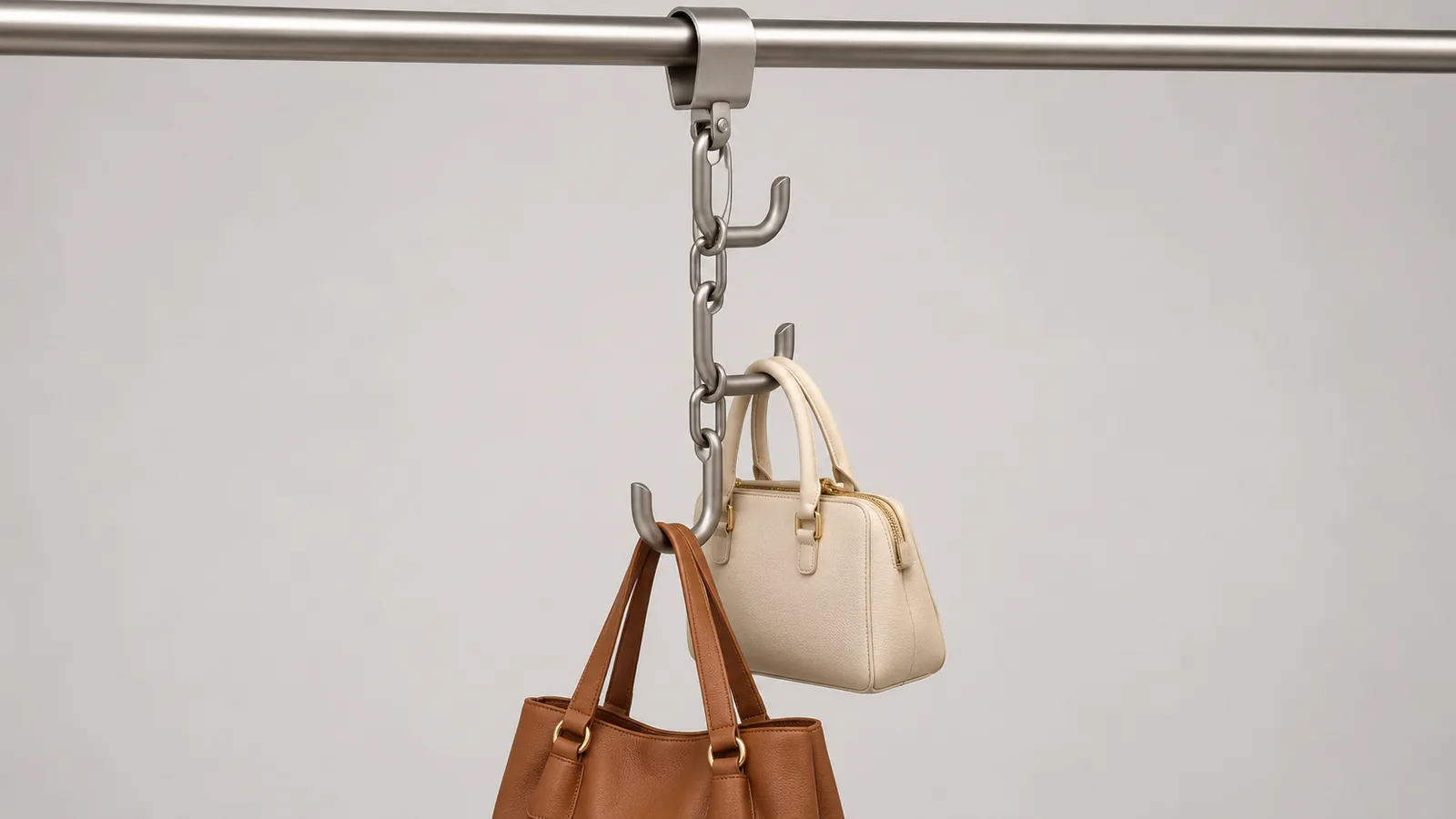
A cascading handbag hanger linked hooks program should be approved as a complete configuration, not as a loose hook count. The buyer needs to define the top fitting, number and orientation of links, mounting mode, bag-handle contact and the usable envelope when loaded. A sample that proves one connection works does not establish that every chain length, attachment or bag strap will behave the same way.
What should a cascading handbag hanger linked hooks specification include?
It needs to identify each interface from the support point down to the last link. Buyers often describe a product as “four hooks” or “a cascading hanger,” but that leaves open whether the top part is a closet hook, a rail adapter, a wall plate or a door fitting. The links may be fixed, removable, reversible or shaped to face the same or opposite directions. Those choices alter how the unit hangs and how bags are accessed.
Create a configuration drawing or an annotated reference sheet with a clear top-to-bottom sequence. Record the top fitting as its own component. Then show each link, its orientation, connection geometry and whether a link can be removed without tools. If the product is offered in several lengths, give every length a distinct configuration code rather than relying on a product family name.
The drawing should also show the condition used for approval. A compact empty sample can look orderly, while several bags can rotate into one another or occupy the same space. Where the buyer wants bags to face outward, record that intended direction and use actual representative bags during review. The accompanying image is conceptual; its parts are not a Koitor catalog item.
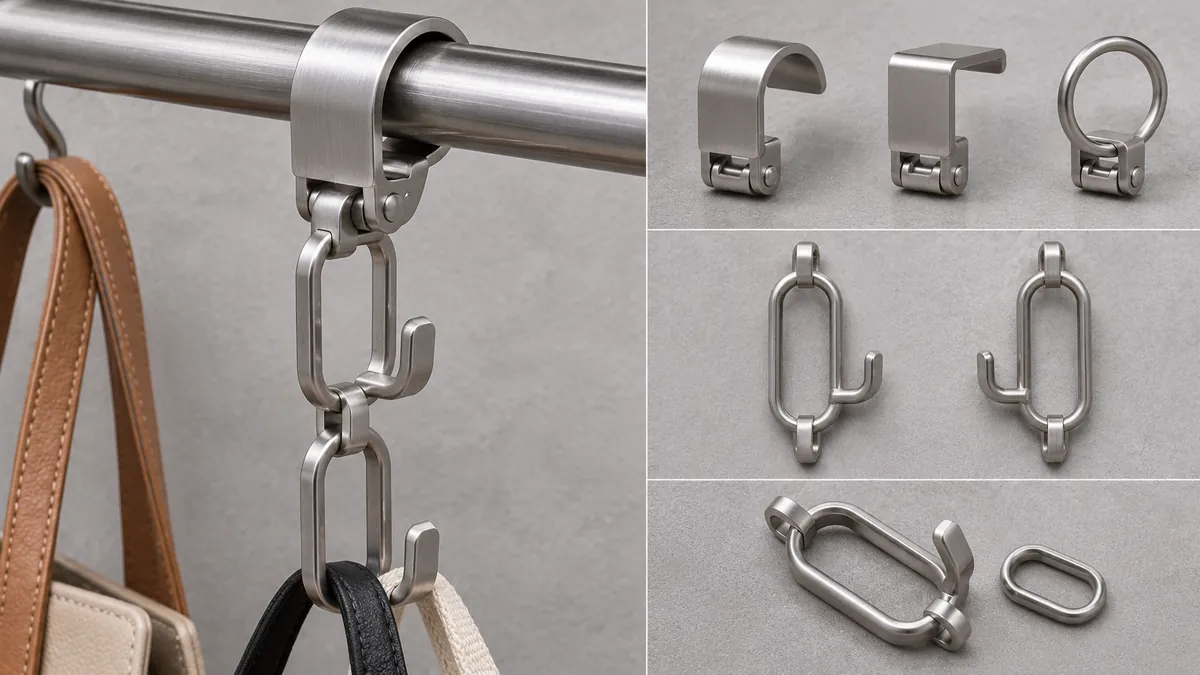
For procurement, define a complete bill of materials or exploded view: top attachment, intermediate link count, terminal link, end treatment and any supplied accessory. State what ships in the carton and what a retailer must source separately. Two products with a similar silhouette can have different included fittings and therefore different installation assumptions.
How should buyers compare link count, direction and access?
Compare the usable bag positions after the hanger is mounted, not merely the nominal number of links. A link may be present but inaccessible if bags overlap, handles crowd one another or the product sits too close to a wall or cabinet side. A configuration review should examine the loaded arrangement from the front and side, including the space needed for a user to lift one bag off without disturbing the others.
At minimum, evaluate these points:
- Link sequence: identify the number of links, whether all are identical and whether any link has a different opening or end shape.
- Orientation: state whether adjacent links face forward, backward, alternate or can rotate freely. Do not assume a reference photograph shows a locked orientation.
- Spacing: record center-to-center spacing or the actual geometry that determines clearance. Where spacing is not fixed, document the permitted movement.
- Access path: show how a representative handle enters and leaves each link. Test upper and lower positions; they can behave differently.
- Visual arrangement: check whether the linked assembly remains in the intended display position when bags are removed one by one.
- Replacement parts: decide whether the buyer expects individual links, only a complete assembly or a matched top-fitting spare.
Ask the supplier to identify which dimensions control interchangeability. A change in wire diameter, bend radius, link opening or connector shape may change the way two pieces articulate. If the connector can rotate, the sample review should show the range of motion and the condition in which the final configuration will be packed. A visual comparison is not proof of a load rating or a long-term service life.
Which mounting mode and top fitting belong in the quotation?
Name one mounting mode for each SKU and make the supplied attachment explicit. A hook intended for a closet rail is a different buyer proposition from a wall-mounted strip or a door-mounted fitting. A product listing that says “multi-use” can conceal extra parts, installation constraints or a different upper connector. A quote should not quietly substitute one attachment for another.
Some manufacturers present distinct top accessories and separate mounting options. Yamazaki’s European Joint Bag Holder page describes detachable elements and different rail, door and wall approaches; the manufacturer’s product page for another named version identifies its own accessory set and a version-specific tier limit. These references show why version and mounting mode must be confirmed independently. Their design details, capacities and limits must not be transferred to another supplier’s product. See the Yamazaki Europe product description and Yamazaki Home product page.
For each intended mount, ask for an interface sketch or physical sample that identifies the mating rail, door edge, wall plate or other support. Do not infer compatibility from a shared word such as “hook.” If the buyer is comparing mounts, put them in separate sample configurations and specify which attachment is included in each pack.
The commercial checklist should state whether mounting hardware is included, whether the top fitting is fixed or replaceable, whether the buyer needs a retail-ready set and whether the point-of-sale description must call out a compatible surface or support. These details affect SKU accuracy and returns even when the lower links are unchanged.
How do bag handles affect fit and retrieval?
Handle geometry can determine whether a bag stays in the intended position. A loop handle, narrow strap, wide shoulder strap and paired handle may contact a link differently. A narrow opening can pinch or bunch soft material; a smooth open hook may allow a strap to slide toward the end. Neither outcome should be assumed from a product photograph alone.
Use a representative test set selected by the buyer, not a claim that one sample represents every handbag. Record handle width, thickness, stiffness and whether a pair of handles is used together. Include the lightest and bulkiest relevant examples if these are part of the intended assortment. During review, place and remove each bag several times, inspect how the strap rests, and note whether the link turns or neighboring items move.
If a concern appears, treat it as a design input. The possible adjustments could include a different opening profile, more controlled orientation, a different link count, or a changed top fitting. Each change has trade-offs in material use, storage envelope, ease of access and visual appearance. Confirm the revised sample instead of assuming that a verbal note automatically resolves a fit issue.
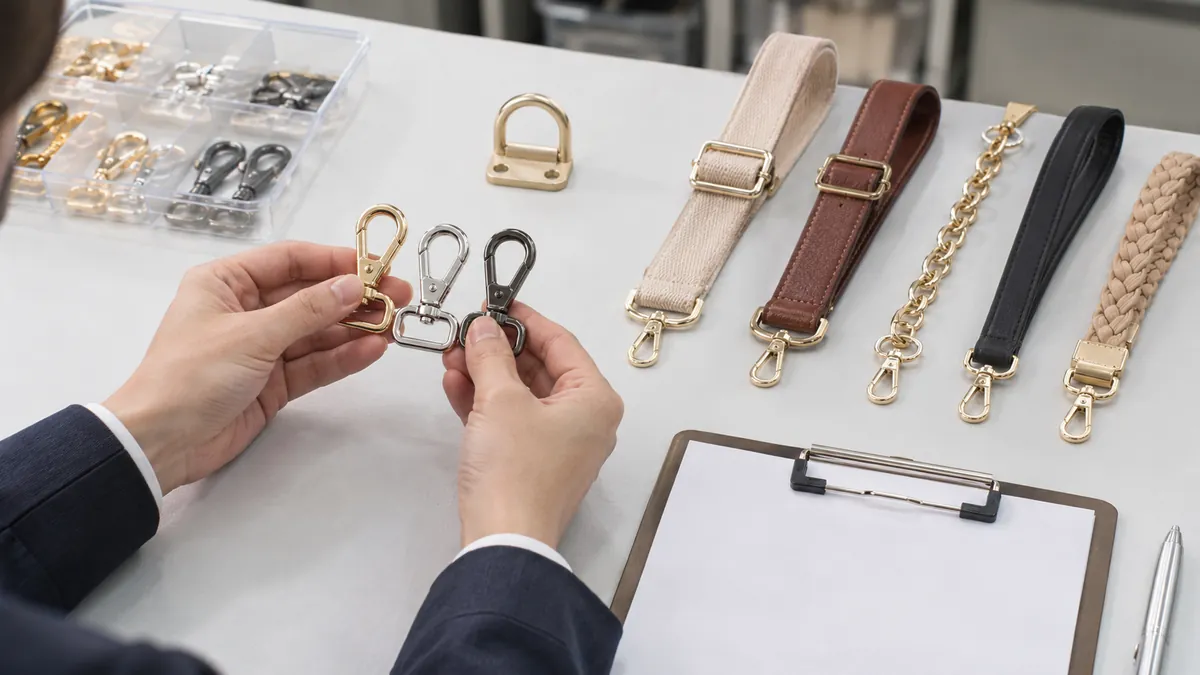
The manufacturer’s website library did not confirm that Koitor currently makes cascading handbag hangers. Treat this article as adjacent-product buyer guidance, not as a catalog or capability statement. Koitor’s general custom metal storage rack manufacturing work is a relevant route for discussing a metal drawing or sample, but the particular hanger, mount and commercial scope need direct confirmation before quotation.
What should the buyer record at sample approval?
Use a dated approval record that binds the assembly to its drawing and pack configuration. A sample without its identifier can be difficult to compare with a later revision, especially when several top fittings or link counts are under discussion. Keep a retained reference sample or clear photographs of the approved views where the project process supports it.
The approval record should identify:
| Approval field | What to capture | Why it matters |
|---|---|---|
| SKU/configuration | Link count, orientation and top fitting | Prevents family names from hiding different assemblies |
| Mounting mode | Rail, door, wall or other named interface | Keeps the sales claim aligned with the supplied fitting |
| Geometry | Link opening, connector and overall envelope references | Makes revisions comparable to the approved sample |
| Handle review | Representative strap types and observed contact | Documents which use cases were actually examined |
| Finish and appearance | Agreed color, sheen and visible surface areas | Distinguishes cosmetic acceptance from fit acceptance |
| Pack contents | Links, top fitting, instructions and spare parts | Reduces missing-component disputes and listing errors |
| Revision | Drawing, sample and packaging versions | Keeps later production aligned with the approved state |
The record should separate observations from conclusions. “The selected test bag could be removed without rotating the lower link in this setup” is more informative than “easy to use.” It also limits the statement to the configuration actually reviewed. If the retailer intends other bag shapes or mounting conditions, add them to a new review rather than expanding the approval by implication.
How can an OEM supplier review the project without overpromising?
A supplier can help translate the buyer’s drawing, sample and intended display mode into a manufacturable component set. That discussion can cover link geometry, joining method, finish coverage, assembly sequence and pack protection. It cannot replace the buyer’s decision about which mounting options to sell or which bags represent the intended application.
For a custom metal item, send the intended configuration rather than a single isolated hook. Include the top-fitting drawing, link arrangement, important dimensions, finish reference, target pack contents, artwork or label requirements and forecast order quantities by variant. If the buyer supplies a physical sample, identify which surfaces and interfaces are critical and whether the sample is a visual reference, a dimensional reference or both.
Small-batch development can be useful when the buyer needs to compare two link arrangements or test a proposed assortment before a larger commitment. The scope and minimum quantity depend on materials, processes, fixtures and finishing choices; do not assume every configuration shares the same cost or timing. Confirm quotation assumptions in writing, especially when changes affect welds, forming, polishing, coating or packaging.
Koitor is a family-owned custom metal hardware manufacturer focused on bathroom and home storage hardware. The company can review suitable drawings or samples within its confirmed product and process scope. The buyer should first ask whether this adjacent hanger product and its required top-fitting options fit the current capability and project schedule. Use the contact page to share the defined brief for review.
Buyer checklist before requesting a quotation
- Attach a dimensioned drawing or labeled physical reference for the complete assembly.
- Specify top-fitting type and one mounting mode for every proposed SKU.
- State link count, link orientation and whether components are detachable.
- Provide the target use envelope and representative bag-handle examples.
- Identify critical openings, connector geometry, finish and cosmetic surfaces.
- List included parts, spare parts, instructions, labels and retail packaging.
- Separate visual requirements from functional interface requirements.
- Give forecast quantity by configuration, not only a combined family total.
- Request an approved sample record with drawing and pack revision references.
- Avoid unsupported claims about universal mounting, fit, capacity or compatibility.
Keep the cascading handbag hanger linked hooks review tied to the exact mount and link sequence so later changes do not broaden the approved configuration.
Frequently asked questions
Is a cascading handbag hanger the same as a simple multi-hook rack?
No. A cascading design uses a linked arrangement in which the top fitting and lower links interact. A fixed multi-hook rack may have a single mounting plate and fixed positions. The drawing and SKU description should identify which architecture is being quoted.
Can one top fitting work with every closet rail or door?
Do not assume so. The mating support dimensions and geometry must be specified, and the proposed fitting should be reviewed against the actual intended installation mode. A product page for one version does not validate a different version.
Does a successful sample prove that every bag handle will stay in place?
No. It proves only what was examined under the sample setup. Review representative handle forms, link positions and retrieval movements, then describe the intended fit narrowly.
Should each link orientation be fixed or freely rotating?
That depends on the display and access goal. Fixed orientation may control presentation, while rotation may help access but change spacing. Compare both concepts with the intended bag set and approve one arrangement.
What is the most useful information to send with an RFQ?
Send the complete top-to-bottom configuration, mount mode, important dimensions, finish, pack contents, representative handles, target quantities and any existing sample. That lets the supplier distinguish core geometry from optional variants.
Work With Koitor Hardware
Review a Custom Metal Storage Hardware Drawing
Share the product drawing, mounting interface, finish reference and target pack configuration. Koitor can confirm whether the project fits its current bathroom and home storage hardware scope before quotation.
OEM / PRIVATE LABEL
Turn this sourcing guide into a product brief
Share your target product, size, finish, order quantity and packaging requirements. Your team receives a practical manufacturability review before quotation.


 English
 Español
 Português
 Français
 Deutsch
 العربية