

Cast vs blown stretch film is a comparison of two manufacturing routes for stretch wrap, but the route name alone does not tell an importer which roll will work for a particular pallet. Cast film is formed through a slot die and cooling rolls; blown film is formed as an air-expanded tube through an annular die, then cooled and collapsed. Buyers should compare the named film specification and a representative wrapped load alongside the route, especially when carton visibility, unwind behavior, or contact with projecting hardware matters.
What do cast and blown stretch film mean?
The words identify how the film is made. They do not describe whether the film shrinks around a product, how many layers a supplier uses, what resin formulation is present, or whether a roll is approved for a specific load. Both are stretch films intended to elongate during application and help contain a unit load. That shared application does not make two rolls interchangeable, and a manufacturing label is not a performance certificate.
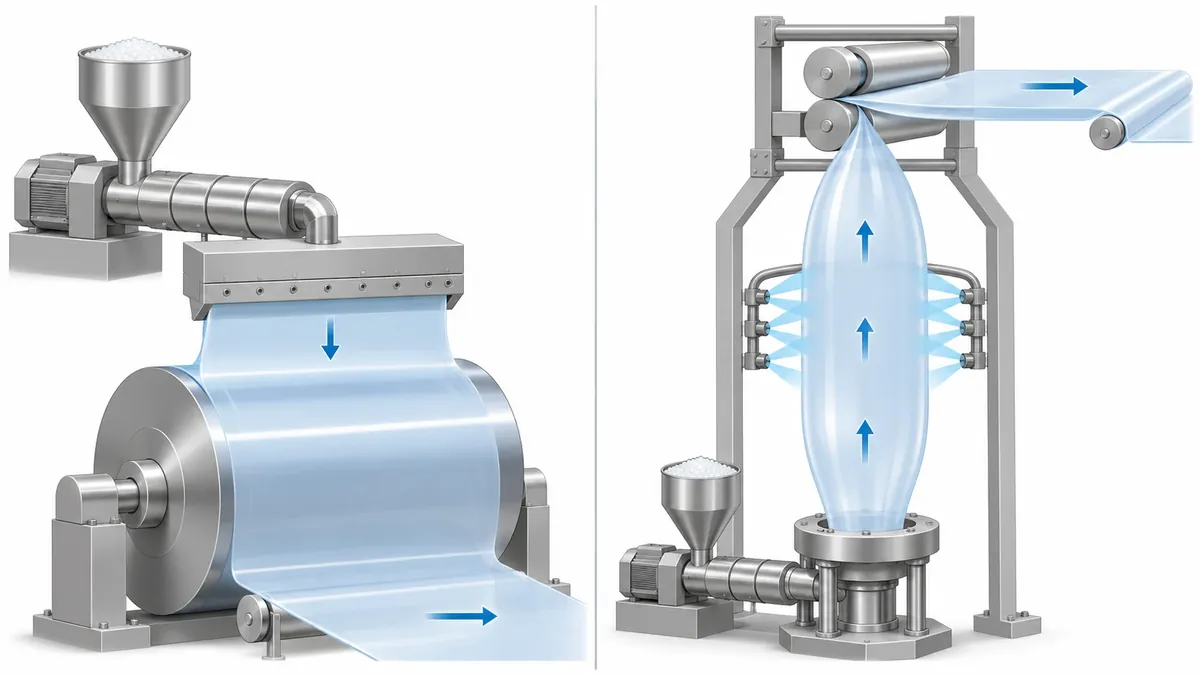
In a cast route, polymer is extruded through a relatively straight, linear slot. The hot sheet is brought against cooling rolls, which cool it into a continuous web. It is then wound or further converted into a roll. In a blown route, polymer passes through an annular opening and forms a tube. Air expands that tube into a bubble; the film cools as the bubble travels, and the tube is collapsed into a flat web before winding. Those descriptions explain the broad process distinction without specifying a manufacturer’s formulation, equipment settings, layer design, or quality controls.
The manufacturing process is useful context, but it is only the first layer of a buyer’s decision. The second layer is the actual film product: its supplier identity, construction, gauge, width, roll length, stated properties, and test conditions. The third layer is the way that film performs on the buyer’s actual pallet pattern and application. A process label cannot replace either of the later layers.
| Comparison layer | What it establishes | What it does not establish |
|---|---|---|
| Manufacturing route | Whether the supplier describes a slot-die/cooling-roll cast route or an annular-die/inflated-tube blown route | Exact resin, layer structure, additives, thickness, or suitability for a specific pallet |
| Film specification | The named product and the properties the supplier documents under stated methods or conditions | How the roll will behave on a different wrapper, operator, load, or application setting |
| Applied load | Whether a representative wrapping configuration meets the buyer’s defined handling and containment needs | A guarantee for other pallet patterns, shipping lanes, or environmental conditions |
How are the two manufacturing routes different?
In a cast vs blown stretch film comparison, the cast route uses a flat die opening and a cooling-roll sequence. A buyer does not need to operate or evaluate the extrusion line to understand the distinction. The useful procurement question is whether the supplier’s route description is attached to a specific product reference and to the information needed to compare that product. If a sales description simply says “cast,” it has not yet answered what the supplied roll is, how it is specified, or how it is expected to be applied.
The blown route uses a circular or annular die opening. The extruded tube is expanded by air into a bubble and cooled before it is collapsed. Again, this is a process explanation rather than a complete specification. The name does not disclose the actual formulation, the number or function of layers, the film’s exact thickness, or the conditions used to measure a reported result. It does not tell the buyer what wrapper settings to use. Those are product- and application-specific matters for the film supplier and packaging operation.
The routes also should not be confused with shrink wrap versus stretch wrap. Stretch film is elongated during application to help hold items together. Shrink film is designed to contract under a suitable heating process. The terms answer different questions: cast versus blown identifies a stretch-film production route; stretch versus shrink identifies a different material/application behavior. A buyer comparing those two categories should not infer that a cast or blown label means a film is shrink film. For the separate activation distinction, see shrink wrap versus stretch wrap.
Nor should the route comparison be confused with pre-stretch or containment force. How a film is manufactured and how it is applied are separate parts of the packaging discussion. A pallet can be wrapped with different application patterns and stretch levels, and its containment depends on more than a route label. See the existing guide to stretch-wrap containment force and pre-stretch for that separate question. This article stays focused on how cast and blown film are made and how buyers should use that distinction without over-reading it.
Are cast and blown films always different in performance?
For a cast vs blown stretch film buying decision, market descriptions often associate cast film with clarity and quieter unwind, and blown film with puncture resistance or a noisier unwind. Treat those as tendencies reported in technical explanations, not universal rankings. One product from one supplier may differ from another product carrying the same route label. Resin formulation, layer structure, gauge, additives, converting choices, storage, and application conditions can affect what the buyer observes. The route is a helpful category; it is not an acceptance criterion by itself.
Clarity may matter when warehouse staff need to see a carton label or scan an identifier through wrapped layers. A transparent loose sample on a table is not the same as a finished pallet with multiple film layers, folds, labels, glare, and the buyer’s scanner. The relevant question is whether the completed load remains identifiable under the actual receiving workflow. Buyers should define which labels need to remain visible and compare the proposed film on a representative wrap configuration. Do not promise that a “cast” designation guarantees scanning or that a “blown” designation makes labels unreadable.
Unwind noise can matter in a work area, but “quiet” and “noisy” are comparative descriptions rather than measured workplace limits. If the operating environment makes sound a purchasing consideration, compare the actual roll on the intended equipment and record the conditions. Avoid converting a general product tendency into a decibel claim, occupational-safety conclusion, or promise about every roll. Supplier descriptions can help shortlist samples; they do not replace the buyer’s own environment-specific evaluation.
Puncture and tear behavior also need careful wording. A general route description does not establish how the actual film will respond to a particular edge, bracket, tube end, or carton corner. Gauge and construction matter, as do the shape of the contact point and the way the load is handled. A buyer shipping metal racks or baskets should identify the protrusion, its orientation, and whether it touches the outer wrap in the real pack-out. An existing article covers stretch-film puncture resistance around wire-rack protrusions, including the distinction between a film property and the specific contact test. The cast/blown label should not be used as a substitute for that evidence.
Claims about cling, stretch response, tear propagation, roll yield, cost, or the number of pallets per roll are especially easy to overgeneralize. The label alone does not fix those properties. Ask for the supplier’s actual product data and how it was measured. Keep the method and conditions beside any number. If two quotations use different widths, gauges, lengths, or application assumptions, a lower price per roll is not automatically a lower cost per wrapped pallet. Do not assign a mechanical or molecular cause to an observed property unless a reliable source supports that specific explanation.
How should buyers compare a film for a hardware shipment?
Start by describing the job rather than asking only “Which route is better?” Record the load that needs wrapping: product and carton types, pallet footprint, arrangement, approximate total height, fragile or protruding areas, label locations, and the receiving workflow. This is a packaging brief, not an invitation to make unsupported strength claims about the products. It lets the film supplier and pack-out team respond to a real configuration instead of a general noun.
Next, name the current product or reference and the proposed alternative. Capture the supplier, exact roll/product code, width, stated gauge or thickness, roll length if specified, and any construction information the supplier provides. Record the production route when known. If a supplier cannot substantiate a specific detail, mark it as unconfirmed instead of filling it in from the word “cast” or “blown.” Keep the original product data sheet or written quotation with the sample so that later observations refer to an identifiable item.
Then separate three questions that are often collapsed into one:
- What is the film? Identify the supplier’s named product and its documented specification. Keep stated values and test methods together.
- What is the application? Record the wrapper or manual process, number and placement of wraps, and any operating assumptions the packaging team controls. Do not prescribe machine settings from a general route comparison.
- What is the observed result? Check the finished load for the buyer’s defined needs, such as carton restraint, required label visibility, handling consistency, and visible contact damage to the wrap. Record the observation and setup; do not extrapolate it to untested loads.
This separation makes sample review more useful. If a roll is changed and the finished pallet becomes easier to identify, the team can distinguish that observation from changes in labels, lighting, wrap pattern, or scanner position. If a wrap is torn after handling, the buyer can document where contact occurred and investigate whether the edge geometry, carton layout, film product, application, or transport event contributed. The note should not claim a single cause until the responsible parties have evidence.
A practical comparison does not need a complicated laboratory protocol to prevent basic misunderstandings. It does need a stable reference and a fair comparison. Use the same representative pallet pattern where possible. Note differences in film width, stated gauge, roll length, operator or wrapper, and application pattern. Keep photos of the load before and after handling if the business process permits. If multiple variables change at once, mark the result as an initial observation, not proof that the manufacturing route alone caused it.
For cartonized bathroom hardware, protect the product inside the package independently from the exterior pallet wrap. The wrap groups the load; it does not replace separators, bags, corner protection, or other approved package components that prevent metal surfaces from contacting one another. Do not wrap film directly around plated or powder-coated product surfaces unless the material compatibility and packaging method have been specifically approved. Contact, pressure, trapped moisture, abrasion, and adhesive residue are separate packaging considerations. A pallet-wrap comparison should not silently change the product’s inner-pack design.
What should a buyer ask the film supplier?
Ask for answers tied to the actual roll, not general statements about a production category. A concise request can ask the supplier to identify the product code, route, nominal dimensions, available product data, and the conditions associated with any stated performance values. Where the supplier offers several constructions, request a comparison that keeps the names and data sheets attached to the correct samples. This reduces the chance that a generic sales description will be mistaken for a product-level commitment.
Useful questions include:
- Which exact film reference is being quoted, and is it cast or blown according to the manufacturer?
- What roll dimensions and construction details are part of the quotation?
- Which properties are documented, and what test method or conditions accompany each reported value?
- Is the stated clarity, unwind, cling, puncture, or stretch information specific to this product or a general description of the route?
- What application assumptions does the recommendation depend on?
- Can the buyer compare samples on a representative pallet pattern before changing the approved pack-out?
- If a substitution is proposed, what other details change at the same time, such as width, gauge, roll length, core, or application instructions?
These questions do not guarantee that a supplier’s response is correct. They create a traceable basis for clarification and sample review. If data is not available, the buyer can make a conditional decision or request a different level of substantiation. For a high-impact shipment, the procurement team may also need its own packaging engineer or logistics provider to define the relevant handling conditions. Koitor does not operate the buyer’s film line or warehouse and should not be presented as the authority for a third-party film’s technical claims.
How can an importer make a fair cost comparison?
Compare equivalent scope. A price per roll can obscure differences in width, length, gauge, construction, roll weight, packaging, delivery terms, and application assumptions. A more useful comparison records the exact proposed product and the buyer’s expected quantity, then asks the supplier to explain any difference that affects usable amount. Do not assume that a thicker roll is automatically stronger for every load or that a lower purchase price produces a lower packaging cost.
If the supplier can provide a supported estimate of consumption on the buyer’s configuration, label it as an estimate and record its assumptions. The estimate may depend on pallet size, wrap pattern, overlap, operator, equipment, and target outcome. A controlled comparison can then measure actual rolls or length consumed on comparable loads. The result applies to those conditions; it does not establish universal savings. Any report should distinguish an observed operational measurement from a forecast, and a forecast from an invoice price.
A purchasing file can use a simple row structure: supplier and product reference; route as declared; roll dimensions; cited data and method; sample date; pallet pattern; application conditions; observed result; price basis; and unresolved items. A reviewer can then see whether both quotations describe comparable films and comparable work. If the underlying assumptions differ, request clarification before ranking them. This is more defensible than selecting a route label and treating it as a proxy for total cost.
When the film is a bought-in packaging consumable for a metal hardware order, responsibility should remain clear. The film producer supplies the product specification. The importer or pack-out owner sets the receiving and handling needs. The warehouse or packaging operator controls its process. The hardware supplier communicates the actual product, carton, and approved packaging configuration within its role. No one should infer from a factory’s participation in pack-out planning that it manufactures stretch film, owns a wrapper, runs a film laboratory, or guarantees carrier handling.
Common comparison mistakes
Choosing by route label alone. “Cast” or “blown” narrows the manufacturing category but does not identify a complete product or demonstrate performance. Keep the exact product reference and the actual shipment configuration in the decision record.
Treating tendencies as promises. Clarity, noise, puncture behavior, cling, tear resistance, and cost may be discussed as general tendencies. They should not be turned into guaranteed outcomes for every supplier’s film. Ask for product-level evidence and compare the representative load.
Mixing stretch and shrink terminology. The cast/blown distinction applies within stretch-film manufacturing routes. Shrink versus stretch concerns a different activation/application distinction. Confirm which product class is actually being quoted before comparing specifications.
Changing multiple variables without recording them. A different film may arrive with a different gauge, width, roll length, wrap pattern, operator, or pallet layout. If those changes are unrecorded, the reason for a different observation is unclear. Change one or a controlled set of factors and document the rest.
Confusing exterior containment with product protection. Stretch film may help hold cartons together, but it does not replace internal packaging that prevents scratches, deformation, or finish-to-finish contact. Review the whole packaging system at the appropriate level.
Assuming a clear sample proves barcode performance. Labels, layers, folds, glare, lighting, and scanning equipment affect whether a code can be read. Verify the finished wrap in the intended receiving setting if scanning is a requirement.
Using a price-per-roll comparison as a cost-per-load conclusion. The roll prices may cover different quantities or specifications. A cost-per-load conclusion needs comparable product data and a stated or measured application basis. If consumption was not measured, call it an estimate.
Turning a receiving observation into a cause claim. A torn or noisy wrap can have more than one contributing factor. Record the observation, inspect the configuration, and ask the supplier or operator about the part they control. Avoid assigning fault or promising a correction without evidence.
How does this connect to a hardware sourcing project?
Bathroom racks, shower baskets, towel bars, and other metal storage hardware move through a packaging chain that includes product protection, cartons, pallet patterns, labels, and transport handling. A buyer may coordinate that chain with multiple vendors. A specific stretch-film choice can affect how the final pallet is grouped or identified, but it should remain one controlled component of the pack-out rather than a claim about the finished hardware’s strength or corrosion performance.
For a custom OEM project, the practical discussion begins with the approved product and packing brief. Share the relevant drawing or physical sample, product revision, finish, order quantity, carton arrangement, label location, and any receiving constraint that matters. The factory can clarify product and packaging information within confirmed project scope. The film supplier and pack-out operator should confirm their own product and process details. This responsibility split helps avoid assigning an unverified film capability to a metal hardware manufacturer.
A family-owned custom metal hardware factory can communicate directly about drawings, samples, product revisions, finish discussions, and packaging scope for the hardware it produces. That does not establish that the factory makes the film, has a particular pallet wrapper, or has tested every possible shipping lane. Small-scale production flexibility can support a discussion about a representative order or packaging sample where the project scope permits, but the buyer must confirm the available quantity, sample plan, cost, and timing with the supplier. Do not interpret flexibility as a guaranteed MOQ or lead time.
If the order uses a new carton pattern or includes a metal projection near the outside of a package, identify that geometry before choosing the film. Share accurate carton and product details with the pack-out owner. Where the concern is the film’s contact with protruding wire, consult the separate puncture article and the film supplier’s evidence. Where the concern is how much wrap force holds a load together, consult the containment and pre-stretch owner. Where the question is whether the package protects the finish, review the inner-pack specification and actual contact points. Keeping these decisions separate creates clearer approvals and change records.
A worked buyer comparison map
Consider an importer comparing two supplier proposals for palletized cartons of metal storage products. Proposal A identifies a cast film by product code and provides dimensions plus selected data. Proposal B identifies a blown film and provides a different set of data. The importer should not conclude that A is better because the route is associated with clarity, or that B is better because the route is associated with puncture resistance. First, normalize the scope: what is each roll, and are width, stated gauge, length, core, and delivery terms comparable? Second, identify any property data that is actually comparable. If methods or conditions differ, keep them separate rather than ranking the numbers as if they came from one test.
Third, identify the job outcome. If staff must read carton labels through the wrap, use the actual labels and receiving process. If an outer edge could contact the film, record the edge location and consult the specific puncture evidence. If the load tends to shift during known handling, determine the relevant application and handling factors with the packaging operator. Fourth, use a representative pallet pattern to compare the products under recorded conditions. The review should state which product reference was used, what remained constant, what changed, and what the team observed.
Finally, write the decision conditionally. For example: “For the tested carton pattern and application, product A met the defined label-visibility requirement; film consumption and handling outcome were not evaluated for other pallet patterns.” This form separates what the comparison established from what remains unknown. It does not claim that all cast film is clearer, that the product will behave the same on another wrapper, or that Koitor independently validated the film. A different shipment or requirement may need another review.
This comparison map is useful because it keeps the process name, product specification, and applied load in separate columns. The route helps a buyer understand a supplier’s explanation. Product data distinguishes actual offers. A representative load can reveal whether a selected product fits the buyer’s stated use. None of these layers should be used as a substitute for the others.
What records should be retained?
Keep the supplier quotation, exact roll reference, current product data sheet, sample label or lot identifier, and correspondence explaining the route or specification. Retain the pallet pattern or packaging revision used for a comparison. If the buyer records a sample result, store the date, location, operator or wrapper context, and conditions necessary to interpret it. Include photos only where the company’s process permits and avoid exposing confidential shipment or customer information.
When a substitution is approved, record what changed and who approved the change. A new film reference may require a new pack-out review, especially if dimensions, application instructions, or the buyer’s label requirements differ. The approved record should not imply that every future shipment has been tested. If a requirement is based on a specific customer, retailer, warehouse, or destination, attach the actual current instructions rather than relying on a remembered general rule.
The same discipline applies when a supplier changes a formulation or process while keeping a familiar product label. The label is an identification aid only to the extent that the supplier defines it. Ask whether the supplied reference remains the same and whether any declared property, dimensions, or instructions have changed. Do not assume that a name change is harmless or that an unchanged commercial name proves an unchanged construction. The product owner should clarify the revision basis.
A clear record also supports future cost and quality discussions. If actual use differs from the original estimate, the buyer can identify whether the difference came from pallet dimensions, wrap pattern, handling, or the film product. If labels are harder to scan after a pack-out change, the team can investigate the number of layers, fold locations, label placement, lighting, and scanner conditions instead of attributing the outcome to a broad manufacturing category. Better records make the next supplier conversation more specific without pretending that one shipment predicts every other shipment.

Buyer checklist before approving a film comparison
- Identify the exact cast or blown film product and its supplier; do not rely on the route word alone.
- Record roll dimensions and every property value with its method and conditions.
- Confirm which variables are comparable across proposed quotations and which are not.
- Describe the pallet pattern, carton types, labels or scanning requirement, handling context, and relevant contact points.
- Keep film selection separate from stretch-versus-shrink classification and containment-force questions.
- Compare the actual film on a representative load when the purchasing decision depends on an applied result.
- Record the wrapper or manual application context, wrap pattern, sample date, and observed result.
- Protect coated and plated hardware through its approved inner packaging; do not assume exterior wrap replaces separators.
- Clarify responsibility among the film supplier, importer, packaging operator, warehouse, and hardware supplier.
- State the scope and limits of the final decision, including what was not tested.
Frequently Asked Questions
Is cast stretch film always clearer than blown stretch film?
No. Clarity is often described as a cast-film tendency, but the exact result depends on the actual film product and its construction. Check the roll’s product-specific information and compare the completed wrap if carton visibility matters. A route label does not guarantee that a barcode will scan through every wrapped load.
Is blown stretch film always more puncture resistant?
No. Puncture behavior depends on the product and on contact geometry, application, and conditions. General route descriptions can help frame a supplier discussion, but they do not replace product-level evidence or a relevant sample evaluation.
Does “cast” mean the film is made by a casting mold?
In the stretch-film context described here, cast refers to extrusion through a linear slot followed by cooling rolls. It does not mean the film is molded into a final hardware shape. Ask the film supplier to confirm the route for the specific product reference.
Does a cast or blown label tell me how much stretch to apply?
No. A manufacturing route is not an operating instruction. Application guidance depends on the actual roll and the equipment or manual process. Follow the film supplier’s instructions and the pack-out operator’s approved procedure.
Can I compare two films by price per roll?
Only as an initial price comparison if the quoted scope is clear. To compare cost per wrapped pallet, buyers need comparable roll specifications and a stated or measured application basis. Do not present an unmeasured consumption estimate as proven savings.
Is stretch film responsible for protecting each metal product’s finish?
Not by itself. Stretch film is commonly discussed as an outer load-wrapping material. Product-to-product separation, scratch protection, and moisture management belong to the package design and should be specified separately. Confirm compatibility before film contacts a finished surface.
Which details should I send with a quotation request?
Provide the product reference, pallet and carton arrangement, labels or scanning requirement, handling context, expected quantity, and any existing film reference. Ask the supplier to identify the exact proposed roll, route, and supporting specification. Share only information authorized for that supplier.
Can Koitor recommend a specific cast or blown film?
Koitor’s approved role is custom metal bathroom and home-storage hardware manufacturing and project communication. The film supplier should substantiate the film’s product properties, and the packaging operator should confirm application. Koitor can discuss the hardware and its approved packaging scope without claiming to manufacture film or run a stretch-wrap test laboratory.
Sources and scope
The route descriptions and source-bounded comparison tendencies draw on Lantech’s explanation of blown and cast film production and Robopac USA’s cast-versus-blown overview. Those manufacturer explanations support broad route descriptions and general comparison language; they do not establish every supplier’s performance or prove a specific film’s suitability. No source diagram, test value, machine setting, customer result, or Koitor test result is reproduced here.
The discussion is general sourcing education, not a film specification, machine operating procedure, occupational-safety assessment, carrier requirement, or guarantee of load performance. Confirm the exact product with its supplier and actual receiving requirements with the responsible buyer or logistics provider.
Discuss a related hardware project with Koitor
Share the relevant drawing or sample, product revision, finish, order quantity, and packaging scope to clarify the manufacturing discussion.
OEM / PRIVATE LABEL
Turn this sourcing guide into a product brief
Share your target product, size, finish, order quantity and packaging requirements. Your team receives a practical manufacturability review before quotation.


 English
 Español
 Português
 Français
 Deutsch
 العربية