
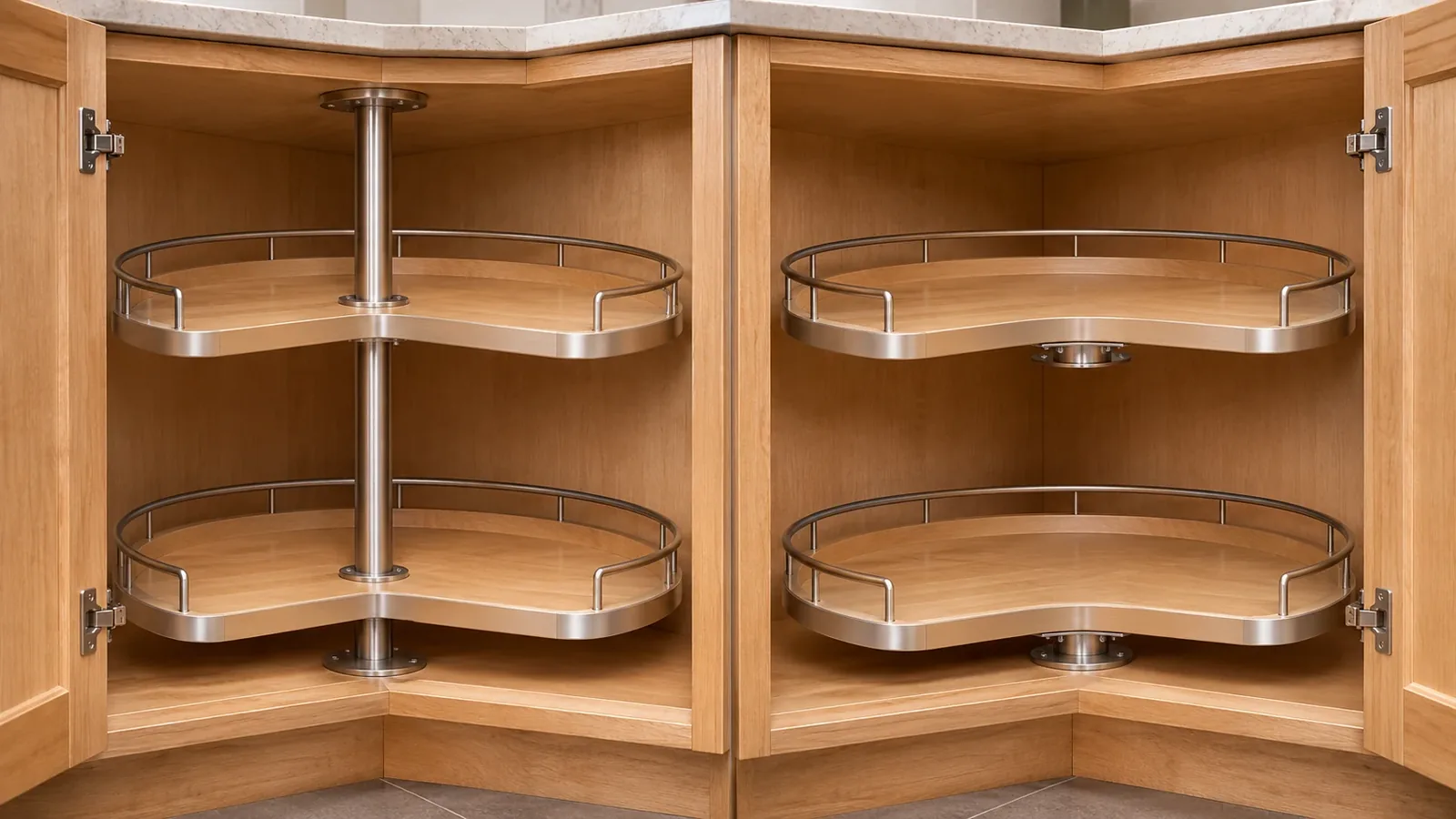
Lazy Susan vs Super Susan is primarily a comparison of how rotating trays are supported, not a comparison of tray outlines. A traditional center-post system uses a continuous post to support or connect multiple trays, while a Super Susan commonly uses independently supported rotating trays on a cabinet floor or fixed shelf. For a lazy susan vs super susan buying decision, the support arrangement changes which parts occupy the center and what remains beneath each tray, but it does not determine cabinet fit, usable capacity, adjustment features, or compatibility by itself. Buyers should review the actual cabinet section, organizer model, and installation arrangement.
What does Lazy Susan vs Super Susan compare?
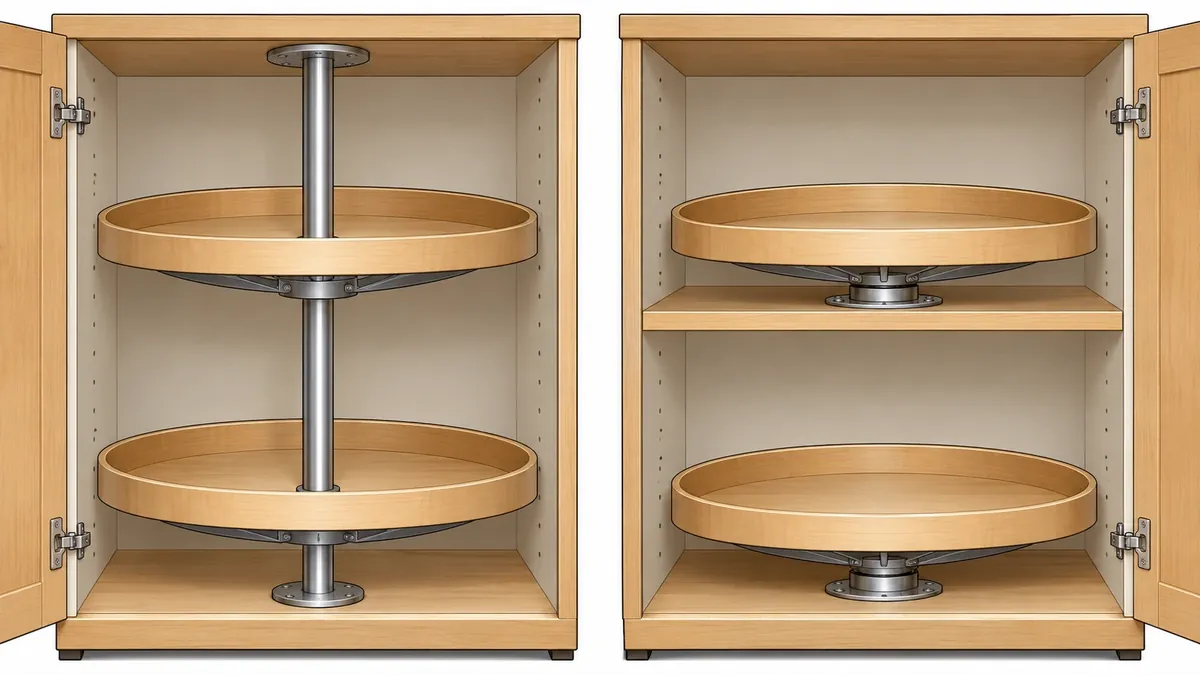
The name “Lazy Susan” is used broadly for rotating corner-storage organizers. Some suppliers use it for center-post products, while others use it as a general category that can also include Super Susan designs. A Super Susan is commonly a shelf-supported rotating arrangement: each tray has local support at the cabinet floor or an internal shelf instead of relying on a continuous center post running between levels. Terminology can vary, so a buyer should confirm the actual product construction rather than infer it from the label alone.
The core difference is the support system. A center-post system places a vertical post through the storage area. A shelf-supported system removes that continuous post from the space between trays, but it still needs support at each tray. The tray may rotate around a local pivot or bearing at its own support plane. The cabinet floor, fixed shelf, cabinet walls and door opening also remain part of the storage envelope. An open center in a product photo does not mean there is a completely unobstructed vertical column through the cabinet.
Tray shape is a separate design axis. Round, kidney-shaped, pie-cut or other outlines can be used with different rotating arrangements depending on the product. A buyer comparing systems should avoid assuming that “Super” names a tray outline or guarantees a larger tray. Two organizers may look similar from above but use different support arrangements. Conversely, different tray outlines can be installed using similar support principles. The important questions are what bears the trays, where the pivot is located, how each level rotates, and what cabinet geometry the product needs.
| Buyer comparison | Center-post arrangement | Shelf-supported Super Susan arrangement |
|---|---|---|
| Main support concept | A continuous post supports or connects multiple levels | Each rotating tray is supported at its own shelf or cabinet-floor plane |
| Center space between trays | Occupied in part by the post | No continuous shared post through the full vertical span, but local supports remain |
| Cabinet dependency | Post, tray interfaces and cabinet geometry must match the actual system | A suitable support shelf or floor plane and compatible local pivots are required |
| What the name proves | It may identify a familiar product family, but construction should still be confirmed | It suggests a support concept, but does not define every product’s dimensions or mechanism |
| What still requires checking | Door opening, tray clearance, post arrangement, mounting and actual model | Cabinet section, support plane, local pivot, door coupling, clearances and actual model |
This table is a concept comparison, not a universal product specification. Product makers may define product names differently, and particular kits can add features beyond the general support distinction. Confirm the exact model and cabinet installation details in current manufacturer documentation.
How does the support arrangement affect usable space?
A center post occupies some of the space between trays. This can affect how buyers think about storing taller items near the center, but the post is only one part of the storage geometry. The tray rim, rotating pivot, cabinet wall, door opening, frame, hinges, and the contents themselves can limit how an item is placed or removed. It is not accurate to convert “no continuous post” into “the entire cabinet center is clear” or “every item fits.”
A shelf-supported tray can leave more open space between levels where the continuous post would otherwise pass. However, each tray still has a local support point. A shelf or cabinet floor under a tray may also constrain the arrangement. The support shelf itself consumes vertical space and must be positioned in a way that the selected model permits. In a photograph, the viewer may not see how a lower shelf, pivot or bearing relates to the cabinet structure. A buyer needs the product diagram and cabinet section, not a visual assumption.
Compare usable storage by asking what the household, retailer or product category actually needs to store, then check that specific item against the installed arrangement. Note its height, width, shape, handle, lid or protruding parts. Consider where it will sit on the tray and whether a user can reach it through the opening while the tray is in the relevant position. A broad “capacity” statement can hide local restrictions: a tall bottle may clear the tray above at the perimeter but not near a central post; a wide container may fit on the tray but be difficult to pass through a door opening.
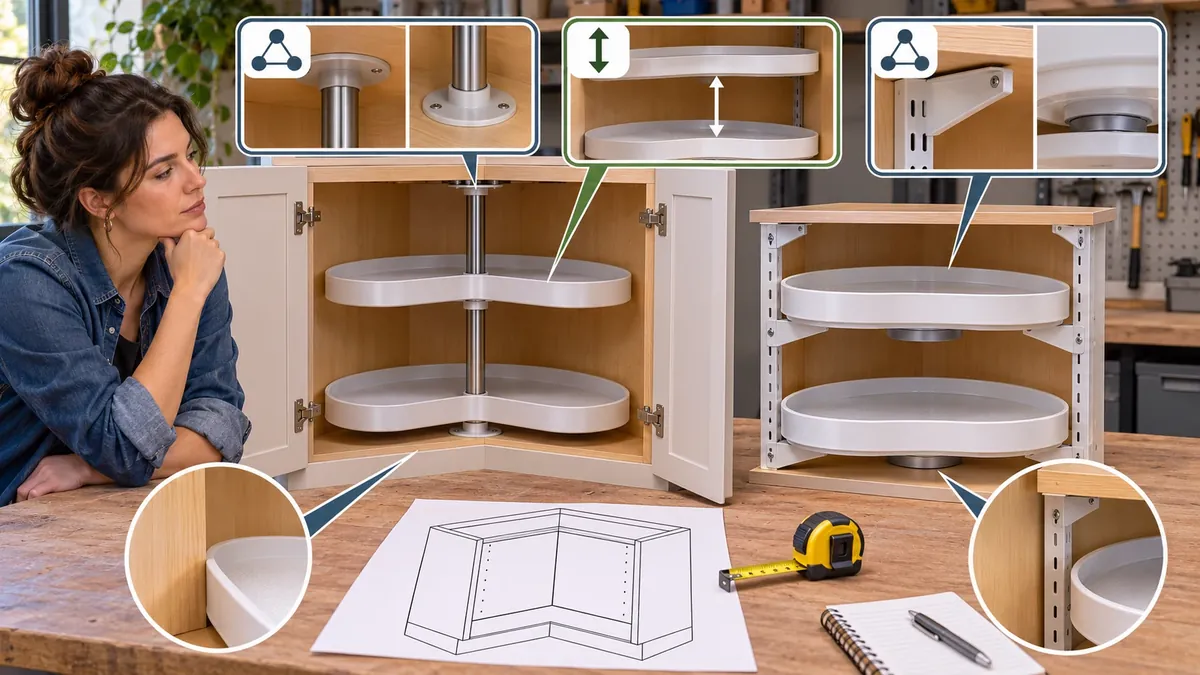
The comparison also depends on cabinet construction. A fixed shelf may already exist, or the organizer may include a shelf designed for its support. The cabinet’s finished opening, inside width, depth, vertical clearance, wall angles and door hardware can determine whether the selected assembly fits. A drawing that shows only the organizer’s tray diameter cannot answer every installation question. Ask for the cabinet-specific dimensions required by the manufacturer’s installation instructions and compare them with the actual cabinet.
Independent rotation is another feature to confirm. A Super Susan label may be associated with independently rotating trays, but a buyer should verify the specific model. Some systems couple a tray to a door or use other arrangements; some rotate as separate shelves. Those behaviors affect access and user expectations, but they are not proven by the support label alone. Door coupling, adjustment, height range, mounting details and pivot construction should be checked in the product-specific documentation rather than inferred from the category name.
Why should buyers separate support from tray shape?
The top view can make two organizers appear similar. A round tray mounted around a center post and a round tray supported at a shelf can occupy a similar plan area, yet their center obstruction and cabinet interfaces differ. A kidney-shaped tray can be used for a corner access pattern, but its outline does not itself identify whether a post or local pivots support it. Buyers should compare plan view, cabinet section and support detail separately.
This separation also helps when a supplier uses different naming conventions. One catalog may use Lazy Susan as the broad class; another may distinguish a post system from a Super Susan explicitly. If a purchaser maps a product to a keyword or assortment group using names alone, two physically different systems may be grouped together or duplicate product descriptions may be created. Use the manufacturer part number, drawing, product photos and installation documentation to establish what is actually being sold.
A useful comparison record has four fields: the product name exactly as used by the supplier; the support construction shown in the diagram; the tray outline and dimensions; and the cabinet interface required. If any field is not documented, mark it as unknown and request clarification. Do not fill a gap with a common industry assumption. For example, “Super Susan” may communicate a general shelf-supported concept, but it does not give an exact bearing type, material, load rating, finish, adjustability or cabinet fit.
The difference matters for replacement and service as well. A replacement tray that appears similar may not attach to the existing post or shelf pivot. A different interface can turn a tray-only replacement into a system-level change. Before ordering a replacement, identify whether the current assembly uses a post, shelf support, door coupling, local pivot or another model-specific interface. The existing Lazy Susan retained-interface replacement guide addresses the separate replacement question. This article focuses on comparing the two support concepts for selection and assortment planning.
What should a buyer measure before selecting an organizer?
Begin with the cabinet rather than the tray catalog photo. Record the inside clear width and depth, opening dimensions, vertical clearance, shelf positions, wall or corner arrangement, door swing and any frame or hinge interference. Use the measurement method specified by the cabinet or organizer manufacturer where available. A cabinet’s nominal width does not necessarily equal the clear space available to the rotating assembly after doors, frames and other hardware are installed.
Then collect the exact organizer information: manufacturer, model or SKU, tray outline, overall diameter or envelope, number of trays, support style, local pivot or post arrangement, mounting approach and required shelf planes. If the organizer includes a support shelf, record its dimensions and location. If it depends on an existing fixed shelf, verify that the shelf is suitable for the specific system. Avoid relying only on one dimension printed in a category listing.
The product being stored should also be represented realistically. A buyer planning a retail assortment may select a typical item and a boundary item: perhaps a tall container, a wider package, or a product with a handle. Measure the item in its actual orientation. Check if the rotating tray can bring it to the opening without catching a rim, post, door or adjacent product. A bare tray diameter cannot prove access for every object that fits on its surface.
For a cabinet or organizer that will be sold as a kit, confirm what is included and which installation conditions are outside the kit. Ask whether the shelf, post, pivot hardware, mounting fasteners and adjustment components are supplied or are part of the cabinet. The product description should distinguish a complete organizer from a replacement tray or accessory. If the kit relies on a cabinet feature, state that dependency clearly and make sure the packaging or instructions do not imply otherwise.
How can a distributor compare product proposals?
A distributor should compare complete product configurations rather than category labels. A supplier quote should identify the model, tray count and outline, support arrangement, cabinet interface and included installation components. Where dimensions appear in a catalog, record whether they refer to the tray, the full assembly, an opening requirement or a cabinet nominal size. The figure matters because products that look alike in a lifestyle image may require different support shelves or clearances.
If two proposals use the same broad support concept, compare their remaining specifications separately. Tray material, finish, diameter, edge profile, number of levels, support locations, rotation behavior and included hardware may differ by model. Do not infer that one is more durable, easier to install, quieter, stronger or higher-capacity because of the “Super” name. Those outcomes require model-specific evidence and, where the buying decision depends on them, suitable product evaluation.
For private-label sourcing, a buyer should also establish which items are manufactured by which supplier. A rotating shelf assembly may combine trays, pivots, posts, fasteners and cabinet components from different sources. The buyer’s specification should identify the responsible party for each component and the approved interface. Avoid implying that a metal hardware factory makes wooden cabinet carcasses or a complete cabinet organizer unless documented company facts establish that capability. When a custom metal component is part of a broader storage project, separate that metal scope from the cabinet and mechanism supplier’s responsibilities.
A fair comparison can be recorded in a simple matrix:
| Decision item | Proposal A | Proposal B | Evidence needed |
|---|---|---|---|
| Supplier model and version | Record exact SKU and revision | Record exact SKU and revision | Current catalog or quotation |
| Support arrangement | Center post, shelf support, or other stated design | Same classification, based on product evidence | Diagram or installation documentation |
| Tray outline and dimensions | Record tray and assembly envelope separately | Record tray and assembly envelope separately | Dimensioned drawing |
| Cabinet interface | Fixed shelf, floor support, post mount, door coupling, etc. | Identify the actual interface | Cabinet section and manufacturer instructions |
| Use-case clearance | Record the tested item and cabinet location | Record same or clearly note differences | Representative product and installed layout |
| Included components | List trays, pivots, shelves, post and fasteners | List all supplied items | Bill of materials or package contents |
| Unknowns | Mark unanswered details | Mark unanswered details | Written supplier clarification |
This matrix is not a product ranking. It helps a procurement team identify whether the proposals are comparable at all. If one supplier gives a tray diameter and another gives the cabinet opening, the two values should not be placed in the same column as equivalent measurements. Clarify the dimensional basis before ranking fit or cost.
What are the common selection and sourcing mistakes?
Treating the names as formal standards. Lazy Susan and Super Susan labels can be used differently across suppliers. Ask how each specific model is supported and what cabinet interface it needs.
Assuming a clear center means no obstruction. A system without a continuous post still uses a local pivot or bearing at each tray. The supporting shelf, cabinet floor and walls also occupy space. Review the installed section, not only a top-down photo.
Using tray shape as a proxy for mechanism. Round, kidney or pie-cut outline does not establish whether trays use a center post or shelf-supported pivots. Compare the outline and support construction as separate specifications.
Comparing nominal cabinet widths with clear openings. A cabinet’s outside size may not represent the available space after frames, doors, hinges and shelves are considered. Use the exact measurement basis from the relevant manufacturer instructions.
Assuming every level rotates independently. Rotation behavior can be product-specific. Confirm whether trays rotate separately, move together, couple to a door, or use another configuration. Do not infer this behavior from the word Super.
Ignoring what comes in the box. A quoted tray set may not include a support shelf, post, pivots, fasteners or other mounting parts. Confirm included components and dependencies before comparing unit prices.
Treating an illustrative diagram as an installation instruction. A conceptual comparison can explain the support idea but should not be used to adjust or install a particular model. Follow current product documentation for installation and adjustment.
Calling every storage problem a tray-capacity issue. An item may fit on a tray but fail to pass through the opening, clear the level above or remain accessible after rotation. Evaluate both footprint and access path.
Assuming replacement parts are interchangeable. A new tray that appears similar may not fit an existing post or shelf pivot. Identify the existing product model and retained interface before ordering replacements.
Assigning unsupported product capabilities to a supplier. A factory’s involvement in custom metal hardware does not establish that it manufactures cabinets, wood shelves, rotating bearings or a branded organizer system. Identify the component scope and responsible supplier.
How should a buyer review a sample or product listing?
A sample review should verify that the delivered model matches its approved identification and drawings. Compare the tray outline, support locations, mounting interfaces, included parts and stated cabinet dependency. If the product is shown assembled, verify that the key details can be reconciled with the dimensioned diagram. A photo can help identify visual differences, but it does not replace the manufacturer’s current instructions or prove a hidden material or performance property.
For a listing, the title and images should name the product class without overclaiming what the category guarantees. If the item is shelf-supported and uses individual pivots, describe those observable or manufacturer-documented features. Do not call the center fully empty if local supports remain. Avoid broad words such as “fits any corner cabinet,” “maximum storage,” or “easy installation” unless the product documentation substantiates the exact scope and conditions.
A buyer can ask the supplier for a cabinet compatibility drawing or a list of required opening dimensions. Check that the document has a revision date or model identifier. When a product is selected for a retailer’s assortment, store the approved listing text, image set and dimensional reference together. That makes later substitution review more reliable and helps prevent an old image from remaining attached to a changed product version.
If a trial installation is within the buyer’s process, record the cabinet model, organizer SKU, installed shelf position, clearance checks and observed rotation behavior. Do not generalize a result from one cabinet to every nominal size. If an issue appears, identify whether it concerns support interface, tray outline, cabinet interference, door behavior or stored-item access. This diagnostic separation helps the buyer direct the question to the appropriate product owner.
What information should appear in a sourcing brief?
A concise sourcing brief can specify the buyer’s decision without presuming the product solution. Identify the target market, buyer segment, cabinet or storage application, desired tray count and outline if known, model alternatives, representative stored items, packaging requirements and any required documentation. Note whether the request concerns a new kit, a component, a private-label product, or replacement compatibility. If the supplier is expected to recommend a configuration, list the cabinet measurements and any constraints that the supplier must use.
For an OEM or private-label request, include a dimensioned drawing or physical reference for the component that is actually in scope. If the order concerns a metal accessory rather than the cabinet system, make that distinction explicit. Identify surface finish, material, mounting interface, quantity, sample stage and packaging expectations only where those requirements are known. Leave unresolved choices open rather than putting an assumed answer in the specification.
The commercial conversation should be routed to the correct owner. The cabinet-system supplier confirms the cabinet dimensions, included mechanism, installation dependency and model-specific behavior. The importer or distributor determines assortment and user requirements. A metal hardware supplier can address only the metal components and production scope confirmed for its project. If a buyer discusses an adjacent organizer category with Koitor, the discussion should remain within Koitor’s verified custom metal bathroom and home-storage hardware capabilities and should not imply cabinet or wood-system manufacturing.
Buyer checklist before selecting a system
- Confirm the supplier’s exact product name, model and revision.
- Identify whether the trays use a continuous center post, shelf support or another documented arrangement.
- Separate tray outline from support construction.
- Check local pivots or bearings, support shelves, cabinet floor and other interfaces.
- Compare the actual cabinet opening and internal clearance with the manufacturer’s requirements.
- Test representative stored items for footprint, height and access through the opening.
- Confirm whether trays rotate independently or use a door-coupled or other arrangement.
- List all components included in the quotation and all cabinet dependencies.
- Verify replacement compatibility against the retained support interface.
- Keep product-specific claims and installation statements within current documentation.
Frequently Asked Questions
Is a Super Susan always a Lazy Susan?
The terms are not used uniformly. Lazy Susan is often used broadly for rotating corner storage, and some suppliers place Super Susan products within that category. Confirm the actual model’s support construction rather than assuming that the two names are mutually exclusive product standards.
Does a Super Susan have no center support?
It commonly lacks a continuous post connecting multiple trays, but each tray still needs local support. A pivot or bearing may remain at the center of an individual shelf, and the cabinet floor or a fixed shelf supports the arrangement. “No continuous post” is more precise than “no center support.”
Does a Super Susan provide more usable storage?
Not automatically. Removing a post may clear some space between levels, but tray outline, support points, cabinet opening, door hardware, vertical clearance and stored items still govern what can be placed and reached. Compare the actual model in the intended cabinet.
Are round trays exclusive to one support system?
No. Tray outline and support construction are separate design choices. A round, kidney or pie-cut shape does not by itself identify a center-post or shelf-supported mechanism.
Do all Super Susan trays rotate independently?
Do not assume so. Rotation behavior is product-specific. Check the selected model’s product diagram or instructions to determine whether each tray moves independently, is coupled to another part, or uses a different arrangement.
Can I replace a center-post tray with a Super Susan tray?
Not based on appearance alone. The support interface may be different. Identify the existing model, post or shelf support, pivot and mounting arrangement before selecting replacement parts.
What cabinet dimensions should be checked?
Use the exact model’s current documentation for its required opening and installation conditions. Buyers commonly need to distinguish nominal cabinet size from clear internal width, depth, opening, shelf position and vertical clearance. The required measurement set depends on the specific system.
Does the term Super Susan specify material or load rating?
No. The name alone does not define tray material, finish, bearing type, load rating, dimensions or performance. Request the selected manufacturer’s product data and keep any stated limits attached to that model.
Sources and scope
The support-system comparison is based on Superior Cabinets’ overview of Lazy Susan alternatives and the product-specific KraftMaid Wood Super-Susan page. A manufacturer instruction document was also reviewed for examples of both a telescopic post arrangement and independently supported trays; its adjustment steps and dimensions are not reproduced here. These sources support a general construction distinction, not a universal product standard or a claim that every model bearing the same name behaves identically.
This is a buyer comparison guide, not an installation instruction, cabinet compatibility guarantee, load rating or product recommendation for an unmeasured cabinet. Follow the current documentation for the exact model and confirm the cabinet interface with its responsible supplier.
Discuss a related hardware project with Koitor
Share the relevant drawing or sample, product revision, finish, order quantity, and packaging scope to clarify the manufacturing discussion.
OEM / PRIVATE LABEL
Turn this sourcing guide into a product brief
Share your target product, size, finish, order quantity and packaging requirements. Your team receives a practical manufacturability review before quotation.

 English
 Español
 Português
 Français
 Deutsch
 العربية