
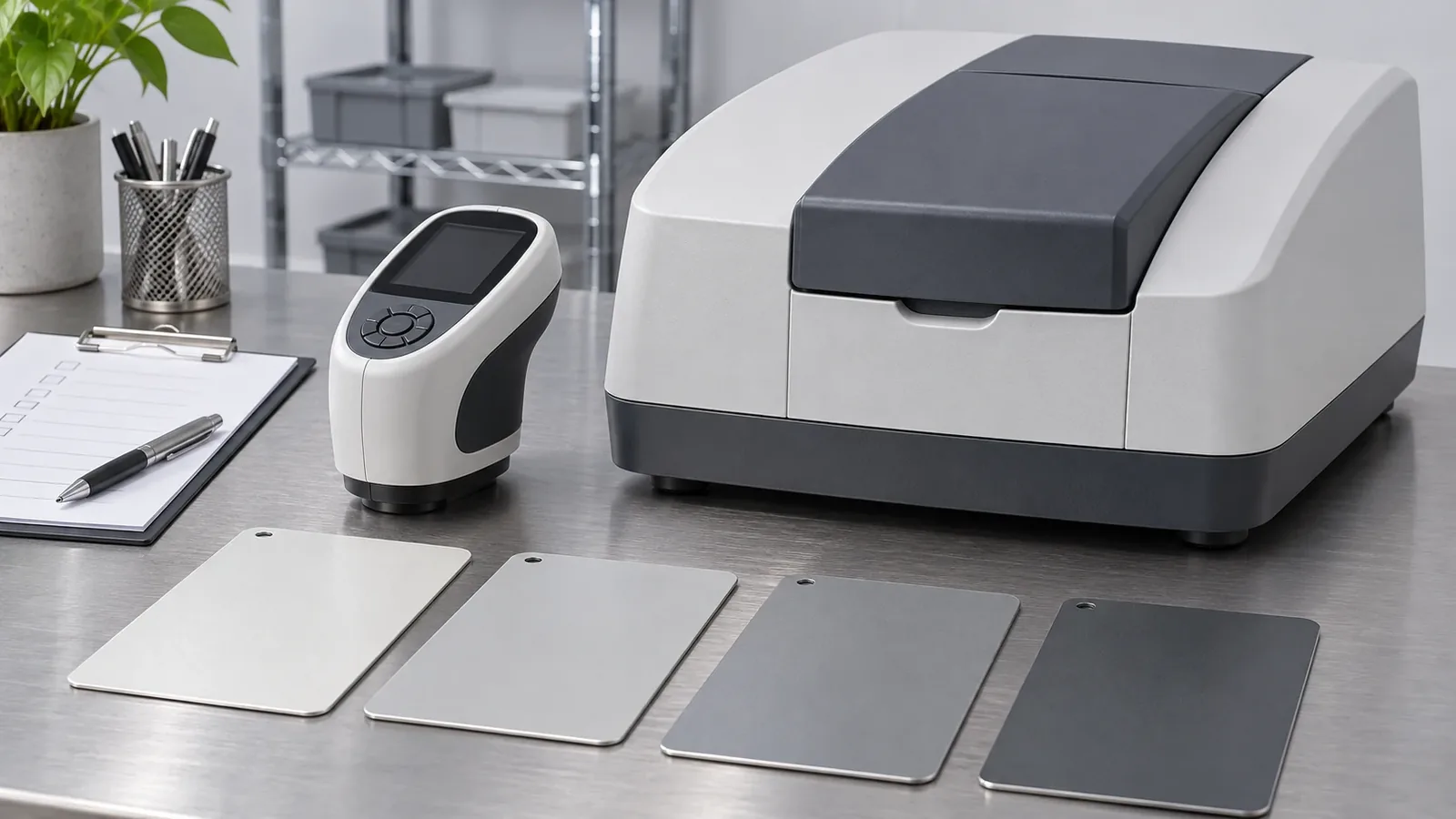
In a colorimeter vs spectrophotometer comparison for surface finishes, the central difference is the information captured before a color value is reported. A colorimeter uses filtered channels intended to approximate tristimulus response, while a spectrophotometer measures spectral response across wavelengths and can calculate colorimetric values under stated conditions. Both may produce familiar color values, but matching report formats do not prove that the instruments captured the same underlying data. For a coated bathroom rack, basket, or bracket, ask what measurement method was used, how the sample was presented, and what conclusion the record can support. Neither device name alone guarantees a better match, a particular accuracy, or acceptance of a coating lot.
Colorimeter vs Spectrophotometer: What Is the Core Difference?
A colorimeter estimates color through a set of filters that approximate the response of the human visual system. The instrument converts its filtered detector responses into a colorimetric result according to its design and selected conditions. This can be useful when the purpose is a defined comparison under a specified illuminant and observer setting. The measured output is tied to that instrument’s channel response and method; it is not a direct record of every wavelength reflected by the sample.
A spectrophotometer measures spectral response at multiple wavelength intervals over a stated range. In a surface-color application, that response is commonly represented as spectral reflectance. Software or a calculation then converts the spectral data into colorimetric values using chosen illuminant and observer conditions. The additional wavelength-resolved record can support questions that cannot be answered from a single set of tristimulus values alone, such as whether two samples with similar reported values may behave differently under another specified lighting condition. That does not make every spectrophotometer automatically suitable for every finish or sample.

The names describe instrument families, not complete measurement specifications. A buyer still needs to identify the sample, measurement geometry, aperture, specular treatment where applicable, instrument settings, calibration or verification record required by the project, and the acceptance method. A handheld colorimeter may be convenient for a particular comparison, while a spectrophotometer may collect more underlying spectral information. Convenience and information content are different attributes. Neither tells the buyer whether the instrument can consistently present a small curved hook, polished tube, textured coating, or narrow basket wire in the intended geometry.
The reviewed X-Rite explanation and Konica Minolta explanation distinguish filtered tristimulus readings from wavelength-resolved measurement. Their descriptions support the information-path comparison, not a universal claim that one family is more accurate, affordable, or appropriate. A device’s actual design and use conditions matter. Do not turn a manufacturer’s general explanation into a specification for an unidentified model or a guarantee for a particular coating.
| Comparison point | Colorimeter | Spectrophotometer |
|---|---|---|
| Captured response | Filtered detector channels intended to approximate tristimulus response | Response sampled across wavelength intervals over a stated range |
| Common report | Colorimetric values under selected conditions | Spectral data and, when calculated, colorimetric values under selected conditions |
| What the label does not prove | That the reading is comparable to another instrument or lot without a matched method | That the geometry, aperture, settings, or sample presentation are suitable for the part |
| Buyer question | Which conditions and repeat method define this value? | Is wavelength-resolved data available, and which conditions produced the reported value? |
Follow the Measurement Data from Sample to Report
An authored two-path view makes the difference easier to use. In the first path, light interacts with a finish sample, filtered channels respond, and the instrument calculates a colorimetric result. In the second, the instrument records wavelength-resolved response, then a calculation produces color values under stated conditions. The final report may present color coordinates in either case. A similar-looking report therefore does not establish that the same kind of underlying record exists.
Imagine that a buyer receives two coating reports with a color difference value and a named illuminant. If one report contains only the calculated color values and the other includes the spectral record, the buyer has different evidence available for follow-up questions. The color value can help compare samples under its stated conditions. It cannot be reverse-engineered into a full spectrum simply because a spectrophotometer could have produced one. The buyer should ask for the actual export or instrument record when spectral information is part of the requirement.
This is the article’s practical increment: separate what was measured from what was later reported. A report field answers only the question its method supports. If the buyer wants to assess a potential difference under another illuminant, the parties must confirm that the needed spectral information exists and that a suitable calculation or comparison has been agreed. An existing number under one condition is not a universal forecast of appearance in every showroom, bathroom, retail display, or home.
| Data stage | Filtered-channel path | Wavelength-resolved path |
|---|---|---|
| Sample presented | Coated sample is positioned according to the chosen method | Coated sample is positioned according to the chosen method |
| Instrument response | A set of filtered channels produces detector responses | Multiple wavelength bands produce spectral-response data |
| Report calculation | Colorimetric result is calculated from channel responses | Spectral data can be used to calculate colorimetric values under selected conditions |
| What to retain | Instrument identity, conditions, sample identity, and repeated comparison record required by the project | The same context plus the actual spectral record if the comparison needs it |
The diagram does not imply that filtered channels are defective or that wavelength data removes every uncertainty. It shows what the buyer can request. Method, sample consistency, surface texture, geometry, and instrument handling still affect whether two records can be meaningfully compared. If the project has an approved master sample, preserve its identification and handling requirements so a later reading can be tied to the same reference.
What a Color Value Can and Cannot Establish
A color value can communicate a calculated result under identified settings and a defined method. When a buyer compares a production sample with an approved reference, the record can help show whether the values fall within the project’s agreed comparison rule. It is useful when the sample identity, measurement location, instrument, settings, and acceptance criterion are clear. A number detached from those conditions is harder to interpret.
A value alone does not reveal every feature of the measurement. It does not show whether the test piece was flat or curved, whether the instrument aperture fit the part, which area was measured, how many readings were taken, how readings were averaged, or whether the reference had changed. It also does not establish that two different instrument models give interchangeable results. Those are method and record questions, not conclusions that can safely be inferred from the reported coordinate or difference value.
Color difference terminology also has its own mathematical definitions and tolerance decisions. This article does not choose a formula, set a pass/fail limit, or interpret a project tolerance. The existing guide on the Delta E formula, tolerance, and metamerism covers that distinct question. Here, the buyer’s first decision is whether the underlying measurement record matches the question being asked.
Suppose two finish panels look close under one light and produce close colorimetric values under one agreed setting. That result supports the stated comparison only. It does not prove that the panels will appear identical under every light source or viewing angle. If the project has a specific lighting concern, name the illuminant or display condition and ask what data and procedure can address it. Do not assume that a device family label by itself answers the lighting question.
The same caution applies to surface appearance. Gloss, texture, metallic or pearlescent effects, translucency, and local curvature can make measurement geometry important. A color reading is not a complete visual-quality inspection. Buyers should define whether the finish is judged instrumentally, visually, or with a combination of methods, and should make clear which method controls a disagreement. The separate SCI/SCE measurement guide addresses specular included and excluded modes; it should not be collapsed into the instrument-family comparison here.
Match the Instrument to the Coated Hardware Sample
Bathroom and home-storage hardware presents measurement challenges that differ from a large flat panel. A towel bar may be curved, a basket wire may be narrow, and a hook may have a small coated face. An instrument’s aperture and measurement geometry need to fit the available area and finish. If the aperture spans an edge, hole, shadow, or adjacent surface, the reading may not represent the intended finish area. The aperture guide for a small curved sample explains that distinct sample-presentation issue.
Before accepting a comparison, identify the component and the exact face or zone that matters. A flat witness panel may be useful for some agreed finish-control purposes, but it does not automatically represent every curved or welded feature on the finished item. The parties should agree whether they are measuring a witness panel, a formed part, or both. If two forms are used, record their relationship rather than treating them as identical without evidence.
For a small sample, ask how it will be supported and oriented. The measurement should avoid a hole, edge, seam, or mixed-color boundary unless the intended requirement specifically concerns that location. If the instrument cannot cover the target area with the planned aperture, that limitation should be raised before data are used to approve the finish. The requested method may need a representative larger sample, a defined flat area, or another agreed approach; the article does not prescribe which is technically feasible for a particular supplier.
Repeat readings also need a stated purpose. Multiple readings can describe variation across positions or repeatability under an agreed method, but the count and calculation should not be improvised after results are seen. Specify locations or a sampling plan appropriate to the project, and keep individual readings if the comparison depends on variation. A single average can conceal a local difference that matters on a visible face.
Ask for the Right Evidence Before Approving a Finish
Instead of asking only whether a supplier owns a spectrophotometer, request a record that answers the project’s actual decision. Include the sample identifier and revision, reference-sample identifier, instrument family and model where available, measurement conditions, geometry or aperture relevant to the part, locations, number of readings, reported values, and the agreed comparison rule. If spectral data are needed, say so directly and ask whether the file can be supplied. The exact fields should match the product and purchase agreement rather than an assumed universal form.

The following request is deliberately neutral: “Please identify the measurement method, the sample and reference IDs, the reported conditions, measurement locations, and the record available for this comparison. If the decision requires spectral response, please confirm whether the underlying wavelength data are available.” It avoids ordering a particular instrument when the method could be the more important requirement.
Do not accept a marketing statement such as “spectrophotometer tested” as a substitute for the actual record. The statement might identify a device family, but not the settings, sample surface, reading location, reference, or whether the instrument output was retained. Conversely, a colorimeter result is not automatically unusable: it may meet a project requirement when the purpose is a specified comparison under a matched method. The buyer should choose evidence based on the question and record it before production approval.
| Buyer check | Information to identify | Why it matters |
|---|---|---|
| Sample | Part, finish, revision, and surface zone | Prevents a result from being detached from the product it describes |
| Reference | Approved master, control sample, or named comparison piece | Defines what the measured sample is being compared against |
| Measurement | Instrument family, model if available, settings, geometry, and aperture | Helps interpret whether the reading method fits the sample |
| Coverage | Reading locations and count, including individual records if needed | Shows whether the value represents one spot or a broader comparison |
| Data | Reported color values and spectral file when specifically required | Clarifies what was captured and what is available for later review |
| Decision | Agreed tolerance, review route, and disposition owner | Prevents a measurement result from silently becoming a purchase release |
These fields do not create a certification or laboratory requirement. They form a practical request for project evidence. A supplier may not be able to share proprietary instrument files or every internal record; if so, agree what buyer-facing evidence is sufficient before the order reaches a decision point. Keep any deviation or substitution visible in writing.
Avoid These Colorimeter and Spectrophotometer Assumptions
The first common mistake is treating “more data” as the same thing as “more accurate.” A spectrophotometer’s spectral record can answer some questions that a tristimulus-only record cannot, but performance still depends on instrument design, method, sample handling, calibration state, and the intended measurement. No family label eliminates uncertainty.
The second mistake is assuming that the same reported color coordinates prove the same measurement route. Different acquisition data can lead to similar output fields. If the buyer needs a particular type of evidence, the requirement should state what underlying data or method is expected rather than relying on the output’s appearance.
The third mistake is comparing readings collected under different conditions as if the only difference were the finish. Illuminant, observer, geometry, aperture, specular mode, sample orientation, and measurement location can all be relevant to the interpretation. This is why the project should specify the comparison setup and retain it with the record.
The fourth mistake is using a flat color chip as automatic proof of a formed component’s appearance. Forming, welding, polishing, coating coverage, curvature, and local surface texture may change how a finished part is viewed or measured. A witness panel can be an agreed reference, but its role should be explicit. The buyer should decide whether the final product also needs a visual or instrumental check.
Finally, do not make a purchase or supplier-quality decision from a single unlabeled score. Connect the record to a named reference, a visible product zone, and a written acceptance process. If the report does not contain enough context, request clarification before interpreting it as a pass or failure. That keeps measurement evidence separate from the commercial release decision.
Frequently Asked Questions
Is a spectrophotometer always more accurate than a colorimeter?
No universal ranking follows from the instrument names. A spectrophotometer can capture wavelength-resolved information, while a colorimeter uses filtered channels intended to approximate tristimulus response. Accuracy and usefulness depend on the specific device, method, sample, settings, and project requirement.
Can a colorimeter detect a difference under another light source?
A colorimeter’s reported reading is tied to its available channels and stated conditions. Do not infer a complete spectrum or a result under another illuminant from one set of color values. Ask whether the needed spectral record exists and which agreed calculation or procedure will be used.
Do both instruments report the same color coordinates?
They may report common colorimetric formats, but the underlying captured information can differ. The report should identify the measurement conditions and instrument so the buyer knows what the values represent.
Which instrument should a hardware importer request?
Start with the decision and the evidence required. For a specified comparison, a defined method may be more important than the device label. If the project requires spectral information, name that requirement and confirm the actual data can be supplied.
Does a coating color measurement prove the whole part will look uniform?
No. The reading covers the sample area and method used. It does not automatically establish appearance across curved, welded, textured, or differently oriented areas of a finished product. Identify any additional visual or part-level review in the project criteria.
For a repeat order, the record should help the team distinguish a true finish change from a change in measurement setup. A production sample may be compared with a retained reference, but the reference needs an identity and condition. If it has been handled, exposed, or replaced, that fact could matter to interpretation. Buyers can store the approved reference according to the project agreement and record when a new master supersedes it. Avoid keeping an unlabeled chip in a drawer and later treating it as a traceable standard.
When the supplier returns a measurement report, check that the sample name, finish, revision, date, and comparison target are visible. If the report contains multiple values, ask which one controls the stated decision and whether the others are diagnostic or informative. If spectral data were requested, confirm the file belongs to the same sample and record. A separate file without a clear link to the sample identifier can create ambiguity rather than resolve it. These are document-control questions, not a claim that every project requires the same record format.
Also decide in advance how disagreements will be handled. One party may see a visible mismatch while the instrument reading remains within the agreed numeric tolerance, or the reverse may occur. The purchase specification should identify whether the instrumental criterion, visual review, or both control the release decision and who resolves a conflict. If the project uses a limit, define its formula, conditions, and decision rule with the relevant parties before reading the result. This article does not choose those limits. It helps the buyer establish whether the data path and sample context are adequate for the agreed review.
This separation is especially useful when different suppliers participate in coating and final assembly. A coating supplier may provide a measurement record, while a hardware supplier presents the finished component. The buyer should decide whether the coating-stage panel is only a process reference or also an acceptance sample for the finished product. If the component shape changes how it is measured, preserve that distinction instead of implying that a panel reading proves every surface on the part.
A fifth mistake is asking for instrument model information without explaining the decision. A model number may help identify equipment, but it does not tell the supplier what finish, surface zone, report field, or review threshold matters. Put the business decision first: compare an approved sample, investigate a possible light-dependent mismatch, or document a finish change. Then request the method and data that directly support that decision. This keeps the request proportionate and reduces back-and-forth about equipment labels.
Finally, retain enough context to compare the next lot. The record can capture the reference identity, sample location, instrument and settings, date, and the agreed decision rule. If the method changes, note the change instead of comparing values as though they were collected under identical conditions. This is particularly useful when an order spans several production runs or when a finish sample is replaced. The goal is a traceable buyer decision; it is not to prescribe a universal color laboratory workflow.
Colorimeter vs spectrophotometer is therefore an information-capture comparison first, with instrument selection following the evidence the project requires.
Discuss a finish-measurement requirement
Share the finish reference, sample form, drawing revision, and measurement requirement so the project scope and available evidence can be reviewed together.
OEM / PRIVATE LABEL
Turn this sourcing guide into a product brief
Share your target product, size, finish, order quantity and packaging requirements. Your team receives a practical manufacturability review before quotation.


 English
 Español
 Português
 Français
 Deutsch
 العربية