
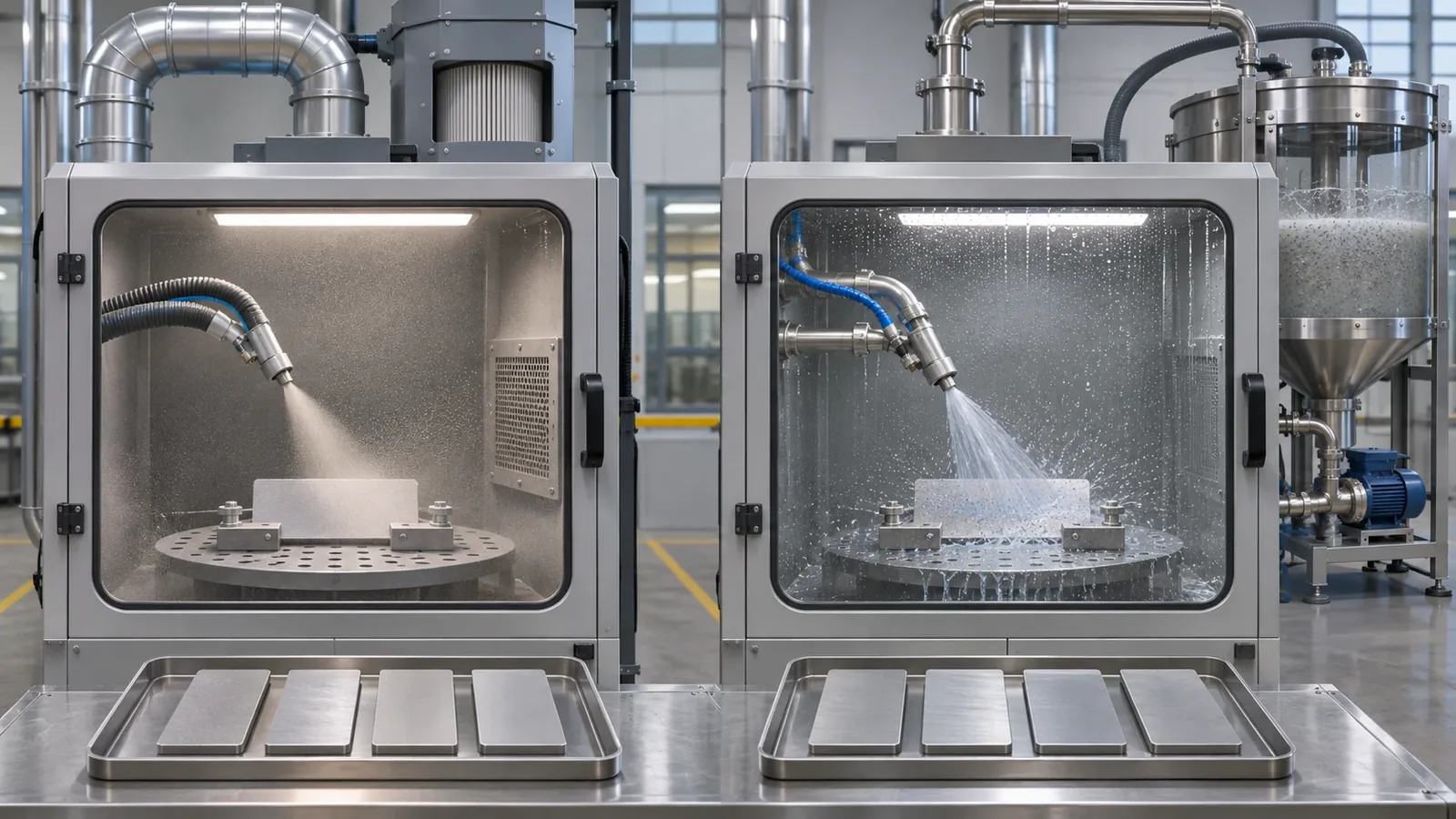
In vapor blasting vs sandblasting, the useful comparison is not simply “water versus sand.” Dry abrasive blasting generally propels abrasive media with air, while wet or vapor blasting adds liquid to the abrasive route. The liquid is a process medium; it does not name the abrasive, require steam, or select a particular finish. Different equipment handles liquid and slurry in different ways. For a metal bathroom rack, basket, or bracket, buyers should identify the proposed media, carrier, sample result, and downstream rinse or drying steps separately. Neither route label proves a specific roughness, coating adhesion, corrosion resistance, or that the finished part is ready for the next operation.
Vapor Blasting vs Sandblasting: Separate the Process Medium
In a dry abrasive-blasting route, compressed air carries abrasive particles toward the workpiece. The media and the process setup influence how the surface is affected, but the words “sandblasting” are often used loosely in everyday descriptions. The buyer should not assume that literal sand is being used or that a supplier has named a complete procedure by using the generic term. Ask for the media type and the intended purpose for the actual part.
In wet or vapor blasting, liquid is added to the abrasive process. The Vapormatt process explanation describes water used with air and media, rather than steam as a necessary part of the definition. “Vapor blasting” is a conventional process name, but a buyer should ask how the supplier’s proposed system introduces liquid and manages the mixture. Machine designs vary, so a label does not specify an exact pump, nozzle, circulation, or separation arrangement.

The main comparison is therefore about the process carrier: air carrying abrasive in the dry route, versus a route that includes liquid alongside the abrasive. This does not mean the abrasive itself changes automatically. The media remains a separate selection. The existing bead-media identity as a separate specification question covers the distinct media-name comparison. This article adds the process-fluid dimension without repeating that article’s explanation of abrasive forms.
| Process question | Dry abrasive route | Wet or vapor route |
|---|---|---|
| What carries the abrasive? | Air propels abrasive media toward the work | Liquid is added to the air-and-media route, with machine-specific handling |
| Does the name identify the abrasive? | No; specify the actual abrasive media | No; wet systems can use different media, as well as liquid |
| What extra process handling may be needed? | Media containment, collection, or other system-specific controls | Liquid/slurry condition, filtration or separation where used, rinse, and drying requirements |
| What does the label not prove? | A particular texture or coating-ready condition | A smoother result, no residue, universal safety, or automatic coating readiness |
The table describes general process distinctions based on reviewed technical explanations. It is not a process specification or a claim about equipment at Koitor. A supplier proposal should identify the actual route and sample rather than relying on the vocabulary alone.
What the Added Liquid Changes—and What It Does Not
Liquid adds another process stream that must be considered. Depending on the machine design, the supplier may need to control the slurry or liquid condition, manage spent media, and handle parts after blasting. The Guyson wet-system example describes its own separation of spent abrasive from water. That example demonstrates that wet processing still involves media management; it does not establish that every wet machine uses the same separator or arrangement.
The presence of liquid does not by itself guarantee lower dust, safer work, zero residue, no distortion, or a smoother finish. Those are outcome claims that depend on equipment, media, setup, part geometry, material, operator controls, and the specific measurement method. This article does not provide abrasive safety instructions, operating pressures, exposure guidance, or a regulatory determination. Buyers should obtain appropriate safety and process documentation directly from the responsible finishing provider.
The buyer’s product-level concern is the handoff after surface preparation. If a finish coating follows blasting, determine whether the supplier’s process includes a rinse or other cleaning step and how the part is dried or transferred. The answer must reflect the real route. A wet process can introduce downstream liquid handling; a dry process has its own media and residue considerations. Neither label guarantees a ready-to-coat surface. The surface-dust preparation check covers the broader coating handoff and its separate evidence questions.
Likewise, adding water does not choose a finer or coarser abrasive. Both process routes can involve different media and operating approaches. Media, carrier, equipment setup, workpiece material, part geometry, and the required final condition must be discussed as separate inputs. If a supplier says “vapor blast” but cannot identify the proposed media or the post-process handling, the description is not detailed enough for a finish approval.
The physical comparison should also avoid equating appearance with measured performance. A metal coupon may look more uniform after one route, yet the buyer still needs an agreed visual reference or test if the acceptance decision depends on texture or coating performance. An authored example: suppose a flat sample and a welded wire basket are both processed using the same named route. The process label does not show whether the basket’s intersections, inside corners, or curved wires received the same treatment as the sample. The buyer must decide what representative part or area demonstrates the requirement.
Keep Abrasive Media Separate from the Carrier
Media names refer to the abrasive material or its form; carrier or wet/dry terminology describes how the abrasive is delivered. These are different axes. A wet system can still use a selected abrasive, and a dry system also uses media. “Sandblasting” is commonly used as a broad label, but a procurement specification should identify the actual media rather than relying on colloquial wording.
This separation prevents an avoidable substitution problem. Imagine that the buyer approved a sample prepared with a stated bead media, then receives a supplier proposal for vapor blasting. The proposal has changed or clarified the carrier, but it has not yet shown whether the abrasive media remain the same. If the visual or functional result matters, ask the supplier to list both the abrasive and the wet/dry route. Then compare the resulting sample with the approved target under the agreed review method.
For an example specification line, a buyer could write: “Identify the abrasive media and size range, state whether liquid is used, describe the rinse/dry handoff if applicable, and submit a representative sample for approval before treating the process as accepted.” This is a request for project-specific information, not a universal instruction or performance guarantee. A separate soluble-salt contamination guide addresses another coating-preparation question, but neither check identifies every blasting condition or proves the final surface.
| Specification axis | Example information to request | Why it should stay distinct |
|---|---|---|
| Abrasive media | Name, form, and size range proposed for the sample | The process carrier does not identify the abrasive |
| Carrier route | Dry air-carried or liquid-assisted, with supplier’s process description | The media name does not say whether water is introduced |
| Part and area | Material, geometry, visible faces, joints, and critical locations | A flat coupon may not represent every feature on a formed part |
| Downstream handoff | Cleaning, rinse, drying, transfer, or coating steps that actually apply | A wet route may require additional liquid handling; do not infer completion |
| Acceptance evidence | Agreed sample, visual criteria, measurement, or subsequent coating check | A route name is not a pass/fail record |
The commercial goal is not to prescribe one route for all bathroom hardware. A wire basket, formed shelf, welded bracket, and decorative hook may have different surfaces and acceptance concerns. The supplier should explain the proposed route for the item and submit the evidence the buyer has agreed to review. If the route changes after sample approval, record the substitution and decide whether a new sample or comparison is required.
Follow the Work Through the Wet and Dry Routes
The following conceptual map shows where liquid handling enters a wet route. It is not a machine design drawing. In a dry route, air carries media to the part; spent media and any collected material are managed according to the actual equipment and work procedure. In a wet route, liquid is combined with the abrasive route; a particular system may circulate, filter, or separate the mixture, and the part may need rinsing and drying before transfer. The exact arrangement is supplier-specific.
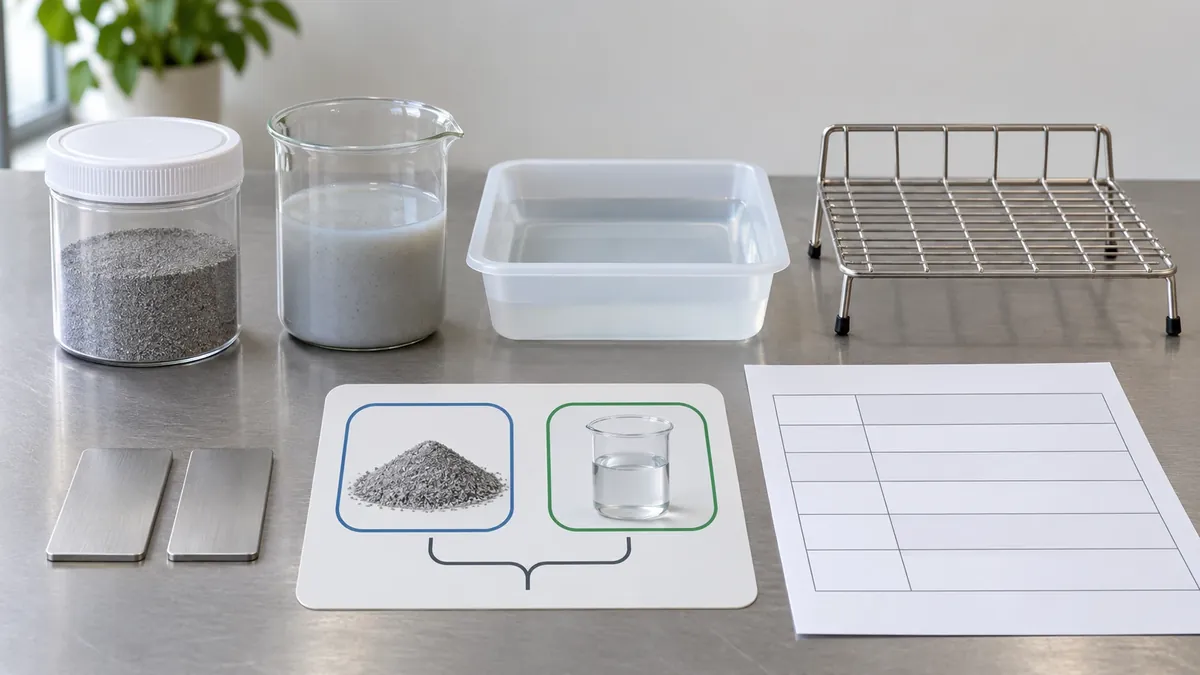
The flow diagram is useful because it exposes missing handoffs. If the proposal ends at “wet blast,” the buyer can ask who manages the liquid-containing process, whether rinsing is included, how the part is dried, and how the condition is confirmed before coating or packing. The questions should be answered for the actual process rather than copied from an unrelated machine brochure.
Do not infer that every wet route includes the same rinse or dryer. Some arrangements may use a defined rinse/dry sequence, while others may rely on a separate downstream operation. Confirm where responsibility lies and what record or sample is available. Similarly, do not assume the dry route is free from residual media or requires no cleaning. The particular process procedure governs what must happen next.
An importer can map the decision with four rows: material and part geometry; abrasive media; carrier route; and downstream release evidence. For each, record the supplier’s proposal, buyer’s acceptance, and any open question. If a visible surface is sensitive, keep a representative approved sample and define how it will be compared. If coating follows, identify the relevant coating or adhesion acceptance route separately rather than treating the blasting step as proof.
Compare a Representative Sample Before Approving the Route
A sample is more useful when it represents the features that matter. For a simple plate, a flat coupon may show one surface. For a welded basket, it may not represent wire intersections, inside corners, or shadowed areas. For a bent bracket, a wide face and a narrow edge may respond differently to the chosen process. The buyer should identify which geometry is relevant and whether the sample should be a coupon, formed piece, or representative finished component.
Before comparison, agree how the samples will be viewed and what result is being judged. A visual review should identify the lighting, orientation, distance or inspection context if those conditions affect the decision. A measurement should name the method and locations. If a coating is applied after blasting, the buyer should decide whether the pre-coating surface or the final coated part controls acceptance. These are different stages and should not be collapsed into one check.
Make sure the sample record names the route and media used. If the process supplier changed the abrasive, liquid condition, or other material, preserve that information with the sample. A sample without process identification may still be visible, but it cannot clearly confirm what production is supposed to repeat. The objective is a traceable comparison, not an assumption that the same generic term always creates the same result.
When a result is not acceptable, document the specific observation and location. “Surface not good” is difficult to act on. “Visible residue at the inside joint after the proposed wet route” or “texture differs from the reference on the exposed face” is more useful, provided it accurately describes what was observed. The supplier and buyer can then discuss whether the cause is media, process route, part access, cleaning, coating, or another factor. Do not claim a root cause until it is established.
| Review item | Buyer and supplier should record |
|---|---|
| Sample identity | Part or coupon, material, drawing revision, and finish stage |
| Route | Dry air-carried or liquid-assisted, plus the supplier’s process description |
| Media | Actual abrasive identity and size information proposed for the sample |
| Relevant features | Faces, joints, edges, corners, and geometry to be reviewed |
| Result | Observed appearance or agreed measurement, with location and date |
| Next operation | Rinse, drying, coating, inspection, or other handoff that applies |
| Decision | Accepted, rejected, or held pending clarification by the authorized reviewer |
This record template is a buyer-authored planning aid. It is not a formal inspection certificate, safety document, or evidence that a particular supplier has executed a process.
Common Claims That Need More Specific Evidence
“Vapor blasting always produces a smoother finish” is too broad. The result depends on the media, equipment, setup, part, and comparison method. Ask to inspect a representative sample and define the required surface appearance or measurement rather than accepting a universal adjective.
“Wet blasting eliminates all dust or hazards” is also too broad. The reviewed sources do not support an across-the-board safety conclusion, and this article gives no exposure or compliance advice. The responsible finishing provider should supply the applicable hazard controls and operating documentation. A liquid-assisted process still requires appropriate professional controls and should not be treated as risk-free.
“Wet blasting is automatically ready for coating” skips the handoff. The existence of liquid may make rinsing or drying relevant, but the label does not show whether those steps occurred or whether the surface meets the actual coating preparation requirement. Confirm the process sequence and the required evidence.
“Sandblasting means silica sand” should not be assumed from colloquial language. Ask what abrasive is actually proposed. Similarly, “vapor blasting” does not mean steam or a single mandatory bead. The process name does not replace a clear media and carrier specification.
Finally, “the sample passed” should identify who reviewed it, which reference or criterion was applied, and what is authorized next. Sample appearance, process conformity, and a purchase release are related but separate decisions. Record the outcome and any open condition before treating the route as accepted for the order.
Frequently Asked Questions
Is vapor blasting the same as wet blasting?
The terms are commonly used for liquid-assisted abrasive processes, but the label does not describe one universal machine arrangement. Ask the supplier how liquid is introduced and managed in the proposed system.
Does vapor blasting use steam?
The reviewed process descriptions involve liquid or water with air and abrasive media. The word “vapor” should not be taken as proof that steam is used. Confirm the actual method with the process provider.
Does vapor blasting use beads while sandblasting uses sand?
Not necessarily. Media selection is separate from whether the route is dry or liquid-assisted. Request the actual abrasive type and size information. The media comparison is covered in the linked bead-versus-sand guide.
Does wet blasting guarantee a smoother surface?
No universal result follows from the label. Compare representative samples under agreed criteria and record the media, route, part geometry, and finish stage.
Is a wet-blasted part ready for powder coating?
The process name alone cannot establish readiness. Confirm any required rinse, drying, handling, and coating-preparation checks for the actual part and agreed process.
The buyer can also use the process map to ask about responsibility at a supplier boundary. If one company performs blasting and another applies coating, identify who accepts the blasted part, who controls temporary storage, and what condition must be maintained before coating. If blasting and coating are performed by one supplier, the buyer still benefits from understanding where the blast stage ends and how the next operation is released. A general process description is not a substitute for the agreed responsibility matrix, but it can expose gaps before a sample or production lot is transferred.
For a multi-component product, consider whether all components need the same surface preparation. A flat mounting plate, a welded basket, and a thin formed hook may have different accessible areas and visible requirements. The team should not assume that one sample represents every geometry unless the sampling rationale is agreed. A supplier may propose one route for all items, but the buyer can request representative samples or identify a critical component when the product appearance or fit depends on it. This is a project decision, not a universal rule that every part needs a separate test.
Changes should be recorded at the point where they occur. If a sample was processed dry and a later proposal switches to wet processing, the buyer should see the change before treating the sample as proof of the new route. Likewise, if the media changes while the carrier remains the same, the sample may no longer represent the proposed production process. A revision note can state the old and new media, route, affected part, and whether re-approval is needed. That trace keeps the process description aligned with the product requirement.
Another point to challenge is a claim that an equipment feature guarantees a result. A circulation loop, filtration unit, separator, or rinse station may be part of a particular installation, but its presence alone does not prove that the part received the required treatment or that the resulting surface meets an acceptance criterion. Ask for the process description and evidence tied to the actual sample or lot. Avoid extrapolating from brochure photography or a machine specification to production quality.
When a finishing supplier cannot disclose a proprietary setting, the buyer can still define observable requirements and request an approved sample. The record can state the product identity, media description at an appropriate level, wet or dry route, relevant downstream steps, and comparison method. If a change is proposed, the parties can decide whether it needs another sample. This practical route respects confidential process details while preventing a vague label from silently substituting for a controlled product requirement.
It is also useful to separate a process requirement from a commercial preference. The buyer might ask for an appearance, cleanliness, or coating-preparation result, while the supplier recommends a method to achieve it. The supplier method remains a proposal until its suitability is reviewed and agreed for the part. If the buyer instead prescribes a particular route, that requirement should still define the intended result and acceptance evidence. Neither party should assume that a familiar process name settles all project details.
The purchase record can preserve this distinction by listing the product requirement in one field and the supplier’s proposed process in another. A sample approval can then state whether it approves only the observed appearance, the described process, or both. If a process substitution occurs later, the buyer can decide whether the change affects the approved requirement. This avoids treating a process name as a substitute for the contractual specification or for a product-level review.
If the part is destined for a coating operation, keep the blast sample and coated sample identifiable as separate stages. The blast stage may be reviewed for a specified surface condition, while the coating stage may have its own appearance or performance criteria. A result at one stage does not automatically establish the outcome at the next. The buyer should state which record supports each decision and who has authority to release the next step. This is especially helpful when the process provider and coating supplier are different companies.
Vapor blasting vs sandblasting leaves separate approval questions about abrasive identity, liquid handling, and the condition required before the next operation.
Review a surface-preparation requirement
Share the part drawing, material, finish target, proposed abrasive route, and representative sample requirement so the manufacturing scope can be reviewed.
OEM / PRIVATE LABEL
Turn this sourcing guide into a product brief
Share your target product, size, finish, order quantity and packaging requirements. Your team receives a practical manufacturability review before quotation.


 English
 Español
 Português
 Français
 Deutsch
 العربية