
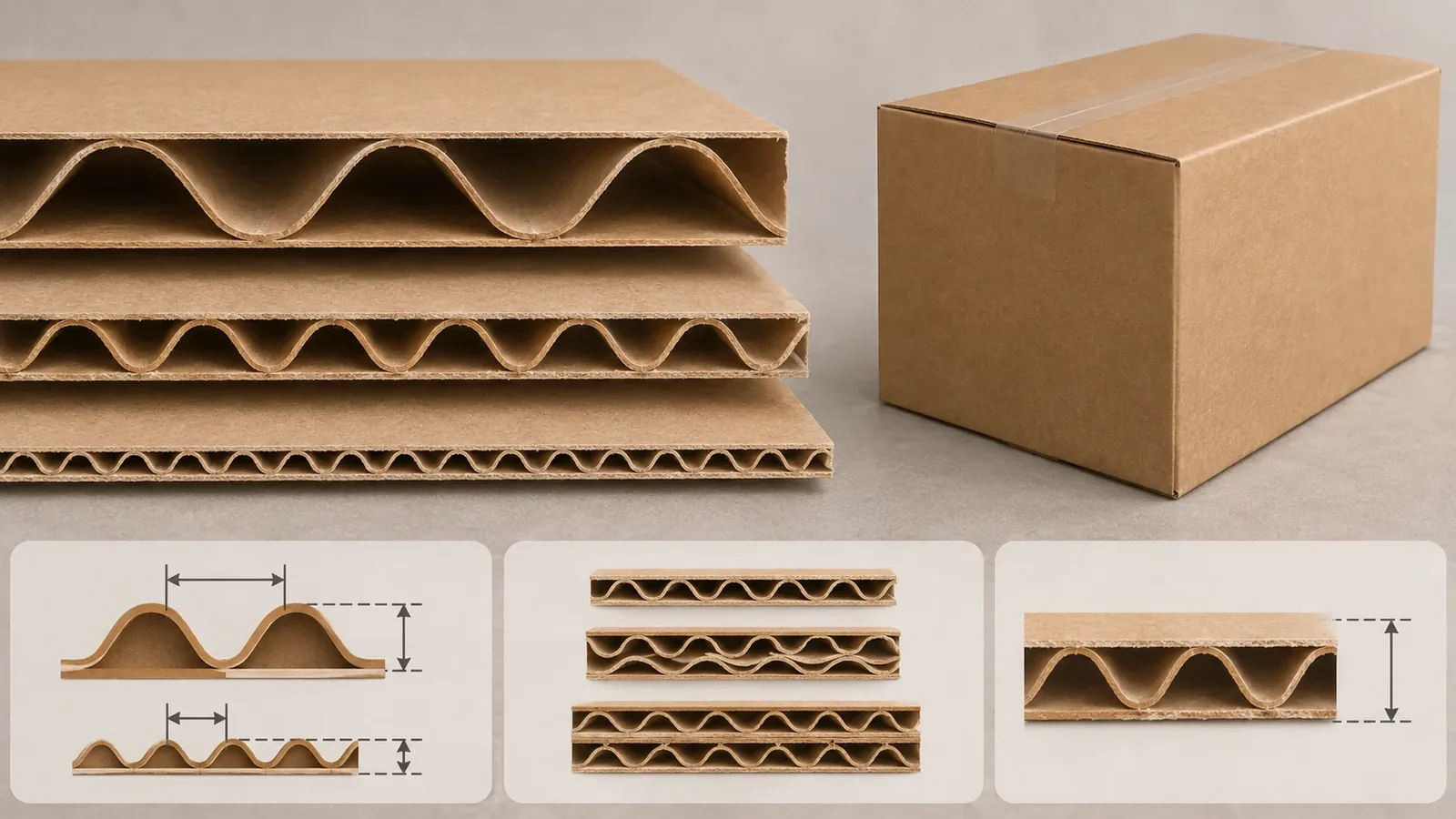
Corrugated flute sizes such as A, B, C, E, and F name profile families, not exact finished-carton thicknesses or alphabetical strength grades. A flute designation can be associated with an approximate number of corrugations per foot, but that count describes spacing, not the arch height or the total thickness of a finished board. Wall count, liner construction, and finished caliper are separate specification questions. Buyers should confirm the actual board construction and measured sample with the packaging supplier when carton fit or pack-out depends on thickness.
What Do Corrugated Flute Sizes Describe?
The flute is the wave-shaped corrugated medium between flat liner sheets. Flute families such as A, B, C, E, and F describe profile types. The Fibre Box Association presents approximate flute counts per foot for these families and notes that the actual count can vary within a designation because roll profiles vary. Those counts help describe spacing frequency; they are not a promise that every supplier’s board has one identical physical profile.
For orientation, the Fibre Box Association lists approximate values of A 33, B 47, C 38, E 90, and F 125 flutes per foot. These are approximate family references, not a drawing tolerance or a finished-box performance rating. The count tells a buyer roughly how many waves occur along a foot of medium. It does not state the wave’s vertical height, the number of corrugated layers in the board, the liner thickness, or the total caliper of the assembled board.
The alphabetical labels should not be read as a universal ranking. A letter identifies a family of profiles; it does not alone specify whether a carton is stronger, more protective, or better for a given product. Actual package performance depends on the complete board construction and box geometry, together with the product, pack-out, and shipping conditions. This article does not compare load capacity or transit performance based on flute letters.
The Fibre Box Association’s explanation of corrugated board is a useful family-level reference. It describes flute families and combined board, while the dimensional distinctions below explain how a buyer can avoid treating a frequency number as a thickness measurement.
How Is Flute Spacing Different from Flute Height and Board Caliper?
Flute spacing, flute height, and total board caliper describe different dimensions. Spacing is measured along the direction of the waves: it indicates how frequently the corrugations repeat. Flute height is the vertical dimension of an arch between liners. Caliper is the overall thickness measured through the assembled board from its outer surface to the opposite outer surface. The corrugated medium and liner sheets contribute to the finished thickness.
These dimensions are related by the board construction, but they are not interchangeable. A buyer who asks only for a flute letter may not have specified the carton thickness required to fit a metal shelf, hardware kit, or inner tray. A supplier’s flute designation may also fail to capture the final caliper after the liners and corrugated medium are combined. If the fit of the packed product is sensitive, request the supplier’s actual board specification and verify a representative sample using the agreed measurement approach.

A Worked Pitch Example
The difference can be illustrated with a simple unit calculation. One foot equals 304.8 millimeters. If a reference lists an approximate 38 flutes per foot for C flute, dividing 304.8 millimeters by 38 gives an average repeat spacing of approximately 8.0 millimeters. This is an authored calculation from the approximate count, not a measured board profile or a supplier tolerance.
That 8.0-millimeter result is an average pitch along the sheet. It is not an 8.0-millimeter flute height. It is also not an 8.0-millimeter total board caliper. The calculation does not tell the buyer how high the arch rises between liners, how thick the liners are, or what the total finished board measures. Confusing pitch with caliper would produce a false dimension in a carton specification.
The same arithmetic can help a buyer understand why a flute-count chart should be treated as a profile-spacing reference only. If two suppliers list a similar family name but use rolls with slightly different profiles, their individual flute counts and resulting board construction may not match exactly. The family designation can help organize the comparison; the physical specification and sample resolve what is actually being supplied.
| Quantity | Direction or reference | What it tells the buyer | What it does not tell the buyer |
|---|---|---|---|
| Flute count per foot | Along the repeating wave pattern | Approximate profile frequency | Finished board thickness or package performance |
| Flute pitch | Distance along the sheet between repeated profile positions | Approximate spacing between waves | Vertical arch height or total caliper |
| Flute height | Across the depth of the corrugated medium | Approximate arch dimension between liner levels | Complete assembled-board thickness on its own |
| Board caliper | Through the completed board | Overall board thickness for fit and pack-out review | Carton strength or transit approval by itself |
| Wall count | Number and arrangement of corrugated layers | Single-wall, double-wall, or another construction distinction | The exact flute profile or finished caliper by itself |
Why Do Published Thickness References Differ?
Published thickness figures can differ because they may describe different products, profiles, measurement conventions, or approximate nominal references. They may also refer to flute height rather than total finished-board caliper. A chart that gives one number next to a flute letter should not be assumed to establish a universal dimension unless its scope, units, and method are clear.
For example, Packsize publishes approximate references of B flute at 1/8 inch and E flute at 1/16 inch. Converted for orientation, these are approximately 3.2 millimeters and 1.6 millimeters. Those are the nominal examples stated by that guide; they should not be treated as guaranteed flute heights, universal finished-board calipers, or acceptance tolerances for every supplier. The buyer should retain the source label when using the figures and compare them with the proposed board’s actual specification.
Other published tables may use different references or contain inconsistent unit conversions. The saved review for this topic found differences among available charts, including a C-flute reference that did not match Packsize’s examples. Rather than combining the most favorable numbers into one apparent standard, this article keeps the sources separate and avoids claiming a universal thickness table. A practical request to the packaging supplier should state the intended flute family and ask for the specific board construction and finished caliper being quoted.
The Packsize overview of corrugated board types provides its own approximate B and E references. Those examples are useful as source-labeled context, not as a substitute for the named supplier’s product data. If carton clearance depends on an exact dimension, the buyer should measure the actual sample or require a stated caliper from the responsible packaging supplier.
How Do Wall Count and Flute Direction Fit In?
Wall count and flute direction answer questions separate from flute size. Wall count describes how many corrugated mediums and liners are combined in the board construction. Flute direction describes the orientation of the corrugations relative to the carton panels or product. A flute letter alone does not state either one.
For example, a buyer may need to compare single-wall and double-wall packaging, but that comparison involves the overall board build, not only whether one layer uses A, B, C, E, or another profile. Similarly, a buyer may need to specify panel orientation, but orientation cannot be inferred from the flute family. Keep these variables visible in the packaging quotation rather than assuming that a flute designation supplies all packaging information.
The existing single-wall versus double-wall carton guide covers wall-count construction, while the flute direction and compression discussion focuses on orientation and its separate implications. The corrugated versus cardboard explanation addresses material terminology. These topics have distinct roles: they should not be collapsed into a single flute-size definition.
Keeping these questions separate improves the buyer’s comparison table. A quote can list flute family, wall count, liner and medium description, board caliper, box dimensions, and required package evidence as separate fields. The buyer can then ask the packaging supplier to confirm any unknown dimension rather than treating a letter as a complete packaging specification.
What Should an Importer Specify for a Hardware Carton?
An importer should specify the packaging details that affect the product’s actual fit and buyer requirement. The responsible packaging maker supplies the corrugated board; the hardware buyer or OEM supplier should not imply that a metal-hardware factory manufactures corrugated stock unless that is independently confirmed. For a metal rack or basket carton, a clear pack-out record can identify the carton size, intended board build, flute family if specified, total wall count, finished-caliper reference, dividers or inserts, and any sample or packaging test evidence agreed by the parties.
| Buyer field | What to request or record | Reason for keeping it separate |
|---|---|---|
| Flute family | A, B, C, E, F, or the supplier’s stated profile | Identifies the approximate profile family, not exact thickness |
| Board build | Number and arrangement of liners and corrugated mediums | Distinguishes wall count and combined construction |
| Finished caliper | Supplier-stated or buyer-measured overall board thickness, with method if specified | Helps review fit and pack-out dimensions |
| Carton dimensions | Inside and outside dimensions when relevant to the project | Clarifies space available for product and protective materials |
| Pack-out components | Dividers, pads, bags, inserts, or other included parts | Shows how the actual product is positioned within the carton |
| Reference sample | Identified packaging sample and revision where used | Keeps a comparison tied to a known physical configuration |
| Test or transit evidence | The specific method and report agreed for the shipment | Prevents flute letters from being mistaken for proof of performance |
The correct list depends on the project. If the package contains nested wire baskets, the buyer may need to discuss separation and abrasion control with the responsible packaging supplier. If a metal rack has a tight clearance, actual carton and insert dimensions may matter more than an approximate flute-height chart. If the buyer has a transport test requirement, the test result must identify the board and pack-out that were actually assessed. None of these conditions can be resolved from the flute letter alone.
For a sample, confirm that the measured board is the same construction intended for production. Record the sample source and date, identify the flute family and wall count if the supplier has provided them, and note how caliper was obtained. Do not assume that a sample’s one measurement represents every packaging lot unless the supply agreement defines the control and tolerance.
The corrugated panel stiffness and box compression guide covers another distinct packaging question: panel behavior and box geometry. A flute-size label does not establish the box’s compression result. Keep test requirements and performance conclusions tied to the evidence for the exact board and carton design.
What Mistakes Should a Buyer Avoid When Comparing Quotes?
One common mistake is treating a flute letter as an exact thickness. A, B, C, E, or F is a profile-family designation. If clearance depends on a dimension, ask for the finished-board caliper and define the measurement reference instead of converting a flute count into thickness.
Another mistake is treating the flute count as flute height. Counts per foot describe approximate frequency along a length. They do not provide the vertical arch dimension. A buyer can calculate average pitch as an explanatory comparison, but must not label that pitch as arch height or board caliper.
A third mistake is assuming that a higher count or later letter means stronger packaging. The family label is not a universal strength grade. Board construction, wall count, box geometry, liners, pack-out, and other conditions affect the package. This guide makes no strength ranking based on flute letters.
A fourth mistake is mixing reference values from different suppliers into a table that appears to be an official standard. If a source gives approximate figures, identify that source and keep its scope visible. When references differ, ask the packaging supplier which profile and finished board are being offered. Do not merge numbers just to create one definitive chart.
A fifth mistake is confusing the corrugated medium with the complete board. The medium is the wavy layer, while liners form the flat outer surfaces. Their assembled thickness is different from the flute’s frequency or height. A specification that mentions only the medium may not tell the buyer the final carton thickness.
A sixth mistake is using flute size to infer a transit-test result. A family designation does not prove a carton has been tested with the buyer’s product, pack-out, or route. If shipping performance is a requirement, agree on the relevant package configuration and evidence with the responsible parties. Do not describe an untested package as approved based on a nominal flute label.
Finally, avoid assuming that the factory supplying metal hardware also supplies corrugated board. Identify the packaging maker and preserve supplier responsibilities. Koitor’s approved scope includes packaging preparation and buyer communication around hardware projects, but it does not establish corrugated-board production or an in-house packaging laboratory.
How Can a Buyer Review a Corrugated Sample?
Review the sample against the fields in the purchase specification. Confirm which flute family and wall count the supplier says it represents. Ask for the board’s stated caliper if thickness matters, then measure the sample using the agreed method. Compare the sample with the carton drawing and the product pack-out rather than assuming that a familiar letter guarantees the same fit across suppliers.
Inspect a cut edge or cross-section to see the liners and corrugated medium. The profile may look different at different points, which is consistent with the source’s warning that a family designation can vary. The visual sample can help the buyer understand construction, but it does not establish compression strength, cushioning performance, or transit suitability without the appropriate agreed evidence.

If the board is too thick or thin for the planned pack-out, do not change the flute family by guesswork alone. Tell the packaging supplier which fit issue needs resolution and ask for a revised board or carton sample with its specification. The supplier may propose a different combination of profile and liner build; the buyer should review the actual dimensions and packaging evidence rather than approving a letter in isolation.
Keep packaging revisions controlled. If the carton or insert changes after the hardware sample has been approved, review how that change affects the pack-out, product protection requirements, dimensions, and buyer-facing package information. A packaging sample is useful only when its revision is known and it can be traced to the quotation and shipment configuration.
If two supplier samples differ, compare the same measurable attributes side by side. Record the flute family each supplier identifies, the stated wall build, the sample’s measured caliper, and the location where the measurement was taken. Ask whether the result represents the quoted production board or only an illustrative sample. Differences can then be discussed as observable construction or dimension changes instead of an assumed quality ranking based on the profile letter.
For an importer managing a packed metal product, coordinate the packaging review with the product and pack-out review. A carton that fits one hardware revision may not fit a later revision with a different insert or accessory set. Identify the product version, carton drawing, insert configuration, and supplier sample clearly in the same record. This does not predict transit performance, but it helps the team confirm that the packaging being ordered is the packaging actually evaluated.
Frequently Asked Questions
What does a corrugated flute size identify?
It identifies a profile family such as A, B, C, E, or F. A flute family may be associated with an approximate number of corrugations per foot, but that count describes spacing frequency. It does not specify a universal finished-board thickness or performance result.
How many flutes per foot are in A, B, C, E, and F profiles?
The Fibre Box Association lists approximate reference counts of A 33, B 47, C 38, E 90, and F 125 per foot, while noting that profiles can vary within a designation. Treat the figures as approximate source references, not exact tolerances or guarantees for a supplier’s board.
Does 38 flutes per foot mean the board is 8 millimeters thick?
No. Dividing 304.8 millimeters in one foot by 38 gives about 8.0 millimeters of average spacing between repeated profile positions. That is flute pitch along the sheet, not flute height or finished board caliper.
Is B flute always 1/8 inch thick and E flute always 1/16 inch thick?
Those are approximate references published by Packsize for its guide, not universal finished-board calipers or acceptance tolerances. Retain the source and confirm the actual product specification and sample with the packaging supplier.
Does a flute letter tell me whether the board is single-wall or double-wall?
No. Flute size and wall count describe different construction features. Ask the supplier to state the number and arrangement of the corrugated mediums and liners separately.
Can I infer carton strength from a flute family?
No. A flute letter alone does not establish a box compression or transit-test result. Performance must be tied to the actual board, carton design, pack-out, conditions, and agreed test evidence.
Who should confirm a carton thickness for a hardware order?
The responsible packaging supplier should state the construction and actual finished caliper. The hardware buyer can review the sample and pack-out dimensions, then record the agreed specification and reference sample.
Does Koitor manufacture corrugated board?
This article does not claim that Koitor produces corrugated stock or operates a packaging test laboratory. Koitor is a custom metal bathroom and home-storage hardware factory; packaging materials and board specifications should be confirmed with the responsible packaging supplier.
The dimensions on a packaging drawing also need a reference convention. A supplier might report board caliper measured by an identified method, while a drawing gives internal or external carton dimensions. Those are different observations. A buyer who specifies only the outside size may still need to confirm how the packed product fits after liners, dividers, inserts, or protective wraps are added. A sample packed by hand can reveal fit issues that a board grade description cannot. It does not replace an agreed dimensional check, but it can show where folds and protective components consume space.
When a supplier proposes a flute substitution, ask which parts of the proposal change and which acceptance evidence remains relevant. If the flute changes but carton dimensions remain constant, usable interior space may change. If external dimensions change, palletization and freight planning may also be affected. These are conditional consequences to review against the actual pack; the letter name alone cannot quantify them. Record the previous and proposed constructions together so the buyer, packaging supplier, and product supplier are evaluating the same revision.
The buyer should also distinguish a board sample from a finished, assembled carton. A flat sample can help identify a profile or construction, but it does not show how the converted box folds, how closures meet, or how the packed hardware sits in its protective inserts. If carton fit or product movement matters, review the actual pack-out and identify the test or inspection evidence needed. Keep the board construction, carton dimensions, and pack configuration linked to the same packaging revision.
Corrugated flute sizes should be compared as profile families alongside the actual board build and finished-carton dimensions.
Review a hardware pack-out requirement
Share the metal product drawing, carton dimensions, pack-out arrangement, and confirmed packaging-supplier specification so the project scope can be reviewed. Corrugated-board construction and testing should be confirmed by the responsible packaging supplier.
OEM / PRIVATE LABEL
Turn this sourcing guide into a product brief
Share your target product, size, finish, order quantity and packaging requirements. Your team receives a practical manufacturability review before quotation.


 English
 Español
 Português
 Français
 Deutsch
 العربية