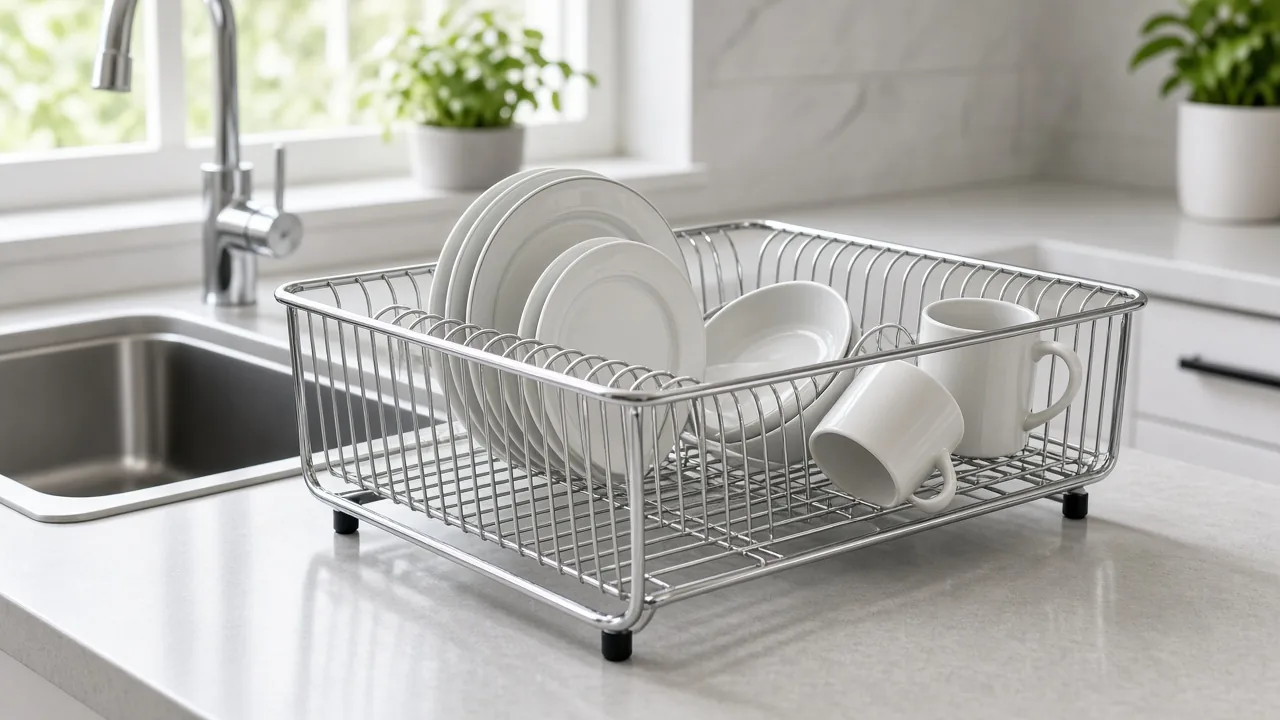

Importers who buy a chrome dish rack often learn that “bright chrome finish” is not a purchase specification. Sink splash, detergent wipe-downs, nested cartons, and daily plate loads punish porosity, thin chromium, weak adhesion at welds, and packaging scuffs long after the sample looked mirror-perfect. This guide is a buyer and OEM defect catalog for chrome-plated kitchen wire dish racks: nine named plating and stability defects, photo-spec labeling, RFQ language, and clear accept / rework / reject rules—not a rewrite of a general kitchen product catalog page.
Use it beside your drawing package and IQC checklist. Keep process depth—wire forming, spot welding, and finish stacks—in the manufacturing playbook when you audit a line. Photos in this article are generic visual starting points for RFQ language; they do not claim that every SKU ships from one factory.
Contents: why plating defect language matters · how to spec a chrome dish rack finish · nine plating and stability defects · accept / rework / reject rules · RFQ and IQC checklist language · FAQ · how to send a brief for review.
- Why Plating Defect Specs Matter for Kitchen Wire Hardware
- How to Spec a Chrome Dish Rack Finish for RFQ and IQC
- 9 Chrome Dish Rack Plating Defects to Photo-Spec Before PO
- Accept, Rework, or Reject Decision Rules for IQC
- RFQ and IQC Checklist Language for Chrome-Plated Racks
- FAQ: Chrome Dish Rack Plating and Defect Specs
- Send Your Chrome Dish Rack Spec for Review
Why Plating Defect Specs Matter for Kitchen Wire Hardware
A kitchen wire dish rack combines dense weld grids, plate slots, cup holders, cut wire ends, and often small tip feet or rubber tips. Those geometries make decorative nickel-chromium stacks uneven even when the plating line looks busy. A buyer who only writes “chrome plated, bright” leaves the factory free to ship porous flats, nickel show-through on crowns, wipe stains from poor rinsing, and weld zones where burn-through sits under a thin flash of chrome.
Retail returns rarely say “service condition number” or “chromium discontinuity.” They say “rust spots,” “yellow chrome,” “looks dull,” “tips over,” or “scratched out of box.” Your RFQ and acceptance plan must translate those complaints into named defects with measurable CTQs. That is the job of this article. Category breadth—dish racks, sink baskets, and related organizers—belongs on the kitchen storage product page. Here we stay on what buyers must call out, photograph, and disposition before the PO.
What “good enough” looks like beside a wet sink
A durable chrome dish rack beside a sink keeps continuous decorative chromium over nickel on customer-facing wires, resists early rust bleed from pores, survives wipe cleaning without cloudy residue patterns, and stands without tipping under a realistic plate load. Weld zones look cleaned and plated, not charcoal-black under a thin flash. Packaging leaves no metal-showing scuffs on A-surfaces. Tip geometry and foot pads keep the rack stable on a wet counter.
Where OEM cost pressure creates hidden risk
Common commercial pressure points include shorter nickel time, thinner chromium to raise rack throughput, aggressive polishing that leaves haze, soft nested packing to cut cube cost, and skipping adhesion or porosity checks on dense weld corners. Each pressure point maps to one or more of the nine defects below. If your PO does not name the defect, photo evidence, and disposition, IQC will argue taste instead of contract.
Importer failure modes that start as “chrome complaints”
Most plating returns for kitchen wire goods cluster into six commercial stories: rust freckles after a few wet weeks, yellowish or dull nickel look, cloudy wipe marks that never buff out, dark weld patches that photograph poorly, racks that tip when half loaded, and scuffed units out of the carton. Each story maps to one or more named defects in this catalog. If your claim system only codes “finish issue,” you cannot trend root causes or hold a supplier to a CAPA that cites DEF-02 versus DEF-06.
Private-label teams also need defect language for chargebacks and for comparing two factories that quote the same “bright chrome.” Without photo masters, the cheaper quote often wins on sample day and loses on the third production lot when porosity and packaging scuffs return. Treat the chrome dish rack finish as a documented product characteristic, not a commodity flash plate.
Boundary with category and process pages
This post does not re-list every kitchen SKU or re-teach CNC bending and packaging CTQs end to end. Those belong in the product category page and the wire basket manufacturing playbook. Buyers still must know when a defect points upstream: porosity and nickel exposure often implicate bath control and current density; weld burn-through under plate implicates weld heat and grind prep; packaging scuffs implicate nesting and bagging. Use defect IDs in the nonconformance report, then open the process checklist with the factory engineer.
How to Spec a Chrome Dish Rack Finish for RFQ and IQC
Write every plating requirement as a closed loop: defect name, where it is inspected, how it is measured or photographed, severity class, and disposition. Ambiguous words such as “nice chrome,” “no rust soon,” or “mirror finish” fail under dispute. For a chrome dish rack program, treat decorative plating as a CTQ family equal to weld integrity, tip stability, and dimensional fit.
Photo-spec labeling that survives email and WhatsApp
Golden-sample photos work only when each image carries a label block: SKU, finish code, viewing distance, light type (D65 / daylight / shop LED), magnification if macro, and defect ID from your catalog (for example, DEF-01 Porosity). Mark accept / borderline / reject on the same frame or an adjacent annotated crop. Store the labeled set in the first-article pack so production IQC is not comparing against a faded chat screenshot.
Plating and adhesion wording that matches official standards
For decorative copper-nickel-chromium or nickel-chromium electrodeposits on steel, buyers commonly reference ASTM B456 classification language (service condition and coating designation) as a framework—then lock the exact stack, thickness targets, and appearance limits in the product drawing.
For qualitative adhesion of metallic coatings, cite a named method from ASTM B571 (for example bend, heat-quench, or scribe/pry as agreed) on defined locations. For an international designation system covering nickel plus chromium and copper plus nickel plus chromium decorative coatings, align terminology with ISO 1456 when your market or dual-source plants prefer ISO wording.
Do not mix ASTM and ISO rating numbers without stating which standard applies. Salt-spray hours, if required, belong in your product specification with apparatus practice, specimen type, and acceptance limits—never as a lonely hour number copied from another SKU family.
CTQ table starters for RFQs
Minimum CTQs for most chrome dish rack RFQs include: plating stack identity (Ni+Cr or Cu+Ni+Cr) and minimum thickness on flats and wire crowns; adhesion method and pass rule; visual defect catalog with photo limits; wipe-stain and haze criteria after defined cleaning; weld-zone appearance limits; tip stability under a stated plate load and countertop condition; and packaging abrasion criteria after drop or vibration simulation if you ship densely nested cartons.
Add corrosion chamber testing only when your channel truly needs it—and when you can fund production-representative wire specimens, not only flat panels that ignore grids.
Finish stack choice versus stainless programs
Chrome on carbon steel remains common for mirror aesthetics at a value price. Some programs move to stainless with brushed or polished faces when chloride and warranty risk dominate. That decision is a finish-stack problem, not a synonym swap. When you compare chrome-plated mild steel against stainless options, use the material and finish selection logic in our SS304 vs SS201 surface finish stack selection guide so warranty language matches substrate reality. This defect catalog still applies whenever you keep a decorative chrome stack on wire kitchen goods.
Documentation that survives staff turnover
Buyer teams change; factories change inspectors. A chrome dish rack program that lives only in chat threads will drift. Keep the defect catalog, photo masters, and CTQ table in a controlled folder with revision dates. Require suppliers to echo the same DEF IDs on their IQC sheets. When a new merchandiser asks why a lot was rejected, the photo-spec should answer in one page.
If you run dual sourcing, freeze the catalog before awarding the second tool. Competing plants should not invent local nicknames for nickel exposure or wipe stains. Harmonized language is how you compare true process capability instead of comparing who writes the friendlier inspection report.
9 Chrome Dish Rack Plating Defects to Photo-Spec Before PO
Name these nine defects in the purchase specification for every chrome dish rack finish. Keep the IDs stable across SKUs so IQC and suppliers share one vocabulary. Severity can differ by retail tier, but the names should not.
For each defect, keep four fields in your workbook: definition, primary buyer risk, measurement or photo method, and default disposition. The narratives below are starting points for that workbook. Adjust severity for hospitality versus mass retail, but keep IDs and photo geometry consistent so multi-factory programs stay comparable.
Also record whether the defect is judged on the finished assembly, on a plating coupon, or both. Wire dish racks hide risk when coupons are flat panels that never see dense grids. Prefer production-representative pieces for visual CTQs and, when practical, for adhesion spots agreed at first article.
1. Porosity (DEF-01)
Definition: microscopic or visible discontinuities in the chromium (and sometimes nickel) layer that create moisture paths to nickel or steel. On a chrome dish rack, pores near welds, cut ends, and wire crowns are high risk beside a sink. Causes include bath contamination, poor cleaning, incorrect current density, or inadequate nickel leveling before chrome.
Buyer impact: rust freckles and brown bleed that appear weeks after IQC. Spec tip: zero tolerance for visible pores on A-surfaces under agreed light and distance; optional porosity screening method if your lab capability supports it. Photo-spec: macro accept/reject under the same light. Disposition: reject for visible porosity on wet-zone faces; do not “touch up” with chrome paint pens if you claim electrodeposited integrity.
2. Nickel exposure (DEF-02)
Definition: yellowish, dull, or distinctly nickel-colored show-through where chromium is thin, missing, or worn. Common on high-current burn zones, sharp edges, and poorly racked parts. Buyer impact: “cheap yellow chrome” returns and uneven color across a set. Spec tip: require chromium coverage on marked crown and edge CTQ points; compare to master under D65. Disposition: reject when nickel is visually dominant on facing wires; investigate racking and chrome time before authorizing strip and replate.
3. Wipe stains and drying marks (DEF-03)
Definition: cloudy streaks, water spots, rinse residue, or fingerprint-like haze that remains after a defined wipe with an agreed cloth and cleaner. Often from poor final rinse, hard-water drying, or oily fingerprints after plating. Buyer impact: units look dirty in retail photography even when thickness is fine. Spec tip: define wipe method, cleaner chemistry allowed, and viewing conditions; distinguish removable shop dust from baked-on residue. Disposition: rework by approved cleaning only if metal is not attacked; reject if marks return after the defined wipe or if etching is visible.
4. Weld burn-through under plate (DEF-04)
Definition: dark, blistered, or cratered weld heat damage that remains visible after grinding and plating—chrome flash over a burned joint. Causes include excessive weld current, inadequate grind/polish prep, or plating over slag and oxide. Buyer impact: structural doubt in photos and early corrosion at the joint. Spec tip: require weld appearance masters before and after plating; ban “plate over black” on A-surface joints. Disposition: reject A-surface burn-through; limited rework only if strip, re-prep, and replate are controlled and adhesion is revalidated.
5. Rack tip instability (DEF-05)
Definition: the assembled chrome dish rack tips, rocks, or lifts a foot under a defined plate load or when loaded on one side, on a level wet countertop. Causes include asymmetric weld frames, bent feet, missing or hard rubber tips, and center-of-gravity errors in the design.
Buyer impact: spills, broken plates, and high return rates that are blamed on “quality” even when plating is fine. Spec tip: state test surface, load pattern (for example N plates of mass M on named slots), and maximum tip angle or pass/fail rock. Photo-spec: video or still of the loaded test. Disposition: reject unstable units; tooling or tip-part change before the next lot—do not “accept with foam” as a silent waiver.
6. Packaging scuffs (DEF-06)
Definition: rub-through, polish marks, or edge wear from part-to-part or part-to-carton contact in transit. Often misclassified as a plating-line defect when the root cause is nesting, missing bags, or abrasive corrugate. Spec tip: define bag type, divider, and maximum abrasion after agreed shipping simulation; photograph accept/reject rub marks. Disposition: rework or reject based on whether nickel or steel is exposed; fix packaging before releasing the next lot.
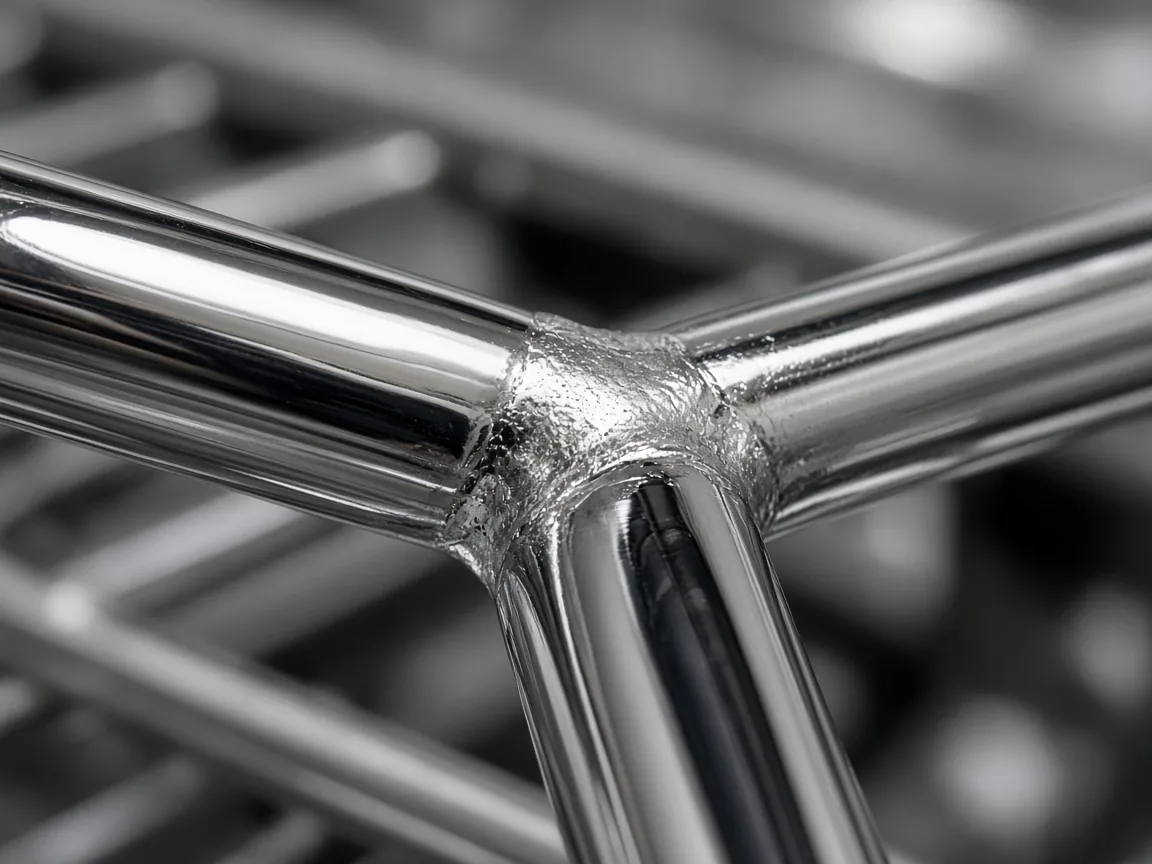
Finally, train both supplier IQC and your inbound auditors on the same accept/rework/reject examples once per season. A fifteen-minute photo review of DEF-02 nickel exposure and DEF-06 packaging scuffs prevents most “why did you reject this” emails. Keep the chrome dish rack defect catalog beside the weld and dimensional sheets so finish is never treated as an afterthought when the line is late.
FAQ: Chrome Dish Rack Plating and Defect Specs
Is light haze always a reject?
No. It depends on your photo-spec and brand tier. Heavy haze on facing surfaces usually fails retail photography; light draw lines on rear wires may be acceptable if labeled.
Why can flats pass thickness while crowns look yellow?
Current density and racking effects thin chromium on crowns and edges. If CTQ crown points are not measured, a chrome dish rack can pass paperwork and fail in the kitchen photo. Always specify crown locations.
Should every PO require salt spray?
Not always. Chamber tests are expensive and apparatus practice does not by itself define pass/fail for your product. Use them when channel risk justifies representative specimens and clear rating limits. Many programs start with adhesion, thickness on crowns, wipe gates, weld masters, tip stability, and packaging rules.
Can IQC accept spray chrome touch-up?
Usually no for OEM electrodeposited claims in wet zones. Spray touch-up rarely matches film integrity and often becomes a corrosion starter. Prefer reject or controlled strip/replate.
How many photo masters do we need?
At least one accept and one reject per high-risk defect (porosity, nickel exposure, wipe stains, weld burn-through, packaging scuffs). Keep revision control. Update when bath chemistry or polish method changes.
Does stainless wire remove the need for plating specs?
If you switch the program to bare or brushed stainless, plating defect IDs for chrome may no longer apply—but you still need finish, weld, tip, and packaging language. Many dish racks remain chrome-plated steel for mirror look and cost. Material choice does not replace defect language for the finish you actually buy.
Where do process controls fit?
Use this defect catalog for acceptance language. Use the wire basket manufacturing playbook for forming, welding, finishing, and packaging CTQs when you audit the line. Use the kitchen storage category page when you are still selecting the SKU family.
How should we label severity on the nine defects?
Start with adhesion peel, porosity with active bleed, A-surface weld burn-through, and tip instability as critical or top major. Nickel exposure and high-current burn on facing wires are usually major trending critical. Wipe stains, mild haze, and non-exposing scuffs are often major or minor by brand. Publish the class next to each DEF ID in the RFQ so AQL switching rules are unambiguous.
What belongs in the first-article pack?
Include labeled photo masters, thickness map, adhesion evidence, wipe-test photos, tip-stability record, packaging method photos, and a signed defect catalog revision. For a chrome dish rack launch, that pack prevents “we never agreed” debates three lots later.
Can we use the same catalog for Cu+Ni+Cr and Ni+Cr?
Yes for defect names. Stack differences still matter for corrosion margin and cost, so keep the stack identity in the finish clause. Do not assume a thin Ni+Cr flash will survive condensate because the defect catalog looks complete.
Send Your Chrome Dish Rack Spec for Review
If you are building or revising a chrome dish rack program, bring a short brief: target market and sink-side expectations, wire diameter and weld density, plating stack and thickness targets, draft CTQ table (flats/crowns, adhesion method, DEF-01–09 photo limits, tip-stability test), packaging method, and whether corrosion chamber evidence is required. Koitor Hardware supports OEM kitchen wire storage programs from Jiangmen, China, with practical RFQ and IQC language—without pretending one plating recipe fits every SKU.
Share drawings and labeled photo masters via our contact page or email simon@koitorhardware.com. We can help you turn the nine defects above into a supplier-ready acceptance sheet before the next production release.
Recommended attachments: PDF defect catalog with DEF-01–09, two photo masters per high-risk defect, draft CTQ table, tip-stability protocol, and packing method photos. If you already buy from multiple plants, send one failed lot report with unlabeled photos—we can help map them to defect IDs before you renegotiate the supplier quality agreement.
Photo disclaimer: Images in this article are generic visual examples for RFQ and IQC discussion. They are not a claim that every pictured unit is a Koitor production SKU.
OEM / EIGENE MARKE
Verwandeln Sie diesen Beschaffungsleitfaden in ein Produktdossier
Teilen Sie uns Ihr Zielprodukt, die Größe, die Oberflächenausführung, die Bestellmenge und Ihre Verpackungsanforderungen mit. Ihr Team erhält vor der Angebotserstellung eine praxisorientierte Prüfung der Herstellbarkeit.
 English
 Español
 Português
 Français
 Deutsch
 العربية