
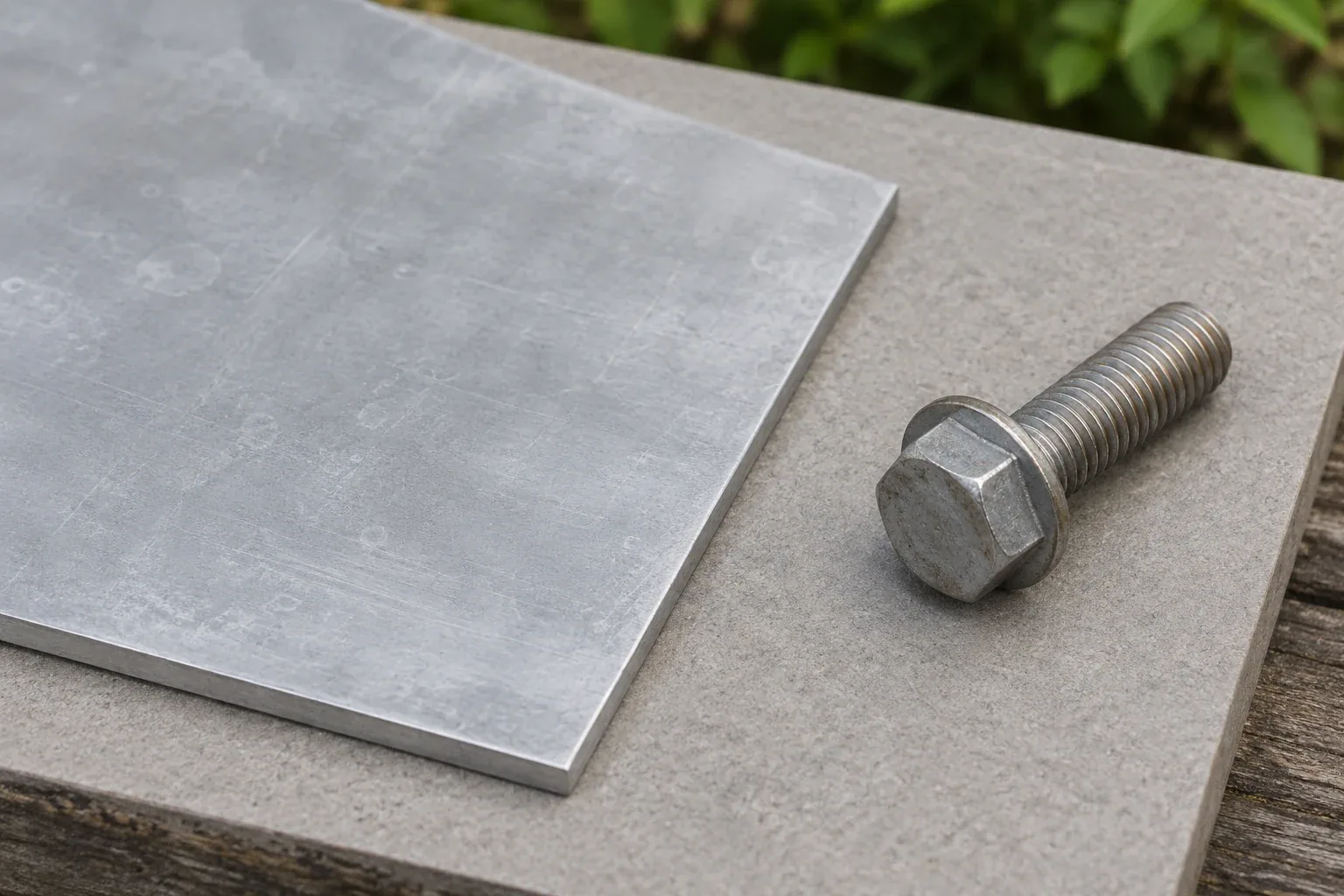
Does aluminum rust? In the strict everyday meaning of rust as iron oxide, aluminum does not rust the way iron or ordinary carbon steel does. That distinction does not mean aluminum hardware cannot corrode, stain, pit, or lose appearance in service. Aluminum develops a thin oxide surface under ordinary conditions, but alloy, surface finish, contaminants, moisture, contact with other metals, and the use environment affect how a finished component behaves.
For a product buyer, the useful answer is not a blanket “rust-proof” label. Identify the aluminum alloy or approved material declaration, the finish, the component geometry, nearby fasteners, drainage and cleaning conditions, and the expected exposure. The Australian Aluminium Council’s FAQ on aluminum explains the difference between rust terminology and aluminum’s oxide layer, while also noting that corrosion depends on conditions. Use that explanation to frame a buyer review, not as a guarantee for a specific hardware product.
What Does “Rust” Mean When the Part Is Aluminum?
Rust commonly refers to iron oxides formed when iron-bearing material reacts with oxygen and moisture. Aluminum corrosion is a different chemical process and may appear as a dull film, discoloration, localized pitting, or another surface change depending on the material and exposure. A product may therefore show corrosion even when the visible mark is not red-brown iron rust. A buyer diagnosing a reported mark should avoid deciding the cause from color alone.
Aluminum rapidly forms a thin oxide at its surface. That layer is often protective in ordinary atmospheres, but the protection is conditional. The Council’s description does not establish that every aluminum alloy, finish, fabrication condition, and environment will behave the same way. A surface layer can be affected by aggressive exposure, deposits, damage, dissimilar-metal contact, or a geometry that retains moisture. For an actual complaint, request product and lot identity, photographs, exposure details, cleaning history, and any relevant supplier records before assigning a cause.
The distinction matters in content and procurement claims. “Does aluminum rust” is a vocabulary question; “will this aluminum bracket retain its appearance in a particular shower or coastal installation” is a product-specific question. Avoid transforming the first answer into a promise that a component cannot corrode or stain. Ask the material and finish suppliers for evidence tied to the exact alloy, finish, part, and conditions in the claim.
A separate steel fastener can also create a mixed-material question. The aluminum part and the screw may have different materials, coatings, and maintenance needs. If a mark appears near a joint, inspect the fastener, washer, water path, and contact surfaces as well as the aluminum itself. The fact that aluminum has no iron-rust mechanism does not identify which component produced a stain or surface change.
Which Material and Finish Details Should a Buyer Request?
Start with the alloy designation or a material declaration that applies to the component and revision. “Aluminum” may be too broad for a controlled specification. The buyer should state whether the component is sheet, extrusion, casting, tube, machined stock, or another form because product form and process can affect fabrication and the surface presented for finishing. If the supplier quotes a material substitution, require its exact designation and evaluate the finished part again.
Separate the substrate from the finish. A surface may be mechanically prepared, anodized, coated, painted, polished, or otherwise treated, depending on the product. Do not infer the finish from a silver or gray appearance, a marketing name, or a photograph. Ask which specification and revision controls the finish, who applies it, what preparation is included, and which sample represents the accepted appearance. A finish can affect both aesthetics and service conditions, but the label alone does not prove adhesion, thickness, or corrosion outcome.
Map material by component in an assembly. The aluminum frame or bracket may connect to steel screws, stainless fasteners, brass inserts, plastic spacers, pads, or other purchased parts. For each one, identify its material or coating and whether it touches the aluminum or can trap moisture at the interface. This matters for replacement planning too: a fastener substitution can change the contact pair, appearance, or maintenance instructions even if the main aluminum profile remains unchanged.
The buyer should preserve the approved drawing, supplier material statement, finish specification, sample ID, and quotation assumptions. When a product includes multiple suppliers, identify who is responsible for each declaration and who must notify the buyer of a change. Keep claims limited to the evidence that those records actually provide.
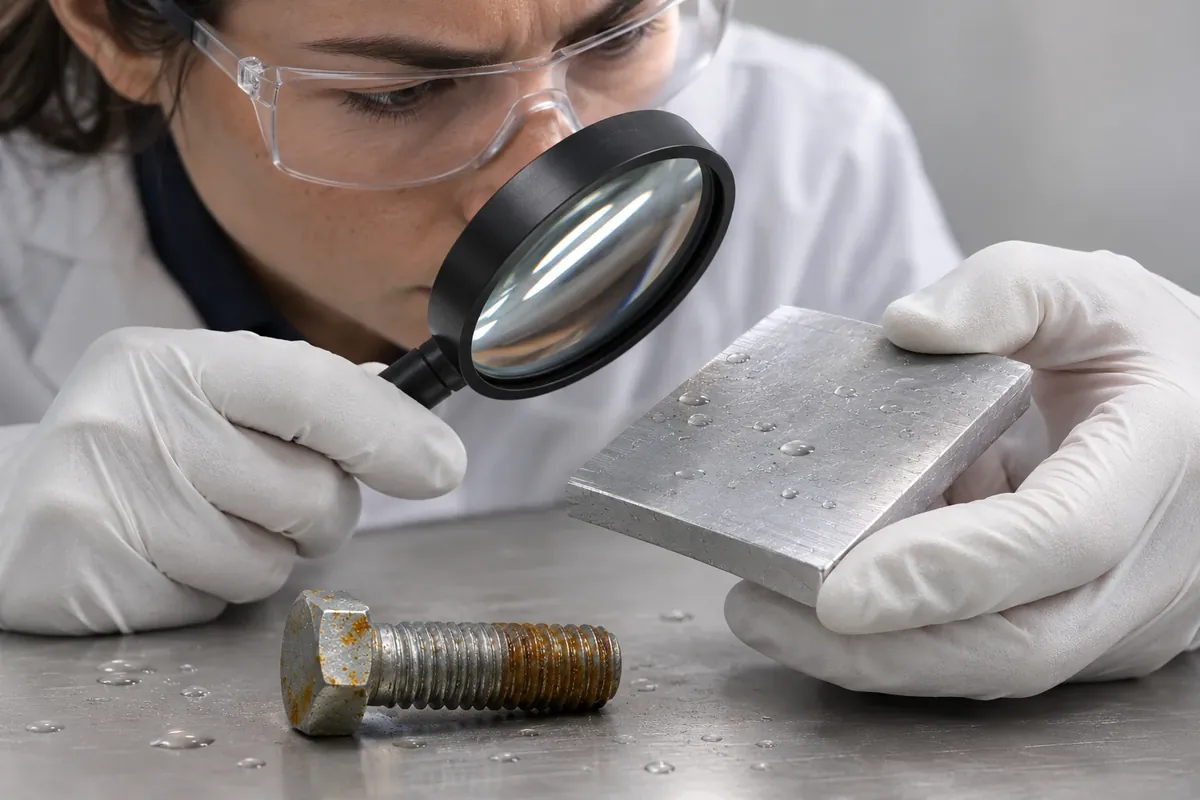
How Do Environment and Product Design Affect Aluminum Corrosion?
Describe the service environment concretely. A dry indoor cabinet, a frequently wet shower area, a coastal installation, and a commercial restroom with regular cleaning are not identical conditions. Record whether the part sees standing water, salt-bearing deposits, cleaning chemicals, condensation, repeated handling, or contact with other materials. The responsible product engineer or material supplier should assess the proposed alloy and finish against the intended environment.
Design details can influence where moisture and deposits collect. Overlapping joints, narrow gaps, unsealed interfaces, sharp edges, fastener recesses, and surfaces that do not drain may create conditions different from a flat coupon. A generic sample test may not represent those features. When a visible or safety-related consequence matters, review the finished geometry and the use conditions with a technical owner; do not extrapolate from a material datasheet or one simple exposure demonstration.
Dissimilar-metal contact deserves a separate check. An aluminum component assembled with another metal can experience a different local environment than an isolated coupon. The risk depends on actual materials, coatings, electrical contact, moisture, area relationship, and service conditions. This is not a reason to declare every mixed-metal assembly unacceptable. It is a reason to identify the material pair and get product-specific guidance rather than assume that a screw is irrelevant.
Cleaning and maintenance also matter. Deposits left on a part or aggressive cleaning may affect a finish. The product maker should provide care instructions for the exact construction. Do not recommend an acid, alkaline cleaner, abrasive pad, or metal polish based only on the word “aluminum.” A cleaner acceptable for one alloy and finish may be unsuitable for another surface treatment or for adjacent components.
How Should a Buyer Review a Corrosion or Rust Complaint?
Begin with identification and evidence. Ask for the product code, lot or purchase reference, installation location, time in service if known, cleaning method, and photographs that show the whole part and close-ups of the affected area. Record whether the mark is on the aluminum, a fastener, a coating, a joint, or a neighboring surface. A photograph can guide investigation but usually cannot identify alloy, contaminant, or mechanism on its own.
Preserve the part in its received condition until the supplier or quality owner decides what examination is appropriate. Cleaning or polishing can remove deposits and alter the evidence. If samples are available, retain an unaffected comparison component from the same lot and a reference sample when possible. Ask the responsible technical team which non-destructive inspection, material record, or laboratory analysis is suitable. Do not promise that a home magnet, color comparison, or wipe test can establish the cause.
Separate confirmed facts from hypotheses in the investigation record. A possible cause might be a different metal fastener, a damaged coating, a cleaning residue, or an exposure condition; those are questions to test, not a conclusion about the supplier or product. The supplier should compare the result with the specification, approved sample, process records, and any controlled test evidence. If the cause remains uncertain, say so and define the next evidence needed.
A corrective action should address the established cause. Depending on evidence, that could involve a design change, material or finish review, packaging separation, cleaning instruction, supplier process correction, or lot containment. Do not prescribe rework before confirming the affected surface and finish. A patch or abrasive repair could change the product’s appearance or protective surface and create a second problem.
What Evidence Supports a Buyer Decision?
Different records prove different things. A material declaration supports material identity within the supplier’s stated scope. A finish specification documents the agreed surface route. A sample supports visual and assembly approval. A process record can show that a stated operation was performed. A test report supports only the sample, conditions, method, and acceptance criteria it identifies. None automatically establishes all other facts or a service-life guarantee.
| Buyer question | Anzufordernde Nachweise | What it does not establish by itself |
|---|---|---|
| What aluminum alloy is used? | Material declaration or traceable supplier record by part and revision | Finished-part corrosion life in every environment |
| Which surface treatment applies? | Finish specification, processor identity, and approved sample | That an unseen lot passed an unlisted test |
| Are dissimilar fasteners present? | Bill of materials, drawing, or component mapping | Whether the assembled contact is suitable for every exposure |
| What happened to the delivered lot? | Lot identity, process records, and complaint evidence | Root cause based only on a certificate or photo |
| Will the appearance meet the project? | Production-intent sample and defined visual criteria | Chemical composition or hidden mechanical properties |
| Is the material suitable for service? | Product-specific design review and applicable evidence | A universal “never corrodes” conclusion |
A useful supplier discussion states the decision the buyer needs to make and the evidence that would support it. For example, the buyer may need to approve a finish sample, compare two materials for a specified room, or investigate a mark on a returned unit. These are different requests. Ask for the relevant record rather than a general assurance that a material is “corrosion resistant.”
If a test is proposed, write down the specimen, surface preparation, exposure, inspection method, acceptance rule, and responsible party. The Australian Stainless Steel Development Association’s material-selection discussion concerns selection in its stated context; it does not establish the performance of an aluminum part. Keep material-family sources in their proper scope and request aluminum-specific evidence for aluminum claims.
How Can Buyers Specify Aluminum Hardware More Clearly?
A specification should identify the component and its material, product form, geometry, finish, visible faces, service environment, cleaning expectations, and any dissimilar-metal interfaces. If there is an appearance requirement, attach the approved sample or reference and state how production variation is accepted. If a product claim depends on a corrosion test, identify the method and the finished sample configuration rather than listing a result without its context.
Include assembly and packaging requirements. State which fasteners are approved, whether component substitutions require consent, how parts are separated in transit, and what protective films or bags are allowed. Packaging contact can affect surface presentation, while an alternate fastener may change the metal pair or finish compatibility. Include a drawing revision and bill of materials so that procurement, quality, and production teams are working from the same release.
For an investigation or warranty claim, define how a buyer reports a problem, which product and lot details are needed, who evaluates the returned part, and what records are retained. This is a quality-system choice for the buyer and supplier, not a universal legal requirement. The purpose is to reduce unsupported cause assignments and preserve enough information for a useful technical review.
For a supplier review, make the approval path explicit. Name the person who accepts the material declaration, the person who approves the finish sample, and the quality owner who reviews lot evidence. If these roles sit in different teams, route the same drawing revision and sample identifier to each one. Keep a record of open questions so purchasing does not treat an unanswered technical field as an approved assumption. A short decision note can state which evidence was received, what it supports, and which product conditions remain outside the review.
Do not specify “aluminum, rust-proof” as a complete requirement. A clearer note might identify the alloy or approved declaration, finish route, environment, contact components, sample, and inspection evidence. If some fields remain open, assign an owner and a decision date before production release. That makes uncertainty visible rather than hiding it in a broad adjective.
Distinguish the Material Decision From the Care Instruction
The material selection record should identify the construction; the care sheet should tell the user how to maintain that construction. Those documents have different audiences and should agree on the same product revision. If a buyer is evaluating whether aluminum is appropriate for a wet location, the decision may depend on material and finish evidence, drainage, assembly, and use conditions. If a customer asks how to remove a deposit from an installed product, the response should follow the product maker’s cleaning guidance rather than an assumption based on the base metal alone.
When writing a consumer-facing statement, avoid the unqualified phrases “rust-proof,” “maintenance-free,” or “cannot corrode.” Instead, use a limited description that matches the approved material, finish, and test evidence. If a claim is important to a retailer or distributor, ask the responsible product and legal owners to confirm the exact wording and supporting record. This keeps a general answer to “does aluminum rust” from being interpreted as a promise about every alloy, finish, and installation.
Plan for Reorders and Replacement Components
A reorder can change the risk profile if a supplier substitutes a fastener, protective pad, coating processor, or packaging material. Keep the approved bill of materials and material declarations connected to the purchase order. State which changes need approval and what evidence the buyer expects before the new lot is released. This is particularly useful when the visible body and its mounting hardware come from separate sources.
For service and replacement, identify whether components are replaceable individually and how buyers can distinguish the approved revision. A replacement screw may be dimensionally compatible but use a different coating or material. A new pad can alter the contact between a part and a surface. Include part numbers, interface dimensions, approved substitute rules, and applicable care instructions in the service record. These details do not establish that a product will last for a particular period; they give the buyer a consistent basis for future sourcing and complaint review.
Check Storage and Packaging Before Shipment
Packaging should keep components clean, dry, and separated in a way that matches the product’s finish and assembly. Ask whether fasteners or metal components can rub against an exposed aluminum face in transit, whether moisture can be trapped inside a bag, and whether labels or adhesive pads contact a cosmetic surface. Review the packaging sample with the finished product and confirm any protective film is compatible with the approved finish and removal instructions.
Warehouse storage and shipment conditions are also part of the handoff. If the product is sensitive to condensation or contact with another material, specify protective separation and handling expectations with the supplier. Do not use packaging language as a substitute for a material or finish requirement; it addresses transport and storage interfaces. A damage report should record carton condition, inner separators, product location, and affected surfaces so the investigation can distinguish transit handling from an earlier process or service condition.

How Can an OEM Factory Help Coordinate the Review?
A custom hardware factory can review the drawing, material schedule, component interfaces, fabrication route, finish requirements, and packaging plan. Koitor Hardware is a family-owned custom metal hardware factory focused on bathroom and home-storage hardware. Approved company information supports customization from buyer drawings or samples and discussion of fabrication, finishing requirements, assembly, and packaging. It does not establish that Koitor produces every aluminum alloy or provides a certified corrosion laboratory.
Send the drawing revision, intended use, existing sample, material and finish documents, quantity, assembly components, and the specific issue or decision. Ask the manufacturer to distinguish its own fabrication scope from bought-in fasteners and specialist finishing. If another supplier owns the coating or anodizing operation, make sure its specification and sample approval remain linked to the finished hardware order. Do not assume that a product assembled by one factory had every part or surface processed there.
When evaluating a new design, the factory can help identify geometry, joining, drainability, access, assembly, or packaging questions that deserve review. The responsible technical supplier should confirm material suitability and any performance claim. For an existing complaint, share sufficient evidence to investigate while protecting confidential customer and project information.
Review Koitor’s Umfang der OEM-Fertigung von Hardware für die Heimdatenspeicherung und custom bathroom hardware scope. Send the drawing, sample, material declaration, and use conditions through the Kontaktseite. The answer to does aluminum rust is only the start of a product-specific sourcing decision.
Häufig gestellte Fragen
Does aluminum rust like steel?
Aluminum does not form iron oxide rust in the same way iron-bearing steel does. Aluminum can still corrode or change appearance under certain material, finish, contact, and exposure conditions.
Does aluminum rust? The short answer is about the chemistry of iron rust; the buyer’s actual decision must also account for the complete assembly and service conditions. Keep those two questions separate when approving a material claim.
Does aluminum ever corrode?
Yes. The form and severity depend on alloy, surface condition, environment, contaminants, contact materials, design, and maintenance. Use evidence tied to the actual product.
Does the natural oxide layer make every aluminum part corrosion-proof?
No. The oxide layer is not a universal guarantee. A product specification must account for alloy, finish, exposure, design, assembly, and care.
Can a buyer identify aluminum alloy from color or a photograph?
Usually not reliably. Request a supplier material declaration or suitable traceable evidence. A photograph can document appearance but does not prove composition.
Can a steel screw cause a mark on an aluminum part?
A mixed-metal interface may be relevant, but the actual cause depends on the materials and conditions. Inspect the complete assembly and gather evidence before concluding.
Is aluminum suitable for a bathroom product?
That depends on the alloy, finish, product design, exposure, cleaning, and assembly. The buyer should specify the intended service conditions and review product-specific evidence.
Does an aluminum finish sample prove corrosion performance?
No. A sample can support appearance and fit review. Performance claims need evidence that identifies the part, finish, test conditions, and acceptance criteria.
What should the RFQ say about aluminum?
State the alloy or approved material declaration, form, finish, use environment, contact components, packaging, inspection evidence, and substitution rules.
Arbeiten Sie mit Koitor Hardware zusammen
Share the part drawing, alloy or material declaration, surface treatment, fasteners, installation environment, and the question that needs a decision. Koitor can help clarify custom hardware and supplier coordination; the material and finish providers must confirm their specific process data.
Specify the Whole Aluminum Assembly
Send the drawing, material and finish details, fasteners, and intended service conditions.
OEM / EIGENE MARKE
Verwandeln Sie diesen Beschaffungsleitfaden in ein Produktdossier
Teilen Sie uns Ihr Zielprodukt, die Größe, die Oberflächenausführung, die Bestellmenge und Ihre Verpackungsanforderungen mit. Ihr Team erhält vor der Angebotserstellung eine praxisorientierte Prüfung der Herstellbarkeit.


 English
 Español
 Português
 Français
 Deutsch
 العربية