

To work out how to calculate freight class, start with the NMFC item that describes the goods, then calculate density for the shipped pallet. Measure length, width and height in inches including the pallet, divide cubic inches by 1,728 to get cubic feet, and divide the gross weight in pounds by cubic feet. If the item uses the density scale, the density points to a class on that scale.
Since July 19, 2025, the standard density scale in the National Motor Freight Classification has 13 subprovisions, from class 400 for freight under 1 pound per cubic foot to class 50 for 50 pounds per cubic foot or more. That change came from NMFTA Docket 2025-1. Many carrier calculators were updated at the same time, but older charts still circulate online.
This guide is for US importers and distributors who move palletized hardware cartons by less-than-truckload (LTL) carrier after the goods clear port. It explains the method, the 2025 density scale and what to put on the bill of lading. It does not assign NMFC items to products or quote freight rates; those come from the classification, the carrier and the broker.
Koitor Hardware is a family-owned China OEM manufacturer of custom metal bathroom and home storage hardware. Our part of the chain is accurate carton and pallet data. Freight class is calculated by the US shipper or broker, and good carton data makes their job easier and their class more defensible.
How to calculate freight class: why does the NMFC item come first?
Because the NMFC item decides whether density sets the class at all, and which density scale applies. Some items are classed by density alone. Others carry a fixed class or adjustments for handling, stowability or liability. Using a density chart without checking the item can give the wrong class, which may be corrected by the carrier after inspection.
The National Motor Freight Classification is maintained by the National Motor Freight Traffic Association. It groups commodities into items, each with a description and class provisions. Shippers look up the item through NMFTA’s ClassIT+ tool or ask their carrier or broker. The NMFTA NMFC page explains the system.
NMFTA has said that density is becoming the primary factor for most freight, but the item number still matters, because items with handling, stowability or liability concerns may not follow the full density scale. That is why “item first, density second” is the safer order.
Describing hardware for classification
Write a plain, accurate description of what is in the cartons: material, product type and packaging. “Steel wire shelving baskets, powder coated, in corrugated cartons” is more useful than “household goods.” The description should match the commercial invoice and the packing list, and it should be the description the item lookup was based on.
Who confirms the item
The shipper is responsible for describing the goods correctly. In practice, many importers rely on their broker or carrier for the item number. Whoever confirms it, record the item and the date it was checked, because classification provisions change over time.
How do you measure the shipped unit for density?
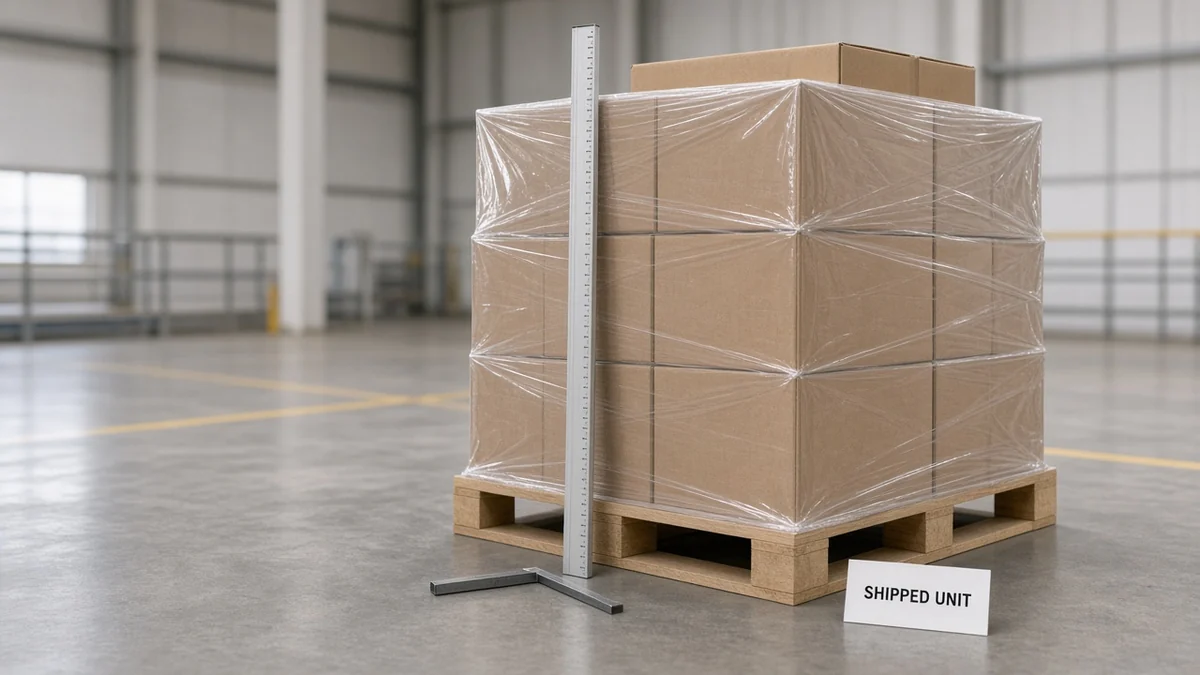
Measure the pallet as it will ship: the longest length and width including any carton overhang, and the height from the floor to the highest point including the pallet. Weigh the complete unit: pallet, cartons, wrap, straps and labels. Density uses the shipped unit, not the product or a single carton.
Round measurements as your carrier’s tariff directs. Many carriers measure to the nearest inch at the extreme points. Record the measurements, the weight and the method, ideally with photos showing the measuring tool against the load.
Why the pallet is included
The pallet takes up space on the trailer and adds weight. Leaving it out of the height makes the volume smaller and the density higher, which can point to a lower class than the carrier will find when it measures. Including it from the start avoids reclassification.
Overhang and irregular loads
If cartons overhang the pallet, the carrier measures to the overhang. A load that is wider at the top than the bottom is measured at its widest point. That is another reason to stack flush with the pallet edges, as covered in the guide on pallet overhang and box compression damage.
Weight
Use a calibrated floor scale where possible. If you calculate weight instead, add the pallet weight, the carton gross weights and an allowance for wrap and straps. The carton gross weights come from the packing list; see packing list net weight and gross weight for how those are set.
How is density calculated?
Multiply length × width × height in inches to get cubic inches. Divide by 1,728 to get cubic feet. Divide the weight in pounds by the cubic feet. The result is pounds per cubic foot, often written pcf. Calculate each handling unit separately when a shipment has several pallets of different sizes, unless your carrier’s tariff says otherwise.
Worked example (labelled as an example, not a class for any product)
A pallet measures 48 in × 40 in × 52 in including the pallet, and weighs 820 lb including pallet, cartons and wrap. Volume: 48 × 40 × 52 = 99,840 cubic inches. Divide by 1,728: 57.78 cubic feet. Density: 820 ÷ 57.78 = 14.19 pcf. If the NMFC item for these goods uses the standard 13-sub density scale, 14.19 pcf falls in the 12 to less than 15 pcf band.
That example shows the arithmetic only. The class that applies depends on the item, and the carrier’s tariff and agreements may apply their own rules on top. Do not use the example as a class for hardware.
Small changes, different band
Look at how close the example sits to a band edge. If the measured height were 56 in instead of 52 in, the volume would be 62.22 cubic feet and the density 13.18 pcf, still in the same band. But a pallet near a band edge can change band with an inch of height or a few pounds of weight. Measure carefully and record how you measured.
Using carrier calculators
Carrier and broker density calculators perform the same arithmetic. They are convenient, but check that they use the current scale and that you enter shipped-unit dimensions including the pallet. A calculator cannot check whether the item is density-based.
Multiple pallets and mixed shipments
A shipment with several pallets of the same build can be measured once and multiplied, as long as every pallet truly matches. If one pallet is shorter because it carries the remainder cartons, measure it separately. Its density will differ, and it may fall in a different band.
Shipments that mix different products may involve more than one NMFC item. Each item is described on its own line of the bill of lading with its own weight and class. Mixing products on one pallet makes this harder, because the pallet cannot easily be split by item. Where possible, keep different items on separate pallets, or ask the broker how they want a mixed pallet described.
Rounding and units
Carriers usually measure in inches and pounds. If your packing data is in centimetres and kilograms, convert carefully: one inch is exactly 2.54 centimetres and one pound is 0.45359237 kilograms. Convert the measurements before calculating, not the final density, so rounding errors stay small. NIST’s unit conversion resources give the exact factors.
Keep the converted figures with the original metric data. If a carrier questions the class, being able to show both sets of numbers and the factors used makes the check quick.
Which density scale applies after Docket 2025-1?
For items that reference it, the standard 13-subprovision density scale adopted under NMFTA Docket 2025-1, effective July 19, 2025. It replaced the earlier 11-sub scale for those items. The table below reproduces the standard breaks as published by NMFTA. Always confirm current provisions in ClassIT+ before relying on them.
| Subprovision | Density, pounds per cubic foot | Class |
|---|---|---|
| Sub 1 | Less than 1 | 400 |
| Sub 2 | 1 but less than 2 | 300 |
| Sub 3 | 2 but less than 4 | 250 |
| Sub 4 | 4 but less than 6 | 175 |
| Sub 5 | 6 but less than 8 | 125 |
| Sub 6 | 8 but less than 10 | 100 |
| Sub 7 | 10 but less than 12 | 92.5 |
| Sub 8 | 12 but less than 15 | 85 |
| Sub 9 | 15 but less than 22.5 | 70 |
| Sub 10 | 22.5 but less than 30 | 65 |
| Sub 11 | 30 but less than 35 | 60 |
| Sub 12 | 35 but less than 50 | 55 |
| Sub 13 | 50 or greater | 50 |
Source and date: NMFTA Disposition Bulletin 1371, Docket 2025-1, dated March 21, 2025, effective July 19, 2025, and NMFTA’s published guidance on density in LTL classification. Table reviewed November 2026.
Reading the table correctly
Each band includes its lower limit and excludes its upper limit. A pallet at exactly 15.00 pcf falls in the 15 but less than 22.5 band, not the 12 but less than 15 band. Do not round density up or down to reach a band; use the calculated figure to two decimal places.
The class number is not a price. Rates depend on the carrier’s tariff, discounts, lane, weight break and accessorial charges. Two shipments with the same class can cost very different amounts, and this guide does not estimate them.
Freight that is very dense or very light
Dense steel hardware can exceed 30 pcf, which under the 2025 scale falls into bands that did not exist in the earlier scale’s structure. Light, bulky goods such as empty baskets or large organizers can fall below 6 pcf. Both ends deserve a careful check of the item provisions, because they are where an outdated chart gives the biggest error.
Dimensional data from the supplier
Before goods ship, the supplier’s packing list gives carton dimensions and weights, and sometimes the pallet build. That allows a planning estimate of density before arrival. Treat it as an estimate: the pallet may be rebuilt at the port or warehouse, and the final measurement should be taken on the unit actually handed to the LTL carrier.
Why older charts mislead
Many websites still show the earlier 11-sub scale, whose densest band began at 30 pcf. Dense hardware loads above 30 pcf now fall into new bands. An old chart can give the wrong class for exactly the kind of heavy, compact pallets that steel hardware often produces.
Items that do not follow the full scale
Some items have their own density breaks, a fixed class or exceptions. Some freight is classed by other characteristics. NMFTA’s guidance says the item number remains important for this reason. Use the table only when the item confirms it applies.
What goes on the bill of lading, and what evidence should you keep?
The bill of lading should carry an accurate description, the NMFC item and class confirmed for that description, the number and type of handling units, and the weight. Keep the measurements, the weight record and photos so you can answer an inspection or reweigh. The carrier may measure and weigh freight and correct the class.
A short, clear description that matches the invoice reduces questions. Vague descriptions such as “parts” or “merchandise” make it hard to match the goods to an item and invite questions. The guide on bill of lading roles covers who appears where on the document.

Evidence file
Keep the item lookup record with its date, the measured dimensions and weight, photos of the pallet with a measuring tool, and the packing list. If the carrier issues a correction, compare its measurements with yours. Differences often come from pallet height, overhang or an extra handling unit.
Repeat shipments
For regular shipments of the same goods in the same pallet build, the measurements will be similar. Recheck the class when the carton size, pack quantity, pallet pattern or product changes. A new carton can move the density into a different band.
Freight class checklist
- The goods are described accurately and the description matches the invoice.
- The NMFC item is confirmed through ClassIT+, the carrier or the broker, with the date.
- The item is checked for whether it uses the density scale.
- Dimensions are measured on the shipped unit, pallet included, at extreme points.
- Weight includes pallet, cartons, wrap and straps.
- Density is calculated per handling unit unless the tariff says otherwise.
- The current, dated density scale is used.
- The bill of lading shows description, item, class, unit count and weight.
- Photos and measurement records are kept.
- The class is rechecked when cartons or pallet builds change.
Common reasons a class gets corrected
Most corrections trace back to a few causes. The pallet was left out of the height. Overhang was ignored. The weight was taken from the product, not the shipped unit. An old density chart was used. The description did not match an item that uses density, or matched a different item. Or the pallet that arrived at the terminal was not the pallet that was measured, because it was rebuilt or rewrapped on the way.
Each of these is preventable with the measurement routine and evidence file above. When a correction does arrive, check which cause applies before disputing it. Sometimes the carrier is right, and the fix belongs in the next shipment’s routine.
When packaging changes the class
Freight class responds to the shipped unit, so packaging decisions upstream affect it. A larger carton with more empty space lowers density. A taller pallet built with loose layers lowers density and adds stability risk. A tighter carton with the same product raises density.
That does not mean packaging should be redesigned just to chase a class. Protection comes first. But when a carton is being redesigned for other reasons, the effect on density is worth checking with the broker before the new carton goes into production, especially for regular LTL lanes.
Where does freight class end and other files begin?
Freight class applies to US LTL moves. It is separate from ocean freight volume, air chargeable weight and the pallet build itself. Each has its own rules and its own guide. Keeping them apart avoids applying the wrong method to the wrong leg of the journey.
Ocean freight from Asia is usually quoted on CBM, the cubic-meter volume of the cartons or pallets. That calculation is explained in the guide on how to calculate CBM. It does not produce a freight class.
The pallet build that sets the measurements is covered by how to stack boxes on a pallet and the mixed-SKU pallet build approval guide. Building a stable, flush pallet is the first step to a reliable density figure.
Who arranges the LTL move and who handles customs entry are different roles. The comparisons of freight forwarder versus customs broker und freight broker versus freight forwarder explain them. Freight cost then flows into landed cost, covered by the landed cost guide for small-batch imports.
What a supplier can and cannot provide
An overseas factory can provide accurate carton sizes, carton weights, pallet builds and photos. It cannot assign an NMFC item or guarantee a US freight class, because those depend on the classification and the carrier. A supplier sheet that promises a class should be treated with caution.
Koitor practice note
For buyers who move goods by LTL after import, Koitor can provide carton and pallet data in the format the broker prefers, including photos of built pallets. The class itself is set by the buyer’s broker or carrier.
Accessorials are separate from class
Liftgate delivery, residential delivery, inside delivery, appointment scheduling and limited-access locations are usually charged as accessorials. They do not change the freight class. Keeping them separate on the booking avoids confusing a class question with a service question, and it makes invoices easier to audit against the bill of lading.
Who should own the routine
On the importer’s side, freight class sits naturally with the logistics or warehouse team that books LTL moves. They own the item lookup record, the measurement routine and the evidence file. Purchasing owns the supplier data that feeds it: carton sizes, carton weights and pallet builds.
When those two teams share one pallet data sheet, the class calculation becomes routine. When they do not, each shipment starts from scratch, and the risk of a wrong measurement or an outdated chart rises.
Frequently asked questions about freight class
What is the formula for freight class density?
Length × width × height in inches, divided by 1,728, gives cubic feet. Weight in pounds divided by cubic feet gives pounds per cubic foot.
Do I include the pallet in the measurements?
Yes. Measure and weigh the shipped unit, including the pallet, wrap and any overhang.
Does density always decide the class?
No. The NMFC item decides whether density applies. Some items have fixed classes or other provisions.
What changed in 2025?
Under Docket 2025-1, effective July 19, 2025, the standard density scale expanded from 11 to 13 subprovisions, adding bands for denser freight.
Can a carrier change my freight class?
Carriers can inspect, measure and weigh freight and correct the class under their tariff. Accurate records make disputes easier to resolve.
Is freight class used for ocean freight?
No. Freight class is used for US LTL shipping. Ocean freight usually uses CBM and weight.
How accurate do my measurements need to be?
Measure as your carrier’s tariff directs, usually to the inch at the extreme points. Loads near a band edge need extra care, because a small difference can change the band.
Should I recheck the class every shipment?
Recheck when the product, carton, pack quantity or pallet build changes, and periodically confirm that the item provisions have not changed.
Where do I find the NMFC item?
Through NMFTA’s ClassIT+ service, or by asking your carrier or broker. Record the item and the date it was confirmed.
Does a heavier pallet always get a lower class?
Not by weight alone. Density relates weight to volume, so a heavy pallet that is also very large may still have moderate density. The item provisions decide how density is used.
Can Koitor tell me the freight class for my order?
No. Koitor can supply accurate carton and pallet data. The class is determined by the NMFC item and confirmed by your carrier or broker.
Arbeiten Sie mit Koitor Hardware zusammen
Prepare carton and pallet data for LTL booking
Send the carton outer sizes, carton weights, pallet build and the product description your broker uses. We can review whether the shipped-unit data on your documents is complete and consistent. We do not assign NMFC items or classes, and we do not quote freight rates.
OEM / EIGENE MARKE
Verwandeln Sie diesen Beschaffungsleitfaden in ein Produktdossier
Teilen Sie uns Ihr Zielprodukt, die Größe, die Oberflächenausführung, die Bestellmenge und Ihre Verpackungsanforderungen mit. Ihr Team erhält vor der Angebotserstellung eine praxisorientierte Prüfung der Herstellbarkeit.



 English
 Español
 Português
 Français
 Deutsch
 العربية