
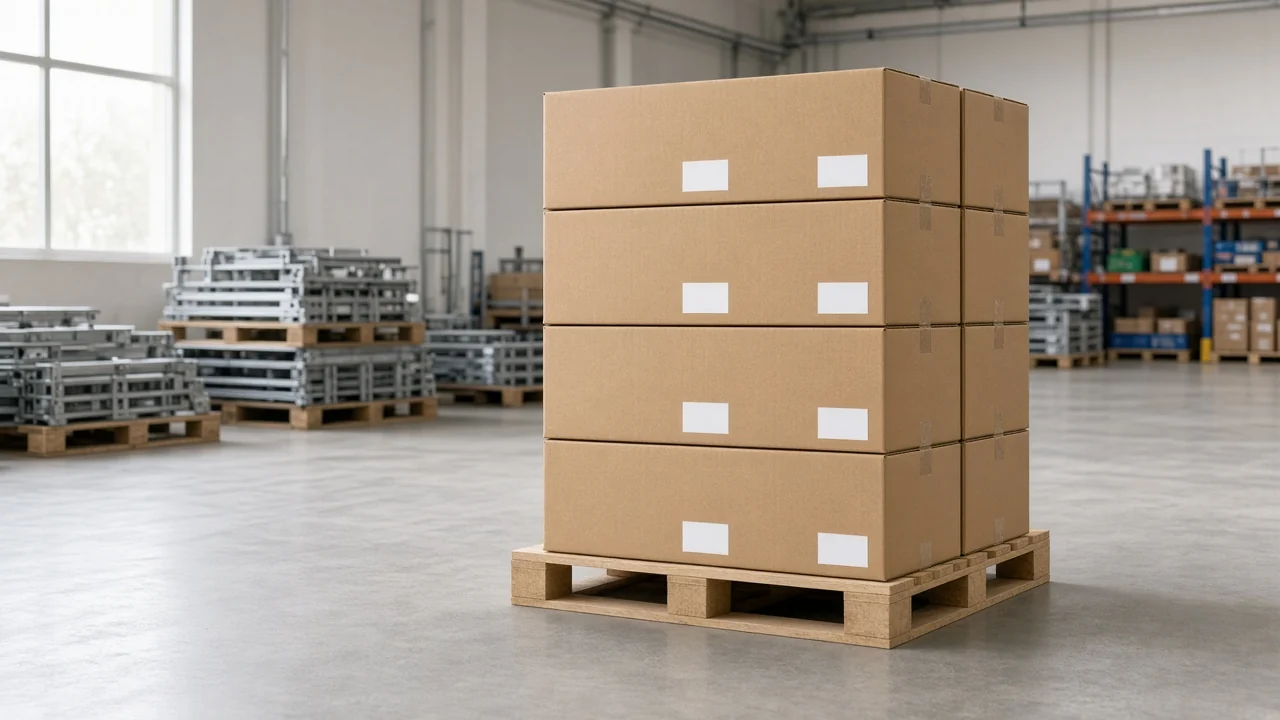
Knowing how to stack boxes on a pallet comes down to five choices, written on one pattern sheet: the pallet footprint, which carton face carries the load, a column or interlock pattern, the number of layers, and the rule that keeps cartons inside the pallet edge. Column stacks keep carton corners lined up; interlocked stacks tie layers together for stability. Both should stay within the pallet edge and the receiver’s height rule.
Those five choices decide whether cartons arrive intact, whether the pallet stays upright in transit, and whether the receiving warehouse can handle it. They also decide whether the next shipment looks the same as the last one, which matters when a retailer has approved a pallet build.
This guide is for importers, distributors, private-label teams and the factories that pack for them. It covers stacking identical master cartons on a pallet and documenting the pattern. Mixed-SKU builds, overhang damage, deck board gaps and wrapping have their own guides, linked below.
Koitor Hardware is a family-owned China OEM manufacturer of custom metal bathroom and home storage hardware. Our products ship in master cartons of many sizes, from slim towel bar cartons to bulky shower caddy cartons. The same stacking questions come up with each new carton size, so a written pattern sheet is the practical answer.
How to stack boxes on a pallet: what decides the pattern?
The carton size, the pallet footprint and the receiver’s rules decide it. The carton size sets how many cartons fit per layer in each orientation. The pallet footprint sets the edge limit. The receiver’s rules set maximum height, weight per pallet and sometimes the pattern itself. Start with those three facts before arranging a single carton.
Pallets come in different footprints by region and customer. US warehouses commonly receive 48 × 40 in pallets, while many European receivers use 1200 × 800 mm or 1200 × 1000 mm. Some retailers specify a pallet type and condition in their routing guide. Confirm the footprint with the receiver before planning, because changing it later changes the whole pattern.
Next, find the carton’s load-bearing orientation. A corrugated carton is usually strongest when its vertical walls, especially its corners, carry the load from above. Turning a carton onto its side can put load on a weaker face and may also turn product inside the carton. Print the “this way up” orientation on the carton and the pattern sheet.
Receiver and carrier rules
Many receivers limit total pallet height, often to fit racking or truck trailers. Some limit gross weight per pallet for handling equipment. Some require two-way or four-way fork entry. These rules differ by receiver, so the pattern sheet should quote the receiver’s rule and its source rather than a general figure.
Product inside the carton
Hardware is often heavy for its size. Steel towel bars, wire baskets and shower caddies can make a carton dense, while plastic accessories may be light and bulky. The weight of each carton affects how many layers sit safely on the bottom layer. That is a packaging and compression question, covered in the guide on compression conditioning and stacking capacity, not something a pattern drawing can decide alone.
Should cartons be column-stacked or interlocked?
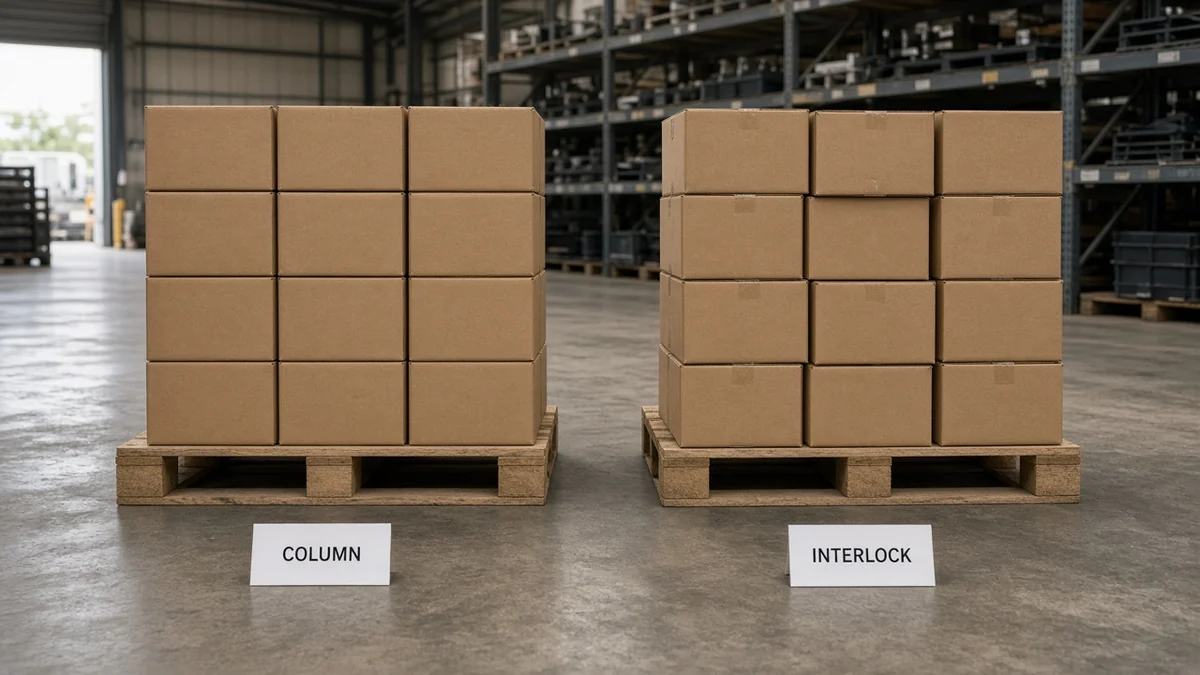
Column stacking puts each carton directly above the one below, corners aligned. It makes best use of the cartons’ vertical walls. Interlocking rotates or offsets each layer so cartons bridge the seams below, which ties the layers together and resists shifting. The choice is a trade-off between using carton strength and holding the load together.
In a column stack, every carton’s corners sit on the corners of the carton below. Load flows straight down through the strongest parts of the carton. The downside is that the stack is made of separate columns, which can lean apart or shift if the pallet is jolted, so containment by stretch wrap, straps or corner boards matters more.
In an interlocked stack, often called a brick pattern, cartons in one layer straddle the joints between cartons in the layer below. The layers lock together like bricks in a wall. The downside is that carton corners no longer sit on corners, so part of each carton’s load rests on the middle of the carton below, which is generally weaker. Heavy cartons can crush more easily this way.
Comparing the two patterns
| Factor | Column stack | Interlocked stack | What the pattern sheet should record |
|---|---|---|---|
| Load path | Corners on corners, straight down | Partly on carton centers and seams | Which pattern is approved |
| Use of carton strength | Usually better | Usually reduced | Any compression test or packaging note |
| Load stability | Relies more on containment | Layers tie each other together | Wrap, straps or corner board method |
| Common use | Heavy or dense cartons, strong containment | Lighter cartons, tall or unstable loads | Carton weight and layer count |
| Edge alignment | Easy to keep flush | Needs care at edges and corners | Edge rule: flush, no overhang |
The table describes general tendencies. How much strength is gained or lost in a given build depends on the carton construction, board grade, humidity and load, and should be confirmed by testing rather than assumed.
Carton design that helps stacking
Some stacking problems are easier to solve in the carton than on the pallet. A carton sized so that a whole number of cartons fills the pallet footprint avoids gaps and overhang. A carton with a well-supported product inside, so the walls are not carrying an empty void, holds its shape under load. Inner dividers or corner posts can add stacking support where the product leaves the carton hollow.
These are packaging design choices made before production. If a carton keeps causing awkward patterns, it is worth revisiting its size with the packaging team rather than tolerating gaps on every pallet.
Hybrid patterns
Some builds use columns for most layers and an interlocked top layer or two to tie the top together. Others interlock only the outer ring. These hybrids can work well, but they must be drawn on the pattern sheet layer by layer so the packing team repeats them.
When the carton does not divide the pallet
Some carton sizes leave gaps in a column pattern. Pinwheel arrangements, where cartons are rotated around a center, can fill a square footprint. If gaps remain, decide whether to fill them with void fill, accept them with stronger containment or change the carton size. Leaving random gaps invites cartons to shift into them.
Building the first pallet step by step
Start with a clean, undamaged pallet of the agreed type. Place it on level ground with the fork entry sides where the loading team needs them. Lay the first carton in one corner, flush with both edges, in the agreed orientation. Build the first layer outward from that corner following the top-view drawing, keeping every outer carton flush with the edge.
Check the first layer before going on. Are the outer faces in a straight line? Are there gaps? Is any carton overhanging? Fixing the first layer takes a minute; fixing a finished pallet means unstacking it. Then build each following layer the same way, using the drawing for that layer.
After the last layer, check the height and weight against the sheet, apply corner boards if specified, wrap or strap the load and attach the label. Photograph the pallet from two adjacent sides so the photos show the pattern, the edges and the label.
How many layers, and how high?
As many as the bottom carton can carry for the journey and the receiver allows. The layer count comes from the carton’s compression strength under real conditions and the receiver’s height and weight limits. A pattern sheet should state the layer count and total height, and name where those limits came from.
Carton strength is reduced by humidity, time under load, vibration and the stacking pattern. A carton that carries a given load for a day in a dry warehouse may fail after weeks in a humid container. That is why packaging engineers test with conditioning. The International Safe Transit Association publishes test procedures widely used for transit packaging.
Double stacking pallets
If pallets will be stacked on top of each other in a warehouse or container, the bottom pallet’s cartons carry the top pallet too. The pattern sheet should say whether the pallet may be double stacked. If the answer is not known, mark it “do not double stack” until testing or the receiver confirms otherwise.
Height and safe handling
Taller pallets are harder to handle and more likely to tip. Workplace rules on safe storage generally require stored material to be stacked so it is stable. In the US, OSHA’s storage rule 1910.176 is one such reference. The receiver’s own height limit is usually the practical cap.
Weight distribution
Put heavier cartons on the bottom when a pallet carries cartons of different weights. In a single-SKU build every carton weighs about the same, so the main question is whether the bottom layer can carry the total load above it. If the pallet mixes SKUs, the mixed-SKU pallet build approval guide covers layer maps.
Humidity and time in transit
Ocean containers can see large swings in humidity and temperature. Corrugated board absorbs moisture and loses strength as it does. A pallet that stands well in a dry factory may lean after weeks at sea. That is one reason the layer count should come from conditioned testing or experience on the same lane, and why containment and moisture protection matter on long routes.
Desiccants, liners and keeping cartons off wet floors before loading all help. They are packaging and logistics decisions rather than pattern decisions, but the pattern sheet can note them so the packing team does not skip them.
Pallets inside the container
Palletized cargo in a container still needs securing. Pallets should be placed tightly against each other and the container walls, with gaps filled by airbags, dunnage or blocking as the loading plan requires. A well-built pallet can still be damaged if it slides across the container floor.
The container load plan sits with the forwarder or loading team. The pattern sheet can say how many pallets are planned and in which orientation, so the loading team does not need to rebuild or rotate them.
Why do the pallet edges matter so much?
Because cartons that overhang the pallet lose support at their edges and corners, which is where their strength is. Cartons pulled back too far from the edge leave the pallet deck exposed and can make the load unstable. The pattern sheet should state an edge rule, usually that cartons sit flush with the pallet edge.
Overhang concentrates the load on the part of the carton still on the pallet, and the overhanging part can be crushed by forklift tines, wrap tension or the next pallet. The guide on pallet overhang and box compression damage explains the damage mechanism in detail.
Underhang, where cartons sit well inside the pallet edge, is less damaging but has its own problems. Exposed deck boards can catch other pallets, and a load that sits off-center can tip. Center the load and keep it as close to flush as the carton size allows.
Deck boards and small cartons
Small cartons can sag or crush into gaps between deck boards. If your bottom layer has small cartons, check the deck board spacing. The guide on pallet deck gaps and small carton support covers when a tier sheet or bottom deck sheet helps.
Fork entry and clearance
The pallet’s fork entry sides should match how the receiver will lift it. A load stacked flush on all sides does not block fork entry, but overhanging cartons can be struck by tines. See pallet fork entry and clearance for how to set those dimensions.
Pallet or slip sheet
Some receivers prefer slip sheets to pallets to save space and weight. Stacking principles still apply, but handling changes. The comparison of slip sheets versus pallets covers that decision, and pallet vs skid explains the base types.
What goes on the pallet pattern sheet?
A pattern sheet is a one-page drawing and table that lets anyone build the same pallet. It shows the pallet type and footprint, the carton size and orientation, a top view of each layer, a side view showing the layer count, the total height and weight, the edge rule, the containment method and the label positions.
Draw the top view for each distinct layer. A column stack needs one top view; an interlocked stack needs two, for odd and even layers. Mark which carton face points outward if the carton has a printed side that must be visible. Draw the side view with the layer count and total height.

Containment and labels
Write the containment method: stretch wrap, straps, corner boards or a combination. The guide on stretch wrap containment force versus pre-stretch explains why wrap settings matter more than wrap thickness. Mark where the pallet label goes. If the receiver uses SSCC pallet labels, see the guide on GS1 SSCC pallet labels versus carton GTINs.
Who builds and who checks
The factory packing team builds the pallet to the sheet. An inspector checks the first pallets of each shipment against the sheet: footprint, pattern, layer count, edge alignment, height, label and wrap. Photos of the finished pallet from two sides go into the shipment record.
Pattern sheet checklist
- Pallet type, footprint and condition match the receiver’s requirement.
- Carton outer size and the “this way up” orientation are stated.
- The pattern is named: column, interlock or a drawn hybrid.
- Each distinct layer has a top-view drawing.
- Cartons per layer and the number of layers are stated.
- Total height including the pallet is stated and within the receiver’s limit.
- Gross pallet weight is stated and within the receiver’s limit.
- The edge rule is stated: flush, no overhang.
- Double stacking is allowed or prohibited, with the basis.
- Containment method and label position are shown.
- The sheet has a revision number and date.
Industry guidance
Warehouse and material handling associations publish practical guidance on unit loads and storage. The MHI resources are one starting point for teams building their own pallet standards.
Inspecting a built pallet at shipment
Pre-shipment inspectors can check a few things quickly. Count the cartons per layer and the layers. Measure total height. Walk around the pallet and look for any carton beyond the edge. Check that labels are on the agreed faces and readable. Check the wrap covers the pallet base, so the load and pallet move as one. Compare with the photo of the approved build.
Any difference from the sheet should be fixed before loading, not reported after arrival. A pallet that leaves the factory correct still has the best chance of arriving correct.
What should the sheet and listing not claim?
They should not claim a stacking strength, a compression figure or a safe height unless a test report for that carton and pattern supports it. They should not borrow a pattern from a different carton or receiver. And they should not mix SKU layer rules into a single-SKU sheet.
A common mistake is to print “stack up to five high” on a carton because a previous carton could. Carton board grade, size and product weight change the answer. If a stacking limit is printed, it must come from testing of that carton and the conditions it was tested under.
Repeatability is the real goal
Most pallet damage claims come from pallets that were not built the same way as the approved one. A pattern sheet that is followed every time, checked on the first pallets and updated when cartons change, does more to prevent damage than any single rule of thumb.
When cartons change
A new carton size, board grade or pack quantity means a new pattern sheet. Re-plan the layers, re-check the height and weight, and update the revision. Do not let the packing team adjust the old pattern on the fly.
Koitor practice note
On Koitor programs, the pattern can be agreed with the buyer before the first shipment, using the receiver’s routing guide where one exists. Photos of the first built pallets help the buyer confirm the build before the goods leave. Stacking or compression testing, if required, is arranged per project.
Frequently asked questions about stacking boxes on pallets
Should heavy boxes go on the bottom?
Yes, when a pallet carries cartons of different weights. In a single-SKU build all cartons weigh about the same, so focus on whether the bottom layer can carry the full load.
Is interlocking always better?
No. It improves stability but usually puts more load on the weaker middle of each carton. Heavy or dense cartons often do better column-stacked with good containment.
Can boxes hang over the edge of the pallet?
They should not. Overhang removes support from carton edges and corners and invites damage. Keep cartons flush with the pallet edge.
How high can I stack a pallet?
As high as the receiver allows and the cartons can carry for the trip. Ask the receiver for their limit and confirm carton strength by testing if the load is heavy.
Do I need corner boards?
They help on column stacks and tall loads by tying the corners and protecting edges from straps. Whether they are required depends on the load and the receiver.
Should the pattern change between shipments?
Not without a reason and a revised sheet. Consistent pallets are easier to receive and less likely to be damaged.
Does Koitor ship on pallets?
Koitor shipments can be floor-loaded in containers or palletized, depending on the buyer’s receiving requirements. The method and pattern are agreed per order.
Arbeiten Sie mit Koitor Hardware zusammen
Review a pallet pattern sheet
Send the carton outer sizes, the pallet type, the receiver’s height or handling rules and your current pattern sheet. We can review whether the footprint, orientation, pattern, layer count and edge rule are named. We will not quote stacking-strength figures or universal height limits.
OEM / EIGENE MARKE
Verwandeln Sie diesen Beschaffungsleitfaden in ein Produktdossier
Teilen Sie uns Ihr Zielprodukt, die Größe, die Oberflächenausführung, die Bestellmenge und Ihre Verpackungsanforderungen mit. Ihr Team erhält vor der Angebotserstellung eine praxisorientierte Prüfung der Herstellbarkeit.



 English
 Español
 Português
 Français
 Deutsch
 العربية