
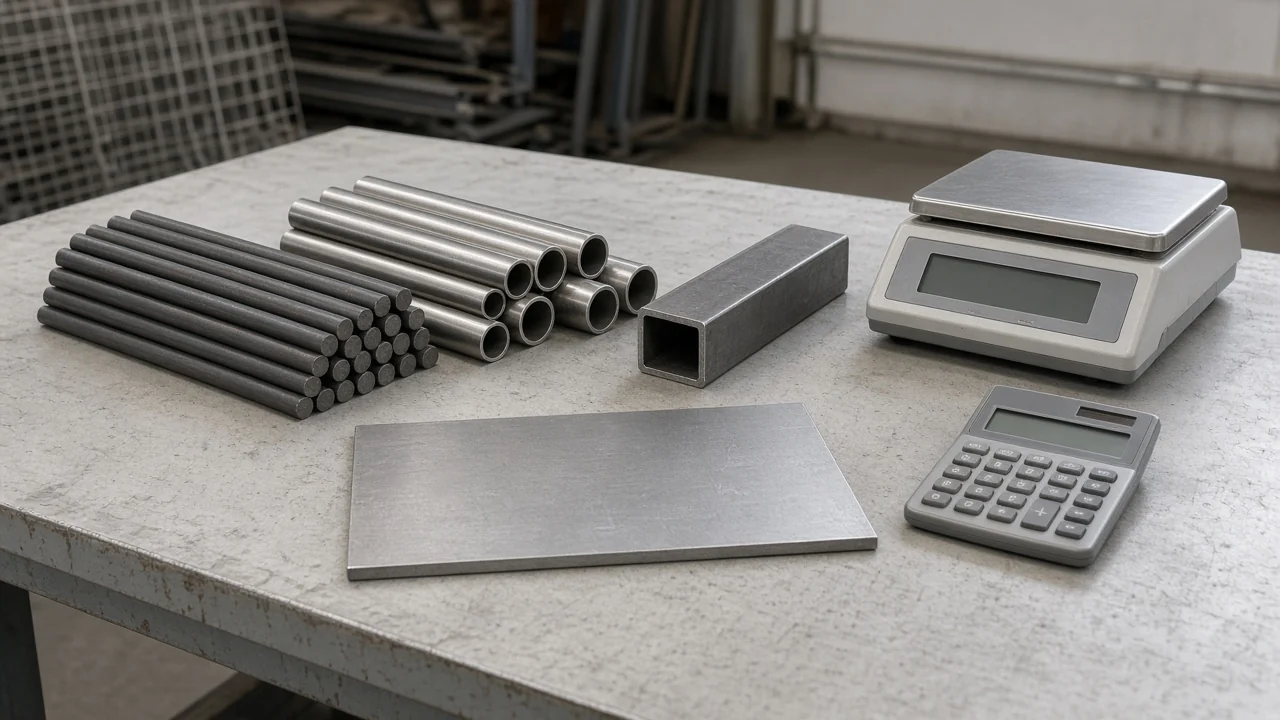
To work out how to calculate steel weight, find the volume of the part from its shape and nominal dimensions, then multiply by the density of the named steel grade. For a round wire or bar, volume is the cross-section area times length. For a tube, use the wall area. For sheet, multiply length, width and thickness. Carbon steel is commonly taken as about 7.85 grams per cubic centimetre; 300-series stainless is slightly higher.
The result is a theoretical weight. It does not include coating, scrap, offcuts or the tolerance on thickness and diameter, and it is not the same as the net weight on a packing list. Stating which density you used and what the number excludes is what makes it reproducible.
This guide is for buyers, product developers and cost analysts who check material weight lines on quotations and bills of materials for wire, tube and sheet-steel hardware. It covers the formulas, densities, units, worked examples and what to exclude. It does not give prices per kilogram, and it does not draw load or strength conclusions from weight.
Koitor Hardware is a family-owned China OEM manufacturer of custom metal bathroom and home storage hardware, built largely from steel wire, tube and sheet in carbon and stainless grades. Material weight is a starting point for cost and shipping discussions, so a weight line that both sides can reproduce saves time.
How to calculate steel weight: what goes into the formula?
Three inputs: the shape, the dimensions and the density. Weight equals volume times density. The shape decides how volume is calculated. The dimensions should be the nominal sizes from the drawing or the material order. The density should come from a named source for the named grade.
Keep the units consistent. In metric work, dimensions in millimetres and density in grams per cubic centimetre are common; in imperial work, inches and pounds per cubic inch. Mixing units is the most frequent cause of weight errors that are off by a factor of ten or a thousand.
Nominal versus measured dimensions
Nominal dimensions are the sizes ordered: 4 mm wire, 25 × 1.2 mm tube, 1.0 mm sheet. Measured dimensions on real material vary within the tolerance of the product standard. Theoretical weight uses nominal dimensions unless both sides agree otherwise. If you want to compare a real part with the calculation, measure it and recalculate, rather than assuming the nominal is exact.
Gauge numbers are not dimensions
Wire and sheet are sometimes described by gauge numbers. Different gauge systems give different thicknesses for the same number. Convert the gauge to a thickness in millimetres or inches before calculating, and write the thickness on the weight line. See sheet metal gauge versus thickness und AWG versus SWG wire diameter.
One part, several shapes
A wire basket may have wire for the grid, a flat bar for the rim and a sheet bracket. Calculate each shape separately and add them. A bill of materials with one line per shape makes the total easy to check and easy to update when a single component changes.
Which formula fits each shape?
Each common hardware shape has a simple area formula. Multiply the cross-section area by the length to get volume, or for sheet multiply the three dimensions. Then multiply by density. The process figure shows the order; the table below lists the formulas in metric form.

| Shape | Cross-section area or volume | Metric weight form | What to state on the line |
|---|---|---|---|
| Round wire or bar | π × d² ÷ 4 | kg per metre = area in mm² × density in g/cm³ ÷ 1,000 | Diameter, length, grade |
| Round tube | π × (D − t) × t | kg per metre = area in mm² × density ÷ 1,000 | Outside diameter, wall, length, grade |
| Square or rectangular tube | About 2 × t × (B + H − 2t), sharp-corner estimate | kg per metre = area in mm² × density ÷ 1,000 | Outside sizes, wall, length, corner note |
| Flat bar | Width × thickness | kg per metre = area in mm² × density ÷ 1,000 | Width, thickness, length, grade |
| Sheet or plate | Length × width × thickness | kg = length m × width m × thickness mm × density | All three dimensions, grade |
Round wire and bar
Area is π times diameter squared divided by four. For a 4 mm wire, the area is about 12.57 mm². Multiply by density and divide by 1,000 to get kilograms per metre. Then multiply by the total length of wire in the part.
Round tube
Use the wall area, not the outside diameter. The area of a tube wall is π times the mean diameter, D minus t, times the wall thickness t. Using the outside diameter as if the tube were solid overstates weight several times. Bending can change wall thickness and ovality slightly; see mandrel tube bending ovality.
Square and rectangular tube
For a sharp-cornered estimate, the area is twice the wall times the sum of the outside dimensions, minus four times the wall squared. Real tubes have rounded corners, which slightly reduce the area. For most hardware tubes the difference is small, but note on the line that the sharp-corner estimate was used.
Sheet and plate
For sheet, multiply length and width in metres by thickness in millimetres and by density in grams per cubic centimetre; the result is in kilograms. A one square metre sheet of 1 mm carbon steel at 7.85 g/cm³ weighs 7.85 kg. Subtract holes and cut-outs if they are significant.
Totalling wire length in a basket
For wire products, the hard part is often the total length, not the formula. Count each wire type separately: grid wires in one direction, grid wires in the other, frame wires, and formed parts such as hooks or feet. Multiply each count by its developed length, including bends, and add them. A drawing with a wire schedule makes this quick; without one, list the wires from the drawing and have the factory confirm.
Developed length matters for bent wire. A wire bent into a U is longer than the straight distance between its ends. Measure along the centreline of the wire, or use the cut length from the factory’s production sheet if it is available.
Stamped and formed sheet parts
For a stamped or bent sheet part, the finished weight is the flat blank area minus holes, times thickness and density. Bending does not change the volume of the material in any practical sense for weight. The blank size, also called the flat pattern, comes from the CAD model or the factory’s unfolding. Offcuts from the strip or sheet the blank is cut from are scrap, not part weight.
Holes, slots and cut-outs
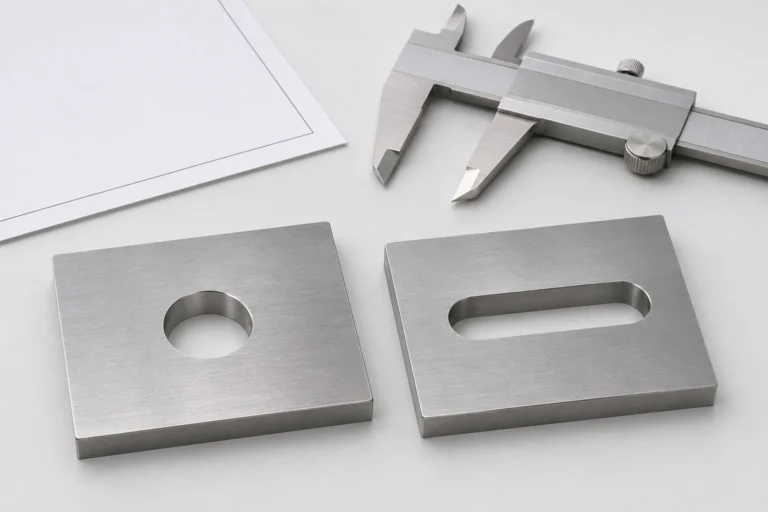
Small holes barely change weight, but a perforated panel or a large cut-out can remove a significant share of the sheet. Calculate the removed area and subtract it, or calculate the open area percentage from the perforation pattern. State whether holes were subtracted, so the number is not compared with a gross-sheet figure.
Which density should you use?
Use the density for the named grade from a named source. Carbon steel is commonly taken as 7.85 g/cm³. Austenitic stainless grades such as 304 and 316 are typically listed at around 7.9 to 8.0 g/cm³ depending on grade. Ferritic grades such as 430 are slightly lower. Write the value and its source on the weight line.
Stainless steel data are published by industry bodies such as the Specialty Steel Industry of North America and the World Stainless Association, and by producers on grade data sheets. A weight line that just says “steel” without a grade or a density is not reproducible.
Data sheets versus calculated values
Producers’ data sheets for a grade usually give a single density value. Handbooks may give slightly different values for the same grade. Either is acceptable if it is named. What matters is that both buyer and supplier use the same value for the same comparison, so the numbers agree.
Why a small density difference matters
The difference between 7.85 and 7.93 g/cm³ is about one percent. On a single basket that is a few grams. On a container of parts or a cost calculation per tonne, one percent adds up. Using carbon-steel density for a stainless part is a common, avoidable error.
Grades on the drawing
Confirm the grade before choosing a density. A drawing that says “stainless” without a grade leaves room for 201, 304, 430 or others. The guides on SS304 versus SS201 for home storage und 201 versus 304 substitution explain why the grade matters beyond weight.
Other metals in the same assembly
Some assemblies include zinc alloy castings, aluminum or brass parts. Each needs its own density from its own source. Do not apply steel density to non-steel components, and list them on separate lines.
Welded assemblies
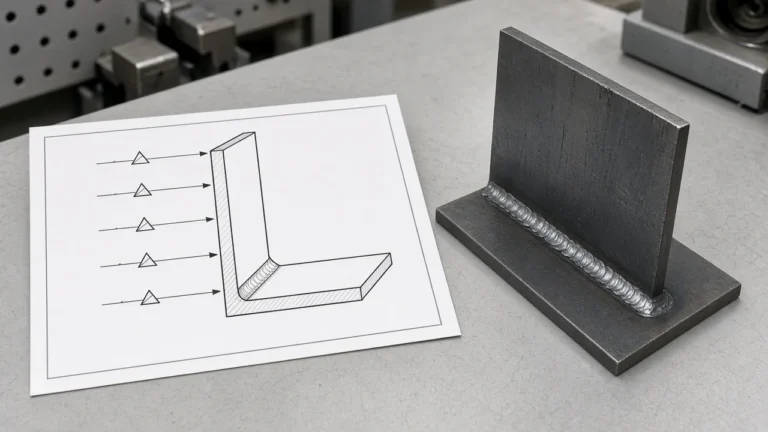
Welding adds a small amount of filler metal on some joints and none on resistance spot welds. For most wire and tube hardware, weld filler is negligible compared with the parts. Note it as an exclusion rather than estimate it, unless the design has long, heavy welds.
Checking a calculated weight against a sample
When a sample arrives, weigh it and compare it with the theoretical weight plus estimated coating and accessories. A difference of a few percent is expected from tolerance and coating. A large difference points to a wrong dimension, a different wire diameter or wall, an extra component, or a calculation error. Investigate it before quoting volume production.
Weigh several samples rather than one, and use a scale with suitable resolution for the part weight. Record the scale, the date and the sample references with the result so the comparison can be repeated later.
How do units and worked examples look?
Worked examples help check a formula. The examples below are labelled as examples only, with nominal dimensions and stated densities. They show arithmetic, not the weight of any Koitor product.
Example 1, round wire: 4 mm diameter, 304 stainless at 7.93 g/cm³. Area 12.57 mm². Weight per metre 12.57 × 7.93 ÷ 1,000 = 0.0997 kg. If a basket uses 18 m of that wire, the wire weighs about 1.79 kg.
Example 2, round tube: 25 mm outside diameter, 1.2 mm wall, 304 at 7.93 g/cm³. Area π × 23.8 × 1.2 = 89.72 mm². Weight per metre 89.72 × 7.93 ÷ 1,000 = 0.712 kg.
Example 3, sheet: 800 × 400 × 1.0 mm, 304 at 7.93 g/cm³. Weight 0.8 × 0.4 × 1.0 × 7.93 = 2.54 kg before holes.
Imperial units
In imperial units, multiply volume in cubic inches by density in pounds per cubic inch. Carbon steel at 7.85 g/cm³ is about 0.2836 lb/in³; 304 at 7.93 g/cm³ is about 0.2865 lb/in³. Exact conversion factors are available from NIST’s unit conversion resources.
Conversions between systems
Convert dimensions before calculating, then convert the final weight if needed. One inch is exactly 25.4 mm and one pound is exactly 0.45359237 kg. Converting densities and rounding at several steps compounds errors. See converting inch drawings for metric production for drawing conversion.
Shortcuts
Some shops use shortcuts such as diameter squared times a factor for carbon steel round bar. Shortcuts are fine if the factor and the density behind it are stated. They should give the same answer as the full formula; if not, check the factor.
Setting up a weight spreadsheet
A simple spreadsheet keeps weight lines consistent. Use one row per component with columns for shape, dimensions, length or area, count, grade, density value, density source, weight per unit and total. Put the density in its own cell so a grade change updates every row that uses it. Add a column for exclusions.
Keep the formulas visible rather than typing results. When someone questions a number, they can follow the arithmetic. When a dimension changes, the total updates without retyping. The same sheet can be shared with the supplier so both sides work from the same calculation.
Rounding
Carry full precision through the calculation and round only the final result, usually to grams for small parts and to tenths of a kilogram for larger assemblies. Rounding each component before adding can push the total off by more than the precision you report.
Common calculation errors
A handful of errors explain most wrong weight lines. Tube treated as solid bar. Diameter used where radius belongs, giving four times the area. Millimetres mixed with metres. A gauge number typed as millimetres. Carbon-steel density used for stainless. Holes ignored on a perforated panel. Developed length of bent wire replaced by the straight distance. Each one is caught by writing the shape, dimensions, units and density on the line, so a second person can repeat the calculation.
What does theoretical weight exclude?
Theoretical weight is the steel in the finished geometry at nominal size. It excludes coating such as plating or powder coat, scrap and offcuts from cutting, weld filler, fasteners, plastic parts, and the effect of dimensional tolerance. State the exclusions on the line, so the number is not compared with the wrong figure.
Material purchased is always more than theoretical weight because of offcuts, trimming and scrap. Cost models often apply a yield or utilization factor for that. Those factors are commercial and process-specific, and they belong on a separate line, not hidden inside the weight.

Theoretical weight versus packing-list net weight
Net weight on a packing list is the weight of the goods without packaging, usually measured or calculated from weighed samples. It includes coating, fasteners and accessories. Theoretical steel weight is usually lower. The two numbers answer different questions; see packing list net weight and gross weight.
Coating weight
Plating adds little weight; powder coating adds more, depending on film thickness and surface area. If coating weight matters for a calculation, estimate it separately from area and film build, or weigh coated and uncoated samples. Do not fold it into the steel density.
Tolerance
Wire and sheet are produced within tolerances. Material at the upper limit of thickness weighs more than nominal; at the lower limit, less. For most cost checks nominal is the agreed basis. If a weight dispute arises, measure the actual material.
Steel weight checklist
- The shape of each component is named.
- Nominal dimensions come from the drawing or material order.
- Gauge numbers are converted to thickness.
- Tube weight uses wall area, not solid diameter.
- The grade is named and the density value and source are written.
- Units are consistent through the calculation.
- Each component is a separate line.
- Exclusions are stated: coating, scrap, filler, fasteners, tolerance.
- The result is labelled theoretical weight.
- Theoretical weight is not used as packing-list net weight.
How should buyers use the number?
Use theoretical weight to check that a material line on a quotation is plausible, to compare design options, and to plan shipping before samples exist. Do not use it as proof of grade, as a load rating, or as the shipped weight. For load questions, test the product; for grade, use a material certificate or verification.
Weight also feeds landed cost estimates and freight planning, as covered in the landed cost guide und how to calculate CBM. Those depend on packed weight and volume, which start from material weight but add packaging.
Comparing two designs
If a redesign changes wire diameter or tube wall, theoretical weight shows the effect on material quickly. A change from 4 mm to 5 mm wire raises the wire weight by about 56 percent, because area scales with diameter squared. That is often a useful first check before a quotation is revised.
When weight is used in pricing
Some quotations show a material weight and a material cost. The weight should be reproducible from the drawing. The price per kilogram is a commercial term set at quotation and changes with the market; this guide does not estimate it.
Using weight for early shipping plans
Before samples exist, theoretical weight lets a buyer estimate whether a carton will be heavy, whether a pallet will reach a weight limit and how weight compares with volume. Add estimated packaging and accessories, label the figure as an estimate, and replace it with weighed samples when they are available.
Koitor practice note
Where a Koitor quotation includes a material weight line, it can show the shapes, nominal dimensions and density used, so the buyer can reproduce it. Pricing is set on the quotation itself.
Frequently asked questions about steel weight
What is the basic formula for steel weight?
Weight equals volume times density. Volume comes from the shape and nominal dimensions.
What density should I use for carbon steel?
7.85 g/cm³ is a common value. State the value and source on your calculation.
Is stainless steel heavier than carbon steel?
Austenitic stainless grades such as 304 are slightly denser, typically around 7.9 to 8.0 g/cm³. The difference is about one to two percent.
How do I calculate tube weight?
Use the wall area: π × (outside diameter − wall) × wall, times length and density.
How do I calculate the weight of a steel sheet?
Multiply length and width in metres by thickness in millimetres and by density in g/cm³. The result is kilograms.
Does galvanizing or plating change the weight much?
Plating adds very little. Hot-dip galvanizing and powder coating add more. Estimate coating separately rather than changing the steel density.
Why does my calculated weight differ from the packing list?
The packing list net weight includes coating, fasteners and accessories, and may be weighed. Theoretical weight is bare steel at nominal size.
How accurate is theoretical weight?
It is as accurate as its inputs. With correct dimensions and density, it is usually close to the bare steel weight, with differences from tolerance and corner radii.
Can I check the steel grade by weighing a part?
No. Density differences between grades are too small for weight to confirm a grade. Use material certificates or testing.
Does this guide give a price per kilogram?
No. Material prices change with the market and are set on a quotation. This guide covers only how the weight is calculated.
Arbeiten Sie mit Koitor Hardware zusammen
Check a material weight line on your quotation
Send the drawing, the material grade and the weight line you want to check. We can show how the theoretical weight was built from the shape, the dimensions and the named density. We do not publish price per kilogram here; pricing is discussed on a quotation.
OEM / EIGENE MARKE
Verwandeln Sie diesen Beschaffungsleitfaden in ein Produktdossier
Teilen Sie uns Ihr Zielprodukt, die Größe, die Oberflächenausführung, die Bestellmenge und Ihre Verpackungsanforderungen mit. Ihr Team erhält vor der Angebotserstellung eine praxisorientierte Prüfung der Herstellbarkeit.

 English
 Español
 Português
 Français
 Deutsch
 العربية