
So verpacken Sie ein Weinregal für 9 Flaschen für den Online-Handel (so vermeiden Sie Kratzer, Dellen und senken die Versandkosten)
A 9 bottle wine racklooks simple, but it ships like a high-return SKU: coated metal scuffs during vibration, wire frames can deform under compression, and “cosmetic” defects become instant returns online. This factory-ready guide gives you a measurable packaging spec—pack-out rules, test matrix, QC checkpoints, and PO clauses that protect surfaces withoutinflating dimensional weight.
Hero Module: Packaging + Space Blueprint
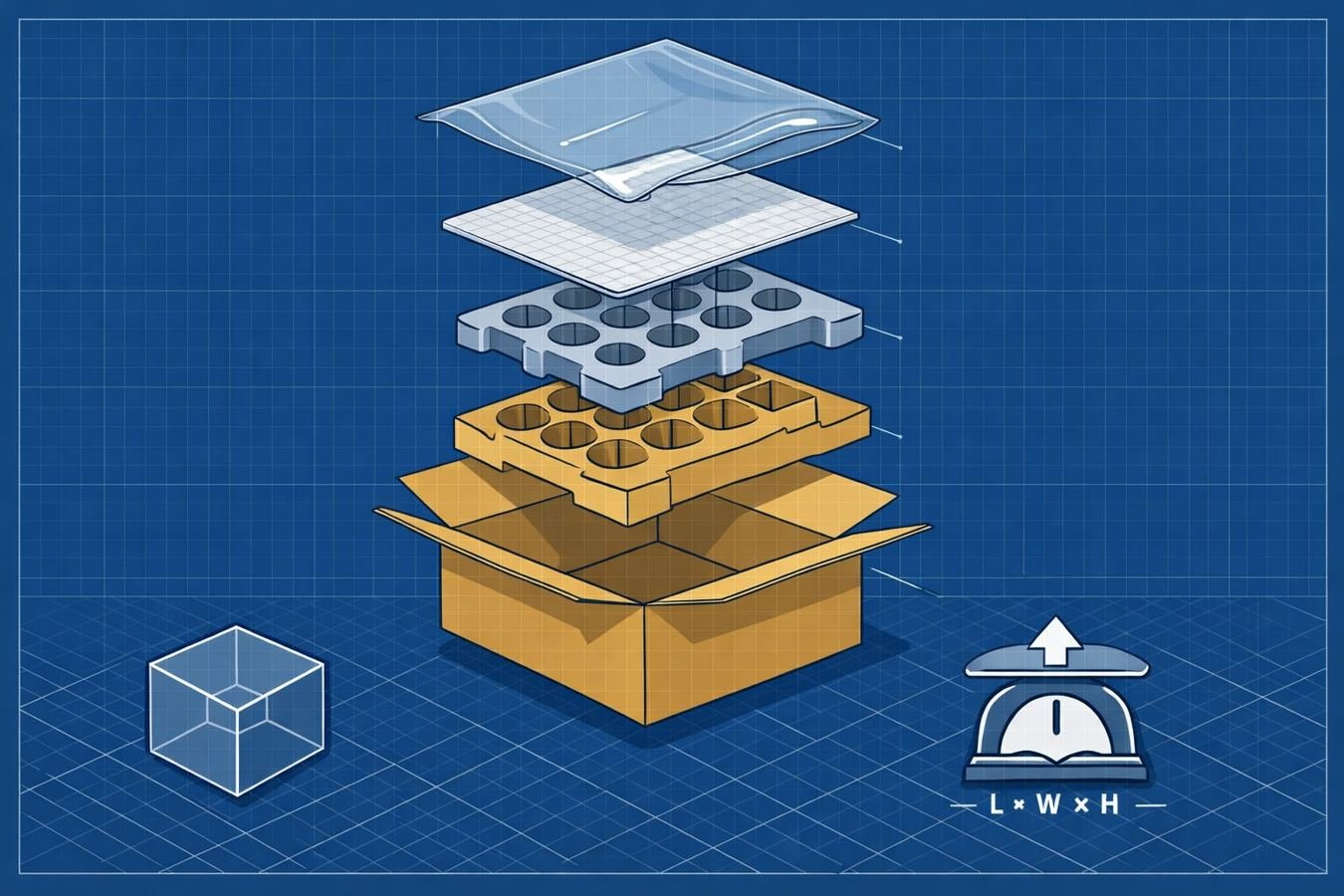
Most packaging failures come from treating protection and cube separately. The Packaging + Space Blueprintlinks four controllable elements into one spec your supplier can quote and execute: (1) product CTQs, (2) finish risk, (3) transit profile + tests, and (4) cube efficiency (dim weight, master carton, pallet).
Market Reality: Why E-Commerce Is Tougher
E-commerce distribution typically means more handling points, more random orientation, and higher mixed-load compression than pallet-only retail flows. Your PO should not say “pack well.” It should define measurable pass/failoutcomes:
- No rub-through to base metal on coated surfaces (especially front-facing zones).
- No permanent deformation that causes wobble or misfit.
- Carton integrity: no burst, no tape failure, acceptable corner crush.
Material & Finish Risk (What Packaging Must Protect)
Packaging design depends on finish behavior:
- Powder-coated steel: highest scratch risk—micro-rubbing during vibration is the #1 defect mode.
- Stainless steel: scuffing/fingerprint/abrasion risk—paperboard contact can mark surfaces.
- Wire frames: deformation risk under top-load—carton strength and load paths matter.
For humid routes, tie packaging to finish controls (pretreatment + DFT plan + edge/recess awareness) so thin-film zones don’t become corrosion initiation points.
Manufacturing CTQs Before Packing (Pack-Ready Gate)
The best packaging fails if the rack is not pack-ready. Require a pre-pack CTQ gate:
- No burrs / sharp points(bags/foam must not be cut).
- No weld spatterin contact areas (prevents puncture + point loads).
- Square + stable(limit rocking; reduces self-rubbing inside carton).
- Clean + cured finish(soft coating scratches easily).
Pack-Out Rules (Immobilize + Isolate + Resist Top-Load)
Use inside-out rules to stop the two root causes of damage: Kontaktand movement.
1) Primary surface layer
- Polybag every unit.
- Add anti-scratch sheet on front-facing surfaces (Zone A).
2) Contact-point isolation
- Place foam/EPE separators anywhere metal could touch metal under vibration.
- If two metal parts can touch, they will—design for “no possible contact.”
3) Immobilization structure
- Use a die-cut corrugated tray (or molded pulp) that locks geometry.
- Define a movement limit (example: no visible migration under a standardized shake test).
4) Carton system + cube control
- Right-size the carton to reduce void (less acceleration + less corner crush).
- Lock tape pattern + carton strength target (ECT/BCT) on the PO.
Core Packaging Specification (RFQ / PO-ready)
| Spec Item | Default Recommendation | Lock on the PO |
|---|---|---|
| Primary protection | Polybag + anti-scratch sheet on Zone A | Bag thickness; sheet type; sealing; “no trapped moisture” rule |
| Contact-point isolation | Foam/EPE separators at any potential contact point | Separator locations on pack-out drawing; “no metal contact” acceptance |
| Immobilization | Die-cut corrugated tray (or molded pulp) | Movement limit; tray revision control |
| Carton system | Right-sized shipper + controlled tape pattern | Carton size; strength target; tape width/pattern; labels |
| Humidity control (route-dependent) | Desiccant / barrier for ocean or humid seasons | Type/grams/placement; barrier material + sealing |
Test Matrix (Drop / Vibration / Compression)
You don’t need a perfect lab—you need repeatable verification with clear acceptance criteria.
| Test | Purpose | Typical Acceptance Criteria (Customize) |
|---|---|---|
| Drop sequence | Corner impacts + shock | No rub-through; no wobble-causing deformation; carton integrity OK |
| Vibration | Reveal abrasion + migration | No Zone A scuffs; separators remain; movement stays under limit |
| Compression / top-load | Stacking stress | Permanent deformation below gauge limit; carton not collapsed |
| Humidity conditioning (if required) | Moisture risk screening | No corrosion staining; packaging stays dry; desiccant intact |
Buyer Decision Checklist
- Define Zone A surfaces (front-facing in listing/unboxing). Set stricter cosmetic limits.
- Confirm finish type (powder coat vs stainless). Choose protection accordingly.
- Confirm channel (parcel vs retail vs export). Set test profile + humidity controls.
- Require pack-out drawing + BOM (revision controlled).
- Lock carton spec + tape pattern + change control in the PO.
Supplier Verification Plan
- Layer-by-layer photos + sealed-carton photos (tape pattern visible).
- Pack-out drawing + BOM for all packaging components.
- Test evidence (drop/vibration/compression) + sample size + defect map.
- Pre-pack CTQ records (deburr, wipe-down, fit gauge, cosmetic grading).
PO Clause Starter Pack
- No direct metal-to-metal contact is permitted inside the unit shipper.
- All racks must be polybagged; Zone A must include anti-scratch sheet per pack-out rev __.
- Carton specification and tape pattern are controlled; any change requires written approval.
- Supplier must provide packaging evidence pack and first-lot verification before shipment.
- AQL applies to packaging + cosmetic defects; rework/replacement responsibility is defined upfront.
Internal Links (Related Programs)
Explore broader OEM programs and adjacent SKUs: custom home storage solutions, Maßgeschneiderte Aufbewahrungslösungen für die Küche, Chinese OEM hardware supplier.
Simon, Experte für Beschaffung
Sind Sie bereit, Ihre Lieferkette zu optimieren:
Zahlen Sie nicht länger für Mängel. Richten Sie ein standardisiertes OEM-Programm für Duschkörbe aus Draht, Handtuchhalter und Aufbewahrungskörbe ein – mit Qualitätskontrollen, Exportverpackungen und stabilen Lieferzeiten.
Katalog 2025 anfordern OEM-Projekt starten
E-Mail: simon@koitorhardware.com | Werk: Jiangmen, China
Senden Sie Koitor Ihre Zeichnung, ein Musterfoto, eine Referenz zur Oberflächenbeschaffenheit, die gewünschte Stückzahl und den Zielmarkt.
OEM / EIGENE MARKE
Verwandeln Sie diesen Beschaffungsleitfaden in ein Produktdossier
Teilen Sie uns Ihr Zielprodukt, die Größe, die Oberflächenausführung, die Bestellmenge und Ihre Verpackungsanforderungen mit. Ihr Team erhält vor der Angebotserstellung eine praxisorientierte Prüfung der Herstellbarkeit.
 English
  Español
  Português
  Français
  Deutsch
  العربية