
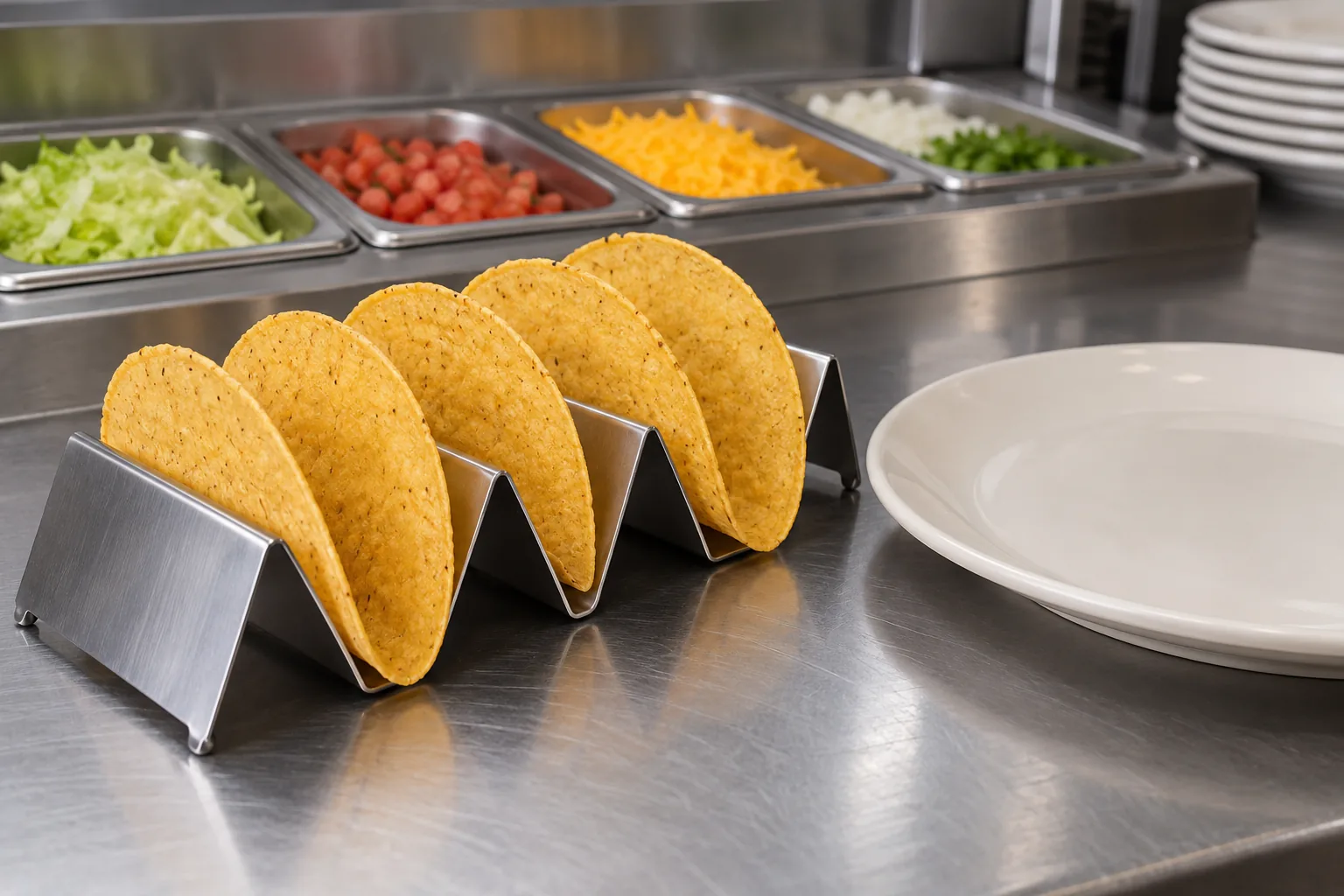
For procurement, the metal taco holder specification starts with the exact reference parts and intended arrangement. A metal taco holder specification should define the shell profile and serving arrangement, then check how the formed cradles support the actual shell and whether the complete holder fits the intended plate or service surface. Product position count is not enough to confirm that shells sit as expected, that filled servings clear one another or that the assembly can be placed and removed conveniently.
This guide is for importers and private-label buyers sourcing an unheated formed-metal serving accessory. It does not establish food-contact compliance, thermal suitability, dishwasher safety, load capacity or universal shell compatibility. Those are separate requirements for the specific materials, finish, design, jurisdiction and use conditions. The sample review here focuses on physical fit and serving configuration.
Why does the exact shell and serving position matter?
Tablecraft’s official Taco Taxi product family documents formed stainless products with different serving-position counts and hard- or soft-shell presentation. Its specification sheet for a named model also records package contents and product dimensions. These are source-specific product descriptions. They show why buyers should make the shell and serving arrangement explicit; they do not prove every shell fits every cradle, or transfer any material, care, heat or dishwasher claim to another design.
Select a reference shell model, size, shape and material form. Decide whether the holder is intended for empty shells, filled servings, or both. The filled version changes the occupied envelope and center of mass. If the buyer wants multiple shell types or portion sizes in one SKU, test each reference separately. Do not infer compatibility from “hard shell” or “soft shell” as broad labels alone.
The holder can be a wave-shaped formed sheet, wire frame or another architecture. Identify the cradle contact surfaces from a drawing or sample and check the shell rests in the intended orientation. Do not copy a branded product’s protected geometry. The purchasing objective is to specify the buyer’s own interface and acceptance evidence.
How should the shell cradle be reviewed?
Inspect the spacing and shape of the support valleys. Determine where the shell touches the holder, how far it leans, and whether a neighboring shell changes its position. For a formed sheet product, also inspect the edge and contact finish where shell surfaces meet the metal. For wire construction, identify which wire segments support the shell. These are visual and physical observations; they do not prove strength, food-contact safety or coating durability.
Review the holder with actual shells, not only a CAD outline. Place one shell, then fill all intended positions. Compare the contact and spacing between the first and last positions. Note whether the shell can be removed without lifting or disturbing the adjacent shell in the planned serving setup. If the product is intended for filled servings, use the actual assembly or a representative controlled sample. Do not make up a portion size or weight if the buyer has not supplied one.
| Specification field | Buyer reference | Sample acceptance record |
|---|---|---|
| Shell type | Supplier, model and hard/soft form | Reference sample and orientation |
| Serving state | Empty shell or defined filled serving | Agreed sample condition |
| Position count | Number of actual support valleys | Named configuration only |
| Cradle geometry | Contact area, opening and spacing | Drawing and contact observations |
| Plate | Model, usable area, rim and shape | Actual holder and plate assembly |
| Access | Hand, utensil and removal direction | Observed serving sequence |
| Material/finish | Approved documents for exact SKU | Supplier evidence and revision |
| Package | Holder, plate or accessory inclusion | BOM and carton contents |
This is a buyer worksheet. Its dimensions and acceptance criteria should be set from the specific product and reference plate, not assumed to apply to a product family.
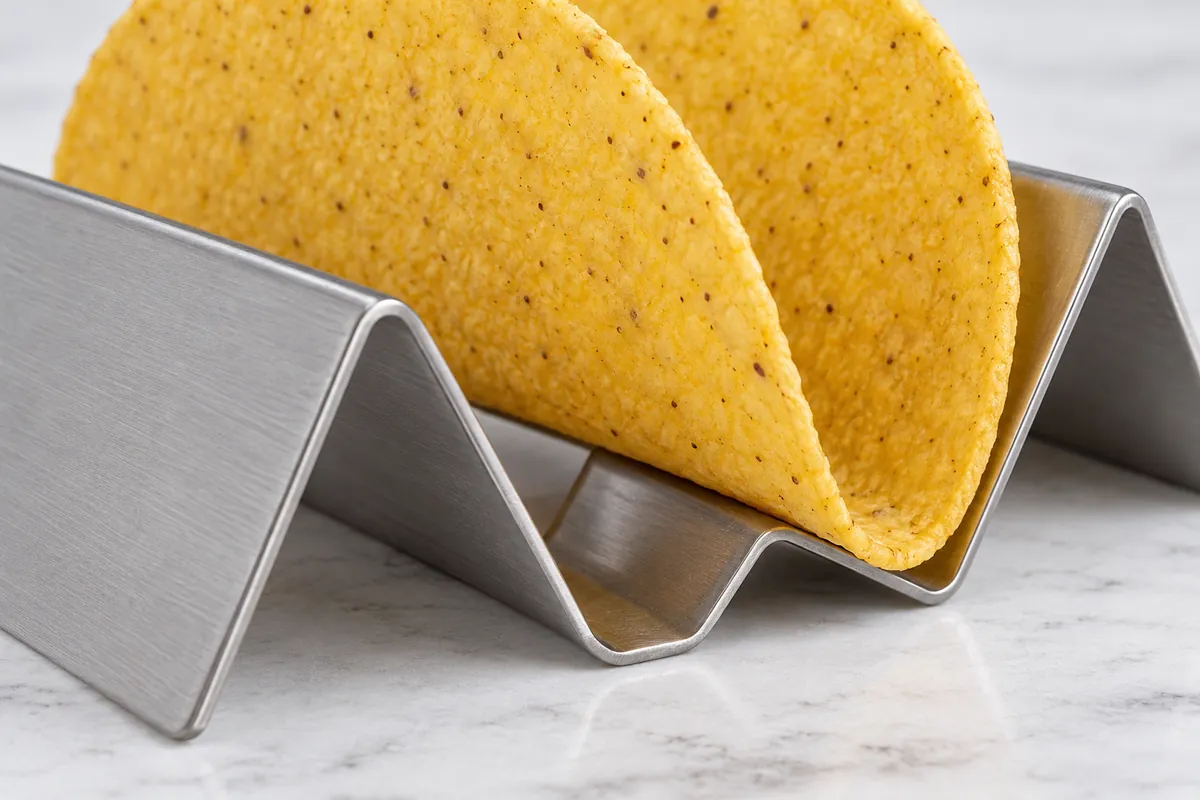
How should plate fit and serving access be checked?
Compare the holder’s footprint with the plate’s usable top surface, not simply its outside diameter or length. A raised rim, corners, handles or plate shape may reduce usable area. Confirm the holder sits in the intended orientation and that its feet or contact points rest on the surface as designed. If the holder is supplied as a stand-alone item, define which plates or serving surfaces are examples only and do not imply that a plate is included.
Place the assembly on the actual plate and check whether the holder moves, rocks or extends beyond the intended serving area. These observations describe the reviewed sample; they do not establish anti-slip behavior or stability under all serving conditions. The buyer should identify the plate revision and the surface on which it was reviewed. If several plate SKUs are used, qualify each relevant combination.
Then assess the access path. Can a server place the filled holder on the plate? Can an individual shell be removed without contacting another shell or catching on a rim? Does the holder’s end or handle interfere with a utensil? Record the sequence and any interference. Avoid describing the design as ergonomic or safe without a separately supported assessment.
What should the RFQ say about materials and use?
Specify the intended serving environment and the actual product scope. If the item is described as food-contact metal, the responsible supplier must provide documentation appropriate to the material, finish, manufacturing process and destination market. A stainless appearance or product-family comparison is not compliance evidence. K203 covers the project’s separate food-contact applicability guidance; do not recast geometric fit as regulatory approval.
If the buyer expects hot food contact, high-temperature service or dishwasher cleaning, define those conditions and request model-specific substantiation. Tablecraft’s product statements apply to its own referenced item and care directions. They are not evidence that another alloy, coating, weld, forming process or finish behaves the same way. The research pack identifies existing K1183 as the owner for thermal-use evidence; avoid repeating its general answer here.
The RFQ should provide the shell and plate models, serving state, number of positions, requested material/finish, intended use and packaging scope. Ask for a drawing of the cradle profile, dimensions, joints and contact finish. If a sample has a separate plate or decorative item, say whether it is included. This prevents a product photograph from being mistaken for a complete package offer.
How should an importer approve the sample?
Use the production-intent holder, reference shells and plate. Record the sample’s model and drawing revision. Check each cradle with empty shells, then check the intended filled arrangement if that is within scope. Place the full holder on the reference plate, note contact and clearances, and observe how each serving is loaded and removed. The approval file should preserve photographs and the exact sample configuration.
A sensible sample sequence is:
- Verify item number, material/finish documents and revision.
- Confirm shell type and serving state for the evaluation.
- Seat one shell in each intended cradle and record contact.
- Load adjacent positions and observe shell-to-shell clearance.
- Assemble filled servings if the SKU is intended for them.
- Place the holder on the actual plate and note footprint/contact.
- Repeat placement and removal using the intended serving path.
- Record which accessories or serving surfaces are excluded.
- Route any fit, finish or sharp-edge observation to the agreed criteria.
This sequence is not a load, drop, heat, food-contact or dishwasher test. If the project needs those evaluations, the buyer should define the protocol and have the responsible party assess the exact finished product. Do not infer performance from a brief fit check.
For broader context on metal storage products, buyers can review Koitor’s OEM-Hardware für die Heim-Datenspeicherung und Fertigung von maßgefertigten Metallregalen pages. They do not confirm a current taco-holder catalog or food-contact certification. Buyers may share drawings and reference items through the contact page for a bounded metal-component feasibility discussion.
What should be reviewed before final artwork?
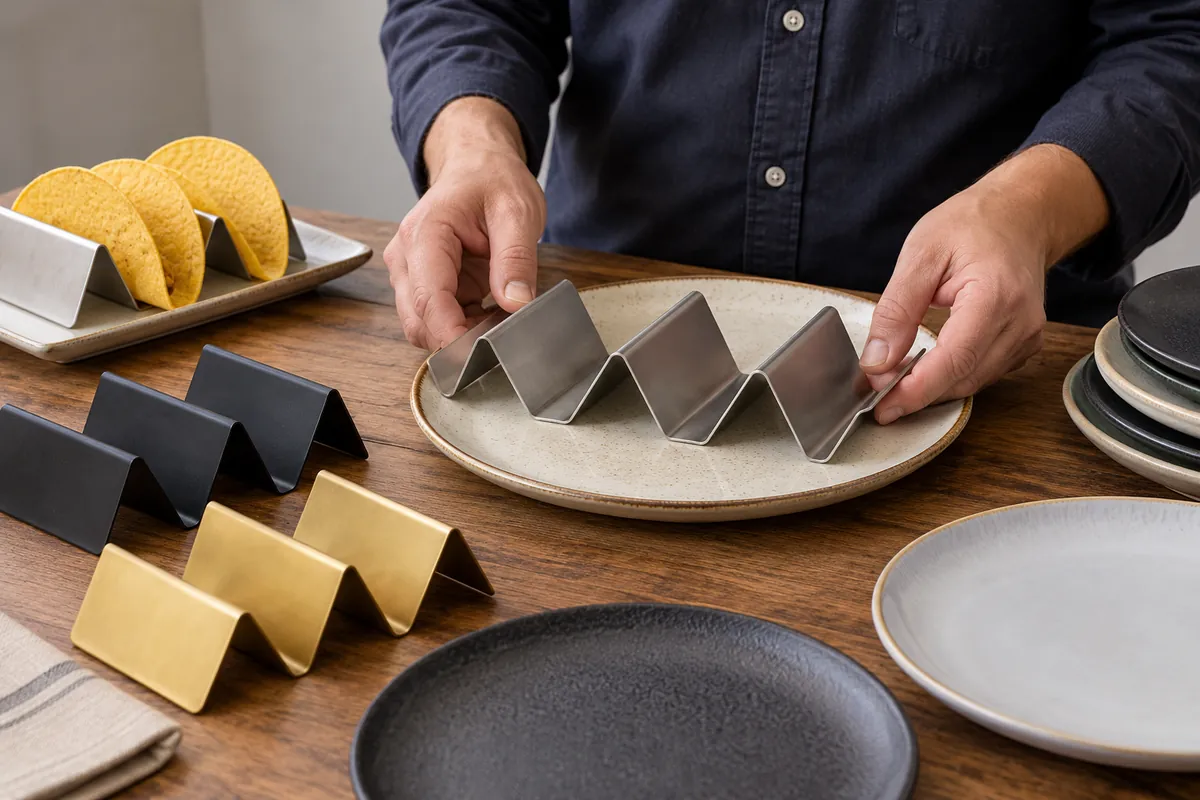
Packaging and listing images often become the buyer’s compatibility explanation. Before artwork approval, compare the pictured holder with the final SKU: position count, footprint, finish, supplied plate and any included utensils should be accurate. If a shell is displayed only to show scale, make that clear where needed. Avoid using another supplier’s recognizable product or logo as though it were the proposed item. A rendered sample should not depict a branded design so closely that customers could mistake the source.
The instruction sheet can identify the intended shell and plate references, assembly steps and care source. It should not create a heat or dishwasher instruction from another company’s product page. If the product has multiple finishes, ensure the claims and photographs correspond to the correct option. Provide the product team with the approved drawing revision and BOM before artwork is released.
When a retailer requests a new serving arrangement, clarify whether it is a new configuration or simply a different shell placed in an existing holder. The distinction matters: a different shell can change contact while a different plate changes footprint and access. Ask for both reference items if both interfaces are being changed.
How should SKU claims and changes be managed?
Separate variations by position count, holder footprint, finish, material and supplied accessories. A change in shell position count may also change the overall footprint or plate pairing. A holder that has been reviewed with one plate should not be described as compatible with all plates of a similar size. Keep the approved combination in a product matrix and state unreviewed combinations as unconfirmed.
Product copy and imagery need to match the sold configuration. If a plate or shell is only shown to illustrate scale, label it as not included where appropriate. If the item is sold with a serving plate, record its supplier and model in the BOM. Never imply that the stand’s source-specific care or material claims belong to a different SKU.
Before a reorder, compare the approved drawing, finish, material records, pack and accessories. Any change to the shell reference, formed profile, contact edge, plate, or coating should trigger a targeted fit or document review. Maintain exact revisions so that quality and merchandising teams are not relying on an old photograph without a clear approval basis.
How should issues be categorized after review?
When a sample review finds a mismatch, describe the observed interface before prescribing a change. For example, note whether the shell contacts an edge, a neighboring serving reduces access, or the holder footprint crosses the plate rim. The supplier can then determine whether a geometry revision, different plate pairing or narrower compatibility statement is appropriate. Avoid instructing a supplier to add material or increase an opening without a drawing-based review, since a change to one area can alter another contact.
Separate visual finish observations from functional fit observations. A mark on a cosmetic face, a sharp edge, an unclear contact point and a plate overhang are distinct issues with distinct acceptance criteria. Keep dated photographs and note the sample revision so that an approved correction can be verified on the next sample.
What is the practical acceptance decision?
The product is ready for assortment when the buyer can name the reference shell and serving state, observe how each cradle contacts it, verify the occupied footprint on the intended plate, and document the parts included. Food-contact and use suitability remain separately evidenced requirements. A concise fit matrix is more useful than a broad “fits all taco shells” claim that the available sample does not support.
How should a new shell or plate be introduced?
A new shell type can change the support contact and spacing; a new plate can change the available footprint and rim interaction. Identify which interface has changed and review that pairing with the complete serving arrangement. If the holder itself remains unchanged, this still does not make the new combination automatically approved. Record the exact shell and plate SKUs alongside the holder revision.
Where the brand offers several position counts, keep each footprint tied to its own drawing and packaging contents. Confirm whether the serving plate or utensils are supplied or shown only as context. If the plate is purchased from a different vendor, document its current item number and sample revision. Keep food-contact, cleaning and temperature evidence in their own compliance files so that geometry approval cannot be mistaken for those separate decisions.
Source basis: Tablecraft Taco Taxi Medium and its TRS23 product specification sheet. Listed construction, position count, care and use claims apply to the named source products only.
Keep the metal taco holder specification tied to the named sample, drawing revision and included components.
Developing a Formed Metal Serving Accessory?
Share a drawing or sample, shell and plate references, finish target and packing scope for a bounded component feasibility discussion.
OEM / EIGENE MARKE
Verwandeln Sie diesen Beschaffungsleitfaden in ein Produktdossier
Teilen Sie uns Ihr Zielprodukt, die Größe, die Oberflächenausführung, die Bestellmenge und Ihre Verpackungsanforderungen mit. Ihr Team erhält vor der Angebotserstellung eine praxisorientierte Prüfung der Herstellbarkeit.
 English
 Español
 Português
 Français
 Deutsch
 العربية