
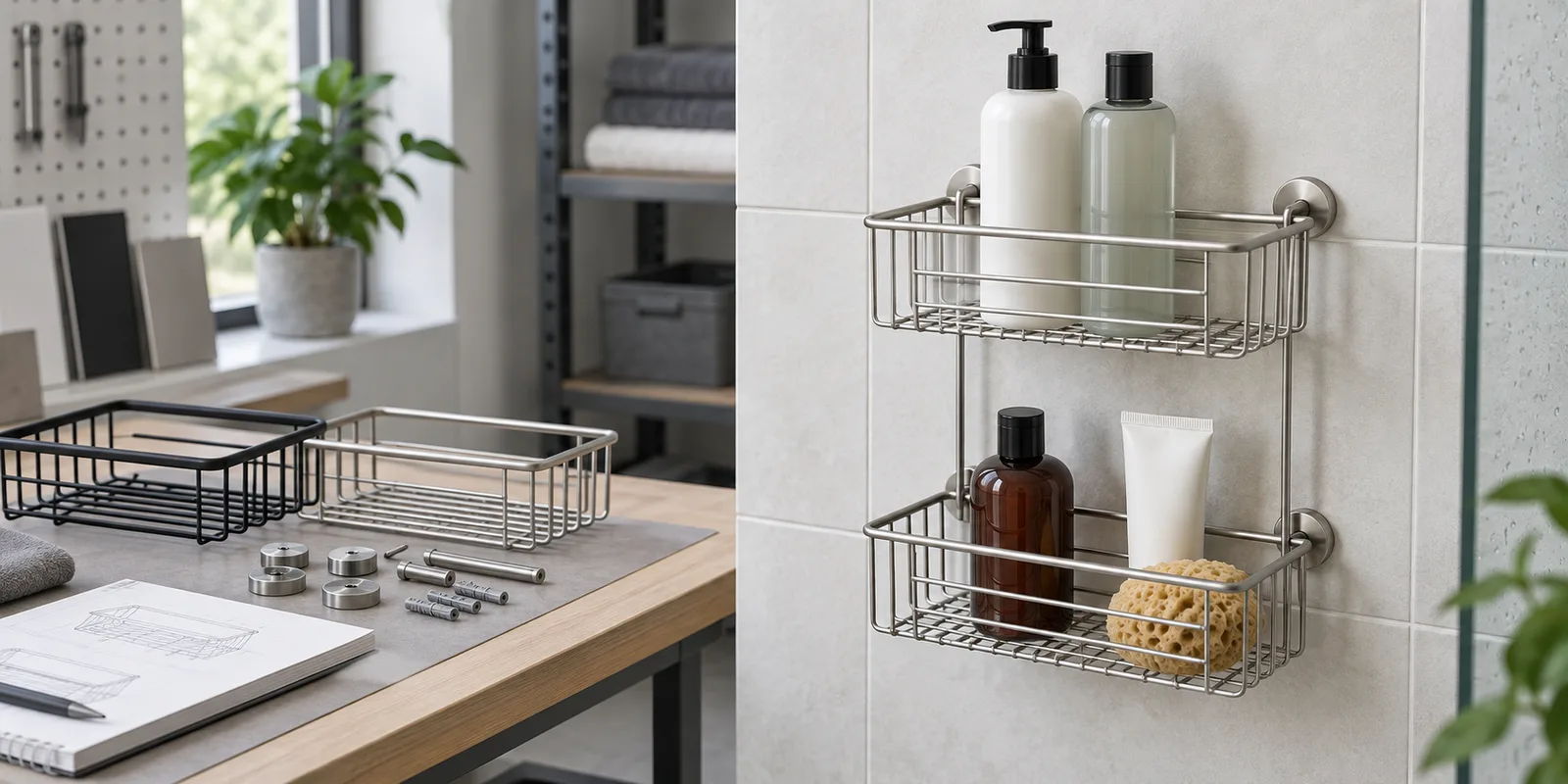
Effective shower caddy drainage design allows water to leave the shelf quickly without making bottles unstable, exposing sharp wire ends or creating difficult-to-coat joints. OEM buyers should review the shelf pattern, spacing, slope, corners, mounting position and product finish as one system. A drainage layout that looks open in a drawing can still trap water around welds, bottle bases or wall contact points, so the design should be confirmed with a functional sample before bulk production.
Why does drainage design matter in an OEM shower caddy?
Drainage design matters because a shower caddy works in a repeatedly wet environment while holding bottles of different sizes and shapes. The shelf must release water, support products, remain easy to clean and retain enough structural stiffness for the intended use.
Water usually does not remain only in the center of a basket. It can collect where horizontal wires meet frames, where a solid tray meets a side wall, around folded corners and beneath broad bottle bases. Soap residue and product labels can also slow drainage. Buyers should therefore evaluate the real contact points rather than simply count open spaces.
Drainage also affects appearance over time. A suitable material and finish can improve corrosion resistance, but no surface should be described as permanently rust-proof. Repeated moisture, cleaning chemicals, damaged coating and poor drying can all affect performance. Product-specific material and finish expectations should be agreed before sampling.
The layout influences customer experience. Very large openings may drain well but allow narrow bottles, razors or small accessories to tip through. Very small openings support products but can retain residue and make cleaning harder. The design task is to balance water release with storage function.
For importers, the drainage decision also affects tooling, welding time, finishing access, product weight, packaging and inspection. Reviewing these tradeoffs early with a custom shower caddy manufacturer is more efficient than correcting an approved appearance after production planning has started.
How should wire spacing and shelf geometry be selected?
Wire spacing and shelf geometry should be selected from the smallest products the caddy must support, the expected water path and the manufacturing structure. Buyers should define a functional range instead of copying one dimension from a competitor sample.
Begin with bottle-base contact. Place representative pump bottles, tubes, jars and small accessories on a sample grid. Check whether each item has multiple support points and whether a rounded or narrow base rocks between wires. A visually regular pattern is not enough if common products lean or fall.
Longitudinal wires can direct water toward the front or rear, while cross wires can increase support. A mixed pattern may provide useful contact areas without closing the shelf. The preferred arrangement depends on basket width, depth, frame design and manufacturing method.
Shelf slope can encourage water movement, but excessive slope may make tall bottles lean or slide. The wall, mounting bracket and floor may not be perfectly level in actual use. A functional sample should be installed in representative conditions before the angle is frozen.
Corners deserve specific attention. A rounded wire frame may leave a triangular opening; a formed sheet tray may need drain slots near the bend; a welded mesh can create close intersections that are harder to finish. The drawing should define corner geometry clearly so different samples do not use different interpretations.
Side rails and front retaining wires also change drainage. A low rail may improve access but provide less bottle retention. A high rail can contain tall products yet create more intersections and cleaning areas. Use the target product assortment to decide the rail height rather than treating drainage as an isolated shelf feature.
How do material and surface finish affect bathroom caddy water drainage?
Material and surface finish do not replace drainage geometry, but they influence how the finished shower caddy handles moisture, cleaning and visible wear. Buyers should specify both the base material and finishing process, then inspect difficult coverage areas on the sample.
Stainless steel is often considered for wet-area bathroom hardware, but grade, fabrication, surface condition and maintenance still matter. Weld discoloration, grinding transitions and contamination should be reviewed according to the project specification. A material name alone does not define the complete finished product.
Powder-coated steel can provide color and a consistent visual family for private-label bathroom accessories. The buyer should examine coating coverage at welds, inside corners, wire intersections, hooks and mounting interfaces. Sharp edges or parts that scrape during assembly can become early damage points.
Chrome or other plated appearances may suit some product programs, but the substrate, preparation, joint design and required finish standard need project-specific review. Buyers should avoid assuming that a bright surface automatically provides the same wet-environment performance across suppliers.
Drainage openings must remain open after finishing. Heavy coating around narrow gaps can change fit or create bridges between close wires. Threaded parts, assembly slots and mounting contacts may require masking or post-finish checks.
Cleaning expectations should also inform the surface choice. Rough textures can hide minor marks but may retain residue differently from smoother finishes. An approved physical finish sample viewed under consistent lighting gives production and inspection teams a better reference than screen images.
What drainage structures should OEM buyers compare?
OEM buyers should compare open-wire shelves, expanded or welded mesh, perforated sheet and hybrid structures according to drainage, bottle support, cleaning, finishing and manufacturing cost. No one structure is automatically best for every shower caddy.
| Shelf Structure | Drainage Character | Buyer Checks | Manufacturing Considerations |
|---|---|---|---|
| Parallel wire shelf | Open water paths with simple visual structure | Small bottle support, spacing consistency and corner gaps | Wire straightness, frame joints and weld access |
| Cross-wire grid | Many smaller openings and broad support | Residue around intersections and cleaning access | More intersections, weld appearance and finish coverage |
| Perforated sheet | Controlled holes but possible water film on solid areas | Hole placement, edge condition and shelf slope | Punching, forming, corner design and coating access |
| Expanded or welded mesh | Distributed openings with smaller item support | Sharp points, flatness and border finishing | Cut-edge treatment and attachment to frame |
| Hybrid wire and tray | Targeted drainage with defined product zones | Water path between materials and removable-part fit | Component count, assembly and mixed finishing needs |
A wire shower caddy design may be easier to see through and can reduce material area, while a formed tray can create a cleaner graphic surface for some retail programs. However, a tray requires deliberate drain locations and may increase wiping needs.
Removable liners or trays can improve cleaning access, but they add parts, fit tolerances and packaging requirements. The sample should confirm that a removable component cannot rattle excessively, lift with a bottle or block intended drainage.
For multi-tier caddies, examine whether water from the upper tier falls directly onto products below. Tier offset, shelf depth and mounting position influence this path. A product may drain quickly but still create an undesirable drip pattern.
How should a shower caddy drainage sample be evaluated?
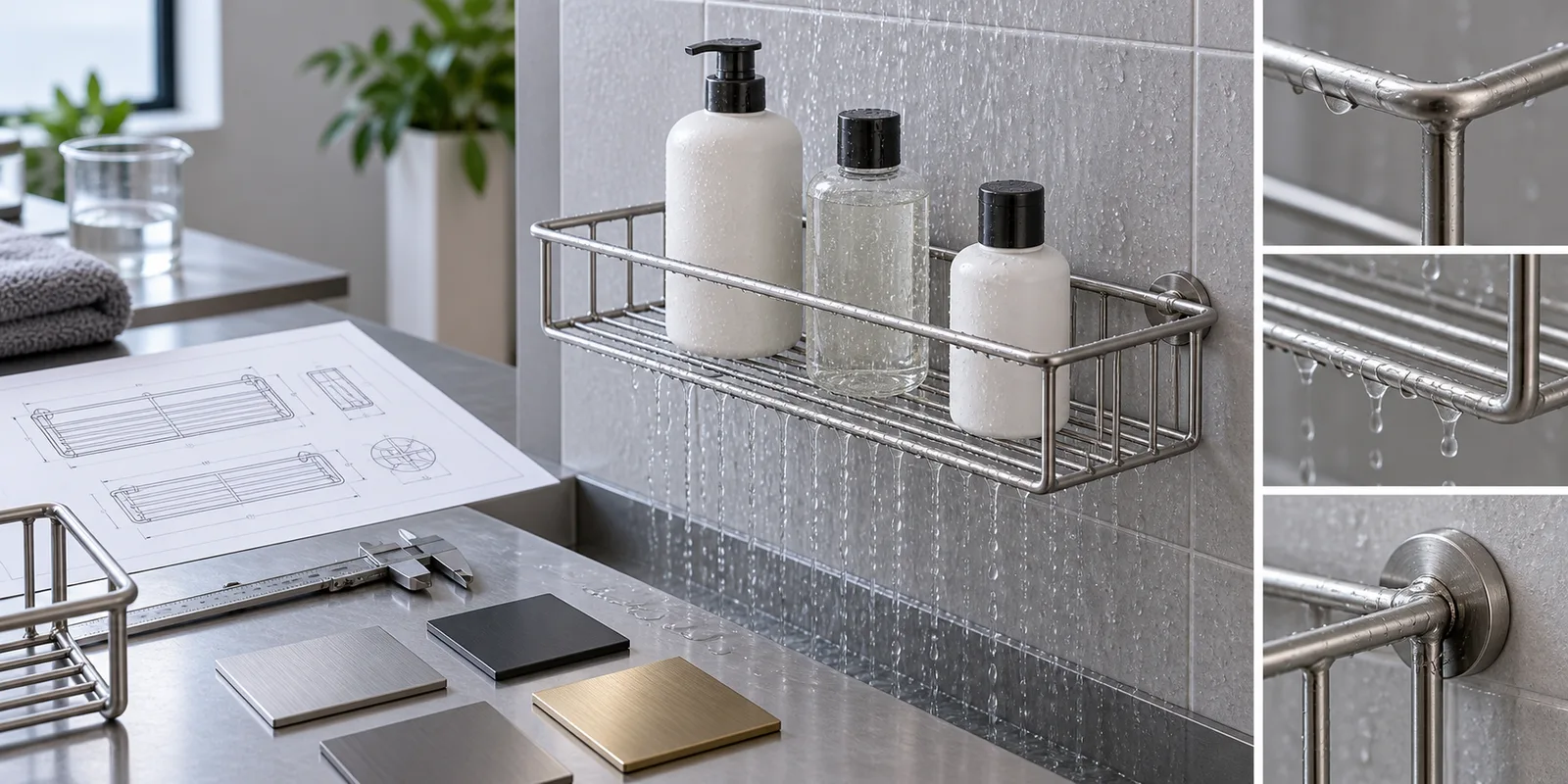
A drainage sample should be evaluated through installed use, not only on a flat inspection table. Buyers should use representative bottles, controlled water application and a written observation sheet while avoiding unsupported universal performance claims.
- Confirm sample identity. Record product code, drawing revision, material, finish and sample date.
- Install the caddy. Use the proposed mounting method and representative wall orientation. Check level, bracket contact and stability.
- Load representative products. Include broad pump bottles, narrow tubes, small jars and any accessory the product is designed to hold.
- Apply water consistently. Observe flow paths, pooling locations and water retained around bottle bases, corners and welds.
- Remove products. Check whether hidden water or residue remains where products contacted the shelf.
- Inspect after drying. Review visible marks, finish changes and areas that remain difficult to wipe.
- Repeat assembly and removal. Confirm that hooks, brackets or removable trays do not scratch finished surfaces.
The buyer and supplier should agree how observations will be judged. “Drains well” is vague. A more useful record identifies where water remains, which product caused the condition and whether a geometry change is required.
Any project-specific load, corrosion, coating or installation performance should be confirmed using appropriate test methods selected for the market and product. Koitor does not need unsupported test numbers to discuss practical sample observations such as wire spacing, bottle stability, visible welds, coating access and packaging fit.
What common drainage design mistakes should buyers avoid?
Common mistakes occur when buyers maximize open area without checking storage function, approve a rendering instead of a sample, or change shelf geometry without reviewing welding and finishing. These mistakes can create instability, difficult cleaning or inconsistent production.
- Openings are too large: small bottles or accessories tip between wires even though water exits easily.
- Openings are too small: residue remains around close intersections and coating coverage becomes harder to inspect.
- Slope is excessive: tall products lean against the front rail or slide on a smooth shelf.
- Drain points miss the corners: water moves away from the center but remains against formed edges.
- Weld access is ignored: added cross wires create crowded intersections with inconsistent appearance.
- Finish thickness is ignored: narrow slots or removable-part clearances change after coating.
- Upper-tier runoff is ignored: drainage from one shelf falls onto labels, soap or products below.
- Packaging changes geometry: a basket is compressed or rubbed in the carton, affecting level or finish.
Another mistake is freezing visible styling before mounting and drainage are resolved. Decorative front wires, hooks and side panels can be adjusted more safely after the functional shelf and frame are proven.
Use one revision-controlled drawing for structure and one approval record for the finished sample. If the drainage pattern changes, repeat the relevant assembly, bottle-support and packaging checks before approving production.
What should a shower caddy drainage design checklist include?
A buyer checklist should connect drainage with product support, manufacturing and packing. Send the completed list with drawings or a physical sample so the factory can identify open questions before quotation.
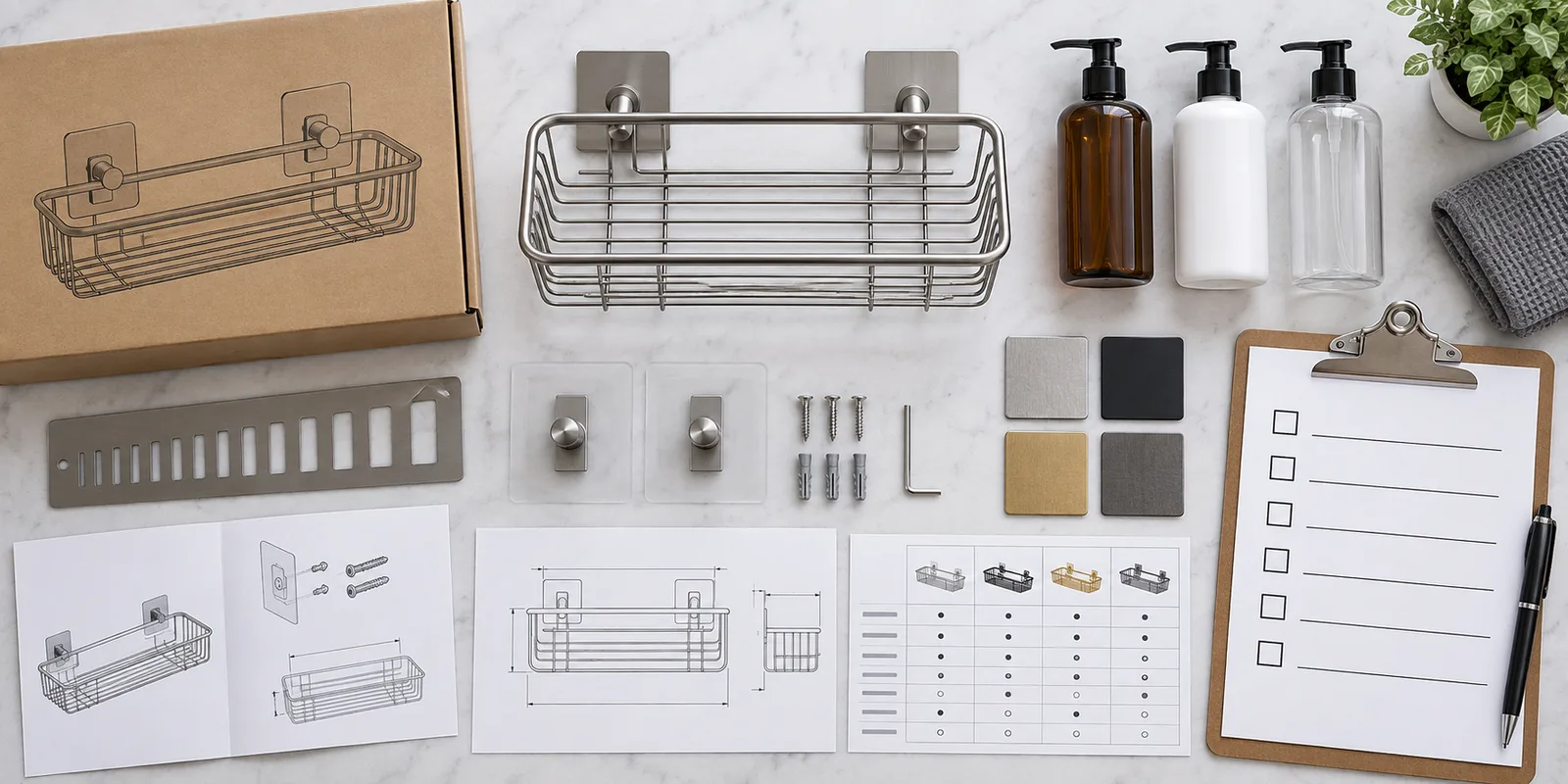
- Target caddy type: wall-mounted, hanging, corner, freestanding or no-drill.
- Overall width, depth, tier spacing and wall clearance.
- Representative bottle and accessory dimensions.
- Shelf structure and maximum acceptable opening zones.
- Required front and side retention geometry.
- Intended water path and any proposed shelf slope.
- Corner, drain-slot and wire-intersection details.
- Base material and surface finish reference.
- Weld appearance, edge condition and visible surfaces.
- Mounting method and supplied installation components.
- Sample evaluation products and observation method.
- Packaging protection for shelves, hooks and finished contact points.
- Target MOQ, sample timing and expected order schedule.
- Private-label packaging, instructions and barcode requirements.
Koitor Hardware can review these details for drawing- or sample-based development. MOQ can start from 100 pieces depending on structure, material, finish and packaging. Samples usually take around 5-7 working days after details are confirmed, while bulk production often takes around 4-6 weeks depending on project conditions. Buyers can find related guidance in the Koitor-Ressourcen hub.
Frequently asked questions about shower caddy drainage
Should a shower caddy shelf be completely flat?
Not necessarily. A slight designed slope may support water movement, but the effect on bottle stability and installation variation must be checked on a sample. The correct geometry depends on shelf structure and mounting.
Is wider wire spacing always better for drainage?
No. Wider spacing can release water but may fail to support small or rounded products. Buyers should test representative bottles and accessories before approving the spacing.
Can powder coating block drainage openings?
Coating can build around close wires, narrow slots and crowded intersections. The finished sample should be checked after coating because bare-metal dimensions do not show the final clearance.
How many drainage tests are needed?
There is no universal number for every product. Buyers should define project-specific observations based on mounting, products, market expectations and risk, then confirm any formal testing requirements separately.
Should drainage be reviewed before packaging?
Yes. The approved structure must also fit the intended carton without deformation or finish abrasion. Packaging changes can affect shelf level, hook shape or assembly interfaces.
How can Koitor help develop a custom shower caddy?
Koitor Hardware can review shelf geometry, wire arrangement, welding points, finish access, mounting, sample feedback and packaging for small-batch OEM development. Buyers can send a drawing or physical sample to Koitor for a practical project review.
Arbeiten Sie mit Koitor Hardware zusammen
Developing a Shower Caddy With Better Drainage?
Send Koitor your drawing, sample, bottle-size targets, mounting method, finish requirement, packaging idea and expected quantity. Our team can review drainage geometry, wire support, welding access and sample options before quotation.
OEM / EIGENE MARKE
Verwandeln Sie diesen Beschaffungsleitfaden in ein Produktdossier
Teilen Sie uns Ihr Zielprodukt, die Größe, die Oberflächenausführung, die Bestellmenge und Ihre Verpackungsanforderungen mit. Ihr Team erhält vor der Angebotserstellung eine praxisorientierte Prüfung der Herstellbarkeit.
 English
  Español
  Português
  Français
  Deutsch
  العربية