

Standard operating procedure vs work instruction is a comparison of document scope and detail, not a universal ranking or mandatory hierarchy. In common manufacturing usage, an SOP describes a defined process, its sequence, roles, and controls, while a work instruction explains a specific task in more operational detail; some organizations combine them or use different names. For a buyer reviewing a bathroom or home-storage hardware supplier’s records, the useful question is whether the current process and task documents refer to the right product revision and acceptance endpoint. For an importer, standard operating procedure vs work instruction is a practical scope question: identify the actual proposal, then compare it with the product requirement and evidence.
What problem does standard operating procedure vs work instruction help a buyer solve?
The distinction helps importers and product teams ask what a document is intended to control. A supplier may refer to an SOP, a work instruction, a process sheet, a packing checklist, or another internal record. The title alone does not tell the buyer whether the document describes a broad process, one task, a quality checkpoint, or an order-specific requirement.
For a custom metal product, the buyer might need to understand how an overall packing process relates to a task sheet used to check a particular mounting kit. If a procedure and instruction use different product revisions, the buyer may not know which specification applies. If the task sheet lists steps but no acceptance endpoint, the buyer may not know what result is recorded. These are document clarity questions, not proof that a supplier is compliant or noncompliant.
This article describes common usage in plain language. It does not establish a mandatory ISO or regulatory document hierarchy, guarantee that a document is implemented, or certify a supplier’s system. Requirements depend on the organization, contract, applicable standards, and qualified audit or regulatory review.
What is an SOP?
A standard operating procedure commonly describes a process or recurring activity at a broader level. It may define purpose, responsibilities, sequence, resources, controls, records, and how the process is reviewed. The exact form varies. Some organizations use a procedure document to explain who does what and when; others put a similar level of detail into one integrated work document.
For a hypothetical hardware order, an SOP might describe the overall packing process: verify the current order information, prepare components, protect finished surfaces, include mounting hardware, close cartons, and record the completion of the defined checks. That example does not claim that Koitor uses this exact procedure. It only illustrates a process-level scope.
The buyer should ask whether the document covers the entire workflow or only a portion. A title such as “Packing SOP” does not automatically show that it includes the buyer’s particular product, packaging specification, labeling, or acceptance requirements. The buyer may need a separate order-specific pack-out sheet or approved sample.
What is a work instruction?
A work instruction commonly explains a specific task in more detail than a broad process procedure. It may identify the sequence of actions, tools, reference points, photos, acceptance checks, or required records for that task. Organizations differ in how much detail they include and whether the instruction is separate from an SOP.
A task-level instruction for a mounting-kit check might identify which kit is reviewed, what pieces are expected, how the buyer-approved drawing or packing list is used, and where the result is recorded. The instruction does not necessarily define the whole production or packing process. It focuses on how a person carries out one defined task.
The buyer should not assume that the existence of a work instruction proves people were trained, the document was followed, or a completed product meets a specification. Those are separate questions. A supplier’s document-control process, training records, observation, or inspection evidence may be relevant if required, but the scope and verification method must be agreed.
| Comparison point | SOP / procedure | Work instruction |
|---|---|---|
| Common scope | A process or recurring workflow | A specific task within or alongside a process |
| Typical focus | Purpose, roles, sequence, controls, records | Task steps, references, tools, checks, recording |
| Example in a hardware context | Overall packing process for a defined product family or order type | Checking one kit’s components against the current pack-out specification |
| Can the documents be combined? | Yes, organizations may use integrated formats | Yes, task detail may appear within a broader document |
| What the title proves | Only the name assigned by the organization | Only the name assigned by the organization |
| What buyer should review | Current scope, owner, revision, related task records | Correct task, applicable revision, execution and result record |
These are practical conventions, not mandatory definitions for every company. Ask the supplier to explain its own document system and how a particular record supports the buyer’s requirements.
How should an importer review the link between a process and a task?
Review the documents as a connected set. A process may describe the overall activity, while a task instruction may tell a person how to perform one check within it. The buyer can trace the product, revision, responsibility, and result through that set.
For example, a hardware pack-out process may state when the finished product is packed and recorded. A task instruction may show how to verify that a specific carton contains the agreed mounting kit. The task record can refer to a current product or packaging revision and record the check result. The work must still be evaluated against the buyer’s actual purchase specification; neither document title alone establishes compliance.
A useful review asks:
- Scope: Does the SOP or procedure cover the relevant process, product, or order?
- Task: Does the work instruction identify the specific activity to be completed?
- Revision: Do both documents reference the same current drawing, sample, or pack-out specification where applicable?
- Responsibility: Is it clear who performs the task and who reviews or approves the record?
- Acceptance endpoint: Does the task say what result is recorded or escalated?
- Change control: Is there a way to identify when a document changes and which version applies?
- Evidence: Does the record show what was checked, when, and against which reference, if that evidence is required?
A document can be well structured and still fail to address a buyer’s specific requirement. Conversely, a document may use a different title but provide enough information for the agreed purpose. Buyers should evaluate content and control, not just vocabulary.
What should be confirmed about revision and access?
A process document and a task instruction are useful only if the relevant people can identify and access the applicable version. The buyer can ask how the supplier distinguishes current and obsolete revisions, how updates are communicated, and whether the work record shows which version was used. These questions help the buyer understand document control without assuming a particular software system or compliance framework.
For custom bathroom hardware, revisions can affect dimensions, hole spacing, finish, assembly, labels, or packaging. A task instruction based on an older drawing might tell a person to check a configuration that is no longer approved. The buyer should therefore ensure that the critical product references are controlled and that changes are reviewed by the appropriate parties.
Access is a practical matter as well. If a task is performed at a packing station, the applicable instruction needs to be available to the person doing the task in the form the supplier’s process uses. The buyer does not need to dictate document technology unless the contract requires it. The key is that a current, understandable instruction is used and the required result is recorded.
| Buyer concern | What to ask | Warum das wichtig ist |
|---|---|---|
| Process scope | What activity does this SOP cover, and what is outside it? | Prevents assuming the procedure governs unrelated work |
| Task detail | Which work instruction applies to this specific check or operation? | Connects broad process intent to a concrete task |
| Revision | Which drawing, sample, and document revisions apply? | Reduces conflicting references |
| Responsibility | Who performs and who reviews the task? | Makes ownership visible |
| Completion record | What is recorded and what happens if a result differs? | Clarifies the evidence and escalation path |
| Document access | How does the relevant person locate the current version? | Supports consistent use without assuming a particular software |
What are common mistakes when reviewing SOPs and work instructions?
Assuming every company uses the same hierarchy. The words “SOP” and “work instruction” do not have one mandatory structure across all organizations. Ask what the documents mean in the supplier’s system.
Treating a document title as proof of implementation. A title does not establish that the document is current, used, understood, or effective. If implementation evidence is a contract requirement, agree how it will be reviewed.
Assuming a work instruction is always a separate document. Some suppliers combine task-level detail and process controls. The content and revision matter more than the file count.
Reviewing steps without the product reference. An instruction can describe an action but still be ambiguous if it does not identify the product, drawing, sample, or acceptance criteria that apply.
Treating a completed checklist as proof of every product attribute. The task record only supports what was actually checked and recorded. It may not prove material composition, hidden structural performance, or unmeasured dimensions.
Assuming a broad SOP contains order-specific packaging details. Product-specific requirements may live in an approved sample, packaging specification, or order record. Confirm the relevant source.
Using a generic audit checklist as a manufacturing requirement. A buyer should distinguish its contractual acceptance requirements from optional system questions. Do not infer a certification or legal obligation from the presence or absence of a document.
Allowing revisions to drift. If a product drawing changes but the related instruction does not, the parties may use mismatched information. Confirm how product and document changes are linked.
How can a small-batch OEM factory use process and task documents responsibly?
A custom metal hardware factory can use process-level and task-level records to clarify who performs work, which product revision applies, and what evidence is retained. Buyers should discuss only the documentation relevant to the product and the agreed supplier scope. A generic SOP does not automatically prove quality, certification, or compliance, and an OEM factory should not claim a document system beyond what is verified.
Koitor Hardware is a family-owned bathroom and home-storage hardware factory. Buyers can share the current drawing or sample, packaging requirements, quantity, target market, and any document expectations in the RFQ. That information can help clarify which product records are needed for quotation, sampling, packing, or order changes. Any additional certification, audit, or legal requirement must be stated and verified separately.
For a supplier evaluation context, see the live guide to a technical factory audit for metal hardware suppliers. For existing purchasing-document context, the live guide to purchase orders versus sales orders is available.
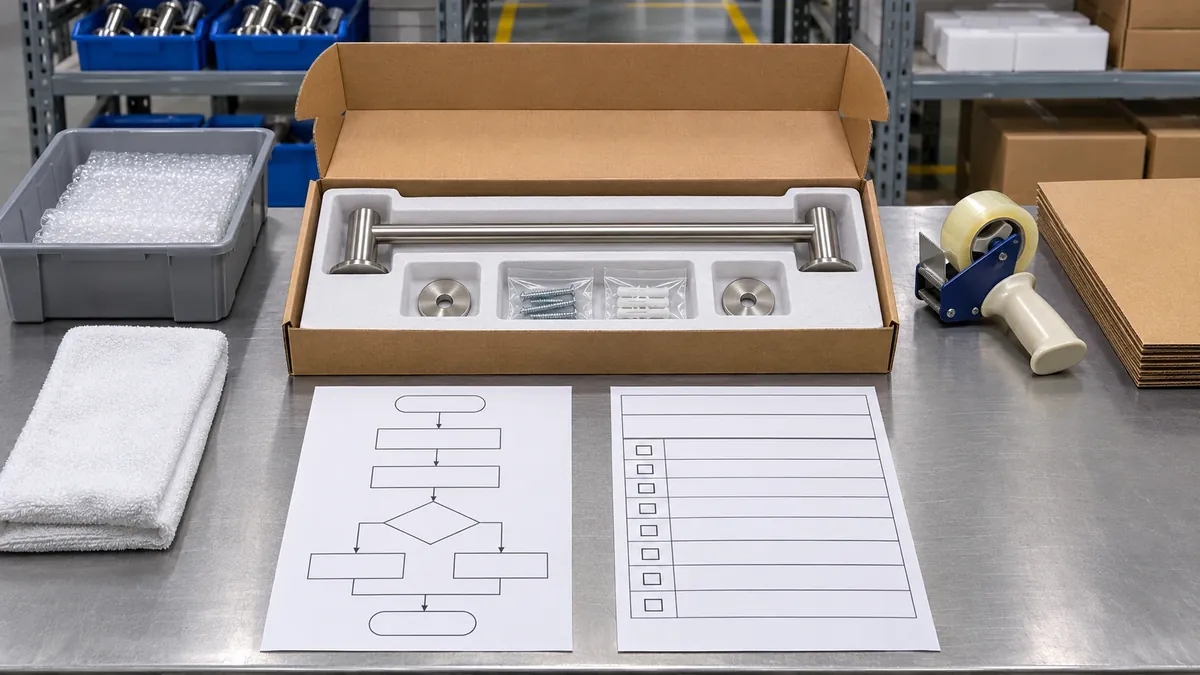
Buyer checklist before reviewing a supplier document
When a buyer asks about a procedure or task instruction, clarify:
- What process or task does the document cover?
- Does it relate to the buyer’s product, purchase order, shipment, or production lot?
- Which drawing, sample, packaging specification, or other revision applies?
- Is the document process-level, task-level, or an integrated record?
- Who performs the task, who approves it, and who keeps the record?
- What is the acceptance endpoint or escalation path, if one is required?
- How does the supplier identify current and obsolete versions?
- How are changes to the product or process reflected in the documents?
- What evidence does the buyer actually require under the commercial agreement?
- Are any certification or regulatory claims being made, and what current evidence supports them?
Keep the review proportionate. A buyer requesting product traceability may need a clear revision link and check record, not an unnecessary reorganization of the supplier’s entire management system.

Technical references
Technical background: Primary technical reference. Consult the source in its stated scope; it does not establish Koitor-specific capability or acceptance.
Häufig gestellte Fragen
Is an SOP always more important than a work instruction?
There is no universal hierarchy that applies to every organization. Some use a broad procedure with task instructions beneath it; others combine the details. Ask how the supplier controls the relevant activity.
Must an SOP and work instruction be separate files?
No. Organizations may combine, separate, or name the documents differently. Buyers should check whether the content covers the agreed process and task.
Does a work instruction prove that a task was completed correctly?
No. It explains or supports task performance. Evidence of completion or acceptance depends on the records created and the agreed review process.
Does an SOP prove ISO or regulatory compliance?
No. A document title does not establish certification or compliance. Verify any claimed requirement and evidence with the appropriate authority or qualified auditor.
Work with Koitor Hardware
For a custom hardware order, share the current drawing or sample, packing requirements, product revision, and any records required under the agreed scope. This helps identify the relevant process and task questions without assuming an unverified certification or document system.
How can the buyer tell whether two documents are connected?
Look for a product, order, process, or revision reference shared by the procedure and the task record. Then confirm that the reference is current and that the task record identifies the activity covered. If no shared identifier exists, ask the supplier how the task is tied to the broader process and the buyer’s approved product requirements. A shared title or folder does not establish that the correct version was used; the record should make the relationship understandable to the people responsible for review.
When a buyer reviews a document sample, focus on whether the scope, owner, revision, responsibility, and expected record are clear. Avoid demanding confidential internal instructions when a supplier can instead demonstrate the relevant control or provide an agreed excerpt. The amount of detail available to a buyer depends on the contract and confidentiality arrangements. The goal is to verify the specific purchasing requirement, not to collect unrelated internal documents.
A supplier may use software to manage revisions, but the software name alone does not prove document control is effective. Ask how the supplier identifies the current version and handles obsolete copies in the context of the relevant task. Do not infer a certification, audit result, or implementation outcome from a software screen or document template.
How should buyers review an example without requesting proprietary detail?
A buyer can ask the supplier to demonstrate how a specific product requirement is linked to a current task record without requesting the entire internal procedure library. For instance, the buyer might ask which revision governs a packing check and what result is recorded. The supplier can answer with an agreed document excerpt, an anonymized example, or a description of the control, subject to the parties’ confidentiality arrangements. The buyer should review only what is needed to establish the requirement in the purchase agreement.
Keep evidence proportionate to the decision. A buyer who needs confirmation of carton contents may need the agreed pack-out reference and a record of the sample review. A request for a broad SOP may not answer that specific question. Conversely, a task checklist alone may not explain roles or escalation across a whole process. Ask for the record that fits the question and confirm its relationship to the correct product and revision.
How should a buyer close an unresolved document question?
When the supplier’s explanation does not show how a task maps to the agreed product requirement, state the missing connection plainly. Identify the product or order reference, the document revision received, the task under review, and the evidence needed to close the question. Ask the supplier to confirm whether the document is current and who owns the next review. Avoid replacing an unresolved gap with an assumption that the document title implies the answer.
The buyer can also separate a one-time request from an ongoing requirement. A sample review may need a single clarification, while a repeated packing or inspection requirement may need to be referenced in the order documents. If the parties agree that a product-specific instruction or checklist will be supplied, identify the relevant revision and how changes will be communicated. Do not demand internal documents that are unrelated to the purchase or beyond the agreed scope.
After clarification, retain the response with the drawing or sample revision and the order reference. If the answer changes the product requirement, use the agreed amendment or approval process. If it simply explains the supplier’s document terminology, record the definition so the same words are not misread on the next order. This keeps the buyer’s review focused on the actual product decision.
How can buyers keep the review focused on product risk?
Not every supplier document needs the same level of buyer review. A routine task with no effect on product acceptance may only require clear ownership and a completion record. A task that changes the drawing, finish, packaging, or inspection outcome may need stronger revision control and buyer approval. The buyer should connect document review to the specific consequence of the task instead of treating every SOP or instruction as an audit of the entire factory.
A practical request identifies the product requirement, the record that should support it, and the decision the buyer needs to make. For example, the buyer may need to know which packing revision applies to a shipment or who records a specified kit check. The supplier can then provide the relevant evidence within the agreed scope. This approach avoids both extremes: relying on a title without understanding it and requesting broad internal materials that do not answer the actual question.
A final review can record the date, reviewer, product reference, document revision, and any open action. If the buyer has no action because the record is only informational, say so rather than implying acceptance. If a document raises a product or contractual question, route it to the person responsible and preserve the answer with the relevant order. That small distinction helps future users understand whether a record was reviewed, approved, or simply received.
Clarify Product and Process Records
Send the controlled drawing or sample, packaging requirements, and the specific document question connected to your bathroom or home-storage hardware order.
OEM / EIGENE MARKE
Verwandeln Sie diesen Beschaffungsleitfaden in ein Produktdossier
Teilen Sie uns Ihr Zielprodukt, die Größe, die Oberflächenausführung, die Bestellmenge und Ihre Verpackungsanforderungen mit. Ihr Team erhält vor der Angebotserstellung eine praxisorientierte Prüfung der Herstellbarkeit.

 English
 Español
 Português
 Français
 Deutsch
 العربية