

Work order vs purchase order compares an instruction to perform defined work with a commercial record used to request goods or services from a supplier. A work order may describe a task, scope, owner, location, parts, and completion criteria; a purchase order (PO) records the buyer’s intended purchase and commercial terms. A metal-hardware importer may need both when a production, repair, or inspection task uses purchased components, but the documents are not automatically interchangeable and terminology varies by company. For an importer, work order vs purchase order is a practical scope question: identify the actual proposal, then compare it with the product requirement and evidence.
What problem does work order vs purchase order help a hardware buyer solve?
The comparison helps buyers understand which record authorizes or tracks a task and which record documents an external purchase. A manufacturer, distributor, or importer can encounter both terms in a supplier’s system, an ERP workflow, a maintenance record, or a project handoff. If the buyer assumes the labels mean the same thing everywhere, the parties may not agree on what work is to be done, which goods or services are being bought, who is responsible, or what evidence closes the task.
For a bathroom or home-storage hardware order, a PO might identify a purchase of finished products, samples, packaging, or a service. A work order might describe internal production activity, a rework task, or a maintenance job. These are examples of possible uses, not a claim about Koitor’s internal system or any specific supplier’s workflow.
This article explains common document purposes. It does not interpret contract enforceability, create a universal ERP process, authorize manufacturing release, or promise that a particular document format is legally sufficient. The parties’ agreement, established procedures, and applicable professional advice govern.
What is a work order?
A work order is commonly used to describe or organize work that someone is expected to perform. Depending on the organization, it may identify the task, product or equipment, location, responsible person or contractor, required parts, planned sequence, priority, target date, and completion record. A work order may concern internal work or work assigned to an outside contractor. The exact fields and approval function differ among companies.
In manufacturing, a work order might be used to track a production lot, assembly job, maintenance activity, inspection, or rework task. But the title alone does not prove that the work has been released, properly approved, or completed. A buyer should ask what the supplier means by “work order” in the specific process being discussed.
When the work affects a custom metal product, the buyer may want to know whether the work record references the correct drawing revision, sample, or order. A work order that names a task without connecting it to the current product requirements may not provide enough traceability for the buyer’s needs. That is a record-control question, not a universal legal conclusion.
What is a purchase order?
A purchase order is commonly a buyer’s commercial request or commitment to acquire goods or services from a supplier, subject to the parties’ agreed terms and applicable rules. It may identify the buyer and seller, product or service, quantity, price or pricing basis, currency, delivery terms, shipment or service date, and referenced specifications. Different organizations and jurisdictions use POs differently, and a PO may interact with a quotation, contract, or other agreement.
For hardware sourcing, the PO should connect to the product scope the parties intend to purchase. The buyer may reference a product code, drawing revision, finish, packaging, quantity, and approved sample. It may also state delivery or documentation requirements. A PO title by itself does not prove that every detail has been agreed or that the supplier has accepted the buyer’s terms. The buyer should follow the purchasing process and confirm acceptance as required by the organization and contract.
| Frage | Work order | Purchase order |
|---|---|---|
| Common purpose | Organizes or records defined work to be done | Documents the buyer’s intended purchase of goods or services |
| Typical scope | Task, location, responsible party, parts, steps or completion criteria | Supplier, goods/services, quantities, commercial terms and delivery details |
| Can it be internal? | Often, depending on the organization | Usually concerns an external purchase, though systems vary |
| Can it involve a supplier? | Yes, a work task can be assigned externally | Yes, it is a buyer-supplier commercial record |
| What does it prove? | Only what its fields, approvals, and records establish | Only what the PO and surrounding agreement establish |
| What buyer should check | Task scope, revision, owner, completion evidence | Purchased scope, order references, accepted terms, revision |
This table captures common usage, not a mandatory document hierarchy. Ask the supplier or purchasing team how the labels function in the actual workflow.
How can a work order and PO relate to one project?
A work order and a PO may refer to different parts of a broader project. Suppose a buyer needs a custom metal storage product and an outside supplier provides a purchased component or service. The PO could document the purchased input. A separate work order could tell an internal or contracted team to perform a defined assembly, inspection, or repair task that uses that input. The records may cross-reference each other without replacing one another.
The following example is hypothetical and is not a Koitor production record. A buyer arranges an order for a metal bathroom accessory kit with a supplier. The purchase order identifies the product scope, quantity, price basis, drawing revision, packaging, and delivery expectation. A separate work order at the buyer’s warehouse could assign staff to inspect received cartons and record quantities. One record describes the purchase; the other organizes the receiving task. The receiving result should be recorded in the appropriate system, but the work-order label does not itself change the commercial order.
In a factory setting, a work order may be connected to production planning while a PO covers purchased material or an external operation. The supplier’s system may combine functions or use different names. Buyers should avoid assuming that a PO releases a drawing to production or that a work order is a purchase commitment. Ask which record controls each decision.
A relationship map can clarify the record chain:
- Commercial scope: What product or service is being bought?
- Technical scope: Which drawing or sample revision applies?
- Task scope: What work is to be performed, by whom, and on which item or lot?
- Completion evidence: What record shows the task was completed and what was observed?
- Commercial resolution: How are changes, shortages, claims, or additional purchases documented?
The PO and work order can reference the same product or project number while serving different purposes.
How do work orders differ from work instructions?
A work order identifies or authorizes a job or task in a particular instance; a work instruction explains how a defined task is performed. The terms may appear together. For example, a work order could request inspection of a particular shipment or lot, while a work instruction describes the buyer’s approved inspection steps. The order identifies the task and context; the instruction explains the method.
Organizations may combine these functions or use other labels. A document title is not proof of implementation, training, or compliance. The current revision, responsible party, task scope, and actual use should be clear wherever those details matter.
This distinction is separate from the PO question. A PO typically records a purchase; a work instruction is procedural guidance. A work order organizes work. One task may be described by a work order, performed using a work instruction, and use parts purchased under a PO.
What should importers check before relying on either document?
Buyers should focus on the information that links the record to the actual product, supplier, task, and agreement.
- Identify the document owner. Is it issued by the buyer, supplier, factory, service provider, or an internal department?
- Confirm its purpose. Does it request goods, assign a task, describe a method, or record completion?
- Check the reference. Does it cite the purchase order, project, product code, lot, service, or other relevant identifier?
- Confirm the product revision. Where custom goods are involved, does the record identify the drawing or approved sample revision?
- Clarify responsibility. Who performs the task, supplies the item, approves a change, and records completion?
- Separate task from commercial terms. A task record may not include the price, quantities, delivery terms, or legal conditions relevant to a purchase.
- Define closure evidence. What is recorded when work is complete, and who reviews the result?
- Ask how changes are controlled. Do not assume an email or work order silently changes an accepted PO or product specification.
- Keep receiving and quality evidence separate. A task to inspect does not itself prove what the inspection found.
- Follow the parties’ process. The organization’s purchasing and document-control rules may define approvals and revisions.
For a sourcing buyer, the main goal is not to force every supplier into one document format. It is to ensure the records collectively make the agreement and responsibilities understandable.
What mistakes should buyers avoid?
Treating a work order as a PO. A work order may describe activity without documenting the commercial purchase terms. Confirm which record covers the goods or service being bought.
Assuming a PO is a production release. A PO can reference a product and quantity, but production release may depend on the contract, approved drawing, sample, deposit, or other agreed condition. The buyer should not infer release rules from the title.
Assuming all companies use the same terminology. ERP software and business processes differ. Ask the issuer what the document controls in that organization.
Leaving the revision out. A task or purchase record that does not connect to the current drawing, specification, or sample can create ambiguity for custom products.
Using one identifier for different record types without traceability. Shared project numbers are helpful, but the records should still make clear which one is the commercial order, task assignment, instruction, or completion record.
Treating task completion as product acceptance. A work order may show that someone completed an activity. The buyer still needs the agreed evidence and acceptance process for the product.
Assuming a PO covers an unlisted service. A purchase order should be reviewed for the goods or services it actually identifies. Ask for clarification when scope is missing.
Making a universal legal claim from a document label. The legal effect depends on terms, context, and applicable law. Qualified counsel should review disputes or contract questions.
How can a small-batch OEM factory help keep product records clear?
A custom metal hardware factory can help by ensuring that quotation and order discussions reference a defined product, drawing or sample, finish, quantity, assembly, and pack-out requirements within the confirmed project scope. When the buyer requests a custom or small-batch product, these details help the parties distinguish commercial scope from technical revisions and production tasks.
Koitor Hardware is a family-owned manufacturer focused on bathroom and home-storage hardware. Buyers can share the current drawing or physical sample, target market, quantity range, finish, packaging, and any service or component expectations. The supplier can clarify what information is needed for a quotation or sample discussion. The buyer remains responsible for its purchasing approval process, while the supplier confirms its own order acceptance and deliverables.
If a purchased component or external service is involved, identify the responsible supplier and the record governing that scope. A PO, work order, or instruction should not be assumed to create capabilities or services that have not been confirmed.
For related buyer-side purchasing document context, read the existing guide on purchase order versus sales order and the comparison of purchase requisition versus purchase order. For a broader supplier-evaluation context, see the guide to a technical factory audit for metal hardware suppliers.
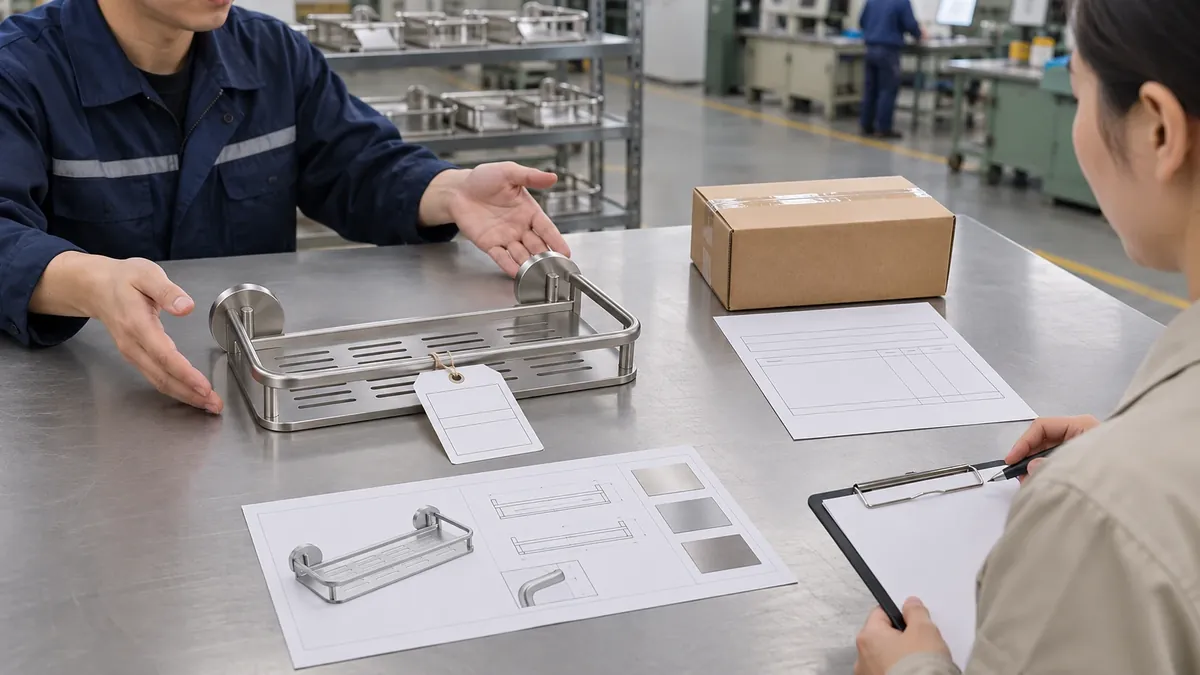
Buyer checklist before issuing or reviewing a PO or work order
- Identify whether the document is commercial, operational, instructional, or a completion record.
- Confirm the buyer, supplier, responsible person, and approver.
- Link the right product, service, purchase order, project, lot, or equipment identifier.
- Reference the current drawing, sample, specification, or revision when applicable.
- State the specific goods or services being purchased and the relevant quantity or scope.
- State the task to be performed, location, timing, and expected completion record when using a work order.
- Identify the party responsible for each component, inspection, or outside service.
- Confirm which document contains price, currency, delivery, payment, and other commercial terms.
- Define what evidence demonstrates task completion and what separate evidence demonstrates product acceptance.
- Record changes and approvals through the process agreed by both parties.
- Avoid relying on an order or task title as proof of legal effect or technical conformity.
These checks help the buyer ask focused questions. They do not impose a single form on every supplier or replace contract review.

Technical references
Technical background: Primary technical reference. Consult the source in its stated scope; it does not establish Koitor-specific capability or acceptance.
Häufig gestellte Fragen
Is a work order the same as a purchase order?
No, in common usage a work order organizes or records work to be performed, while a purchase order documents a buyer’s intended purchase of goods or services. Actual company systems can vary, so confirm the issuer’s definitions.
Can a work order be used for a supplier?
Yes, some organizations use work orders to assign or track external work. That does not make the work order identical to a PO or prove which commercial terms apply.
Does a purchase order automatically release a drawing to production?
Not necessarily. Release conditions depend on the buyer-supplier agreement and the workflow. Confirm the current approved drawing and any required sample, payment, or release authorization.
Can one document serve both purposes?
An organization may combine fields or functions in one system, but the buyer should still be able to distinguish the commercial purchase from the task scope and completion evidence. Ask how that record is controlled.
Work with Koitor Hardware
For a custom bathroom or home-storage product, share the product drawing or sample, quantity, finish, packaging, and order scope. Clear product references help the buyer and manufacturer connect the commercial purchase with the correct technical revision.
How should purchase, production, and receiving records connect?
A buyer can map records by the question each one answers. The purchase order addresses what the buyer intends to acquire from the supplier and under what commercial scope. A work order may organize a particular task, production lot, rework job, or receiving check within one organization. A work instruction may describe how a person performs a repeatable task. A receiving or inspection record states what was observed when goods arrived or were examined. These functions may be linked in a system, but they should not be collapsed conceptually.
For a hypothetical bathroom hardware order, the buyer’s PO might identify the product, quantity, drawing revision, finish, packaging, and delivery destination. The supplier might use an internal work order to organize assembly or packing. After shipment, the buyer might create a receiving task and record carton quantities or visible condition. Each record has its own issuer and purpose. A buyer can use a common order or lot reference to connect the documents without assuming one substitutes for another.
If a discrepancy occurs, identify which record is being questioned. A quantity mismatch belongs to the relevant order, shipment, and receiving records. A process instruction question belongs to the applicable task or document revision. A change in product scope may require a commercial amendment as well as a production-document update. Responsible parties should follow the agreed purchasing and change-control process.
This map is useful during onboarding because a buyer may encounter unfamiliar supplier terminology. Ask the supplier to explain its document names and indicate which record confirms order acceptance, which controls product revision, and which records completion or inspection. The buyer does not need to impose a particular ERP structure if the relationships remain clear and the agreement is satisfied.
What should happen when a PO or work order changes?
A change should be evaluated according to what it affects. A quantity, price, or delivery change may require a commercial update. A drawing, material, or finish change may affect technical approval. A task reassignment may affect the work-order record. A changed inspection method may require updated instructions and a clear effective date. These actions can be related but are not automatically handled by one document.
Before approving a change, identify the original record, proposed revision, reason, affected products or lots, effective timing, and required approvals. Confirm whether work has already started or goods have already been purchased under the previous version. Where commercial terms require formal acceptance, use the agreed method rather than relying on an informal note. Keep the latest approved version accessible to relevant parties.
Also clarify whether the change is temporary for one order or becomes the basis for future orders. If a supplier uses internal work orders, ask how an approved buyer change flows into the applicable task record. The answer should be specific to the supplier’s actual process and should not be inferred from a generic definition.
How can an importer ask for clarification?
Use the document reference and ask a narrow question: “Does this record authorize the purchase, assign the packing task, or record the task’s completion?” Then request the relevant order, task, revision, or acceptance record. Avoid asking a supplier to redesign its entire document system when the immediate need is simply to link a product to the current drawing or identify who owns the next action. Clear questions help preserve the distinction between commercial and operational records.
What if a supplier’s document names a different quantity?
First determine whether the number refers to purchased units, task output, sample quantity, carton count, or another measure. A PO and a work order may legitimately contain different quantities because one describes a commercial purchase and the other a task or lot. Ask the issuer to clarify the unit and relationship, then update the appropriate record through the agreed process if it is incorrect. Do not edit one document to force it to match another without confirming what each number represents.
Clarify a Custom Hardware Order
Send the controlled drawing or sample, target quantity, finish, and packaging requirements so the product and commercial scope can be discussed clearly.
OEM / EIGENE MARKE
Verwandeln Sie diesen Beschaffungsleitfaden in ein Produktdossier
Teilen Sie uns Ihr Zielprodukt, die Größe, die Oberflächenausführung, die Bestellmenge und Ihre Verpackungsanforderungen mit. Ihr Team erhält vor der Angebotserstellung eine praxisorientierte Prüfung der Herstellbarkeit.



 English
 Español
 Português
 Français
 Deutsch
 العربية