

Towel bar length should be selected by comparing the actual towel arrangement with the bar’s usable hanging span and the space available on the wall. A nominal label such as 18 or 24 inches may refer to a product family size or a dimension defined on a drawing; it does not automatically tell you the clear opening between supports, the overall end-to-end length, the mounting-point spacing, or how many towels will fit. Read the model-specific drawing and measure the towel you intend to hang.
For a buyer comparing products or planning a private-label assortment, keep those dimensions separate. Confirm the full assembly envelope, mounting references, towel width and fold, finish, installation method, and rated use from the product maker. Length alone does not establish load capacity, compatibility, or quality. A longer bar can be useful only when it fits the room and its mounting system supports the intended application.
What Does a Towel Bar Length Label Describe?
Product literature may use the word length for different dimensions. Overall length can include end posts, decorative caps, mounting plates, or projecting brackets. Clear span describes the usable distance between the points that support the bar or towel. Mounting-point spacing describes the distance between screw locations. The bar tube itself may have yet another length. A product sheet should identify the endpoints of each measurement, preferably with a dimensioned drawing.
The distinction matters in replacement and new installations. A bar advertised as 24 inches long might require more than 24 inches of wall width once the end supports are included. Its clear hanging span could be shorter than its overall length. If a replacement uses different escutcheons or brackets, matching the tube length alone may not align with existing holes. Check the fixing interface and the usable space as well as the catalog label.
An older Moen Aspen product specification illustrates this point by showing nominal 18- and 24-inch labels together with separately identified A, B, and C dimensions. That is evidence about that model’s drawing convention, not a universal dimensional standard or a guarantee about other brands. KES’s buyer guidance also discusses towel-bar sizing, but the exact product drawing remains the authority for a particular item. Keep the model and drawing revision with any measurement used in an order.
When comparing listings, record the dimension name, starting point, endpoint, and whether the measurement is for the complete installed product or only the bar component. If a listing gives only one number, ask the seller or manufacturer what it describes. Do not infer a clear span from a photograph, since perspective and hardware shape can make the usable width look larger or smaller.
How Should You Measure the Towel and Hanging Arrangement?
Start with the towel type and the way it will be used. Bath towels, hand towels, washcloths, and decorative towels vary in width, thickness, and fold. A towel folded lengthwise occupies a different width on a bar from one draped open. If two towels will share the same bar, consider the arrangement, spacing, and how often users need to remove one without disturbing the other. A product’s stated capacity should be confirmed from its own documentation rather than estimated from bar length alone.
Measure the towel in its intended folded condition. Lay it flat, fold it as the user would, and measure the width that hangs across the bar. Then consider the space needed for fabric to drape without being compressed against a post or adjacent wall. Thick terry fabric can occupy more usable width than a thin sample. If the towel is part of a retail assortment, test representative products rather than choosing a bar from a nominal textile size alone.
The support design affects the real opening. A towel may extend between the inner faces of two posts, or it may be supported by brackets that project into the hanging space. Some bars have a center support that divides the span. A double bar offers separate rails but may have limited clearance between them. The product drawing should clarify where the towel can hang and whether decorative fittings reduce that opening.
For a multi-towel layout, sketch the intended arrangement and mark the clear span required by each folded towel. Add only the clearance that is supported by the product geometry and use preference; avoid presenting an arbitrary universal gap. If the towel must dry between uses, avoid designing the arrangement so the fabric is tightly packed. The actual drying result depends on fabric, air movement, humidity, and use, so do not promise performance based on length alone.
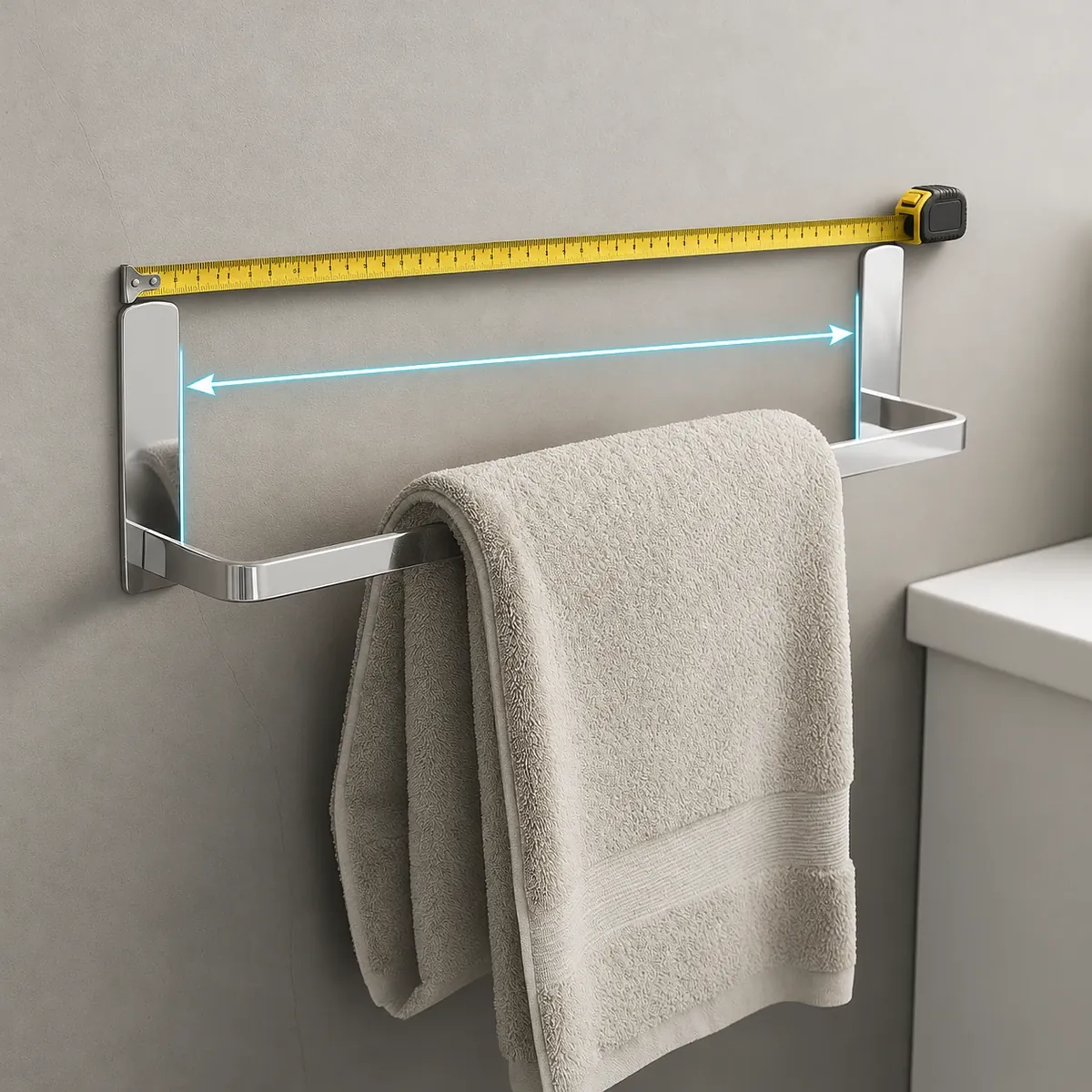
Compare Clear Span, Overall Length, and Mounting Space
Before ordering, make a simple dimension map. Mark the available wall width, the complete installed footprint, the usable hanging span, the bracket or post locations, and any nearby obstruction. This prevents a common sizing mistake: selecting a bar whose clear span seems appropriate while its end fittings collide with a cabinet or mirror. In a narrow bathroom, the projection from the wall and the path of a door can matter as much as the horizontal length.
Use the drawing to locate the mounting points. A two-post bar may have screw centers that are closer together than the product’s overall length. If mounting on existing holes, compare the actual center-to-center spacing and the mounting interface. Do not assume all products with the same nominal length use the same spacing. For a new installation, mark the full envelope and follow the maker’s installation directions for the exact model.
| Dimension | What it usually describes | Käuferprüfung |
|---|---|---|
| Nominal size | Catalog label or family designation | Ask which drawing dimension the label represents |
| Overall length | End-to-end extent of the product | Confirm clearance from adjacent fixtures and trim |
| Clear span | Usable opening for a towel between supports | Compare with the folded towel and intended quantity |
| Bar length | Physical rail or tube length | Check how posts or brackets occupy the ends |
| Mounting spacing | Distance between fixing points | Verify against existing holes or the installation template |
| Projection | Distance the product extends from the wall | Check door swing, circulation, and neighboring objects |
These fields make supplier quotations easier to compare because they identify the same product envelope. If one supplier reports overall size and another reports center spacing, the figures do not directly conflict; they describe different dimensions. Request comparable drawings and state which dimension controls the requirement. If the product is customized, identify the drawing revision and accepted tolerance with the manufacturer rather than assuming a nominal number is exact.
Which Length Fits the Room and Product Layout?
Measure the wall at the intended mounting height and inspect the space around it. A mirror, medicine cabinet, shower enclosure, door casing, niche, shelf, or switch may limit the available width. Check the complete product including end caps and posts. Leave enough access for the product to be installed and for towels to be placed or removed. A longer rail that fits on paper may still obstruct a door or overlap another fixture in use.
Think about the surrounding bathroom layout. A bar positioned beside a shower may need to avoid a glass panel or handle. A bar above a vanity should not interfere with a mirror or cabinet opening. In a shared bathroom, two shorter bars in different locations may serve users better than one long bar, but that is a layout choice, not a universal rule. The buyer should map each user’s actual use and available wall area.
Product type also changes the usable envelope. A single towel bar, swing bar, heated rail, ladder rail, or adhesive-mounted bar can have different bracket projections and installation requirements. A swing bar needs room to rotate. A hinged or multi-rail design needs clearance throughout its motion, not just when closed. An adhesive model requires a suitable surface and must be installed as directed by its manufacturer; the bar length does not determine whether a wall finish is suitable.
When planning a product assortment, state a customer problem that the size range addresses: limited wall space, a wider towel, a replacement interface, or multiple users. Avoid using a bar length as a proxy for load rating or construction strength. If the product carries a rated capacity, confirm the test or product documentation, mounting conditions, and fasteners that support it. Do not transfer a rating from one model or mounting surface to another.
How Do Installation Method and Brackets Affect the Choice?
The mounting method is part of the size decision because brackets and bases contribute to the installed dimensions. Screw-mounted end posts may cover existing marks or require a minimum separation. A concealed fixing plate may have a defined hole pattern that is not visible after installation. An adhesive-mounted bar may have pads whose width and position reduce the available wall area or require a specified surface. Use the model’s instruction sheet and actual mounting components when checking the fit.
For replacement, compare the hole spacing, base footprint, attachment points, bar diameter or profile, and method used to retain the rail. A replacement tube may fit into the posts but fail to match the wall interface. A longer bar may not solve the problem if the bracket position is fixed. If the project is a retrofit, measure the existing hardware before purchasing and check whether the maker supports replacement components for that exact series.
For a new project, identify the wall substrate and finish and let the product maker’s instructions determine the appropriate installation method. Tile, glass, painted drywall, masonry, and wood are not interchangeable surfaces. This guide does not authorize drilling, adhesive use, or a particular anchor. If the installation surface is uncertain or concealed services may be present, consult a qualified installer. The specified product capacity only applies when its stated mounting conditions are met.
An OEM specification should record bracket geometry, included fasteners, finish, rail length, clear span, mounting spacing, and package contents. If the bar or support changes, review the drawing and instructions together. A change in post size can reduce clear span even when the outer length remains unchanged. A change in rail profile can affect how the towel sits. Document the released version so a reorder does not silently substitute a different assembly.
Use a Fit Check Before Finalizing the Size
Create a full-scale layout using the actual product drawing or a safe physical sample. Mark the overall outline, mounting centers, clear span, projection, and nearby obstructions on a wall template or mock-up board. Place the folded towel across the usable space and check whether it can be draped and removed as intended. A paper cutout cannot prove load performance, but it can reveal collisions and size misunderstandings before installation or package artwork is approved.
For a replacement decision, compare the old and proposed products side by side. Measure the old bar’s usable opening and mounting centers instead of relying on the box label. Photograph the mounting points with a ruler in the same plane, keeping the measurement endpoints visible. Check whether the new product includes its own hardware and whether the existing surface remains suitable under the new maker’s instructions.
In product development, verify a production-intent sample against the approved drawing. Measure overall length, clear span, center spacing, projection, and relevant bracket interfaces. The inspection plan should identify which dimensions are critical and what method is used to check them. Do not introduce a tolerance without design approval. The sample should also be reviewed for finish, assembly, packaging protection, and any included installation template.
| Before approval | Record or verify |
|---|---|
| Towel | Type, folded width, thickness, and intended quantity |
| Product drawing | Overall length, clear span, rail length, projection, and mounting centers |
| Room | Available wall width, adjacent fixtures, door path, and mounting surface |
| Product type | Fixed, swing, double, heated, adhesive, or other configuration |
| Installation | Exact model instructions, supplied hardware, and substrate conditions |
| Qualität | Approved dimensions, finish sample, revision, and lot evidence |
| Listing or package | Dimension labels use the same endpoints as the controlled drawing |
Make the final size decision only after resolving differences between the label, drawing, sample, and wall layout. If a supplier’s drawing leaves a dimension unclear, ask for a corrected drawing rather than translating a photograph into a measurement. Preserve the approved sample or marked-up drawing for later production and service questions.
How Can Buyers Explain Size Without Overpromising?
Retail copy should identify the exact dimension represented by a size label. A listing can show overall length and useful span separately when those values are confirmed by a controlled drawing. If it states compatibility with a towel width or quantity, base that statement on an actual product configuration and approved evidence. Do not say that every 24-inch bar holds a fixed number of bath towels or that a longer bar carries more weight unless the exact model documentation supports that claim.
Use clear diagrams with arrow endpoints that match the drawing. Label whether the arrows show post-to-post opening, product end-to-end extent, or screw-center spacing. Keep unit conversions consistent and review any rounded values. A diagram that looks attractive but measures to different edges than the table can confuse buyers and increase returns. When a model has multiple sizes, use the same definition for each so customers can compare them fairly.
For private label, the purchase file should connect artwork, product code, drawing revision, package dimensions, mounting template, and production sample. Ask who approves changes to any of those items. If a manufacturer changes the bracket or end cap, the shown overall size or clear span may change. A controlled change review gives the brand a chance to correct the listing before the new version reaches distribution.
Koitor Hardware’s approved profile supports custom metal hardware and discussions based on buyer drawings or samples. It does not establish that a specific towel-bar model, rated capacity, adhesive system, or accessory is currently produced. Confirm project scope and the responsible source for any product-specific rating or installation statement before using it in customer materials.
Separate dimensional facts from performance claims
Dimensioning a towel bar answers a fit question; it does not by itself answer a load or durability question. A buyer may need both sets of information, but each needs its own evidence. The drawing identifies the product geometry and the inspection points. A load rating, where provided, needs the exact model, mounting method, support condition, and test or qualification basis. Do not use overall length as a substitute for that evidence. Two rails of equal length can use different tube sections, posts, fasteners, or wall interfaces.
The towel bar length should also be distinguished from its packaging size. A carton may be longer than the installed product because of protective material, or shorter than a poorly controlled drawing if the end fittings are omitted from the pack plan. For logistics, confirm the packed dimensions and weight separately from the product dimensions. For retail listings, use the installed product dimensions and explain whether the package includes mounting hardware. Do not mix carton length and usable span in a product comparison.
When suppliers provide a drawing and sample, verify that the sample corresponds to the stated revision. If a dimension changes during development, note whether it affects overall size, clear span, screw spacing, projection, or packaging. This makes the approval meaningful to both engineering and purchasing. If a proposed substitution changes only a decorative cap, the buyer should still check whether the full envelope or mounting interface changed. Record the disposition rather than relying on an informal message.

For a distributor, this separation improves product data quality. A listing can show the nominal family label alongside the defined overall dimensions, and a technical drawing can show clear span and mounting centers. These fields let a buyer choose a towel bar length for a real wall and textile arrangement instead of guessing from a product photo. Keep any stated capacity and installation requirements in their own labeled fields, tied to the exact product evidence.
A listing team should review the exported product feed after the source fields have been approved. A common data error is populating one generic “length” field with clear span for one model and overall length for another. That makes the displayed range look inconsistent even when both drawings are correct. Preserve a named field for each measurement in the product database, and map only the intended field into customer-facing copy. If a distributor must retain one summary dimension, label it explicitly and provide a drawing or secondary dimension for the fit-critical span. The towel bar length remains useful to shoppers only when the number has a stable definition across the series.
For an existing installation, do not assume that the visible distance between the outer ends equals the size needed for a replacement. Measure from the wall or fixing points only when the drawing defines that interface, then separately record the end-to-end span and the inside opening. This creates a useful comparison even when the replacement uses a different decorative post. If the new product uses a different attachment system, check its own template and instructions rather than transferring hole marks from the old bar.
Häufig gestellte Fragen
Does a 24-inch towel bar have 24 inches of clear space?
Not necessarily. The label may refer to a product family size or another defined dimension. Check the model drawing for clear span, overall length, and mounting-point spacing.
How much towel-bar length do I need?
Measure the towel in its intended folded arrangement, then compare its width and the number of towels with the bar’s usable span. Check the room envelope and product documentation as well.
Does a longer towel bar hold more weight?
Length alone does not establish capacity. Load depends on the design, material, supports, fasteners, mounting surface, and the maker’s stated test or rating conditions.
Are mounting holes spaced the same on every bar of the same nominal size?
No universal spacing follows from a nominal label. Check the exact model’s drawing or template before drilling or ordering a replacement.
Can I replace only the bar tube?
Only if the replacement is compatible with the posts, retainers, profile, length, and the maker’s product system. Verify the specific series and part dimensions.
Is an adhesive bar’s length enough to confirm it will fit?
No. Check the full base footprint, surface requirements, included components, room clearance, and the exact manufacturer’s installation directions.
What should a distributor put in a size chart?
Use defined dimensions from a controlled drawing, distinguish overall size from useful span, and make the endpoints clear in text or an approved diagram.
What should an OEM buyer approve before production?
Approve the drawing revision, rail and bracket dimensions, mounting layout, finish, package contents, instruction artwork, and a production-intent sample.
Arbeiten Sie mit Koitor Hardware zusammen
Send the drawing or sample, towel arrangement, desired clear span, wall envelope, mounting method, finish, and package requirements. Koitor can discuss custom metal hardware scope; confirm model-specific capacity and installation conditions with the product owner.
Review the custom bathroom hardware manufacturing page und OEM home-storage hardware page. For project questions, use the Kontaktseite.
Compare the Useful Span With the Complete Product
Share the drawing, towel arrangement, available wall space, mounting layout, finish, and packaging needs.
OEM / EIGENE MARKE
Verwandeln Sie diesen Beschaffungsleitfaden in ein Produktdossier
Teilen Sie uns Ihr Zielprodukt, die Größe, die Oberflächenausführung, die Bestellmenge und Ihre Verpackungsanforderungen mit. Ihr Team erhält vor der Angebotserstellung eine praxisorientierte Prüfung der Herstellbarkeit.


 English
 Español
 Português
 Français
 Deutsch
 العربية