
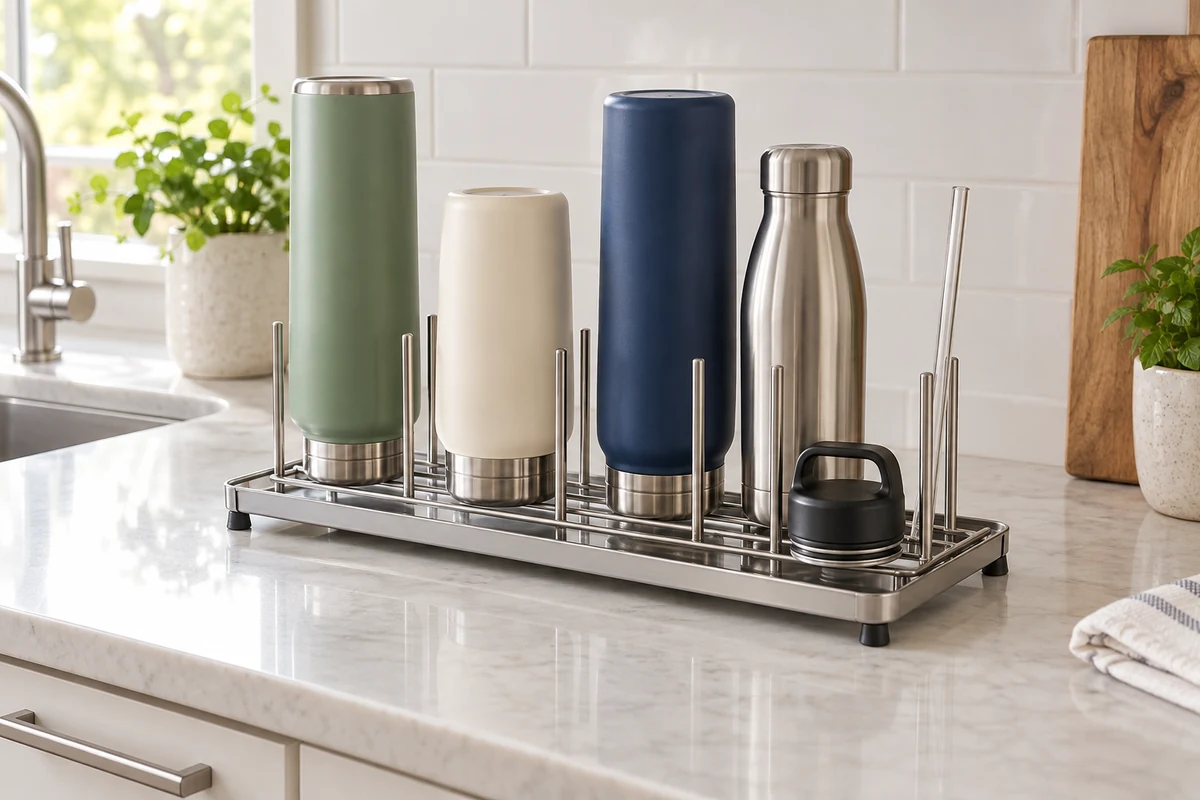
Water bottle drying rack fit should be approved against the buyer’s actual bottle assortment, not inferred from a capacity claim or a headline count. Before an importer promises compatibility, map bottle-body width and height to the rack’s support points, then review necks, lids, straws, tray edges and removal paths on a representative assembled sample. A rack that holds several bottles in a product photograph may still leave a target lid unsupported, obstruct a straw, or crowd the buyer’s tallest bottle.
This is an OEM specification and sample-approval guide, not a claim that Koitor currently makes this product. The example images are conceptual illustrations. Koitor’s metal-forming, finishing and assembly experience can inform a sourcing discussion, while bottle-specific interfaces, tray materials and any food-contact or drying-performance claims must be confirmed with the responsible product supplier.
Why does bottle capacity not establish rack compatibility?
Capacity describes volume, not the outside shape that meets the rack. Two bottles with a similar stated capacity may have different body diameters, shoulder profiles, bases, necks, handles and overall heights. A narrow insulated bottle and a broad travel mug, for example, can contain similar volumes while requiring very different support spacing. A jug’s handle or a tapered body can also change how it sits between rails.
Commercial product examples illustrate why buyers should avoid generalizing. Yamazaki lists a particular steel drying stand for bottles in a stated 500 mL to 2 L range and describes cushioning and a removable tray arrangement. OXO describes a different rack organized for four bottles, four lids and up to four straws, with raised edges and a disassembly feature. Those are model-specific configurations, not a shared industry standard or proof that any rack fits every vessel in those volume ranges. See the manufacturers’ Yamazaki Tower Bottle Drying Stand specifications y OXO Good Grips Water Bottle Drying Rack details.
For a private-label assortment, capacity should be one line in the product brief, while actual fit is a matrix of shapes and contact interfaces. The matrix helps the team decide which bottle families the product is designed for, which are excluded, and which require a separate accessory or rack size. It also gives the factory a concrete sample set to evaluate rather than an ambiguous request for a “universal” rack.
Which bottle measurements should buyers collect?
Begin with the assortment expected at launch and the likely additions planned for the same product family. Collect outside dimensions rather than relying on nominal bottle volume or product names. At minimum, list maximum body width or diameter, body height, base shape, shoulder transition, neck or mouth geometry, handle projection and the bottle’s intended resting orientation. For tapered or oval bottles, record dimensions at more than one height.
The purpose is not to demand arbitrary precision. It is to expose the interfaces that determine whether the bottle can be placed, supported and removed without binding against a neighboring item. Buyers can group similar bodies into a family if their contact areas and envelopes are genuinely alike, but should preserve exceptions such as unusually broad bases, large handles or projecting caps.
| Buyer input | Qué grabar | Why it affects fit |
|---|---|---|
| Body envelope | Maximum width or diameter, height, taper and oval orientation | Determines the space needed between supports and neighboring bottles |
| Base and shoulder | Base footprint, radius or profile, and where the body narrows | Changes the stable resting or inverted contact area |
| Neck and mouth | Outside neck shape, mouth opening zone and any collar | Can collide with rails or require a different neck-support opening |
| Handle and attachments | Handle reach, loops, clips, sleeves or removable parts | Adds lateral space and can prevent insertion or removal |
| Mass and intended loading | Empty bottle mass and planned quantity, documented by the buyer | Helps define the product-specific load review without assuming a rating |
| Accessory set | Lids, caps, straws, brushes or seals included in the assortment | Establishes what the rack must store separately, if anything |
For a multi-market range, ask the product team which exact models are must-fit, optional and explicitly excluded. A supplier should not be expected to infer every bottle sold under a brand from the brand name alone. If buyer-controlled samples are unavailable, request dimensional drawings or a controlled envelope drawing and mark those as provisional inputs until representative finished samples can be checked.
How should buyers evaluate water bottle drying rack fit across a mixed range?
The rack’s contact points should be reviewed against the way each vessel is intended to sit. Some designs support a bottle body on rails or a platform; others use upright posts, a cradle, a neck opening or a combination. No single arrangement is automatically correct for every bottle shape. The product drawing should show the locations that contact or constrain the bottle, along with spacing, clearances and removable parts.
Check both the fit envelope and the way the item behaves during ordinary placement and removal. A bottle that can be forced into a narrow gap is not necessarily a suitable fit. It may be difficult to retrieve, touch adjacent products, or sit in a way the design did not intend. For inverted drying layouts, the neck opening, cap diameter and supporting edge matter; for upright storage, base stability and separation between bodies may matter more. The article’s conceptual detail image highlights these as separate review points, not universal geometry.
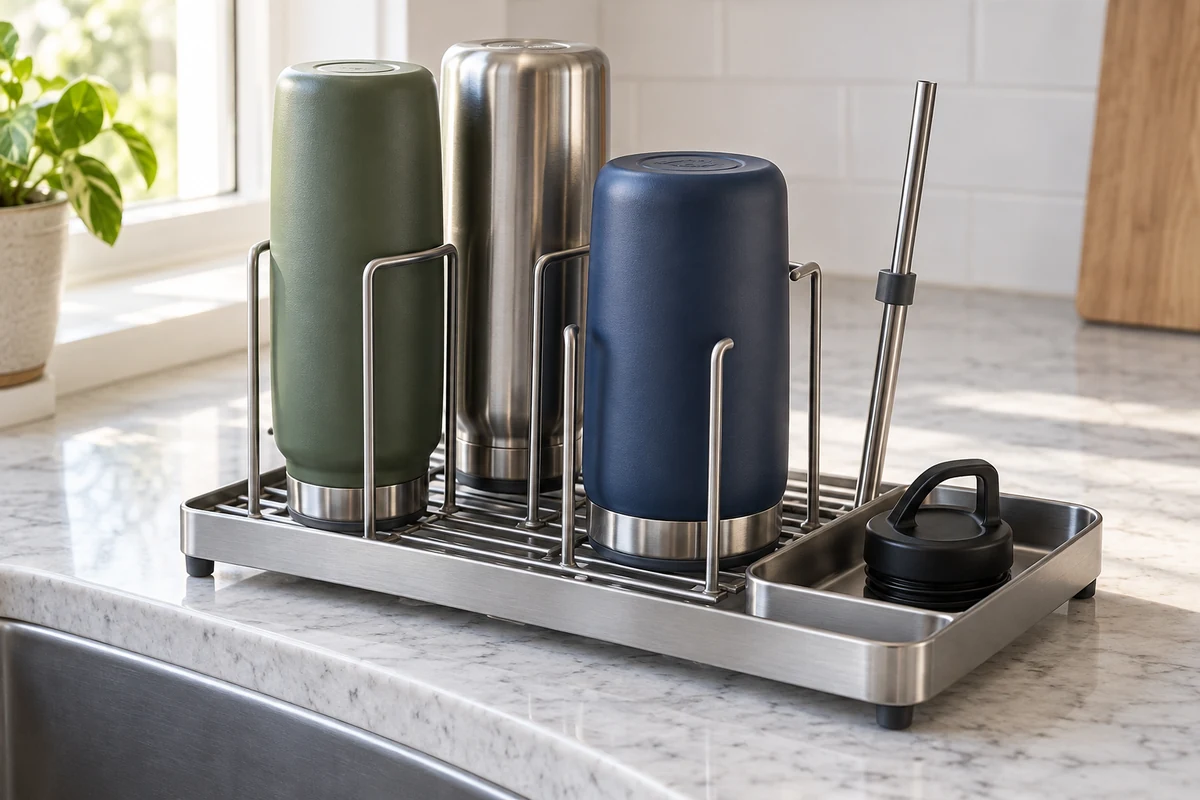
Ask the supplier to identify the design’s intended contact surfaces and any protective pads, clips or inserts. If these parts are purchased from another source, confirm who owns the dimensions, material selection and replacement supply. A metal frame maker may be able to assess the frame interfaces without making the plastic or elastomer components. Keep the scope clear in the quote and bill of materials.
Where do lids, caps and straws need their own specification?
Accessory storage is a separate fit problem from bottle storage. Lids may vary in diameter, height, handle shape and whether a loop or flip tab projects. A cap that rests on a flat tray may roll or occupy more space than its footprint suggests. Straws need a defined position if the design claims to hold them; simply having unused space beside a bottle does not establish that a straw stays separated or is easy to remove.
Create a second row in the assortment matrix for each accessory family. Record the largest and smallest lid or cap, any loop or latch that projects, the number of straws per bottle, and whether components are meant to sit in a tray, clip, slot or open rail. Include the orientation the supplier expects. The OXO example specifically describes four lid positions and raised edges as well as separate straw holders; those features demonstrate a product-specific layout, not a required configuration for every private-label product.
If the product is sold without accessories, state that in the package contents and avoid imagery or copy that implies they are included. If accessories are included, check their fit after the rack has been assembled and loaded with the target bottle mix. Confirm that the user can pick up a lid without moving a neighboring bottle or dislodging another component. Do not make hygiene, sterilization or drying-time guarantees based only on a visual layout review.
What should an OEM buyer inspect on the assembled sample?
Sample approval should use the intended configuration: frame revision, tray, pads or inserts, fasteners, finish and packaged accessory set. A loose frame can help check fabrication, but it cannot establish assembled fit when the final tray or support insert changes the usable space. Keep each sample linked to its drawing and component revision; this documented water bottle drying rack fit review should name every bottle family covered.
Use a representative bottle set chosen from the buyer’s actual assortment. Include the narrowest and widest bodies, shortest and tallest bottles, unusual bases or shoulders, and the most projecting handles. Test lids and straws in the intended positions. Place and remove each item in the expected order; if a bottle must be tilted or neighboring parts moved, note that as an observation for design review rather than assuming the product is acceptable.
| Sample check | Récord | Do not infer |
|---|---|---|
| Each target bottle fits its assigned position | Bottle model or sample ID, orientation and any contact/interference | Universal compatibility with untested bottles |
| Adjacent positions remain usable | Which items were loaded together and any collision | Full assortment fit from one bottle tested alone |
| Lids and straws have stable intended locations | Component ID, placement and removal observation | Hygiene or drying performance from appearance |
| Tray and inserts assemble and remove as specified | Part revision, sequence and visible interference | Dishwasher, temperature or chemical resistance unless documented |
| The rack is stable under the defined sample configuration | Surface, loading arrangement and observation | A load rating or long-term durability guarantee |
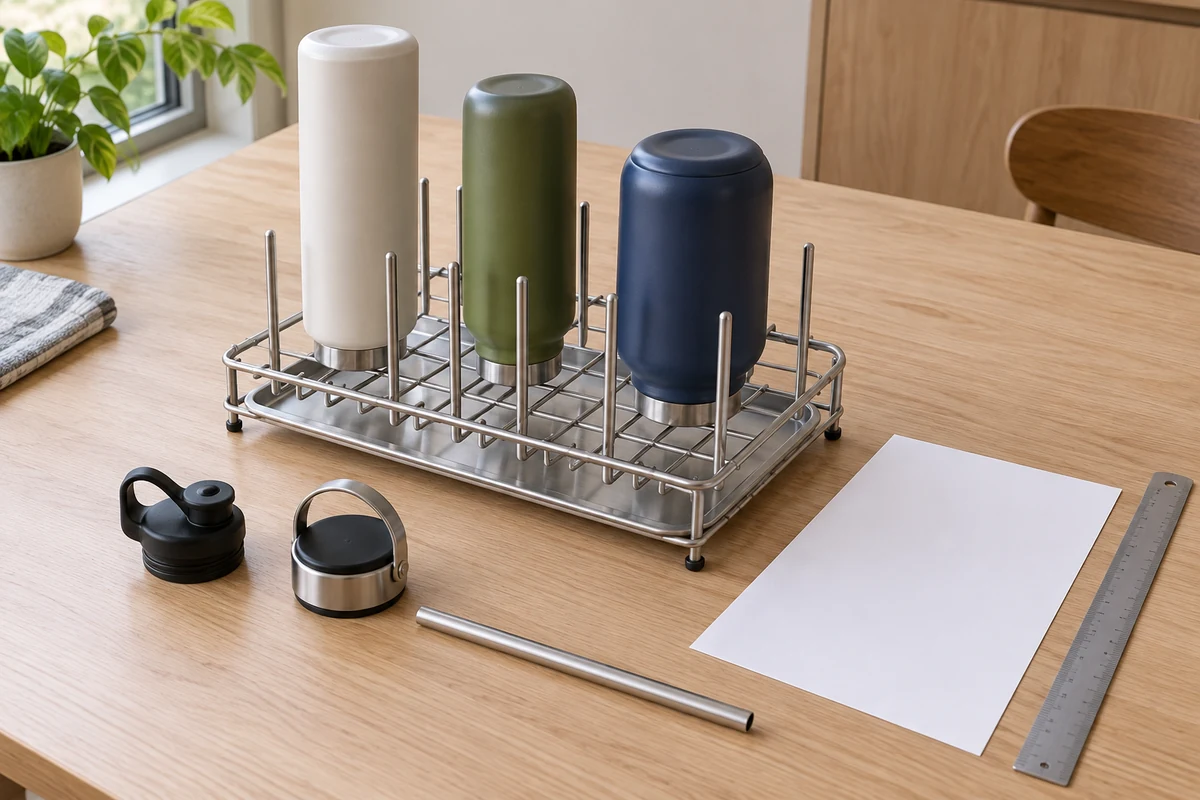
The images below illustrate a generic review setup; the sheet is blank and contains no test data. During a real approval, buyers should use their own measurement record, identified samples and acceptance criteria. If dimensions, tolerances or a load test are needed, agree on the method and limits with the responsible product engineer or supplier before inspection. A short demonstration does not establish cycle life or performance in every countertop condition.
How should a mixed bottle assortment be represented in the RFQ?
An RFQ should make the assortment and scope visible before a supplier quotes the frame or proposes a sample. Send a product brief with target bottle families, the relevant outside dimensions, intended orientation, required number of positions, accessory set, tray requirements, finish, package contents and target market. Mark critical fit cases separately from optional cases so the supplier can identify trade-offs rather than silently narrowing the scope.
Ask for an assembly drawing that identifies the rack’s support layout, usable opening or spacing, accessory locations, tray boundaries and any bought-in contact parts. Request a parts list with supplier responsibility stated for each component. If drawings are not yet mature, ask the supplier to annotate the proposal with assumptions and unresolved dimensions. The buyer should approve or correct those assumptions before a sample is treated as representative.
Use a fit matrix with one line per bottle or grouped family. Keep a column for sample availability and approval state, using values such as “provided,” “drawing only,” “sample checked,” “not checked” or “excluded.” This prevents a provisional CAD envelope from being mistaken for a validated fit. If a supplier proposes a larger gap or additional rail, ask what other position or accessory space changes as a result. The trade-off can affect rack width, packaging volume, tray dimensions and cost, but the magnitude depends on the design and order configuration.
Which changes should trigger another fit review?
Treat bottle fit as part of configuration control. A change to a bottle, rack, tray or accessory can invalidate a prior observation even if the product name remains the same. Define change triggers in the sample approval record and purchase specification.
| Change | Potentially affected interface | Recommended buyer action |
|---|---|---|
| New bottle body or handle | Support spacing, contact point and side clearance | Add the new sample or approved envelope and repeat fit review |
| Different cap, lid or straw | Accessory pocket, tray area and neighboring clearance | Review accessory count, placement and removal |
| Revised rail, post or frame width | Bottle opening and usable spacing | Request updated drawing and representative sample |
| Tray material or wall/edge geometry change | Usable area, assembly and disassembly | Confirm the part revision and inspect the complete assembly |
| Finish or protective insert change | Contact surface, appearance and component fit | Confirm the updated specification and sample condition |
| Supplier or sub-supplier substitution | Part dimensions, material and assembly assumptions | Identify the changed item and determine whether reapproval is required |
Do not assume a visually similar replacement component is interchangeable. Keep the accepted sample, drawing revision, BOM and package-contents record together. When an issue appears, describe the observed mismatch and the exact combination tested; ask the responsible supplier to assess it rather than assigning a cause from a photograph.
What can a metal OEM partner contribute?
A metal hardware OEM can contribute to frame geometry, forming and joining feasibility, finish options, assembly interfaces, packaging coordination and sample review within its confirmed capabilities. It may also coordinate with suppliers for bought-in trays, pads or other non-metal components. That does not automatically make the metal supplier the designer or certifier of every bottle, insert or food-contact component.
Koitor Hardware is a family-owned custom metal hardware factory focused on bathroom and home-storage hardware. Its drawing- and sample-based communication can support discussion of metal frame requirements and sourcing scope, but the exact product category, component responsibilities and current manufacturing capability must be confirmed project by project. No food-contact certification, plastic molding capability, bottle compatibility guarantee, hygiene result or drying performance claim is made here.
For an adjacent kitchen-storage concept, share the target bottle matrix, drawings or physical samples, intended finish, tray/contact-part requirements and package plan during a home-storage OEM discussion. Buyers can also contact Koitor about a project. The supplier’s quotation should distinguish metal parts it will manufacture from components sourced elsewhere.
Preguntas frecuentes
Does a 500 mL to 2 L capacity range prove that every bottle will fit?
No. A published capacity range applies to that named model and its intended configuration. Bottle height, body width, taper, base, neck and handle shape still affect fit. Verify the buyer’s target bottles against the actual product drawing and representative sample.
Should the rack be tested with only the largest bottle?
The largest bottle is useful but not sufficient. Check the range of target geometries and combinations, including the narrowest bottle, unusual bases, projecting handles, lids and straws. A fit review should cover the assortment promised in the buyer’s product information.
Can a rack’s bottle count be used as the SKU compatibility statement?
Not by itself. A count describes a particular arrangement, while compatibility depends on the bottles and accessories occupying those positions. State which families or envelope limits were reviewed and identify exclusions where needed.
Does a successful sample prove drying or hygiene performance?
No. Fit and assembly observations do not establish drying time, microbiological outcomes, material safety or performance under untested conditions. Those claims need appropriate product-specific evidence and qualified review.
Who should supply the bottle samples for approval?
The buyer should provide the actual target models where possible, especially when compatibility is a retail promise. If only drawings or measurements are available, record that limitation and treat the fit as provisional until finished samples are checked.
What should be retained after sample sign-off?
Keep the identified rack and bottle samples or photos, drawing and BOM revisions, fit matrix, sample observations, agreed acceptance criteria and any excluded bottle families. Link them to the purchase specification so later changes can be assessed consistently.
Review a Metal Storage Concept With Koitor
Share the intended bottle assortment, fit matrix, drawings or samples, and the metal-frame and tray scope. Product compatibility and non-metal component responsibilities should be confirmed for the specific project.
OEM / MARCA BLANCA
Convierte esta guía de abastecimiento en un resumen del producto
Indícanos el producto que deseas, el tamaño, el acabado, la cantidad del pedido y los requisitos de embalaje. Tu equipo recibirá un análisis práctico de la viabilidad de fabricación antes de recibir el presupuesto.
 English
 Español
 Português
 Français
 Deutsch
 العربية