

A spot welder duty cycle kVA comparison only helps a hardware buyer when each rating is tied to its stated test basis and the actual basket application. A larger nameplate number is not, by itself, proof of stronger welds or higher repeatable output. Ask what duty-cycle basis and operating conditions the rating uses, then request a representative run of the approved wire-basket design with agreed joint-acceptance evidence. This guide helps importers assess supplier evidence; it does not identify Koitor’s welding-machine make, rating, or production capacity.
What does a spot welder duty-cycle rating tell a buyer?
Duty cycle describes the proportion of a defined period during which a welding machine can carry current under stated conditions without exceeding its thermal limits. The period and definition must come from the relevant machine manual or rating standard. For example, Miller’s resistance spot-welder manual defines duty cycle over a one-minute period and explains its own 50% rating as thirty seconds of operation in that period. That manual is specific to its equipment, so buyers should not assume every manufacturer uses the same explanatory wording or application conditions.
For an importer assessing a wire-basket supplier, the useful question is not simply “What is the duty cycle?” It is “What exact operating pattern, electrical rating basis and product load does this figure describe?” A machine’s rated duty cycle concerns equipment heating under its defined conditions. It does not directly specify the mechanical strength, appearance or consistency of a finished weld on a particular basket. A careful spot welder duty cycle kVA comparison therefore starts by asking for the manufacturer’s stated rating basis rather than assuming percentages and kVA values mean the same thing across offers.
The term can also be used in different contexts. A supplier may discuss the machine’s rating, the share of time current flows, the production schedule, or a component’s cooling interval. In an RFQ, ask the supplier to state what their number refers to and which machine or process it covers. Do not compare two percentages until their definitions, rated conditions and measurement basis are clear.
This distinction matters for a product with many wire intersections. A supplier might make occasional samples at a low cadence but plan a much denser production schedule later. The nameplate alone does not show whether the proposed product, fixture, electrodes, cooling arrangement and operator sequence can sustain the approved quality at that planned pace. That evidence must be tied to the basket design and the buyer’s acceptance criteria.
Why are kVA figures not a complete machine comparison?
The apparent power rating in kVA is one piece of machine information, not a universal measure of usable weld output. Resistance-welding equipment vendors explain that kVA figures may be stated at different duty-cycle bases and that machines with a similar nominal kVA can differ in available secondary current and application configuration. T. J. Snow’s buyer guidance illustrates how a machine’s quoted kVA can change when the duty-cycle basis changes. That is a reason to normalize the comparison—not a reason to treat one vendor’s example as a universal machine-selection formula. The paper is equipment-selection guidance, not independent evidence about any specific hardware supplier.
A spot welder duty cycle kVA comparison should therefore compare the stated rating basis first, then test whether the supplier’s product-specific evidence answers the buyer’s production question.
Ask each prospective supplier to provide the exact line from the machine nameplate or manufacturer’s technical sheet and identify the rating basis in writing. The comparison should include, where applicable:
- Machine type and power supply configuration, without assuming that one topology is automatically better for the basket.
- Rated kVA and the duty-cycle basis associated with that figure.
- The manufacturer’s stated rated conditions and any relevant current or transformer information available for the application.
- The throat or arm reach needed to access the actual weld locations, and the fixture arrangement used for the trial.
- The basket’s material stack, wire diameters, joint geometry and intended weld locations.
- Any cooling or electrode assumptions that the machine maker specifies for the stated rating.
The buyer should not attempt to infer usable weld current or finished-product capacity from a headline kVA figure alone. Those questions depend on the machine and the resistance-welding application. A qualified process engineer or machine supplier should explain the rating data and any calculation used for a specific joint.
| Evidence item | What it helps compare | Lo que no establece por sí mismo |
|---|---|---|
| kVA and stated duty-cycle basis | Whether quoted ratings use comparable conditions | Finished-joint strength or production quality |
| Machine manual or technical sheet | Manufacturer-defined ratings, limits and operating conditions | Suitability for every basket geometry |
| Secondary-current or control data, when available | Application setup and equipment capability under stated conditions | Long-run repeatability without product evidence |
| Approved basket sample and run record | Output observed for a defined product revision and run | Future results after a process, material or fixture change |
The sample comparison must use a consistent basket revision and define which details may change. If one supplier demonstrates a different wire stack, fixture or weld location, the result is not directly comparable unless the buyer has approved that difference. Keep the comparison focused on the product the buyer intends to order, not on an abstract machine contest.
How does the wire-basket joint affect the equipment question?
Resistance spot welding joins suitable overlapping conductive parts through electrical current, contact force and a controlled weld schedule. Its application depends on the materials and geometry being joined, the electrode contact and access, the fixture, and the selected process controls. A welded wire basket may contain many intersections and attachments, but the process route can vary by product. Do not assume every joint on every shower caddy or storage basket is made with the same welder or schedule.
For a buyer, the product drawing or signed-off sample should identify the joints that are structurally or cosmetically important. A simple grid intersection, a wire-to-frame connection and a visible attachment may have different access and acceptance needs. If the buyer has a critical joint, define its location and the acceptable finished condition rather than requesting a vague “strong weld.”
Several factors can influence whether a proposed machine and process are appropriate:
- Joint stack and material: identify the actual materials and the number and thickness or diameter of the pieces at the joint. Do not let a generic “steel” description stand in for the approved specification.
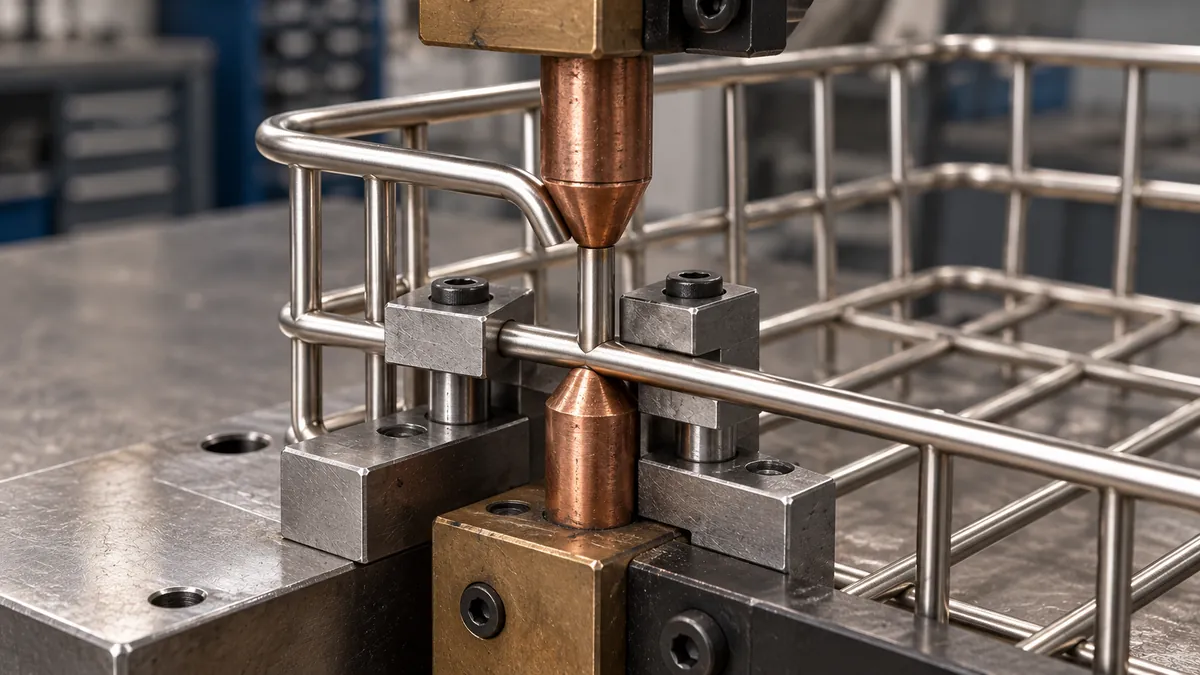
- Electrode contact and access: the electrode faces must reach and contact the joint in the intended fixture. Basket depth, crossings and nearby rails can constrain access.
- Force and current delivery: these interact with weld time and the material stack. The supplier should state which setup is approved for the sample; a buyer should not impose unqualified settings from another product.
- Fixture position and part fit: a well-designed fixture can help place repeat intersections consistently, but the fixture alone does not prove weld acceptance.
- Cooling and electrode condition: these may affect the process under repeated cycles. Confirm the supplier’s actual control and maintenance method rather than assuming a specific system exists.
- Surface and appearance requirements: visible marks, expulsion, indentation or distortion may need separate visual criteria from structural acceptance.
An image of a machine or a factory tour can show that equipment is present. It cannot establish that a particular basket’s joints meet the buyer’s requirements. The buyer needs evidence linked to the drawing revision, weld locations, run conditions and inspection method.
What production evidence should a buyer request?
Ask the supplier to demonstrate repeatable output using a representative product and a documented setup. A practical evidence package can be small, but it needs enough context to be meaningful. Agree the sample quantity, run sequence, inspection points and acceptance criteria before the demonstration; the buyer and supplier should select values for the actual project rather than copy a universal number from another application.
For a supplier evaluation, request:
- A rating record: a photograph or transcription of the machine data plate and the relevant manufacturer’s specification or manual. The record should show the kVA figure, duty-cycle basis and operating conditions being quoted. Sensitive machine serial details need not be shared if they are not required for traceability.
- An application description: the product revision, material stack, joint locations, fixture and process route used for the demonstration. Identify any differences from the approved sample.
- A planned-run protocol: define the representative production cadence, observation period and what counts as an interruption or process adjustment. The protocol should reflect the order’s expected production conditions.
- Traceable observations: record output quantity, stops or adjustments, sample identification and the inspection results at agreed intervals. A generic statement such as “machine ran normally” is not enough to connect the trial to the product.
- Joint acceptance evidence: agree visual requirements and, where justified by risk, suitable destructive or mechanical checks on selected sample joints. The responsible engineering team must choose the method and criteria for the material and joint; do not invent a pull force or pass threshold from a different design.
- Control and change notes: ask how the supplier identifies the approved setup and responds to electrode wear, fixture movement, material changes or repeated defects. A process record is useful only if it can be associated with the product revision and production lot.
If the buyer cannot visit the production site, a supplier can provide dated records, a live or recorded run view, sample images and inspection documentation. These are alternatives for review, not automatically equivalent proof. Ask who collected the evidence, what the camera or record does not show, and whether the sample was made on the actual proposed line.
The evidence should separate three things: machine capability under its rating basis, the observed production process under a defined run, and the product’s acceptance result. Combining them into one marketing claim makes it hard for the buyer to know what was actually demonstrated.
How should a buyer plan a representative run without over-testing?
Start with the buyer’s real production question. If the concern is whether the supplier can hold joint position during a small pilot order, a short sample review may be enough to expose obvious fit or access issues, but it will not demonstrate a long-run capacity claim. If the concern is sustained output at a planned cadence, the trial protocol should reflect that cadence and document interruptions. A demonstration designed for one question should not be presented as proof of a different one.
Before the run, the buyer and supplier should align on:
- The current drawing or golden-sample revision and the specific joints to observe.
- The material, wire dimensions and finish stage used during inspection.
- The intended fixture and whether the parts are representative of production parts.
- The planned number of pieces and cadence, along with any project-specific run period.
- What the operator may adjust during the trial and how each change is recorded.
- The sampling approach, visual criteria, dimensional checks and any engineering-approved joint test.
- How results, defects, pauses and corrective actions will be recorded and who approves them.
If a run stops or the process is adjusted, that is useful information, not automatically a failure. Record what happened, why, what changed, and whether the samples made before and after the adjustment meet the same acceptance criteria. The supplier and buyer should then decide whether another run is needed. Avoid interpreting an isolated pause as proof that a machine is inadequate, or a smooth short demonstration as proof of unlimited capacity.
For new products, a sample approval and a production-capability review serve different purposes. The approved sample establishes the product target. The run evidence checks whether the proposed process can reproduce that target under defined conditions. Neither should silently replace the other.

What does this evidence not prove?
A buyer should state the limits of the evidence so it is not over-read later:
- A nameplate kVA value does not rate the strength of an individual basket joint.
- A duty-cycle percentage does not, by itself, specify hourly output, defect rate or the quality of a finished basket.
- A clean-looking weld does not prove internal joint performance; conversely, an appearance mark should be assessed against the agreed cosmetic and functional criteria.
- One successful sample does not prove that every production lot will match it.
- A short run does not establish performance over a longer schedule that was not tested.
- A machine brand, machine age or factory photo is not a substitute for product-specific evidence.
- A destructive test on selected joints applies to the tested samples and method; it is not a lifetime guarantee for the basket.
- A supplier’s record does not prove Koitor owns a particular machine, rating, laboratory or certification.
T. J. Snow’s selection article is useful for understanding rating-basis comparisons, while equipment manuals such as Miller’s explain the rating and operating limits of particular machines. Spot Weld, Inc.’s machinery user’s manual likewise describes kVA and duty-cycle concepts from an equipment-vendor perspective. These sources are technical guidance, not independent certification of a hardware supplier’s production. The buyer should request records for the actual supplier and SKU being evaluated.
What should importers put in an RFQ or supplier review?
Instead of requesting “a high-capacity spot welder,” describe the product and evidence you need. An RFQ can include the following language and be adapted to the project:
Please identify the resistance-welding equipment and the rating basis relevant to the proposed basket joints. State the kVA figure and associated duty-cycle basis from the manufacturer’s documentation. For the approved product revision, describe the material stack, fixture and weld locations used in the sample run. Before production, agree a representative run cadence, inspection points, joint acceptance method and record format. Notify us before changing the approved material, fixture, electrode setup or process route.
Then ask the supplier to return the assumptions that are not yet known. This avoids forcing a buyer to invent machine ratings, weld settings or acceptance values. If the supplier cannot provide a specific machine detail for commercial or confidentiality reasons, agree an alternative document or demonstration that still supports the buyer’s capability decision.
Useful follow-up questions include:
- Is the quoted duty-cycle basis shown on the manufacturer’s document, and are the compared offers using the same basis?
- Does the representative sample use the same material stack, fixture access and weld locations as the product under review?
- What production cadence will be demonstrated, and how will pauses or changes be recorded?
- Which joints will receive visual inspection, dimensional review or an engineering-approved destructive check?
- How will the approved product and process revision be referenced in the production and inspection records?
- What event requires buyer notification or re-approval, such as a material, fixture or process change?
For small-batch OEM development, it is reasonable to stage the evidence: first confirm manufacturability and sample fit, then agree production controls before the order quantity increases. A supplier’s ability to communicate assumptions and changes clearly is part of the evaluation. The goal is not to demand unnecessary machine data; it is to make sure the evidence answers the risk that matters to the specific basket.
Work with Koitor Hardware
Koitor Hardware is a family-owned custom metal hardware factory focused on bathroom and home storage hardware. For a custom wire basket, shower caddy or storage rack, buyers can share a drawing or physical sample so the product structure, welding points, finish and packaging questions can be discussed before sampling. Machine make, kVA ratings, inspection instruments, production capacity and test results are project-specific facts and should not be assumed from this guide.
For broader context, see our guides to Fabricación a medida de accesorios de baño y accesorios de baño de marca propia. If you are evaluating a welded basket project, send the drawing revision, material specification, target quantity and critical joint locations for a practical discussion.
Discuss a Custom Wire-Basket Project
Share your drawing, sample, material requirement, target quantity and critical weld locations. Koitor can review the product structure and discuss sample-based OEM development and production requirements.
OEM / MARCA BLANCA
Convierte esta guía de abastecimiento en un resumen del producto
Indícanos el producto que deseas, el tamaño, el acabado, la cantidad del pedido y los requisitos de embalaje. Tu equipo recibirá un análisis práctico de la viabilidad de fabricación antes de recibir el presupuesto.

 English
 Español
 Português
 Français
 Deutsch
 العربية