

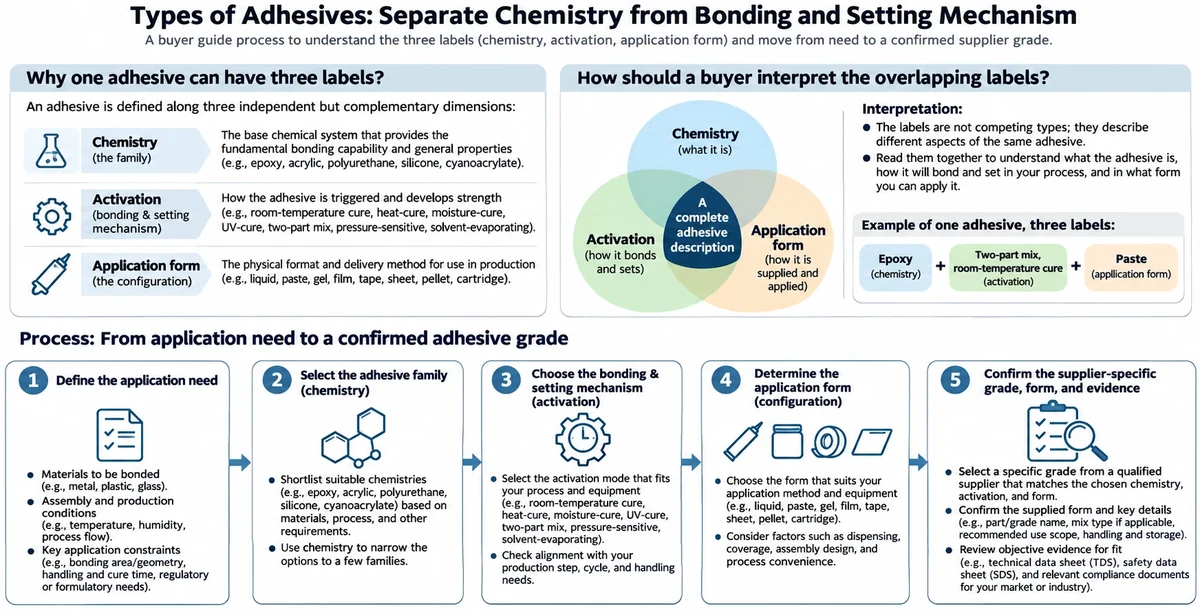
Types of adhesives are easier to understand when the buyer separates three different questions: what chemistry or material system is involved, how the adhesive is applied or develops a bond, and what form is supplied. Epoxy and acrylic are chemistry descriptions; pressure-sensitive, contact, hot-melt, and reactive describe application or bonding behavior; liquid, paste, film, and tape describe forms. These labels can overlap, so they do not make one mutually exclusive list of products ranked from weak to strong. For purchasing, identify the supplier’s actual product and the specific joint before drawing conclusions about suitability.
What problem does adhesive classification solve for buyers?
A buyer may receive a quotation that says “adhesive tape,” “epoxy,” or “hot melt” and assume the phrase answers the same question in each case. It does not. One term may describe the chemistry, another the way a bond is created, and another the physical form. If buyers compare proposals using only these labels, they may miss a difference in application method, cure mechanism, substrate, or supplier-specific product instructions.
This guide addresses a classification question rather than recommending a glue for a specific product. The goal is to help importers and product teams describe what a supplier is proposing and ask for the information needed to evaluate it. A hypothetical pad, liner, tape, or bonded fitting in a metal storage assembly illustrates the communication problem. It does not establish that Koitor manufactures adhesive, designs structural adhesive joints, or qualifies bonded assemblies in a laboratory.
The distinctions matter during RFQ preparation, sample approval, and change control. A drawing that says “adhesive” may leave the supplier to choose the product, application, and process. If those choices affect fit, appearance, assembly sequence, or a required function, the buyer should make the requirements visible and agree how a sample or document will be reviewed. The right amount of detail depends on the joint’s role and the risks of failure.
Which classification axes should be kept separate?
A practical buyer map separates chemistry, setting or bonding mechanism, and supplied form. The categories can intersect. A tape can use acrylic chemistry and be pressure-sensitive; a two-component product can be epoxy chemistry and cure by chemical reaction. Treating these terms as mutually exclusive creates confusion.
| Axis | Example terms | What the axis tells the buyer | What it does not prove |
|---|---|---|---|
| Chemistry or material system | Epoxy, acrylic, rubber-based, polyurethane, silicone | Broad formulation family or supplier description | Exact formulation, substrate compatibility, joint strength, or approval |
| Application or bonding behavior | Pressure-sensitive, contact, hot-melt, reactive | How product is applied or what general action develops a bond | A universal process setting, cure time, or safe load |
| Supplied form | Liquid, paste, film, tape, stick, coating | Physical form delivered to the user or assembler | That the form is appropriate for the actual geometry |
| Package or product role | Bonding, sealing, retaining, cushioning, positioning | Intended function in a defined assembly | That a generic adhesive name is an acceptance criterion |
| Supplier identity | Brand, product code, revision, technical data | Which commercial material is actually proposed | Equivalence to another product without a supported comparison |
This map is not a formal standard or complete taxonomy. Suppliers may combine terms differently or use proprietary product names. The quotation, technical data sheet, and application instructions for the specific product remain the relevant reference. If a supplier writes “acrylic tape,” the buyer can ask whether acrylic identifies the chemistry and whether the tape is pressure-sensitive, then record the exact product code and revision.
What do common adhesive descriptions mean?
Reactive and two-component products
A reactive adhesive develops a bond through a chemical reaction, but the term does not identify every chemistry or process. Some reactive products are supplied as one component and react under defined conditions; others are supplied in multiple components that must be combined. A product family such as epoxy may overlap with a reactive setting description.
Buyers should avoid inferring a mix ratio, open time, cure time, temperature, clamping pressure, or loading schedule from a generic article. The exact manufacturer’s instructions and product documentation control. When an assembly process uses a two-component product, record the supplier product and the approved process documentation for the actual application. Do not substitute general advice for product-specific instructions.
Pressure-sensitive adhesives
Pressure-sensitive describes a bonding behavior in which applied pressure is part of forming contact. The term can be used with different adhesive chemistries and formats. A pressure-sensitive tape is therefore not a chemistry label by itself. Its product construction, liner, adhesive type, substrate, application conditions, and intended use still need identification.
A buyer should not infer a safe load, long-term retention, removability, or performance on a particular coating from the phrase “pressure-sensitive.” Those characteristics depend on the exact product and joint conditions. If the tape retains an accessory or covers a component, the buyer needs a project-specific basis for acceptance.
Contact adhesives
Contact adhesive describes a general application and bonding approach, not one universal chemical family. Manufacturers may provide product-specific directions for applying material to one or both surfaces and for bringing the parts together. Those directions can vary by product. A buyer should use the actual instructions instead of copying a generic sequence into an assembly specification.
The term alone does not establish solvent content, cure schedule, surface preparation, or the suitability of a specific substrate. A quotation should name the product and identify the supplier documents that apply to the proposed use.
Hot-melt adhesives
Hot-melt commonly describes an adhesive applied in a heated state that bonds as it cools. “Hot-melt” is primarily a process or setting description; the supplier’s underlying chemistry and exact formulation still matter. A stick, pellet, or other feed form can be part of the supplied format.
The label does not prescribe a safe processing temperature, equipment setting, open time, or joint load. These are product- and process-specific details. Buyers should not assume all hot-melts are the same or that they belong to one identical chemistry family.
Liquid, paste, film, and tape
These words describe how the adhesive is delivered or handled. A liquid product may be reactive or non-reactive; a tape may be pressure-sensitive and may use different chemistry; a film can require a specified activation method. The form helps a buyer discuss storage, handling, application access, and package fit, but does not replace the material identity.
How should buyers identify an adhesive in an RFQ?
A useful request identifies the joint and asks the supplier to state the actual proposed product. The buyer should distinguish between a mandatory material, a preferred solution, and a performance requirement that permits supplier alternatives. This helps prevent a broad word from turning into an undocumented supplier substitution.
For an adhesive-related component, include:
- The joint or interface. Show the parts to be joined, the surfaces involved, the bond area, and the assembly orientation.
- The required function. State whether the material is meant to attach, seal, position, cushion, or perform another defined role.
- The supplied product identity. Request manufacturer, product name or code, chemistry description if known, and current technical documents.
- The format and packaging. Clarify whether the item is tape, film, liquid, paste, or another supplied form.
- Substrate details. Identify the actual surfaces and finish where the adhesive will be applied. “Metal” may be too broad if surface condition or coating matters.
- The approval method. Define whether the buyer expects a document review, sample review, process record, or a specified test.
- Change control. State whether changes to product code, supplier, formulation, application method, or assembly sequence require prior approval.
A hypothetical foam pad attached to a metal shelf can show why these fields matter. The buyer might need the pad in a specific position and want the supplier to identify the tape or adhesive product. That example does not prove the pad will support a particular weight or that the joint is safe for a load-bearing function. Those claims require a defined design and evidence for the actual assembly.
What should be checked before comparing adhesive proposals?
Start with the actual product and joint rather than a general description of adhesive types. Two proposals using different labels may be similar on the relevant axis, while two products using the same label can differ in other important ways. Normalize the supplier information before comparing cost or sample behavior.
| Comparison question | Information to record | Por qué es importante |
|---|---|---|
| What is the product? | Manufacturer, product name/code, document revision | Prevents a broad label from obscuring a supplier-specific material |
| Which axis does the description refer to? | Chemistry, setting behavior, or physical form | Makes quotations comparable |
| What surfaces are joined? | Substrate, finish, preparation responsibility | Compatibility is application-specific |
| What is the joint supposed to do? | Attach, seal, retain, locate, or other function | The function defines the acceptance question |
| How is the adhesive supplied? | Tape, film, liquid, paste, stick, or other form | Helps identify assembly and storage requirements |
| What instructions apply? | Current manufacturer documentation | Avoids invented or copied process settings |
| What evidence will be accepted? | Sample review, specified test, or documents | Ties claims to a buyer decision |
| What changes need approval? | Product code, supplier, formula, process, or geometry | Supports repeat-order control |
If the supplier offers an alternative, ask for a clear comparison that covers the requested role and identifies what evidence supports the substitution. A statement such as “same type” is not a complete equivalence evaluation. The buyer should decide which characteristics matter and who is responsible for verifying them.
What mistakes should buyers avoid?
Treating chemistry, mechanism, and form as one list
Acrylic, reactive, pressure-sensitive, and tape do not answer the same classification question. A flat list can incorrectly imply that a tape cannot be acrylic or that every reactive adhesive has the same chemistry. Separate the axes in product records and drawings.
Assuming the label predicts strength
A name such as epoxy, hot-melt, or acrylic does not prove the load capacity of a finished shelf, hook, holder, or storage product. Joint geometry, substrates, manufacturing process, conditions, and evidence matter. Do not publish or approve a load claim based on a category label.
Copying process instructions from another product
Mix ratios, flash-off time, pressure, temperature, cure schedule, surface treatment, and safe handling can vary. Use the documentation for the exact product and intended application. General advice should not override supplier instructions or site safety requirements.
Approving by chemistry name alone
A buyer may need a product code, revision, format, supplier, and assembly instructions. Chemistry may be one relevant descriptor, but not the whole record. A product change can occur even if a broad family name remains the same.
Treating a sample as proof of every condition
A sample review can show fit and visible assembly characteristics under the reviewed setup. It does not automatically establish long-term retention, environmental suitability, or a safe load. Define what the sample review proves and what remains untested.
Making an unsupported compatibility claim
Do not assume an adhesive works with every metal, coating, plastic, foam, or cleaning condition. Name the actual surfaces and ask for the appropriate product-specific evidence where compatibility matters.
How can an OEM factory support adhesive-related communication?
Koitor Hardware is a family-owned custom metal hardware factory focused on bathroom and home storage hardware. In a confirmed OEM product project, the buyer can provide a drawing or physical sample and identify where a supplied pad, liner, tape, or other component fits into the metal assembly. This helps clarify the product geometry, finish, packaging, and communication needed between the buyer and the responsible component supplier.
That coordination does not make Koitor an adhesive manufacturer or a laboratory that qualifies bonded joints. Adhesive formulation, specialist bond design, chemical handling procedures, and performance testing are not established company capabilities. If an adhesive is sourced from another supplier, identify who chooses the product, who provides the technical instructions, who applies it, and who verifies the finished joint.
The buyer can also state whether an adhesive solution is required or whether the supplier may propose a mechanical alternative. That is a design decision for the project, not a universal recommendation. Any comparison should account for the actual product, installation constraints, finish, service conditions, and the relevant evidence. To discuss a confirmed metal product scope, see Fabricación a medida de accesorios de baño or share a drawing or sample with Koitor.
Buyer checklist before approving an adhesive proposal
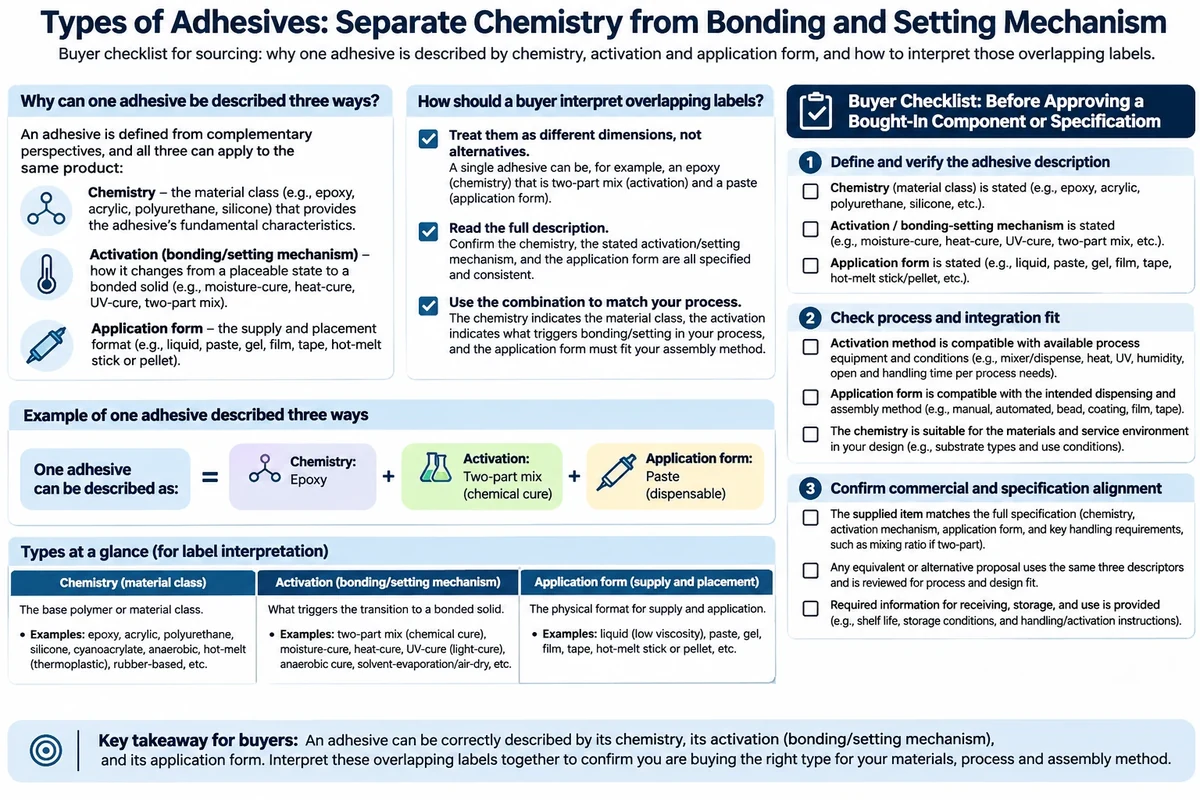
- Identify the exact joint and surfaces involved.
- State the function the adhesive or bonded component must perform.
- Separate chemistry, setting behavior, and supplied form in the specification.
- Request the exact manufacturer, product code, and current technical documents.
- Confirm which supplier controls the application instructions.
- Record the actual metal finish or other substrate where the adhesive is used.
- Define the sample review or test evidence required for the project.
- Do not infer a safe load from a chemistry or product-form label.
- Do not copy process conditions from another adhesive product.
- Document the approved product, drawing revision, and any required change notice.
- Identify whether a supplier may propose an alternative and what comparison is required.
- Keep unverified performance or compatibility statements out of the acceptance record.
How should adhesive information be controlled between sample and repeat order?
Once a buyer has reviewed a proposal, the accepted record should make clear which product and which joint were reviewed. Store the drawing revision, supplier product code, sample identification, and any applicable technical document together. If the sample uses a tape but a production proposal uses a liquid adhesive, that is a change in supplied form and application process even if the seller describes both with a similar broad chemistry term. The buyer should decide whether that difference is acceptable before the repeat order proceeds.
A change log can capture the previous product, proposed product, reason for the change, supplier documentation, sample or verification plan, approver, and date of effect. The log does not need to make an engineering judgment by itself. It provides a traceable question for the person responsible for the design: does the new material still meet the defined joint function, and what evidence supports that conclusion? A supplier statement can be recorded as a statement, but should not be expanded into a performance guarantee the document does not contain.
If the project has no special bond-performance requirement, the buyer should avoid creating one by copying a numerical load or cure schedule from a generic source. Instead, define the desired assembly outcome and ask the responsible supplier for product-specific instructions. If a load-bearing or safety-related function is involved, escalate for appropriate engineering review and relevant qualification; do not treat a category article or appearance check as approval.
This change-control approach is especially helpful when the metal component, coating, adhesive, and packaging are purchased from different suppliers. Assigning responsibility for product selection, application, documentation, and final inspection helps each party know what it must provide. The final purchase specification can point to the approved product and revision so a future buyer is not left to infer the intended material from the word “adhesive” alone.
A short approval record should also name the person or role responsible for confirming the joint requirements and identify the document version used for that decision. This avoids treating an informal supplier description as a controlled specification.
How should adhesive information stay controlled through a repeat order?
A procurement file should capture the adhesive description at a level that matches the risk and supplier arrangement. For a bought-in part, the record may need the responsible supplier, product or grade identification, chemistry label, activation or setting mechanism, supplied form, and any handling information that the supplier has actually provided. It should also identify the component drawing or sample revision to which the description applies. Do not convert a general category such as epoxy or pressure-sensitive into an assumed grade or process instruction.
When a supplier proposes an alternative, compare each classification axis separately. A different product can share the same chemistry family but use a different activation method or application form. Conversely, different chemistry labels can be presented in the same physical form. Ask the responsible technical party to explain the specific proposal, its intended scope, and the evidence available for the buyer’s stated requirement. The article’s types of adhesives framework helps identify missing fields; it does not approve a chemistry or promise bond performance.
For repeat orders, maintain the approved material description alongside the part revision, sample record, responsible supplier, and change history. If the supplier changes a product, formulation, dispensing method, or other controlled detail, the buyer should route the change through the applicable review process rather than silently replacing the former description. The review owner should decide whether updated documentation, sample approval, or a defined evaluation is necessary. This creates a traceable record without prescribing an adhesive recipe or claiming that Koitor manufactures or qualifies bonding materials.
The types of adhesives label is only a starting point; compare the specific chemistry, activation, and application information supplied.
UHU adhesive guidance provides additional examples of adhesive categories.
Preguntas frecuentes
Is hot-melt a chemical family or a setting description?
Hot-melt usually describes how an adhesive is applied and develops a bond as it cools. A supplier’s underlying chemistry and exact product still need identification.
Can a tape be acrylic and pressure-sensitive?
Yes. The terms can describe different axes: acrylic can describe chemistry, while pressure-sensitive describes bonding behavior. The product code and manufacturer’s documents identify the actual offering.
Does a glue type prove a finished shelf load claim?
No. A generic adhesive category does not establish a load rating for a finished assembly. A load claim requires a defined design, actual materials and surfaces, and appropriate project-specific evidence.
Are epoxy adhesives always two-component?
No universal answer follows from the word epoxy. Products and supply formats vary. Buyers should identify the actual product and follow its current manufacturer documentation.
Can a supplier substitute one adhesive for another if both share a category?
Not automatically. A shared broad label does not prove that products have the same formulation, process, substrate compatibility, or performance. Review the proposed product and evidence against the project requirements.
Clarify a Bonded Component in Your Hardware Project
Share the product drawing or sample to discuss the metal assembly, interfaces, finish, and packaging requirements within a confirmed OEM scope.
OEM / MARCA BLANCA
Convierte esta guía de abastecimiento en un resumen del producto
Indícanos el producto que deseas, el tamaño, el acabado, la cantidad del pedido y los requisitos de embalaje. Tu equipo recibirá un análisis práctico de la viabilidad de fabricación antes de recibir el presupuesto.

 English
 Español
 Português
 Français
 Deutsch
 العربية