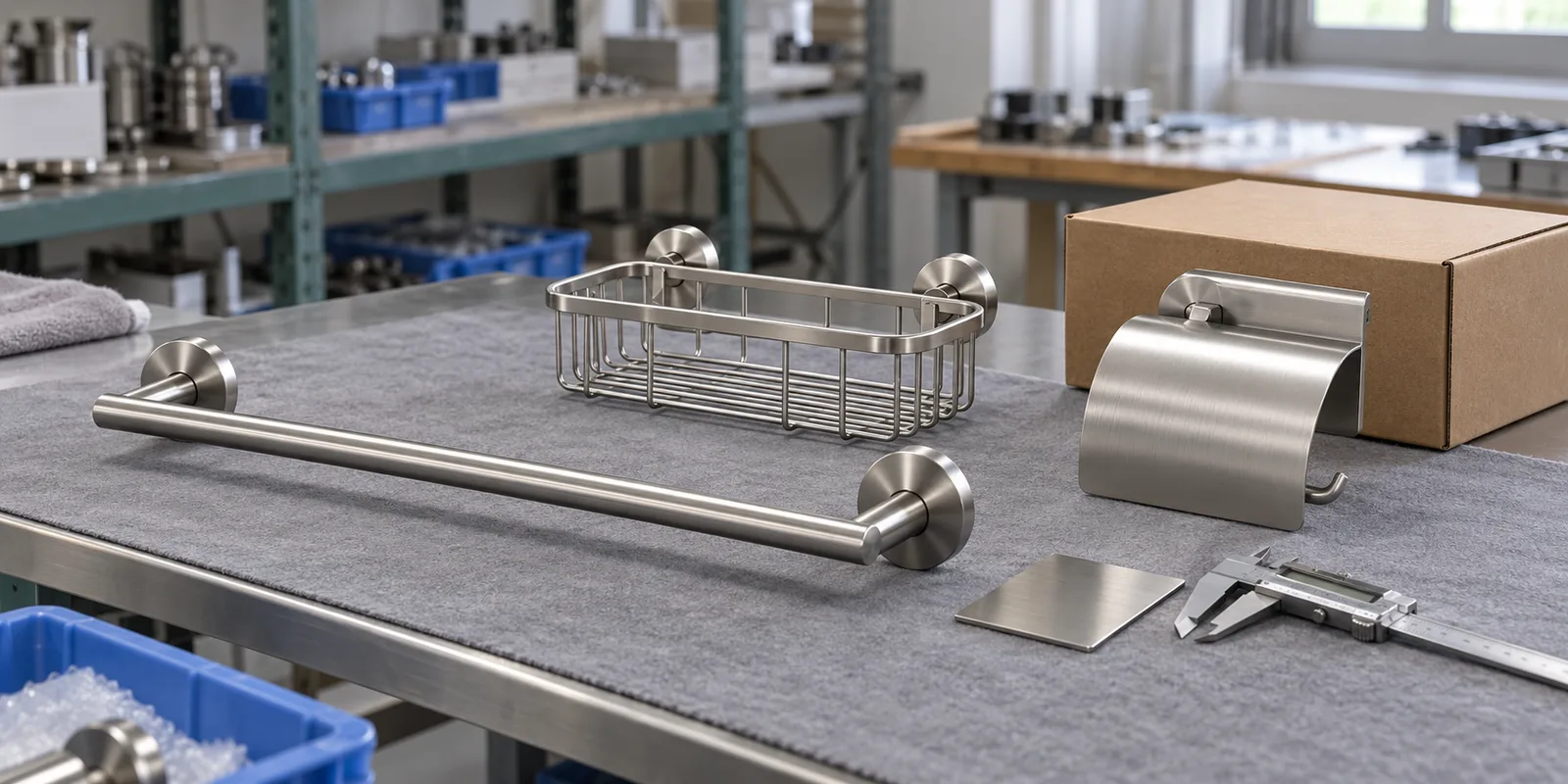
Bathroom hardware quality inspection should compare the actual production batch with the approved drawing, reference sample, component list and packaging requirements before shipment. Importers should agree what will be measured, how products will be selected, how problems will be recorded and who can authorize release. For towel racks, shower caddies, wire baskets and tissue holders, the review should cover identity, dimensions, workmanship, assembly, finish and packed contents. A useful inspection produces traceable findings and a clear decision, rather than a collection of attractive product photographs.
What must buyers agree before inspecting a production batch?
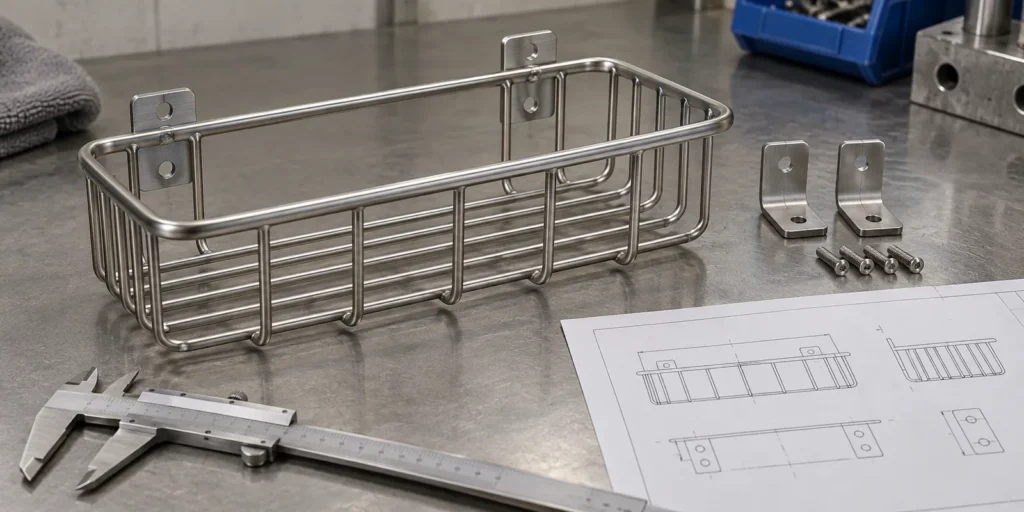
Buyers should agree the inspection reference, scope and decision rules before the production batch is checked. Inspectors cannot consistently judge requirements that exist only in an old email or an unrecorded conversation.
Start with a controlled specification: a named set of current documents that identifies the model, drawing revision, material, finish, included parts and packaging. If the approved sample differs from the drawing, resolve that difference before inspection. The factory and buyer need one consistent basis for deciding whether the goods meet the order.
Identify the inspection lot, meaning the defined group of goods covered by the inspection decision. State its quantity and variations, such as different lengths, colors or accessory sets. A photograph of one black towel bar does not demonstrate that a separate brushed-finish version has been checked.
Specify which features need measurements, which need assembly checks and which use visual comparison. A requirement such as “good finish” is too open to interpretation. An identifiable finish reference and an agreed description of unacceptable marks give both parties a more practical starting point.
Agree how findings affect shipment. Some issues require correction and reinspection; others may need clarification before a decision is possible. Name the person authorized to resolve deviations. A production team should not interpret silence as permission to ship goods that differ from the accepted specification.
Also record what the inspection excludes. Performance testing, material verification and distribution testing can require separate arrangements. A routine visual check should not be described as proving corrosion resistance, load capacity or the suitability of every mounting condition.
How do incoming, in-process and outgoing checks differ?
Incoming checks review materials and components before use, in-process checks review work during manufacturing, and outgoing checks examine completed products and packing before dispatch. These stages answer different questions and should support one another.
| Inspection stage | Typical review focus | Buyer value | Record to request |
|---|---|---|---|
| Incoming materials and parts | Specified material identification, relevant dimensions, purchased components and visible condition | Identifies discrepancies before parts enter production | Material or component reference, checks performed and disposition of discrepancies |
| During fabrication and assembly | Bending geometry, connection locations, fit and condition before later operations | Allows investigation while the affected feature remains accessible | Product revision, process stage, measured results and corrections |
| Finished product | Dimensions, appearance, assembly and supplied parts | Compares saleable units with the accepted specification | Selected unit identifiers, findings and photographs |
| Packing and dispatch preparation | Product variation, packed contents, protection, labels and carton quantities | Checks that the shipment matches the purchasing and packing instructions | Packing checks, carton references and release status |
For incoming quality control for hardware, buyers can ask how the specified wire, tube, sheet or purchased accessory is identified before use. The relevant checks depend on the product. Appearance alone should not be treated as evidence of a particular material grade.
In-process inspection of metal racks can focus on features that become harder to assess after finishing or assembly. For example, a mounting bracket’s position may be easier to measure before the product is packed. Agree the relevant point in the production sequence rather than requesting an unspecified “mid-production check.”
Outgoing inspection of bathroom accessories should connect the finished item with its packaging and components. A correct frame can still become an incomplete sales unit if the wrong bracket or instruction sheet is packed with it.
This staged approach is a planning framework, not a claim that every factory uses the same procedure. Ask your supplier to explain the checks proposed for your order, who performs them and how an unresolved finding is prevented from moving into the next step.
Which dimensions, connections and assembly details matter most?
Prioritize dimensions and connections that affect installation, assembly, usable space and product stability. Measure against agreed references and record actual results so that a different reviewer can understand the finding.
Dimensions and measurement references
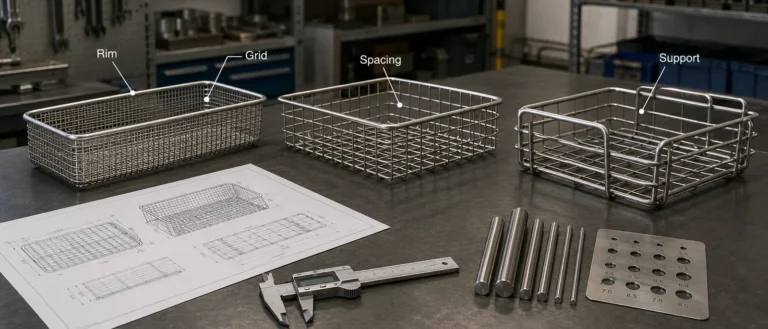
For a towel bar, overall length, usable hanging length and mounting-hole spacing describe different features. For a shower basket, external dimensions do not fully describe usable internal space. Identify the exact feature and measuring points on the drawing.
A tolerance is the permitted variation around a specified dimension. Tolerances should be agreed during development, particularly where variation affects fit. The inspection report should compare the requirement, permitted range and observed measurement instead of recording only “pass.”
Use suitable measuring equipment and a consistent method. Record the equipment identification where relevant to the inspection plan. If two measurements disagree, review the reference points, product position and measurement method before assuming that one party is wrong.
Welds, edges and assembly
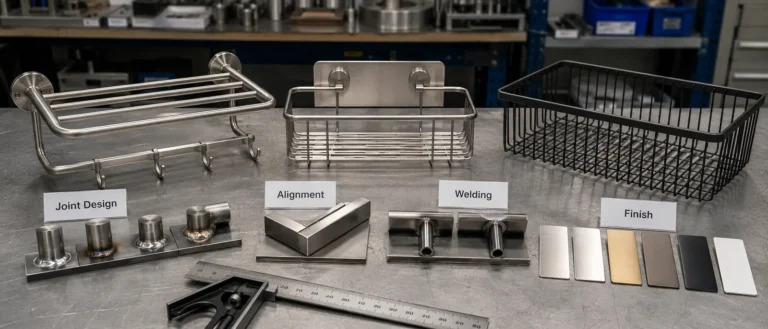
For welded baskets or racks, compare connection locations and visible workmanship with the approved reference. Note missing connections, visible openings, rough projections or distortion that require investigation. Visual appearance alone cannot establish the strength or internal condition of every weld.
Inspect accessible edges, wire ends and contact areas using an appropriate method. Identify sharp projections or rough areas as specific findings; do not ask someone to run an unprotected hand along a suspected sharp edge. Any performance evaluation needs an agreed method suited to the product.
Assemble selected products with the components supplied for the order. Confirm that the intended parts fit and that fastening points can be accessed in the intended sequence. A factory demonstration using a different screw or bracket does not resolve an issue with the customer accessory pack.
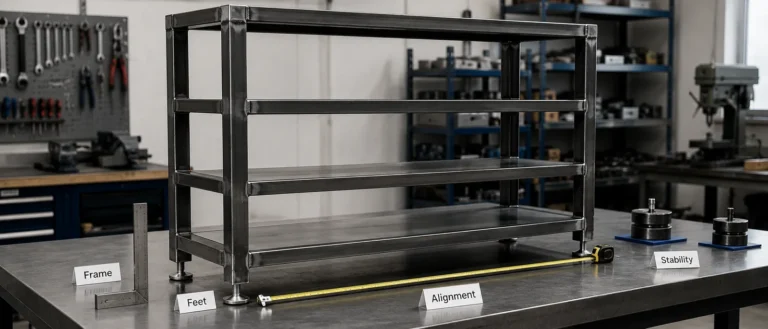
For a freestanding rack, review the agreed stability checks on a suitable reference surface. For wall-mounted bathroom hardware, assess assembly and mounting geometry against the approved design. Installation performance depends on the complete mounting arrangement and should be evaluated separately where required.
Koitor Hardware can review structure and welding points before sample production. Buyers planning inspection requirements can use the Fabricación a medida de accesorios de baño page to identify the relevant product scope before discussing project-specific checks.
How should finish, packaging and product identity be checked?
Check finish against an agreed appearance reference, then verify that the correct product and complete accessory set enter the intended package. Keep these findings separate so a good surface finish does not conceal a packing error.
For appearance review, agree the lighting and viewing conditions that matter to the project. Compare color, texture and visible surface condition with the approved reference. Photographs are useful evidence, but lighting and camera processing can alter how a finish appears.
Inspect both prominent surfaces and areas around joints, brackets and contact points. Record scratches, chips, exposed areas or other discrepancies with close-up photographs and a wider view showing their location. The affected surface matters when discussing whether a mark meets the agreed appearance criteria.
A finish inspection should not imply a verified service life. If the buyer requires coating measurements or corrosion testing, agree the applicable method, specimens, acceptance criteria and reporting arrangements in advance. Do not substitute an informal observation for the evidence required by that project.
Next, compare the packed contents with the current component list. Check the model, size, finish, quantity and any separate accessories. Similar-looking brackets or different bar lengths can be mixed if the inspection records do not identify the variation being checked.
Review protective separation where metal parts could rub against each other. Check that inserts fit the actual item and that accessories remain contained without creating obvious contact points against the finish. Open the package in the expected sequence and record any handling difficulty relevant to the buyer’s requirements.
Finally, compare product labels, carton marks and packing quantities with the approved files and order instructions. Record the artwork version where identification is important. A package used for an earlier sample should not be assumed to represent the shipment packing unless that arrangement was approved.
How should findings, sampling and reinspection be managed?
Use an agreed selection method, record findings against identifiable products, and define what evidence is needed to close each issue. This makes bathroom hardware quality inspection useful for a shipment decision rather than simply documenting that someone visited the factory.
If the inspection uses sampling, define the lot, selection method, sample size and decision rules before checking begins. NIST explains that acceptance sampling uses information from a randomly selected sample to support an accept-or-reject decision for a lot. It does not primarily estimate the lot’s quality. See NIST’s explanation of acceptance sampling.
Do not select a sampling plan by copying a percentage from an unrelated product order. Ask a competent inspection provider to establish an appropriate plan where statistical acceptance sampling is required. A sample of conveniently available pieces is not the same as a properly selected sample from the defined lot.
Record findings in a format that connects the requirement, observed condition, product identifier and supporting evidence. Include how many units were checked for the relevant characteristic. Avoid presenting an observed issue count without the scope needed to interpret it.
Agree defect classifications before inspection if the project uses them. The effect of a discrepancy on safety, function, installation or appearance should inform the agreed classification. Do not relabel an unresolved functional problem as cosmetic merely to reach a shipment date.
When a problem is found, identify and separate affected goods as appropriate, investigate the extent of the issue and agree the correction. Fixing the photographed example alone does not establish whether other units are affected. The response should address the identified group of goods and the reason the problem occurred.
Reinspection should verify the agreed correction and any related features it may have affected. For example, reworking a connection may require another review of alignment and finish. Keep the original finding, corrective action, reinspection result and final decision linked in the record.
Finish with an explicit status: accepted within the agreed scope, awaiting information, or requiring action before release. If the buyer accepts a documented deviation, record its exact scope and approver. Do not let a vague message such as “looks fine” replace the shipment decision.
What belongs on a buyer’s pre-shipment inspection checklist?
A buyer’s checklist should identify the order, the inspection scope and the evidence required for release. Use the following points as a starting framework and adapt the checks to the actual bathroom hardware product.
- Order identity: model codes, quantities, sizes, finishes and the defined lot covered by the inspection.
- Approved references: current drawings, identified reference sample, component list and packaging files.
- Selection plan: product selection method, sample size or full-check scope, and decision rules.
- Dimensions: critical measurements, reference points, tolerances and equipment or method where relevant.
- Structure: connection locations, visible workmanship, alignment, edges and assembly fit.
- Final: accepted reference, viewing conditions, surface locations and recorded discrepancies.
- Accessories: correct brackets, fasteners, caps, feet and instructions where supplied.
- Embalaje: product orientation, separation, inserts, packed quantity and label version.
- Separate evaluations: identify any required performance or material evidence that routine inspection does not cover.
- Issue closure: corrective action, reinspection evidence, unresolved items and named release authority.
Send the checklist early enough for the factory to identify practical questions. Some measurements need access before packing, while some evaluations may require additional equipment or a separate provider. Resolving these points before the inspection date makes the requested work clearer.
Agree how records will be delivered and retained. A concise report with traceable measurements and clear photographs is more useful than a large folder of unlabeled images. Keep the final inspection record with the purchase order and approved specification so it can inform repeat orders.
Frequently asked questions about bathroom hardware inspection
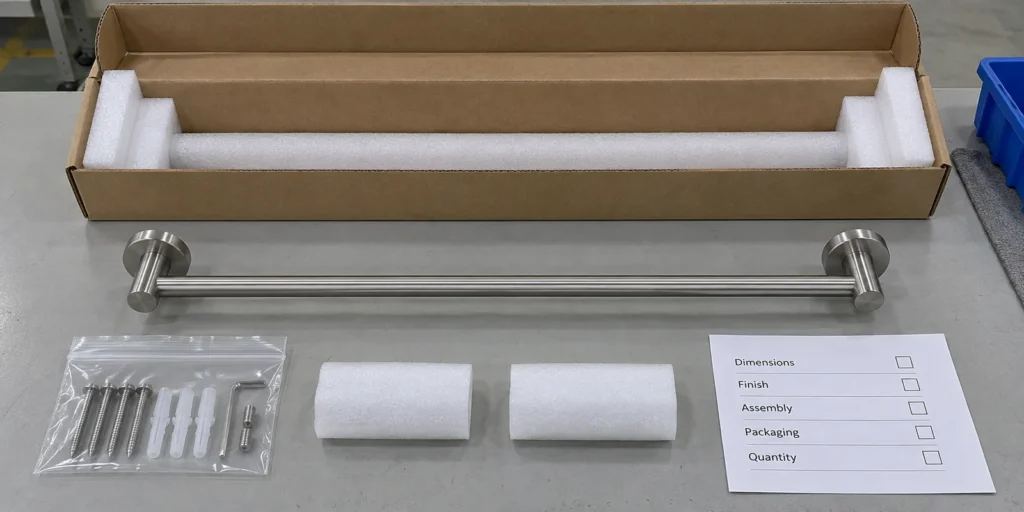
Bathroom hardware inspection decisions depend on the agreed specification, lot and evaluation scope. These answers address common questions importers should resolve before dispatch.
Does an approved sample replace batch inspection?
No. The approved sample helps define the reference, while batch inspection reviews the goods made for the order. Confirm that the current drawing and component list agree with the sample before using them together to judge finished products.
Can photographs prove that every item meets requirements?
No. Photographs document visible conditions on identifiable items at a particular time. They do not establish every dimension, hidden connection or unexamined unit. Request measurements and inspection scope alongside photographs, and arrange physical or specialized evaluation where needed.
Should every product be checked or should the inspector sample?
Agree the approach according to the product, risks, quantity and inspection requirements. Some characteristics may need a different scope from others. If acceptance sampling is used, confirm the selection and decision rules; do not assume that a passed sample proves every unit is defect-free.
What should buyers do when final inspection finds a discrepancy?
Record the discrepancy against the specification, clarify its extent and agree corrective action before release. Request reinspection evidence where correction is required. Confirm who can approve a deviation and retain that decision with the inspection record.
Can small-batch OEM orders still have a clear inspection plan?
Yes. A smaller order still benefits from defined dimensions, appearance references, packing instructions and release responsibilities. Adapt the inspection scope to the project and discuss it during quotation, so the factory and buyer understand the required work.
Discuss your hardware inspection requirements with Koitor
Koitor Hardware can discuss bathroom hardware quality inspection requirements alongside drawing or sample review, surface finish and packaging preparation. The family-owned China OEM manufacturer specializes in bathroom and home storage hardware, with flexible small-batch production and direct factory communication.
Define the Checks for Your Next Hardware Order
Send Koitor your drawing, reference sample, target quantity and inspection priorities. Our team can review structure, welding, finish and packaging requirements and discuss practical checkpoints before quotation.
OEM / MARCA BLANCA
Convierte esta guía de abastecimiento en un resumen del producto
Indícanos el producto que deseas, el tamaño, el acabado, la cantidad del pedido y los requisitos de embalaje. Tu equipo recibirá un análisis práctico de la viabilidad de fabricación antes de recibir el presupuesto.
 English
  Español