
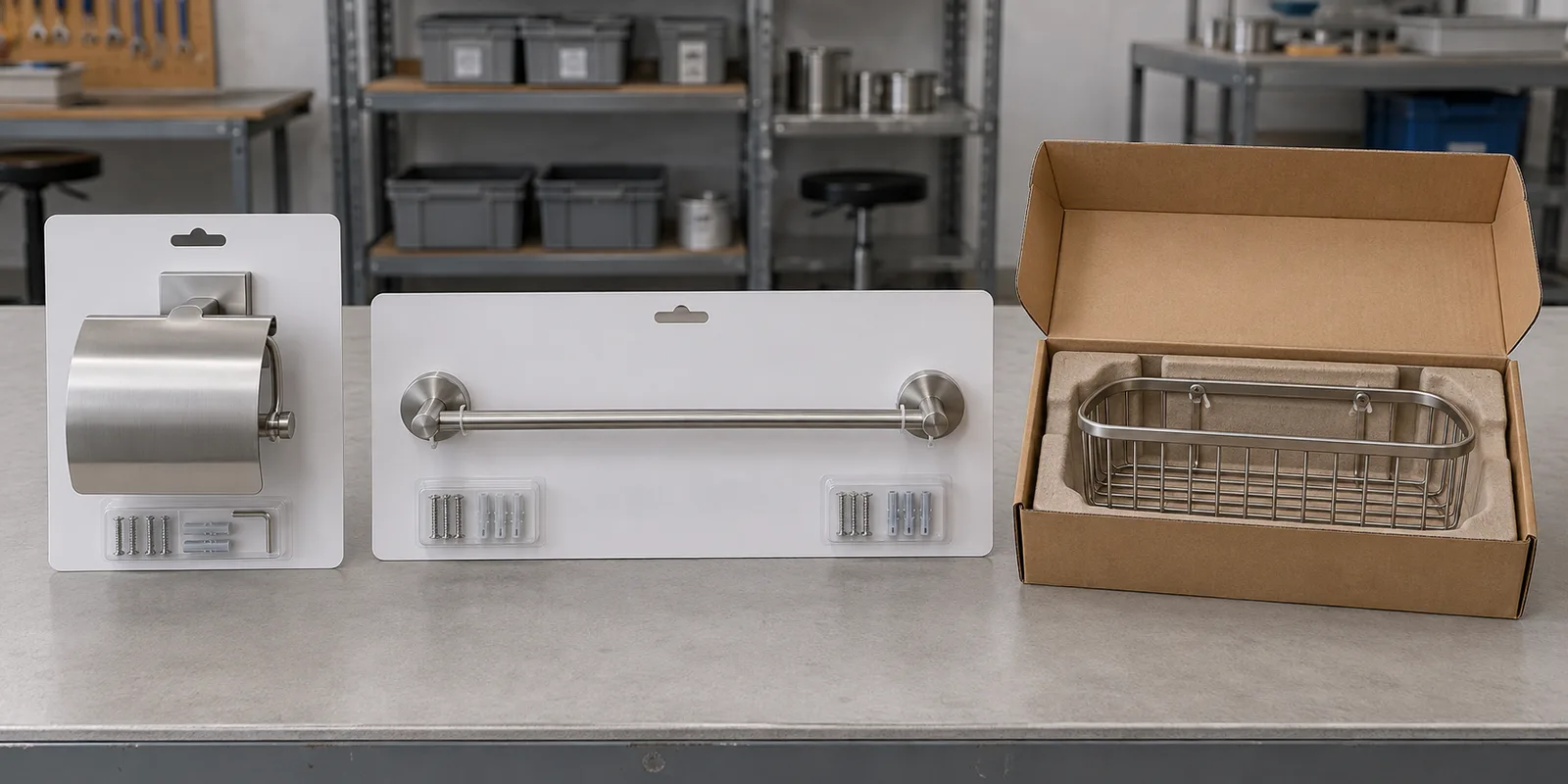
Retail display packaging for bathroom accessories should fit the store fixture, hold the complete product securely and make the model easy to identify. Start with the intended display method, packed dimensions, product weight and included accessories before deciding on a printed card or box. For towel racks, tissue holders and shower caddies, a visually appealing front panel is only one part of the purchasing decision. Approve the physical package with the actual product before committing to printed packaging quantities.
What should retail display packaging for bathroom accessories include?
A retail packaging brief should describe how the bathroom accessory will be displayed, handled and replenished in the store. That information determines the space available for the product, its support and the printed information.
Confirm whether the product hangs from a peg, stands on a shelf, sits in a tray or forms part of a coordinated display. Ask the retailer for the relevant fixture dimensions and product presentation requirements. A generic drawing of a display hook may not represent the fixture used in the target store.
A planogram is a layout showing where products are placed within a retail display. If the buyer has one, share the dimensions and position assigned to the product. If no planogram is available, request enough information to understand available width, height, depth and neighboring products.
Distinguish the metal product size from the final packed size. A mounting bracket, accessory pouch or folded header can increase the space needed. The package may fit within the nominal width while still making adjacent products difficult to remove from the fixture.
Also describe the sales unit. One package might contain a towel bar, two mounting brackets and an accessory pack, while another contains only the bar. Written confirmation of the complete contents helps the packaging team decide what must be visible and what needs a separate compartment.
Finally, identify who approves structure, artwork and retailer requirements. These decisions may belong to different people. Appoint one contact to consolidate the final instructions so that printing does not begin while a fixture or content question remains unresolved.
How do hang cards, sleeves and boxes compare?
Choose the package format according to display method, product geometry and the amount of protection and information required. The following comparison gives buyers a starting point for sampling rather than a universal ranking.
| Format | Useful application | Ventajas para el comprador | Question to resolve in a sample |
|---|---|---|---|
| Printed backing card | Hardware attached to a card for visible display | Shows the product while providing a flat information area | Does the card and attachment arrangement support the complete item? |
| Header or hang card | Products or contained sets suspended from a fixture | Provides an identifiable top panel and hanging position | Does the pack hang correctly and remain easy to remove? |
| Paper sleeve | A band around a product or protective inner pack | Leaves selected product areas visible with a compact printed surface | Does the sleeve stay in position through handling? |
| Printed carton | Products needing more enclosure or separate components | Offers several panels for information and space for inserts | Does the product stay positioned without excessive unused space? |
| Display tray with individual units | Grouped shelf presentation and replenishment | Organizes several sales units within a defined shelf area | Does the tray remain usable as units are removed? |
Color card packaging usually refers to a printed card used to identify, present or support a product. Ask the supplier which function the proposed card performs. A decorative information card and a load-bearing backing card may look similar in an artwork preview but need different structural review.
Product visibility is useful when buyers want shoppers to inspect the finish or understand the actual shape. Exposure also means the product can contact neighboring packs or be handled directly. Decide which areas should remain visible and which need separation or enclosure.
A box can organize loose parts and printed instructions, but it also changes display volume and the unpacking experience. Compare real samples instead of assuming that one format is always cheaper or more protective. The appropriate choice depends on the finished package and its intended use.
What should buyers check on hanging cards and product attachments?
Check the complete hanging assembly, including the card, opening, attachments and actual hardware product. A successful hanging sample needs to fit the fixture and remain appropriately supported under the agreed evaluation conditions.
For hang card towel rack packaging, the product’s length and orientation matter as much as the printed panel. A long towel bar hung vertically uses a different fixture area from a horizontal presentation. Confirm that neighboring products, shelf edges and price labels remain accessible.
The hanging opening must match the intended fixture arrangement. Do not copy a slot from another package without checking its size, location and surrounding material. Ask the packaging supplier to review the design and prepare a sample using the intended card construction.
Look at how the product’s weight and shape affect the hanging position. If a bracket or accessory pouch sits to one side, the pack may rotate or lean. Review the pack with all supplied components in their final locations, not with an empty card.
Product retention means the method used to keep the item in its intended position inside or against the package. Depending on the design, this might involve ties, tabs, inserts or another agreed arrangement. Check that the attachment does not obscure essential information or create unwanted contact with the finish.
Inspect the areas where the product and attachment touch. A narrow contact point can leave a visible mark if the arrangement permits rubbing or excessive pressure. The appropriate solution should be confirmed with the actual material and finish; simply tightening an attachment is not a complete review.
Define any hanging or handling evaluation with the retailer and packaging supplier. Agree the conditions and acceptance criteria rather than inventing a standard time or load. An attractive photograph of a suspended pack does not establish its behavior throughout the intended retail use.
How should printed information and barcodes be arranged?
Arrange printed information around product identification and the buyer’s approved content requirements. Reserve usable areas before artwork is finalized, then check the assembled package to confirm nothing important is hidden by the hardware or attachments.
The front panel should help a shopper distinguish the product type, size or variation without relying on a tiny internal code. For a coordinated bathroom range, use consistent organization while keeping each model’s contents clear. A towel bar and a tissue holder should not be confused because their cards share the same layout.
Confirm the wording for included components and installation method against the actual sales unit. Do not illustrate accessories that are not supplied unless the artwork clearly explains their role. Any material, finish or performance statement must be supported by the agreed product information.
A dieline is a flat layout showing the package’s cutting, folding and other structural features. Review artwork on the correct dieline revision. Text that appears well positioned on a screen may fall behind a fold, tie or product component after assembly.
Barcode placement needs its own review. GS1 advises considering the packaging process so the barcode is not covered or damaged, and preserving the required clear space around the symbol. See GS1’s product barcoding guidance. Confirm the relevant barcode requirements with the retailer and artwork owner.
Check the barcode on a printed, assembled sample using the agreed verification process. A readable digital image is not evidence that every production print and placement will be acceptable. Record the correct product identifier and artwork version for each variation.
Where several languages or regional versions are required, provide approved copy before the print file is released. Keep product instructions and packaging artwork consistent. A later text change can require reprinting even when the metal hardware itself has not changed.
How can buyers approve a retail pack without repeated rework?
Approve package structure with the real product before final printing, then confirm artwork on the accepted structural layout. This sequence helps keep dimensional changes from invalidating a finished print file.
Begin with a physical mockup that represents the proposed construction. Record which materials or details are temporary so reviewers understand the limits of the sample. A plain mockup can answer questions about product position, access and fixture fit before the printed design is complete.
Use a simple approval sequence so every reviewer sees the same package revision. First confirm the product and all included parts. Second, confirm the plain structural mockup on the intended fixture. Third, place draft artwork on the accepted dieline and check the assembled package from the shopper’s viewing direction. Fourth, approve a printed sample with the correct product identifier. Record the date and revision at every step.
Photograph the front, back, sides, hanging point and internal product-retention areas. Include one photograph of the package on the display fixture and another beside a ruler or other agreed size reference. These images support communication, while the physical sample remains the main reference for fit, handling and finish contact.
Review replenishment as well as first presentation. Store staff may need to place several units on one hook, remove the front unit and return a package after inspection. A header that bends, rotates or blocks the next product can create a practical retail problem even when the single display sample looks orderly.
Ask the packaging supplier to identify any hand-packing sequence that affects consistency. The position of ties, tabs, accessory bags and inserts should be clear enough for repeated assembly. If a small change in placement makes the pack lean or exposes the finish to rubbing, add that position to the packing instruction and inspection record.
Before final approval, compare retail display packaging for bathroom accessories with the retailer’s current fixture information and artwork requirements. If either source changes, reopen the affected checks instead of assuming the earlier approval still applies.
Ask reviewers to handle the pack as it will be handled in store. Place it on the intended fixture or an agreed equivalent, remove and replace it, and check access to the product information. For trays, review the presentation with fewer units remaining as well as when full.
Next, inspect the packed accessory set. Fasteners, brackets and instructions should stay with the correct product and be recoverable during unpacking. Opening the package should not require the buyer to guess where small parts were concealed.
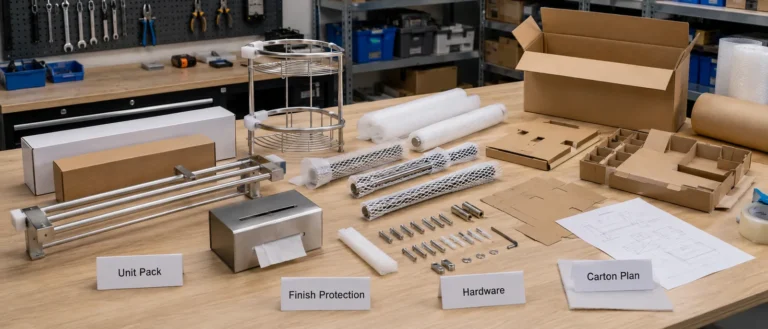
Keep the retail pack and shipping protection as separate review items. The display package may be placed within additional protection for distribution. Confirm both arrangements so a retailer receives presentable sales units, while avoiding the assumption that a display card alone is a complete shipping solution.
Return one consolidated revision list with photographs, the affected feature and the requested outcome. Distinguish a correction to the agreed brief from a new design preference. A changed card width may also affect carton layout, printing and shelf allocation, so review the related documents together.
Koitor Hardware can discuss product structure, finish and packaging preparation during private-label development. The private-label bathroom accessories service provides a relevant starting point for reviewing the hardware and its packaging requirements together.
What should a retail packaging quotation and checklist include?
A packaging quotation should describe the complete approved pack and separate any costs or minimums that do not follow the metal product quantity. Compare offers against the same structure, contents and artwork scope.
To compare retail display packaging for bathroom accessories fairly, ask each supplier to identify the card or carton construction, attachment method, inserts, printing scope and packing work included. A price for an empty printed card is not directly comparable with a price for a fully packed sales unit.
Confirm the minimum purchasing quantity for printed materials and each artwork version. A small hardware order does not automatically mean every custom package component can be purchased in the same quantity. Discuss what happens to unused cards or boxes and who is responsible if a later revision makes them unusable.
At Koitor, MOQ can start from 100 pieces depending on product structure, material, finish and packaging. Treat that as a project-specific starting point, then confirm the packaging quantities and development scope separately. Do not infer a universal printed-packaging minimum from the product MOQ.
- Display method: hanging, shelf-standing, tray or another confirmed retailer arrangement.
- Fixture details: available width, height, depth and relevant hook or shelf dimensions.
- Complete sales unit: model, size, finish and all included parts.
- Packed dimensions: measured with the hardware, attachments and information panels in place.
- Construction: card, sleeve or carton materials and agreed supporting components.
- Product retention: attachment locations, contact protection and accessory containment.
- Artwork: approved wording, language versions, product identification and current dieline.
- Barcode: correct identifier, placement and agreed verification arrangements.
- Aprobación de la muestra: physical reference, revision record and any evaluation still required.
- Commercial details: quantities by version, print preparation charges, packing work and unused material terms.
Retail display packaging for bathroom accessories should be identified by revision, just like the hardware drawing. Keep the final sample, artwork files and packing instructions connected so a repeat order does not mix a current product with an obsolete package.
Frequently asked questions about bathroom hardware retail packs
A bathroom hardware retail pack should be selected around the product and confirmed store requirements. These answers address common decisions before buyers approve cards, sleeves or boxes.
Is a backing card suitable for every bathroom accessory?
No. Suitability depends on product size, weight, shape, attachments and fixture requirements. A card that presents a compact holder well may not support a larger rack in the same way. Ask for a physical sample and evaluate the complete arrangement before choosing the format.
Can one card design cover several product sizes?
It may be possible, but confirm fit, attachment positions, information and identification for every variation. Shared graphics do not guarantee shared construction. A different bar length or bracket position can change how the product hangs or where the package needs support.
Should the product finish remain exposed?
Expose the finish where it helps shoppers understand the product, while reviewing contact and handling risks. Some products may need localized protection or more enclosure. Make the decision using actual samples and the retailer’s presentation requirements rather than an artwork preview alone.
Can a retail display card replace shipping protection?
Not automatically. A display package and a distribution package serve different purposes. Agree how the sales unit will be protected during storage and transport, and arrange the relevant evaluation before relying on the final packing method.
What should be approved before ordering printed packaging?
Approve the physical structure, complete contents, fixture fit, artwork revision and product identifier. Resolve any outstanding retailer requirements and confirm purchasing quantities. Record the final decision so a later product change triggers a review of the package before printing.
Develop your retail hardware pack with Koitor Hardware
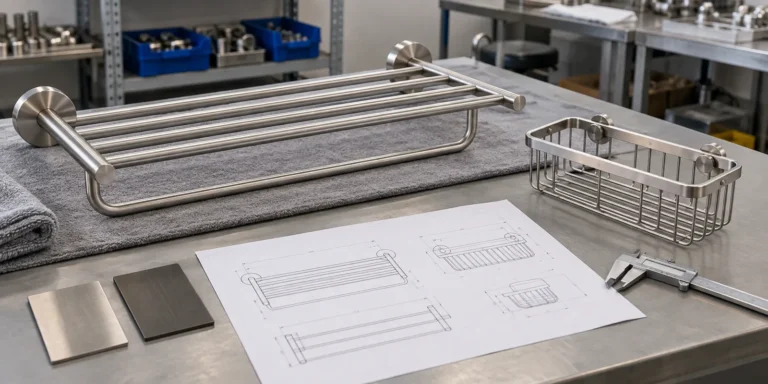
Koitor Hardware can review packaging requirements alongside drawings or physical samples for custom bathroom and home storage hardware. The family-owned China OEM manufacturer supports small-batch projects involving towel racks, shower caddies, wire baskets and tissue holders, with direct factory communication.
Plan the Product and Retail Pack Together
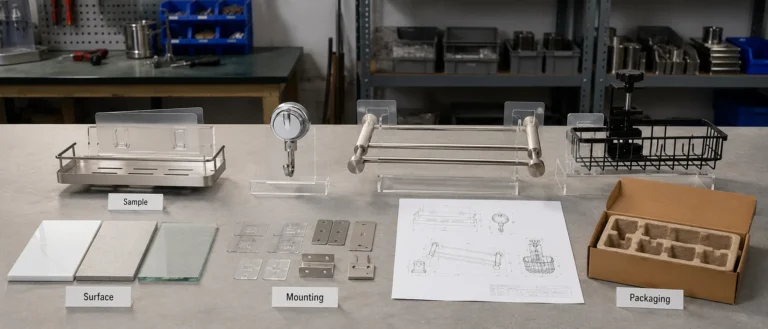
Send Koitor your hardware drawing or sample, display requirements, packaging idea and target quantity. Our team can review product fit, finish protection and packaging preparation before quotation.
OEM / MARCA BLANCA
Convierte esta guía de abastecimiento en un resumen del producto
Indícanos el producto que deseas, el tamaño, el acabado, la cantidad del pedido y los requisitos de embalaje. Tu equipo recibirá un análisis práctico de la viabilidad de fabricación antes de recibir el presupuesto.
 English
  Español