
Brazil plastic packaging reverse logistics is a buyer-side issue as soon as a Brazilian importer places hardware sold in plastic packaging on the market. Decree 12.688/2025 addresses primary, secondary and tertiary packaging and sets duties for importers, but the Ministry of Environment’s current B2C-versus-strict-B2B interpretation is in a non-binding communiqué that may change. Before approving a purchase order, map each package component and its route to the final user, confirm the Brazilian entity and its collective or individual system, and request SKU-level material, weight, recycled-content and revision data from the supplier. The Brazilian importer or its adviser—not the overseas factory—must determine legal scope and reporting.
What does Brazil Decree 12.688/2025 require from importers?
The Decree establishes a reverse-logistics system for plastic packaging involving manufacturers, importers, distributors and merchants. Its text refers to primary, secondary and tertiary packaging and to certain comparable plastic products. For an importer of a metal bathroom basket or home-storage rack, the hardware remains the product; the plastic sleeve, accessory bag or other in-scope plastic packaging is what the buyer must identify and assess.
Article 20 says importers of plastic packaging or products sold in plastic packaging must take part in a reverse-logistics system: either join a collective model or structure, implement and operate an individual model. Importers also have duties concerning consumer and trade-chain guidance, keeping information about the mass of packaging sold up to date, naming the system operator to authorities, and declaring compliance with recycled-content targets under the competent authority’s procedures. These are importer responsibilities; a supplier’s packaging declaration supports them but does not replace the importer’s system participation or reporting.
Article 21 adds a specific point for importers that do not participate in a management entity: the import can be conditioned on prior proof of the minimum recycled-content target incorporated into the plastic packaging, in the form established by competent authorities. Do not choose an individual model on the assumption that it is simply a private alternative with no additional proof step. Ask Brazil counsel or the system owner to confirm how the current procedure applies to the proposed importer and shipment.
The Decree also phases recycled-content target start dates by company size: January 2026 for large companies and July 2026 for small and medium companies. It sets annual recovery and recycled-content targets in its annexes. The applicable target depends on the current rule, material, year and company classification. This guide does not reproduce a percentage or decide how a company is classified. The Brazilian compliance owner should check the current Decree annexes and official instructions, particularly because the target dates have already started as of the article’s review date, October 26, 2026.
A buyer can use the following division of responsibility when collecting evidence:
| Decision or evidence | Brazilian importer or system owner | Overseas supplier |
|---|---|---|
| Importing entity and system model | Identify the responsible local entity and confirm collective versus individual participation | Provide accurate company and transaction data if requested |
| Plastic packaging mass placed on the Brazilian market | Reconcile import, sales and product data under the applicable method | Provide package weights per SKU and pack configuration |
| Recycled content in packaging | Determine applicable target, acceptable proof and declaration procedure | Provide material composition and supported recycled-content evidence for the package |
| System reporting and verification | Coordinate with the management entity or individual system and current SISREV-BR instructions | Keep package facts and revision history available |
| Legal classification | Obtain Brazil-side regulatory or legal assessment | Describe the actual package, materials, assembly and changes |
This is an ownership map, not a substitute for legal advice or a claim that every company has identical filing tasks. The Ministry’s May 2026 interpretation and subsequent SISREV-BR procedures should be read alongside the Decree, not treated as if they amend it.
Does the decree cover B2C and B2B plastic packaging?
The Decree’s statutory wording should be read first. Article 1 covers primary, secondary and tertiary plastic packaging; its text does not itself set out an express “B2B packaging” exception. The Ministry of Environment and Climate Change’s rectified May 2026 communiqué provides a current, non-binding interpretation: it says the system applies to packaging that becomes post-consumer waste after final-consumer use, describes this as B2C, and says packaging traded strictly between businesses is outside this Decree while remaining subject to other environmental rules, including applicable waste-management requirements.
That distinction can affect a hardware buyer’s packaging map, but it should not be converted into the rule “wholesale packaging is always exempt.” The Ministry’s communiqué also says tertiary packaging should be counted when it reaches consumers, including in online or retail purchases. A package that moves through a wholesaler or warehouse may still reach an end consumer as part of the sale. The actual route matters more than the name on the carton.
For a Brazilian hardware program, ask what happens after the importer receives the goods:
- Does the importer sell the unit in its original consumer-ready pack to a retailer or online marketplace?
- Does a distributor remove or replace the plastic sleeve, bag or outer pack before sale?
- Does the packaging remain in a trade-only delivery between companies, or does a tertiary layer travel with the product to a consumer?
- Does an e-commerce or marketplace operator add a new plastic package before delivering to a household?
- Does the product go to a hotel, facilities buyer, wholesaler, individual household, or a mixture of channels?
- Is the product sold in Brazil under the imported brand or private label, and who controls the package configuration?
The Brazil-side reviewer should record each channel and the percentage or volume of products that use each material pack-out. If the answer is “both,” maintain separate versions or document a consistent method for separating them. Do not label the entire SKU B2B because some cartons go to a distributor, and do not call every shipping layer B2C because the hardware could be used in a home.
The communiqué is expressly described by SINIR/MMA as non-binding, valid for the current moment and subject to change. It does not replace regulations or other instructions. Therefore, use the B2C/strict-B2B distinction as the Ministry’s current guidance for a preliminary screen, then confirm the interpretation against current law and competent-authority procedures before a formal reporting or import decision.
How should a hardware importer map each packaging layer?
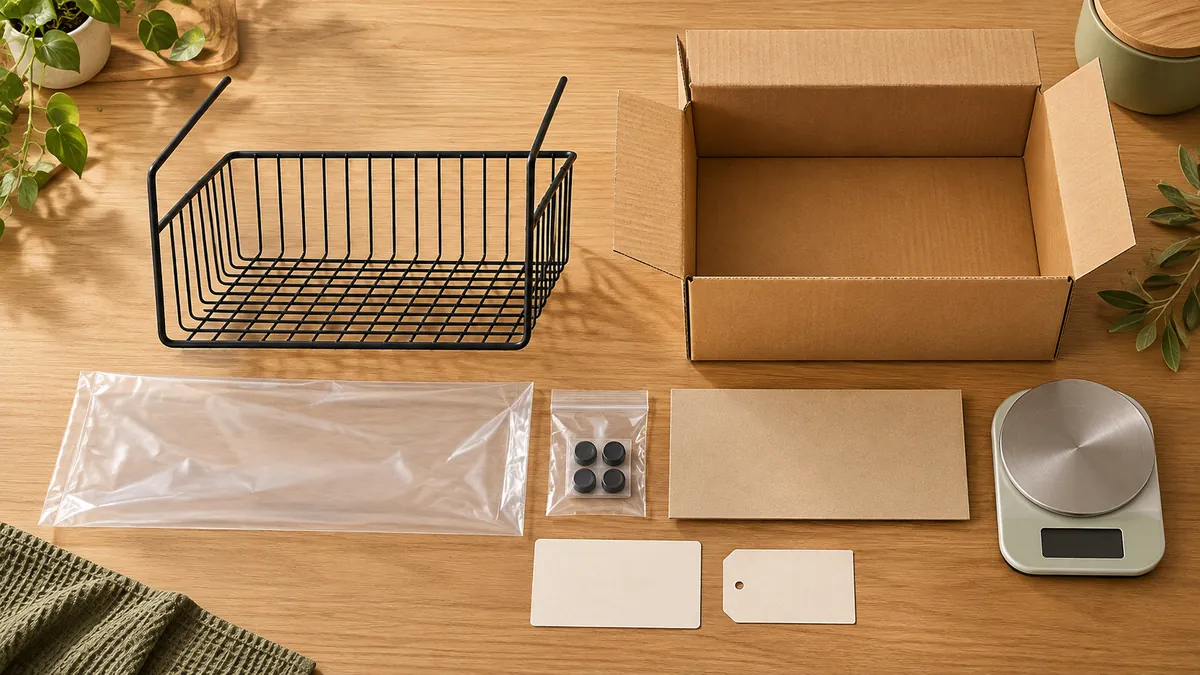
Start with the product and move outward. The terms primary, secondary and tertiary describe packaging levels, but they do not independently settle whether the Decree applies to a given layer. For each component, record its function, material, weight, sales route and whether it reaches the final consumer.
| Example for a wire storage basket | Data to record | Question for the Brazil-side reviewer |
|---|---|---|
| Thin plastic sleeve around the basket | Material or resin if known, unit weight, whether it is removed before retail | Does the sleeve serve a primary/product-contact or protective function in this market pack? |
| Small bag with screws or hooks | Material, unit weight, parts per set, and whether it is packed with the product | Does the bag travel with the consumer-ready product or is it removed upstream? |
| Plastic foam, film or protective pad | Composition, weight, attached or loose status, and where removal occurs | Is it packaging, a product component, or part of a different pack layer under current guidance? |
| Paperboard product box with a plastic window or layer | Full construction, material layers and component weights | Does the mixed-packaging exclusion in Article 2 apply to this exact structure, and what other rules remain relevant? |
| Corrugated master carton or plastic stretch film | Material, weight, number of units, distributor/retail route and final removal point | Is this layer strictly inter-company or does it reach a consumer in any channel? |
| Marketplace-ready mailer or delivery bag | Who adds it, its material, weight, customer channel and order configuration | Does the plastic delivery layer reach the final consumer as part of the product sale? |
The Decree excludes mixed packaging containing paper or cardboard, as well as certain categories handled under separate legislation. Do not use that sentence as a general exemption for all plastic in a paperboard box or for all packaging made of multiple materials. Save a drawing, cross-section, material declaration or representative sample when construction is mixed, and ask the Brazil-side reviewer to determine the exact scope and whether another waste rule applies.
Use the current official Decree 12.688/2025 text for statutory terms and exclusions. Use the rectified SINIR/MMA Communiqué 002/2026 for the Ministry’s current explanatory position, while keeping its non-binding status visible in the buyer’s notes.
What supplier data should be collected before a Brazil order?
A Brazil plastic packaging reverse logistics importer checklist becomes useful when every packaging row maps to a product SKU, package revision, sales route and local reporting record. Ask the supplier for verifiable physical facts rather than a broad claim such as “fully compliant in Brazil.” Use one row per distinct package component, including small accessory bags or a plastic layer that is easy to miss.
| Supplier field | What a buyer should request | Why it helps |
|---|---|---|
| Product identity | SKU, model, drawing or sample revision, color/finish variation and private-label variant | Links package data to the exact item that will be imported |
| Component list | Each sleeve, bag, film, insert, label, tray, window, carton and pack support | Prevents a single “packaging total” from hiding material layers |
| Packaging level and function | Product-contact, protective, retail, e-commerce, master-carton or transport use | Helps compare the physical pack-out with the channel map |
| Material composition | Specific resin or polymer where known; paperboard layer, laminate, adhesive or mixed structure | Gives the local reviewer evidence beyond visual appearance |
| Unit mass | Net mass per component and complete pack, with sample count and weighing method | Supports mass calculations and allows the importer to reconcile supplier values |
| Pack-out quantity | Components per product, products per inner box and inner boxes per master carton | Connects per-unit facts to order and SKU quantities |
| Brazil destination | Intended retailer, marketplace, wholesaler, hotel/project or other channel | Supports a B2C versus strictly B2B route review |
| Recycled-content claim | Declared percentage or certificate if available, material covered, source and revision | Supports—but does not itself prove—the importer’s statutory declaration |
| Artwork and label instructions | File revision, language, placement, and which party requested the change | Preserves the buyer’s instruction trail and avoids unapproved substitutions |
| Control de cambios | Effective date/lot, old/new material, reason and notice/approval process | Lets the importer reassess a packaging change before it reaches the market |
These are useful handoff fields, not a statement that each one is a statutory supplier form. The Brazilian importer must reconcile the per-unit pack data with the volume placed on the Brazilian market and the evidence required by its selected model. Imported quantity, quantity sold, quantity reaching the final consumer and quantity recovered are different measures. A factory cannot calculate the importer’s local sales or recovery results from its carton specification alone.
Ask how a small plastic part was weighed. If a screw bag is too light for a stable single measurement, the supplier can record a sample count, total sample mass and calculated unit mass. For mixed materials, record the visible layers separately and flag any unknown. Do not silently classify a laminate by its dominant color or use the total gross carton weight as if it were plastic packaging mass.
Request dated photographs of the actual Brazil-market sample pack and compare them with the component schedule. If the supplier changes from a thin film to a molded protector, adds a plastic viewing window, or replaces a paper insert with foam, update the packaging revision and resubmit the local assessment. A product drawing can stay unchanged while the packaging mass, material and consumer-facing pack-out change.
What changed with SISREV-BR and the current reporting cycle?
The reverse-logistics workflow has a new reporting system since September 2026. A Ministry announcement says Portaria GM/MMA 1,778/2026 created SISREV-BR as a module integrated with SINIR for registration, reporting, consolidation and monitoring of reverse-logistics systems. The official SINIR page says systems should be registered annually between January 1 and May 31 and prior-year results reported by July 30, with registration updates as required.
For importers, distinguish the two operating models before asking the factory for a document:
- Collective model: the importer participates through a qualified management entity, which organizes and manages the collective system. The Brazilian importer still needs accurate SKU, plastic-mass and recycled-content facts for its reports, contracts and verifications.
- Individual model: the importer structures, implements and operates its own system. Decree Article 21 and the Ministry’s May communiqué connect this model to prior proof of the recycled-content target, under procedures established by competent authorities. Confirm the current import procedure before selecting this route.
- System registration and annual reporting: use current SINIR/SISREV-BR guidance for responsible-party registration, reporting roles, evidence attachments and the current system manual. The official published schedule names Jan. 1-May 31 for annual system registration and July 30 for prior-year result reporting; ask the manager or local adviser how the first cycle applies.
- Traceable recovery evidence: the Decree links obligations to mass placed on the market and evidence of recovery, including electronic invoices and the Waste Transport Manifest (MTR), with verification requirements. Keep records consistent with the selected collective or individual model.
- Recycled-content evidence: Article 34’s phase-in dates have begun. Ask the importer which annual percentage and packaging category apply, and ask the supplier for material evidence that can support the claim. A generic “recycled” label is not a mass-balance record or a substitute for the required proof.
The SISREV-BR announcement says records can be reviewed and requests for correction may follow. The buyer should assign a Brazil-side owner before a reporting deadline, and agree who supplies each data item, in what format, and by when. Do not wait until an annual report is being assembled to discover that packaging weights were never captured by SKU.
The current SINIR SISREV-BR page y el Ministry’s announcement are the relevant sources for the September 2026 system change. Confirm the current form, manual, portal status and first-cycle instructions before filing; this article does not infer a separate 2026 registration deadline from the system’s publication date.
What mistakes can derail a Brazil packaging review?
Most preventable problems begin with a supplier data request that describes the product but not the packaging lifecycle. The buyer can avoid these errors by preserving the distinction between statutory text, ministry interpretation and verified product facts.
- Treating the Ministry communiqué as if it were legislation. It is a current, non-binding interpretation that can change. Keep the Decree and official guidance in separate fields in the review record.
- Calling every wholesale order B2B. The Ministry’s guidance discusses whether packaging remains strictly between businesses or reaches a final consumer. Follow the actual retail, online and repackaging path for each SKU.
- Assuming every tertiary package is outside scope. The Ministry says a tertiary layer should be counted where it reaches the consumer in a retail or online purchase. Track the last pack-out, not only the factory’s export carton.
- Assuming a foreign factory is the Brazilian responsible entity. The Brazilian importer must confirm its local role, select a model and coordinate the reporting. The supplier provides the physical packaging evidence within its control.
- Using a single total weight for a mixed pack. This can obscure which layer is plastic, paper, composite or outside the relevant system. Ask for component-level material and weight data.
- Assuming a paperboard box automatically removes every plastic layer from review. The Decree’s mixed-packaging exclusion needs to be applied to the actual construction, and other environmental rules may still apply.
- Ignoring recycled-content targets because the hardware is metal. The target concerns qualifying plastic packaging, not the metal product body. Product material and package material are separate.
- Choosing an individual system without checking Article 21. The individual model has a prior-proof issue for recycled content under competent-authority procedures; verify it before import.
- Confusing package facts with system performance. A supplier can state the sleeve’s weight. It cannot prove that the Brazilian system recovered the packaging mass or that the importer satisfied its annual target.
- Using stale records after a packaging revision. A new bag or insert can change material mass. Keep the change date and affected lots linked to the Brazil-market SKU.
- Copying an EU EPR or PPWR answer into Brazil. Other guides can help structure a data request, but the scope, system and reporting terms are not interchangeable.
When a fact is unknown, mark it unknown and request the missing specification. Guessing a resin or treating a visually similar sample as proof of the current production pack can create a false report. If local channels vary, give the adviser the actual split and pack-out evidence instead of selecting one convenient category for the whole product family.
How can a hardware OEM support the buyer’s data handoff?
A specialized OEM manufacturer can describe the parts of the package it controls: the component list, known resin or board specification, unit weight, pack-out count, label file revision and date of a change. It can photograph the product and packaging sample, confirm which parts were included in the approved sample, and notify the buyer before substituting a package material. Those inputs help the importer assemble a consistent record for Brazil-side review.
Koitor Hardware is a family-owned custom metal hardware manufacturer for bathroom and home-storage products. A buyer can share the product drawing or sample, SKU matrix, intended Brazilian channels, packaging requirements and any approved private-label artwork. For relevant product context, see OEM home-storage hardware manufacturing. Koitor can discuss supplier-controlled product and package facts; it does not determine a Brazilian entity’s legal status, operate a reverse-logistics system, certify recovery mass or file SISREV-BR reports.
The buyer should give the supplier a controlled worksheet with separate cells for known fact, evidence source, owner, revision and local legal decision. If the supplier cannot verify the recycled-content percentage of a plastic sleeve, it should report the evidence gap instead of making an unsupported claim. The importer or its management entity can then decide whether to obtain a validated material declaration, change the packaging, or use another compliant sourcing route.
If a packaging decision affects product protection, installation kits or private-label presentation, discuss it before mass production. The importer can compare a revised sleeve or pack layout against transit damage needs while the compliance owner checks how the new configuration affects mass, system records and artwork. Product changes and legal determinations should be reviewed by their appropriate owners.
Readers managing multiple countries can use Koitor’s multi-country packaging EPR checklist y PPWR declaration guide as examples of supplier-data organization. Those pages concern other regimes; do not import their thresholds or legal interpretation into Brazil.
Brazil plastic packaging reverse logistics importer checklist and questions
Before approving a Brazil-bound purchase order, complete this importer-side checklist:
- Name the Brazilian legal entity and confirm who introduces the packaged product to the domestic market.
- Identify whether the entity imports plastic packaging, products in plastic packaging, or both.
- Map each package layer by SKU, function, material, mass, pack revision and final sales route.
- Record whether each package remains strictly inter-company or reaches a final consumer through retail, marketplace or e-commerce.
- Ask the Brazil-side adviser to apply the Decree’s text and the current non-binding SINIR/MMA B2C/B2B interpretation separately.
- Review mixed paper/cardboard packaging and any separately regulated category against current law; do not infer a blanket exclusion from appearance.
- Choose collective or individual model and identify the management entity or named system operator.
- Verify whether an individual importer needs prior recycled-content proof under Article 21 and current authority procedures.
- Confirm the current material- and year-specific recovery/recycled-content targets and the applicable company-size phase-in.
- Obtain supplier evidence for plastic weight, package construction, recycled-content claims and approved sample revision.
- Assign one owner to reconcile data placed on the Brazilian market, system reports and recovery documentation.
- Check SISREV-BR registration and annual reporting procedures, current manual and first-cycle instructions.
- Obtain approval before any supplier changes packaging material, label, weight or market pack-out.
The checklist is a preparation tool, not a declaration that any particular hardware SKU is covered. The Brazilian importer and its qualified adviser should record the reasoning, missing data and the date on which the current official guidance was checked.
What is the safest way to decide whether a plastic package is B2B or B2C?
Describe what actually happens to each packaging layer after import, including retailer or marketplace repacking and delivery to the end customer. The May 2026 ministry communiqué currently excludes packaging traded strictly between businesses from this Decree, but it is non-binding and the statutory text has no express B2B sentence. Ask Brazilian counsel or the responsible system owner to apply current instructions to the actual route.
Does a small or medium importer have no duties until 2027?
No general conclusion follows from that assumption. The Decree phases recycled-content target start dates: January 2026 for large companies and July 2026 for small and medium companies. Those dates have passed as of October 2026. Confirm the company’s category, the correct target and other importer duties with the responsible Brazilian compliance owner.
What should the factory provide if it cannot verify a recycled-content percentage?
It should identify the package material and revision, state the exact claim it can support, and provide the available specification or evidence. If it cannot verify a percentage, it should say so rather than estimate. The importer can then request a validated declaration or ask its management entity/adviser what evidence is acceptable under current rules.
Does SISREV-BR replace the importer’s management entity?
No. The official descriptions present SISREV-BR as a government module for registering, reporting, consolidating and monitoring reverse-logistics systems. The Decree still provides for collective and individual models. The importer should confirm how its management entity or individual system uses the current platform.
Is a supplier package-weight sheet enough to prove reverse-logistics compliance?
No. It supports the packaging mass and composition data, but the importer must also follow the applicable model, reconcile market quantities, meet targets and retain system evidence such as required electronic records or MTR documentation. The verifier or competent authority determines whether the evidence meets current requirements.
Which official sources should Brazil-market buyers check?
Read the current Decree 12.688/2025, the rectified SINIR/MMA Communiqué 002/2026, the SISREV-BR system page, y el Ministry announcement about the September 2026 Portaria. Check the pages and current system manual again before filing or importing.
Trabaja con Koitor Hardware
Bring the product drawing or sample, Brazil-market pack-out, packaging component schedule and planned sales channels so supplier-controlled materials and unit weights can be discussed before production. Koitor can provide hardware and package facts within its control; the importer or its Brazilian adviser must decide legal scope, system model and reporting.
Review Brazil-Market Packaging Before Production
Share the product revision, Brazilian sales channels and component schedule so supplier-controlled packaging material, weights and pack-out changes can be reviewed clearly.
OEM / MARCA BLANCA
Convierte esta guía de abastecimiento en un resumen del producto
Indícanos el producto que deseas, el tamaño, el acabado, la cantidad del pedido y los requisitos de embalaje. Tu equipo recibirá un análisis práctico de la viabilidad de fabricación antes de recibir el presupuesto.
 English
 Español
 Português
 Français
 Deutsch
 العربية