

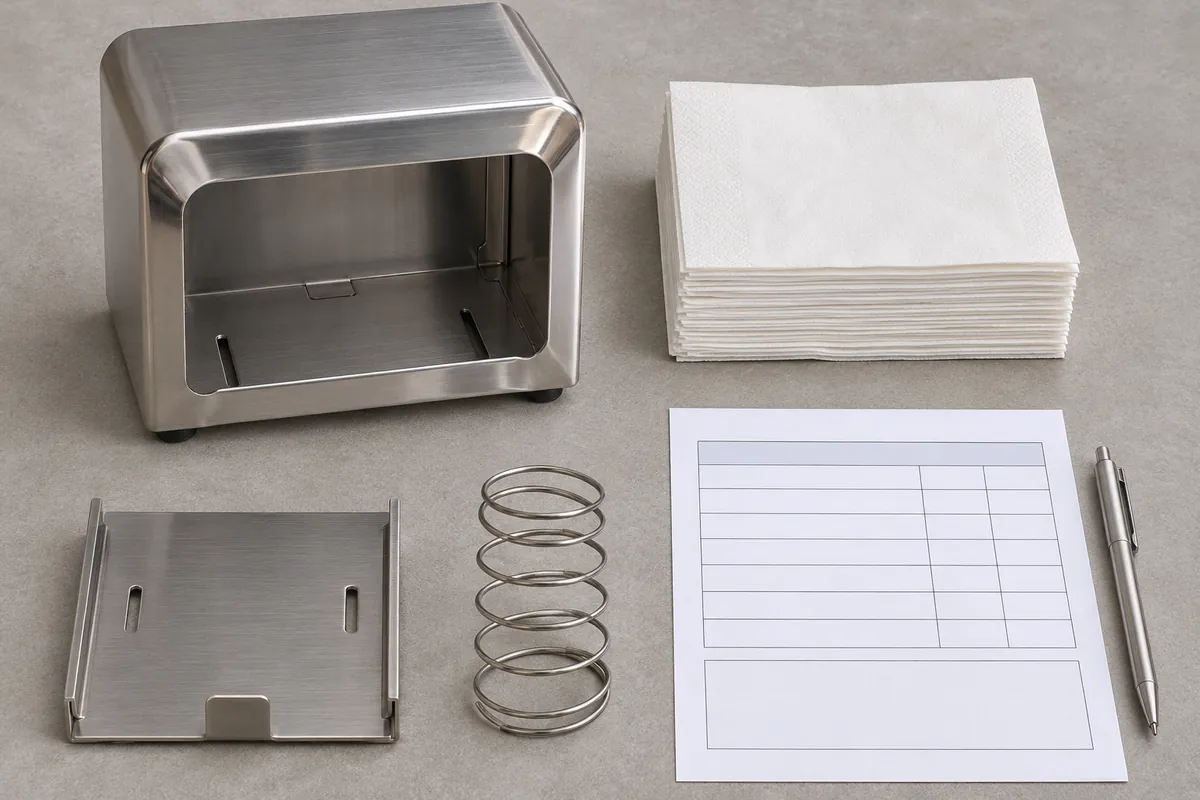
A metal dispenser housing does not by itself establish napkin dispenser refill compatibility. Buyers should approve the actual paper format, loading direction, feed parts, outlet, and operating orientation as one configuration, using the supplier’s instructions and a representative refill sample. A refill that fits inside the shell may still sit differently, press differently against a feed plate, or present its first sheets differently. The useful purchasing decision is therefore not simply whether the folded stack fits the outside dimensions; it is whether the identified refill and identified dispenser assembly have been reviewed together under the intended use conditions.
This distinction matters most when an importer is sourcing an enclosed countertop dispenser, changing a paper supplier, comparing two housing designs, or preparing private-label documentation. An open frame mainly supports and retains a stack. An enclosed feeder may include a cover, platform, spring or another pressure element, an outlet, and model-specific loading instructions. Those components interact with the paper format. The guide below gives buyers a practical approval framework without prescribing universal dimensions, spring forces, cycle counts, or a guaranteed dispensing result.
For a repeatable sourcing decision, define napkin dispenser refill compatibility against a named paper reference and feed assembly rather than a generic paper label.
What does napkin dispenser refill compatibility actually mean?
For a buyer, compatibility means that an identified refill and an identified dispenser configuration have been reviewed together for loading, presentation, access, and the observed feed behavior the buyer requires. It is not a generic property of paper that can be inferred from a nominal folded size alone. Record the paper supplier and stock reference, fold format, supplied dimensions, dispenser model or drawing revision, feed assembly, outlet configuration, and intended orientation. If any of these details are unknown, the sample review is not yet tied to a reproducible product configuration.
The phrase “standard napkin” is not a sufficient purchasing specification. Buyers may encounter full-fold, quarter-fold, interfolded, or other paper arrangements. Terminology and format can vary by supplier and product family, so use the actual maker’s description and physical sample rather than treating one label as universal. Paper that looks similar in a photograph can differ in ply, embossing, stiffness, fold accuracy, stack height, and edge condition. These differences may affect how the stack occupies the enclosure or meets a feed plate. They do not automatically predict a failure; they identify variables the buyer should keep stable during comparison.
A documented example makes the point. Piper Products describes its TDNM countertop dispenser as a stainless housing with a spring-supported metal platform and removable assembly. Its instructions include a model-specific loading approach, ask buyers to provide a napkin sample when ordering, and call for consultation for angled or horizontal installations. These are facts about that particular maker’s product, not a universal design rule or Koitor capability. Piper’s product information and instructions should be followed for that model and checked again before use because model documents can change.
A different manufacturer illustrates another architecture. Vollrath’s one-sided countertop dispenser identifies a metal housing, clear faceplate, a specified full-fold refill range, and model-specific loading and overload features. That example should not be combined with Piper’s spring platform as though all dispensers share the same internal mechanism. Vollrath’s product page describes that specific item. Any marketing statement on either manufacturer page remains a supplier claim tied to its own configuration, not an independently established result for a different product.
The buyer’s working definition should therefore be narrow: “This refill reference, with this fold and stack presentation, was evaluated in this dispenser model and revision, loaded as instructed, in this orientation, with these observations.” That sentence is more useful for purchase orders, sample sign-off, and later supplier discussions than “fits standard napkins.” It also makes clear what a future change needs to trigger: a new paper supplier, altered fold, changed pack height, different cover, revised feed part, or new installation orientation may require another review.

Which product details should the RFQ identify?
An RFQ should define the complete configuration the supplier is being asked to quote, not only the visible metal body. Start with the refill and its source. If the buyer has a paper SKU, maker, sample, or specification sheet, identify it and its revision or date. Record the fold arrangement in the supplier’s terms, the dimensions the paper supplier actually provides, and any other paper attributes that the dispenser maker says matter. Avoid inventing a universal sheet size or assuming that two stacks are equivalent because their outside measurements look close.
Then describe the housing and feed assembly. Identify the drawing revision, product configuration, cover or removable faceplate, outlet opening, platform or support arrangement, and any bought-in mechanism. Make clear which parts are included in the quote and in the production-intent sample. A quotation that covers a formed shell but excludes an internal platform, spring, plastic tab, or purchased feed component is not a quote for the same finished configuration as one that includes those parts. If the supplier is responsible only for the enclosure, identify who selects and validates the dispensing module and who supplies its instructions.
Installation and use orientation also belong in the RFQ when they affect the selected model. Countertop, recessed, wall-mounted, angled, and horizontal arrangements should not be treated as interchangeable without model-specific evidence. For example, Piper’s instructions explicitly call for consultation for angled or horizontal installations. This does not establish the right angle or mounting detail for another product. It tells the buyer to identify the intended orientation early and obtain the applicable current manufacturer guidance rather than improvising a mounting arrangement from a photograph.
A good RFQ also states what the buyer expects to inspect. Are the priorities refill loading, initial sheet presentation, access for reloading, cover removal, cleaning access, or the appearance of the stack through a faceplate? These are different review questions. If one is essential to the product claim, make it visible in the acceptance plan. For instance, a product may look correct when full but become difficult to reload when partially depleted, or the first sheet may require a specific preparation step described in the maker’s instructions. The buyer should capture the required user sequence without turning it into an unsupported performance guarantee.
Use a short configuration record before comparing quotes:
| Campo «Solicitud de presupuesto» | Qué grabar | Por qué es importante |
|---|---|---|
| Paper supplier and reference | Maker, SKU, revision or dated sample | Makes the refill reference reproducible |
| Paper format | Maker’s fold or stack terminology | Separates paper arrangements that may look similar |
| Paper data | Dimensions and material details actually supplied | Avoids assuming missing data or borrowing another model’s limits |
| Dispenser identity | Model, drawing, revision, finish, orientation | Ties the quote to a defined housing configuration |
| Feed components | Platform, spring or other mechanism, cover, outlet | Clarifies what is included and who supplies it |
| Sample scope | Refill, complete feeder, loading instructions | Prevents a housing-only sample from being mistaken for finished approval |
| Review observations | Full and low stack, reload, access, observed exceptions | Records what the buyer actually examined |
| Control de cambios | Supplier, fold, component, drawing or orientation changes | Defines when the approved pairing must be revisited |
This record helps procurement compare like with like. It does not substitute for the actual supplier’s drawing, product instructions, safety review, or applicable foodservice requirements. It also helps prevent a common administrative mismatch: the approved paper sample is identified in one email, while the order or production documents name only a dispenser model. Keep the paper and assembly references together in the quotation, sample sign-off, and final specification.
How should buyers compare paper samples and feed mechanisms?
Compare samples in a controlled sequence. First identify each paper sample and keep it in its original packaging or with a traceable reference. Record the manufacturer, SKU, fold, lot or date where available, and the source of any dimensions. Then identify the exact dispenser model and revision. If comparing two models, do not swap parts between them unless the relevant manufacturer documents explicitly allow that configuration. The goal is to evaluate complete pairings, not to create an unapproved hybrid.
Follow the current instructions for loading. A buyer should not push, stretch, cut, compress, or re-stack the paper in a way that masks the intended user process. If the maker specifies a loading direction, a cover-removal sequence, or an orientation, record that and use it consistently. Do not adjust springs or modify the outlet to make an unmatched refill appear to work. Such changes can alter the mechanism and could create a result that is not representative of the offered product. Ask the supplier or mechanism maker for clarification when instructions are missing or conflict.
Observe the loading and feed as separate questions. During loading, note whether the stack can be placed without forcing it, whether its edges stay aligned, whether the cover closes in the intended way, and whether the assembly returns to its normal position. During use observation, note what happens at the first sheet, middle of the stack, and a lower-stack state if that state is included in the planned review. Record only what was seen with that paper, model, orientation, and sequence. “The refill loaded on the date of the review” is a bounded observation. It does not prove that every pack from that supplier behaves the same way or that no user can ever encounter a jam.
Where the maker asks for an actual napkin sample, provide it. Piper’s product information asks buyers to include a sample when ordering. That is a useful model-specific reminder that a paper reference can be an input to configuration. It is not a rule that every dispenser manufacturer needs the same number of sheets or the same sample format. Ask the maker what sample quantity and condition are useful for its review and document what was sent. Retain a parallel buyer reference where possible so a later production or change review can compare the same paper identity.
When comparing paper types, change one meaningful variable at a time where practical. If the refill supplier, fold, paper weight, embossing, stack height, and dispenser model all change at once, a different result cannot be attributed to one cause. A controlled comparison does not require a laboratory; it requires clear labels, consistent instructions, and a record of what changed. For a distributor assortment, a small matrix can show which tested paper references are associated with each dispenser model. Keep untested combinations visibly marked as unreviewed instead of implying that a close physical fit establishes approval.
Do not convert one successful demonstration into a broad claim. A sample review may establish that the chosen paper loaded and was withdrawn under the observed conditions. It does not establish lifetime, hygiene, waste reduction, one-at-a-time operation, suitability for every fold, or performance across every location. Claims need evidence tied to the particular product and the way the claim is expressed. If the distributor needs a specific claim for packaging or a tender, define the claim before testing and ask the responsible product or testing specialist what evidence would support it.
What should a full-to-low-stack sample review record?
A useful review record captures enough information for someone else to understand what was examined and what remains unknown. Include the date, reviewer, paper identity, dispenser identity, drawing or model revision, finish where relevant, orientation, maker instructions used, and the sample condition. If components came from different suppliers, identify them separately. Mark whether the sample is a concept, appearance sample, production-intent sample, or another defined stage. Do not let “sample approved” stand alone without saying what characteristics were approved.
Begin with the full-stack state. Record the refill quantity or amount only if it is known from the pack or test setup; do not infer a manufacturer’s rated capacity by counting a partial sample. Note how the stack sits in the cavity, whether the cover or faceplate engages as designed, whether any tabs or support surfaces contact the paper, and whether the outlet remains clear. Photograph the setup from the top, side, and user-facing angle if those views help reproduce it. A photo is supporting evidence, not a substitute for the written paper and model references.
Then record observations during the agreed use sequence. The observation sheet may include:
- Whether the refill could be loaded according to the current instructions.
- Whether the cover or feed assembly returned to its intended position.
- What happened to the first sheet and what user preparation, if any, the maker instructs.
- Whether sheets were pulled as expected in the specific observed trial.
- Any tearing, bunching, multiple-sheet pickup, no pickup, or other exception that actually occurred.
- Whether paper edges remained in the outlet area as the stack changed.
- Whether a reload was possible with the access and orientation provided.
- Whether the review was stopped, repeated, or performed with a new sample.
Use neutral descriptions. “The fourth withdrawal in this short review brought two sheets” is more informative than “the model double-feeds.” The latter suggests a general product diagnosis that one limited review may not support. If an exception occurs, document paper identity, loading method, dispenser revision, orientation, and surrounding conditions, then ask the responsible supplier what further review is appropriate. Do not assign a root cause based solely on the visible symptom. It might involve the paper, loading, a component, a tolerance stack, an instruction difference, or another factor.
A lower-stack observation can be valuable when the design or maker instructions make stack height relevant. Define what “low” means for the particular review, such as an identified remaining quantity or a visual threshold. Avoid a universal low-stack percentage unless the buyer has established one for its program. Follow the manufacturer’s normal loading and operating instructions. The buyer is trying to learn whether the approved pair remains usable across an agreed range, not to reverse-engineer or alter the feed mechanism.
Record limitations openly. If the trial used a single sample pack, say so. If there was no access to an internal part, mark the part as not inspected. If the test did not include repeated cycles, public-use conditions, cleaning, or a long-duration assessment, do not imply that it did. That is not a weakness in the record; it protects the buyer from treating a sample review as evidence it does not contain. A clear “not evaluated” field is often more useful than a generalized pass label.
How should buyers separate dispenser formats and supplier responsibilities?
A buyer should separate open holders, enclosed dispensers, and integrated dispensing systems because they answer different product questions. An open-frame holder may organize and retain a stack but does not necessarily control its presentation through a pressure element or outlet. A tissue carton holder is designed around a box and access opening. A built-in or recessed dispenser may involve a mounting cutout, service space, or orientation-specific instructions. Similar words such as “napkin holder” or “dispenser” do not establish the same function or internal parts.
Koitor’s existing article on vertical napkin holder dimensions and importer fit addresses open-frame stack envelope, refill and removal, and tabletop fit. It remains the correct owner for that open-frame question. This article covers the narrower decision of pairing an enclosed feed assembly with its actual paper reference; it should not repeat the open-holder dimension guide or suggest that those measurements apply to an enclosed feeder. Likewise, the tissue box holder carton-fit guide concerns a retail tissue carton and its opening, not direct loading of a napkin stack into a feeder.
Responsibility should be assigned component by component. A metal enclosure supplier may form the housing, finish visible surfaces, and assemble items within its confirmed scope. A separate dispenser mechanism provider may define the feed assembly and supply operating instructions. A paper supplier controls the refill identity and its production specification. The importer or brand owner decides the assortment, claims, package copy, artwork, and distribution requirements. These roles can overlap in a particular project, but the purchase documents should name who approves each interface and who communicates changes.
A responsibility matrix helps:
| Item | Responsible party to identify | Buyer record |
|---|---|---|
| Metal body and visible finish | Enclosure supplier | Drawing, material/finish reference, sample approval |
| Feed mechanism and installation instructions | Mechanism supplier or finished-product supplier | Model/revision and current instructions |
| Refill stock and fold | Paper supplier | SKU, dated sample, technical information provided |
| Complete assembly behavior | Named party coordinating the complete unit | Observations tied to the paired sample |
| Label, claims, and market presentation | Brand owner or importer | Approved copy and evidence file |
| Change notification | Each source responsible for its component | Trigger list and approval route |
If the dispenser is supplied as a complete product, ask for the exact model and the documents that apply to that model. If it is a custom metal housing around a purchased module, ask for the module’s current instructions and a production-intent assembly for review. Do not assume the metal enclosure maker has validated a purchased spring, plastic platform, clear faceplate, or paper refill unless the supplier clearly states its responsibility and provides supporting records. In this adjacent product category, do not infer from Koitor’s bathroom and home-storage metal expertise that it currently manufactures napkin feed mechanisms, springs, proprietary plastic parts, or complete foodservice dispensers.
What changes should trigger another approval?
Approval should be tied to the specific paper and dispenser revisions, so a meaningful change can be recognized. Typical triggers include a new paper supplier or SKU, a fold or stack change, a change in paper attributes identified by the maker, a new dispenser model, a revised drawing, a different feed part, an altered cover or outlet, a different orientation, or a change in the instructions. A packaging change alone may not affect feeding, but if it changes the refill’s stack presentation or protects it differently in transit, the buyer may want a scoped review.
Set a change-control method before bulk ordering. Name who must notify whom, which changes require documents, which require a new sample, and who releases production or product data. For example, the paper supplier may revise an embossing pattern while retaining a similar outer format. The dispenser supplier may make a mechanism revision without changing the external model name. The buyer should decide whether that kind of change is material to its own approval and claims. Do not assume that a familiar SKU label guarantees unchanged construction or instructions; ask suppliers how revisions are identified.
A change matrix can make the trigger practical:
| Proposed change | Initial review question | Possible next step |
|---|---|---|
| Different paper source | Is the fold and stack equivalent under the maker’s specification? | Request a new paper sample and assess the affected states |
| New fold or interfold arrangement | Does the dispenser explicitly support this paper format? | Confirm with the dispenser maker before ordering |
| New housing or feed revision | Are instructions, outlet or internal supports changed? | Compare documents and review a production-intent assembly |
| New orientation or mounting | Does the model support this arrangement? | Obtain current model-specific instructions |
| Revised package or refill wrap | Could the unpacking or loading condition change? | Define whether the buyer’s approved refill sample remains representative |
| New marketing claim | What evidence is needed for the exact claim? | Route through the buyer’s product and compliance process |
Reapproval does not mean repeating every check for every minor administrative edit. It means assess the change against the interface it could affect, document the rationale, and keep the decision traceable. A new carton graphic may not alter the feeder; a changed paper fold may. The buyer can use risk-based review, but should avoid recording a blanket “no review required” without identifying what changed and why it cannot affect the approved interface.
Keep dated records and retain the agreed references where feasible. A sample signed off without a paper SKU or assembly revision can become difficult to compare later. A change log should show the previous and new configurations, the evidence reviewed, the decision maker, and whether production documents were updated. If a supplier cannot provide a needed detail, label it unknown and decide whether the uncertainty is acceptable for the intended channel. This is a procurement control, not a legal opinion or a substitute for contract terms.
What should a buyer ask before approving a private-label napkin dispenser?
Before sample approval, ask the supplier to define the finished offer. Does the quote cover the housing only, or the complete feeder with all internal and purchased parts? Which manufacturer and model identify the feed assembly? Which current loading instructions apply? Which napkin format and actual sample were used in any fit review? What orientation does the offered sample represent? Are parts or refills expected to be sourced separately? These questions help the buyer avoid approving a visually attractive metal shell while assuming the rest of the assembly is included.
Ask the paper source what information it can provide about the refill reference. The buyer may receive dimensions, fold designation, ply, material or other product information, but the available data vary by supplier. Preserve the source’s own terms and do not fill blank fields with guesses. If a supplier states that a refill fits a dispenser, ask which exact model and format that statement covers and what instructions should be followed. A general product family statement may not resolve a specific variant or orientation.
Ask the dispenser or module source how to handle sample evaluation. What sample quantity is useful? Does it require an actual refill pack? Which setup or loading sequence should be used? Which component revisions are represented? Which observations are expected before a product can be treated as a production-intent sample? If the maker provides limitations, include them in the approval record. Do not create a test method that contradicts the product instructions or make unapproved modifications to the mechanism.
For private-label programs, review presentation and documentation separately from mechanical fit. Confirm that the product name, images, instructions, carton copy, refill guidance, and item code refer to the same model and configuration. If the dispenser is sold without paper, make clear that the buyer or end user must select a compatible refill based on the manufacturer’s instructions. If a specific refill is bundled, identify it in the bill of materials and product records. A photograph of a refill in an image does not automatically make that refill part of the sale; packaging and sales copy should state what is included.
Finally, agree what “approved” means for the program. Possible approval categories include appearance only, dimensional fit, component completeness, a defined functional observation, packaging, or a specific claim. A sample may pass one category and remain open in another. Write that distinction into the sign-off instead of using a broad approval mark. If the sample review covers only the shell and visual finish, call it a shell/appearance approval. If the refill and feed assembly have also been reviewed, identify both references. A precise approval scope helps the sourcing team make a defensible release decision and tells suppliers when additional work remains.
The purchasing takeaway is straightforward: treat the refill, housing, feed parts, loading method, and orientation as a named configuration. Keep evidence with the actual sample and document what was and was not observed. That approach reduces ambiguity when comparing suppliers, changing a refill source, or preparing private-label product data. It does not guarantee a particular dispense result, replace model-specific instructions, or establish an untested performance claim.
Preguntas frecuentes
Does a folded napkin fitting inside the dispenser prove compatibility?
No. It establishes a basic spatial fit for that sample. It does not show how the stack loads, how the outlet presents sheets, or what happens as the stack changes. Review the complete assembly and instructions.
Can I use the same refill in every metal dispenser?
Do not assume that. Formats, mechanisms, outlets and manufacturer instructions differ. Confirm the exact model and refill pairing with current supplier information and a representative sample.
Should the supplier provide a napkin sample?
Ask the dispenser maker what sample it needs. Piper’s TDNM product instructions request a napkin sample when ordering, but that is a model-specific instruction, not a universal requirement.
Is a sample sign-off the same as a performance guarantee?
No. A sign-off should state which paper, model, revision, orientation and observations were reviewed. A limited sample review does not guarantee every unit or use condition.
What if the housing supplier does not make the feed mechanism?
Assign responsibility explicitly. Identify the mechanism provider, its model and instructions, and who coordinates the complete assembled sample. Do not imply the housing supplier validated parts outside its scope.
Sources and related Koitor guidance
- Piper Products: Drop-In Napkin Dispenser — model-specific construction and ordering/loading information.
- Vollrath: One-Sided Countertop Napkin Dispenser — a separate product architecture and model-specific refill information.
- Vertical napkin holder dimensions and importer fit guide — open-frame holder scope.
- Tissue box holder carton-fit checks — tissue carton and opening scope.
Discuss a Custom Metal Storage Hardware Concept
Send a drawing or sample, the intended application, finish reference and quantity split. Koitor can first confirm whether the product and process fit its current bathroom and home storage hardware scope.
OEM / MARCA BLANCA
Convierte esta guía de abastecimiento en un resumen del producto
Indícanos el producto que deseas, el tamaño, el acabado, la cantidad del pedido y los requisitos de embalaje. Tu equipo recibirá un análisis práctico de la viabilidad de fabricación antes de recibir el presupuesto.


 English
 Español
 Português
 Français
 Deutsch
 العربية