
Resistance welding electrode wear wire basket matters to buyers because the condition of the electrode can change the contact and process behavior at repeated wire intersections. Buyers do not need to prescribe machine settings to control the risk. They should identify critical joints, request the supplier’s maintenance and inspection approach, and compare representative parts from the beginning, middle, and end of a production run using agreed acceptance criteria.
This article is for importer and supplier-quality teams buying welded wire baskets and metal storage hardware. It explains what to ask and observe, not how to operate a welding machine. TWI’s technical guidance identifies electrode material, cooling, alignment, wear, and maintenance as relevant considerations in resistance spot welding. The implications depend on the actual equipment, materials, joint, and validated process; no universal setting or inspection interval is claimed here. Review TWI’s technical FAQ on minimizing electrode wear.
Why can electrode wear matter across a basket batch?
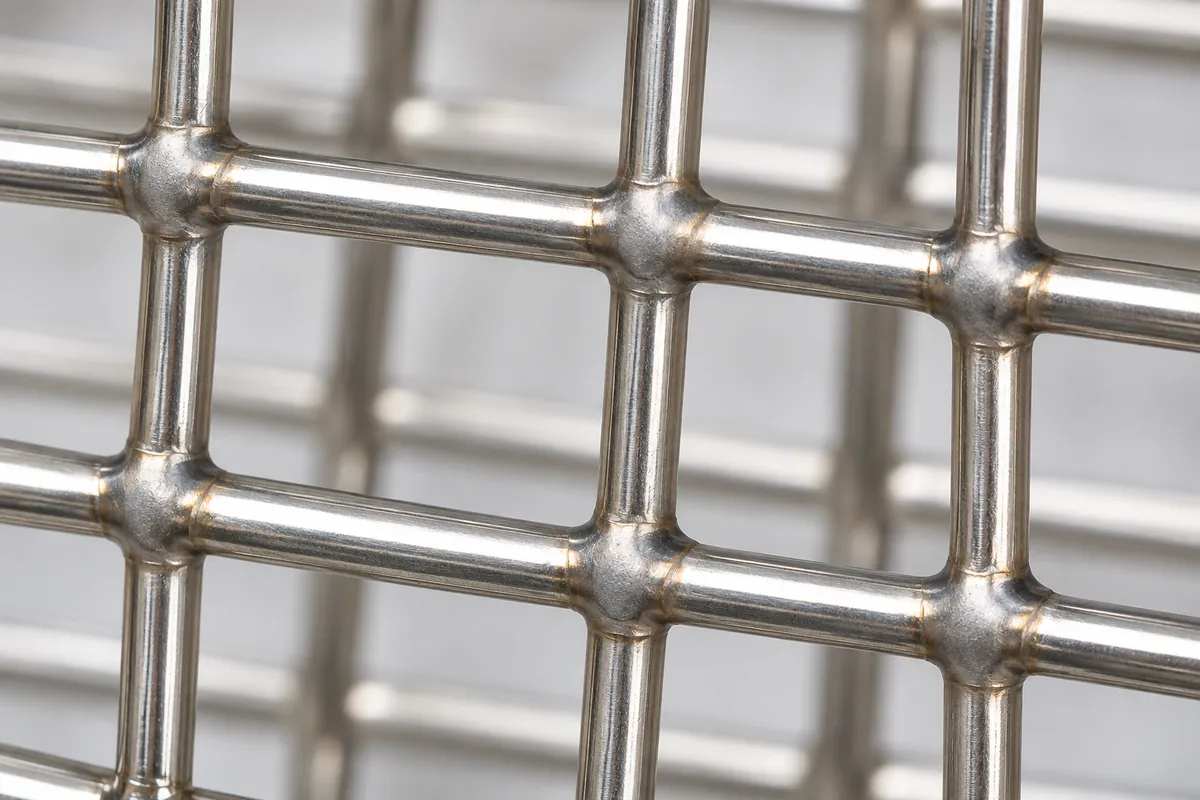
A wire basket contains repeated intersections. The buyer usually expects those joints to be consistent enough for the product’s assembly, appearance, and intended use. During repeated production, electrode condition may change. If the process is not monitored and maintained, contact conditions or weld appearance may drift. This is a process-control concern to discuss with the supplier, not proof that any batch has a defect.
The effect cannot be judged from one isolated weld photo. Joint geometry, wire material and diameter, coatings, electrode material, alignment, cooling, machine condition, and validated parameters interact. A basket may contain joints with different access or orientation, so a sample from one location may not represent the most difficult joint. Buyers should identify which intersections are critical and ensure the supplier’s process review covers them.
TWI’s technical note discusses electrode wear and maintenance in spot welding. It provides a sound reason to ask how the supplier detects wear and maintains repeatability, but it does not provide a buyer-specific acceptance limit for a particular basket. The product drawing and the supplier’s validated process should determine the control plan.
What should a buyer inspect at the wire intersection?
Start with the product requirement. Is the joint primarily functional, visible, or both? Does it carry a component interface, define the basket’s shape, or sit on a customer-facing surface? The acceptance criteria should reflect that role. Buyers should avoid inventing a universal “good weld” appearance that is disconnected from function and process validation.
Review a representative sample for:
- – joint location relative to the drawing and neighboring wires;
- – visible consistency and absence of unintended sharp projections;
- – alignment and whether the basket remains square after assembly;
- – distortion or burn marks that conflict with the agreed finish;
- – fit with mating components and any assembly fixture;
- – sample-to-sample variation in repeated joint positions;
- – surface condition after finishing and cleaning.
A visual check cannot prove internal weld strength or performance. If strength is critical, define a test method, fixture, sample count, and acceptance criterion with qualified engineering input. Do not infer a load rating from the appearance of a weld or use a generic pull test without context.
How should inspection samples be selected?
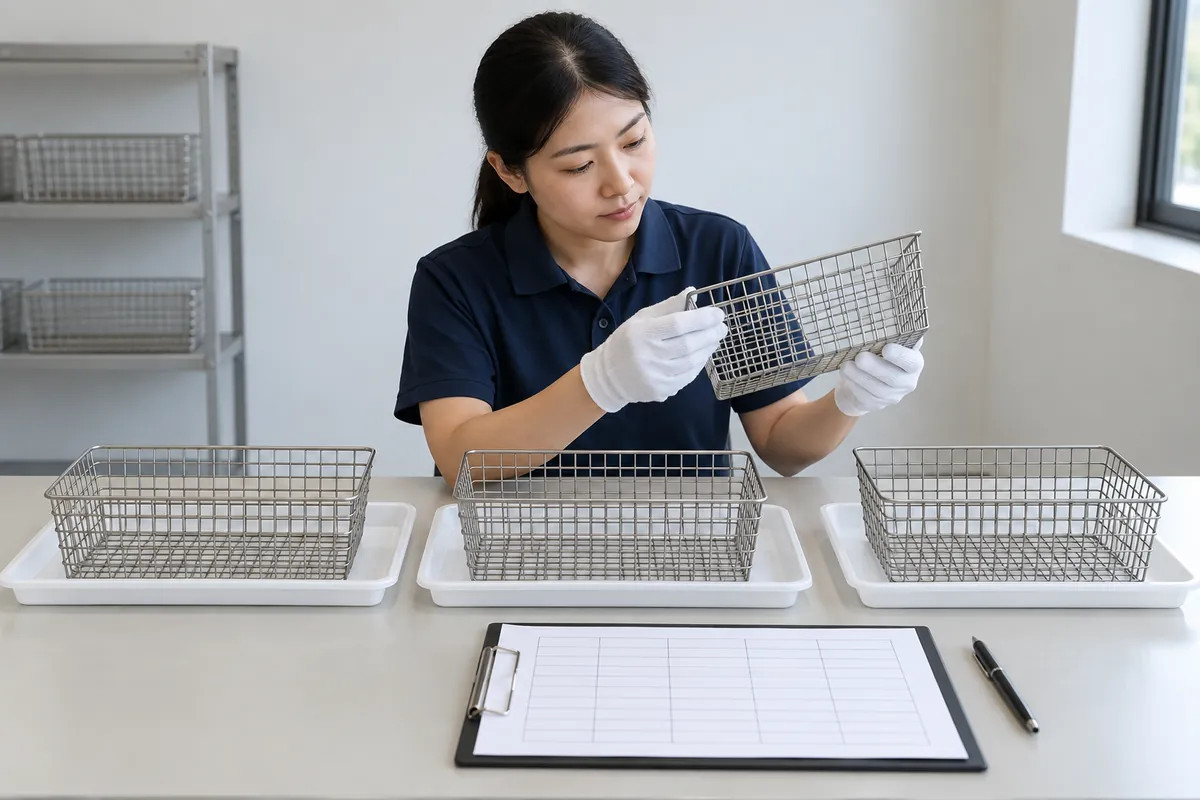
A single first-off sample confirms only a moment in the process. For a long or repetitive production run, buyers can request samples from multiple points—such as the start, middle, and end—if that approach fits the supplier’s quality plan. The purpose is to compare whether the approved appearance and geometry remain consistent, not to imply that a three-piece check is statistically sufficient for every program.
Agree who selects the samples, when they are selected, and how they are identified. Include the product lot, drawing revision, shift or production period where relevant, and the joint locations inspected. If a defect is found, preserve the sample and record its condition before rework. The buyer and supplier can then determine whether the problem is isolated, related to tool condition, linked to material variation, or caused by another factor.
| Review point | Buyer objective | Supplier evidence |
|---|---|---|
| First-off | Confirm setup and approved joint appearance | Initial sample and process release record |
| In-run | Look for change during repetitive production | Defined check points and recorded results |
| End-of-run | Confirm the approved condition remains represented | End sample and lot traceability |
| Critical location | Review difficult or high-visibility intersections | Identified joint map and inspection method |
| After maintenance | Confirm process returns to approved output | Restart verification or sample approval |
The table is a planning framework, not a prescribed sampling frequency. The risk, production volume, history, process stability, and customer requirements should determine the actual plan.
What should buyers ask the supplier about electrode maintenance?
Buyers can ask how the supplier monitors electrode condition without requesting confidential machine settings. The supplier should be able to explain its maintenance triggers, how alignment and cooling are controlled, how wear is detected, and what happens after dressing or replacement. The response should be product- and process-relevant rather than a generic statement that machines are maintained.
A buyer’s supplier checklist can include:
- – electrode type or material where disclosure is appropriate;
- – inspection or maintenance method and responsible role;
- – how the supplier identifies wear or misalignment;
- – how it confirms output after dressing, replacement, or adjustment;
- – which welds or product features are checked during the run;
- – how nonconforming baskets are identified and segregated;
- – whether a maintenance or setup change triggers a new sample review;
- – how records are connected to the production lot.
Avoid setting a universal number of welds between maintenance events. Electrode life depends on the process and the materials being joined. The supplier should base its interval on its own process evidence and adjust it if the product or material changes.
If the buyer sees drift in weld appearance, the immediate response is to contain and document the affected lot, not to guess the machine parameter. Ask the supplier to investigate the equipment, material, geometry, and maintenance records and provide a corrective action. Any process correction should be validated on samples that represent the affected construction.
How do material and finish affect the review?
Wire material, diameter, and surface condition influence the joining situation. Coatings or contamination can also affect contact and may require a different process approach. TWI separately discusses resistance spot welding of coated steels, demonstrating that coated material can create specific process considerations. That guidance should not be generalized to every wire basket; the exact material and coating must be identified with the supplier. See TWI’s guidance on resistance spot welding coated steels.
Finishing occurs before or after joining depending on the product route. Buyers should confirm what the approved sample represents. If welding precedes coating or plating, inspect the finished joint and surrounding surface. If a pre-finished wire is joined, define acceptable effects around the contact area. Do not assume a bare-metal sample represents a finished product.
When the basket includes multiple wire sizes or joint types, identify each critical intersection. One maintenance condition may affect the pattern differently depending on access, alignment, or part geometry. The supplier should explain how the critical joint families are represented in setup and in-process checks.
What should be in the quality agreement?
The quality agreement should connect the drawing to inspection and response. Identify critical joint locations, visual criteria, dimensional checks, sample points, lot identification, and nonconformance handling. Define how the supplier notifies the buyer of a material, electrode, equipment, maintenance, or subcontracting change when that change can affect the finished product.
Include the disposition route. If a basket is out of square or a joint is visibly inconsistent, who decides whether it can be reworked? How will rework be recorded and reinspected? Does the buyer need to approve any repair near a visible or structural feature? Clear rules prevent inconsistent decisions during shipment release.
A supplier’s corrective-action response should state the observed issue, containment scope, root-cause evidence, corrective action, effectiveness check, and any product impact. Avoid accepting an explanation that names electrode wear without evidence. The investigation should consider alternatives such as wire variation, fixture alignment, part positioning, contamination, finish, or setup changes.
For related metal basket sourcing context, see Koitor’s pages on cestas metálicas de almacenamiento a medida y custom metal storage racks. These pages describe product categories and do not claim a particular welding setup or parameter.
Buyer checklist: what should be agreed before bulk production?
- – Joint map: identify critical, visible, and difficult-to-access intersections.
- – Acceptance: define geometry, appearance, sharp-edge, and assembly criteria.
- – Material: record wire grade/form, diameter, surface condition, and coating where known.
- – Ejemplo: approve production-representative samples after the intended finishing sequence.
- – In-process control: agree how samples represent different stages of production.
- – Maintenance: ask how wear, alignment, cooling, and maintenance are controlled.
- – Restart: define how output is confirmed after electrode dressing or replacement.
- – Trazabilidad: link samples and inspection records to the production lot.
- – Nonconformance: document containment, rework, approval, and corrective-action expectations.
- – Control de cambios: review process or material changes that could affect joint quality.
How should the approval record support later orders?
The buyer should also name an owner for each open item. Product engineering may own the interface, sourcing may own price and supplier changes, and quality may own inspection evidence. Smaller teams can combine these responsibilities, but assignment still needs to be explicit. Without an owner, an open dimension or sample deviation can be mistaken for an accepted production condition.
Use sample review to close the highest-risk unknowns first. A photograph or supplier explanation can support the conversation, but a physical, production-representative sample is stronger evidence when the requirement depends on fit, finish, use, or handling. If a full test is not available before purchase, record that limitation and avoid making a performance promise beyond the evidence.When a difference appears, the resistance welding electrode wear wire basket review should begin with containment and a precise observation. Identify the lot, sample stage, joint location, and specific characteristic that changed. Retain the sample and production record before repair. Do not assume electrode wear is the cause merely because the product contains repeated resistance-welded intersections; confirm evidence and consider material, fixture, alignment, and finishing factors as well.
After correction, request a restart sample made using the proposed process. Check the same joint types that showed variation and confirm the complete basket still meets the approved shape and assembly criteria. Record who authorized restart, which lot is covered, and how effectiveness will be verified. This gives the importer traceable evidence without requiring the buyer to prescribe machine settings.
For this project, the resistance welding electrode wear wire basket requirement should be recorded with the approved sample and drawing. Reconfirm the resistance welding electrode wear wire basket criteria if material, process, supplier, or intended use changes.
A practical change-control record can include the electrode maintenance event, affected production window, sample identification, and the buyer’s disposition. This helps both sides investigate a sudden shift without assuming that every visual variation came from electrode wear. Correlate the record with the actual joint geometry, material lot, and inspection method before changing process settings.
FAQ
No. Wear is a process variable to monitor, not proof of a defect. The result depends on the complete welding system and validated process.
Can visual inspection prove weld strength?
No. Visual inspection can assess specified surface characteristics but cannot establish internal performance. Define an appropriate engineering test when strength is critical.
How often should electrodes be maintained?
There is no universal interval. The supplier should set and adjust maintenance based on equipment, material, joint design, and process evidence.
Should buyers prescribe welding current or time?
Usually not without qualified process engineering and validation. Buyers should define product acceptance and request evidence that the supplier’s process meets it.
Is a first-off sample enough?
It confirms initial setup but may not represent later production. A risk-based in-run sampling plan may provide additional evidence.
Does this article describe Koitor’s exact welding equipment?
No. Koitor’s general manufacturing context does not establish a specific machine model or settings. Confirm project-specific process details directly.
Trabaja con Koitor Hardware
Discuss a Custom Metal Hardware Project
Share your drawing, target interface, material, finish, sample needs, and buyer acceptance criteria with Koitor. Confirm exact category capability and process responsibilities for each project.
OEM / MARCA BLANCA
Convierte esta guía de abastecimiento en un resumen del producto
Indícanos el producto que deseas, el tamaño, el acabado, la cantidad del pedido y los requisitos de embalaje. Tu equipo recibirá un análisis práctico de la viabilidad de fabricación antes de recibir el presupuesto.
 English
  Español
  Português
  Français
  Deutsch
  العربية