
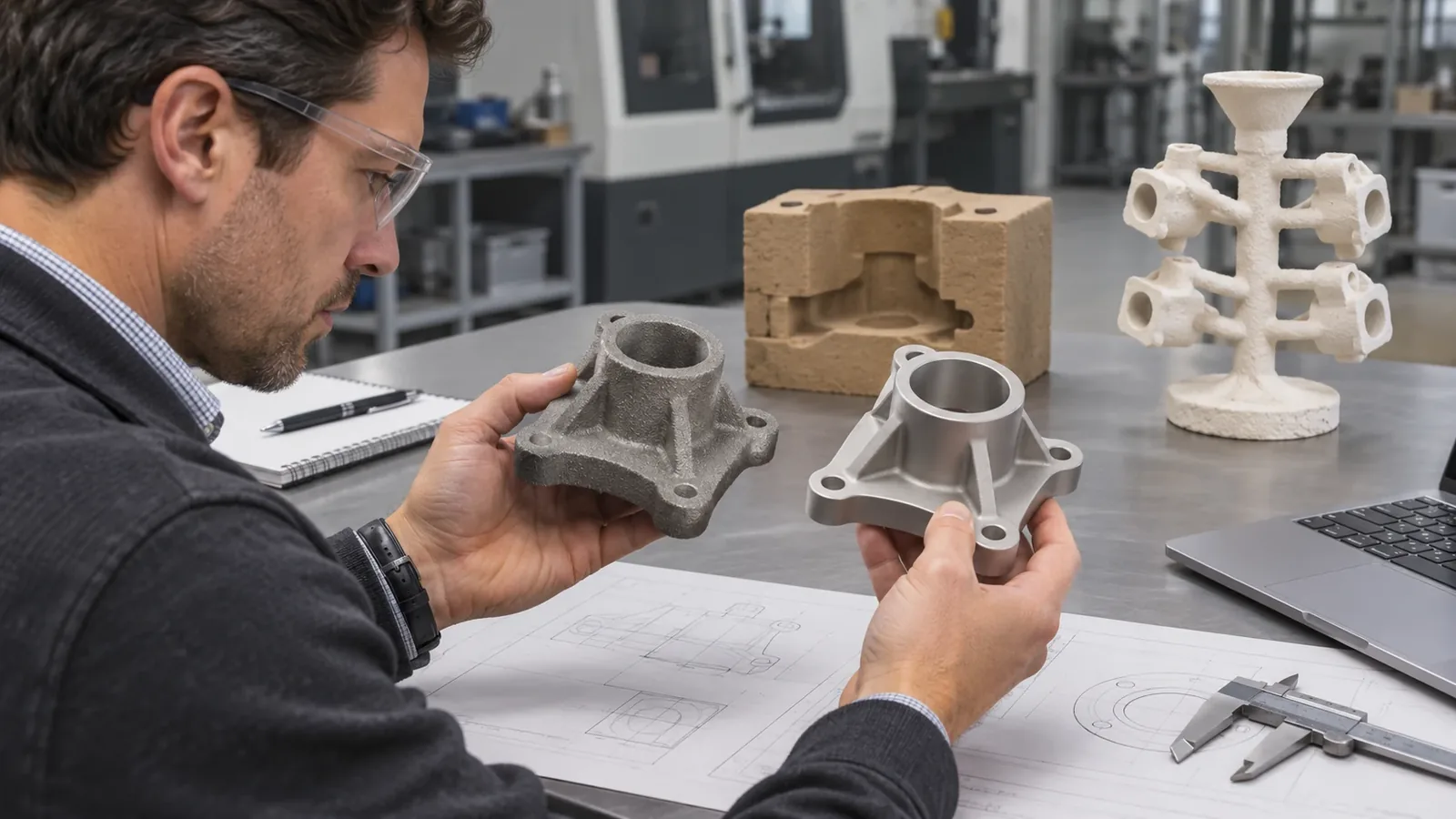
Sand casting vs investment casting compares two mold and pattern routes used by foundries; it does not compare alloys or establish that one finished part is automatically better. In a common sand-casting route, a pattern forms a cavity in a sand-based mold; in a common investment-casting route, a wax pattern receives a ceramic shell that becomes the mold after the wax is removed. For an importer evaluating a bought-in metal fitting or accessory component, the buyer must also specify alloy, geometry, tooling responsibility, as-cast versus machined features, finishing, and acceptance evidence. For an importer, sand casting vs investment casting is a practical scope question: identify the actual proposal, then compare it with the product requirement and evidence.
What problem does sand casting vs investment casting help a buyer solve?
The comparison helps a buyer understand what a supplier means when a casting route is proposed for a metal component. A route name describes a broad manufacturing concept, but buyers still need to know what the actual part requires and which operations are included. The casting could be a near-shape blank that needs machining or finishing before it fits a bathroom accessory or home-storage assembly. A buyer who records only “investment cast” or “sand cast” may leave key questions unresolved.
This can matter when an importer is evaluating a metal fitting, mounting component, decorative detail, or a bought-in part used within a larger product. The foundry process is only one stage of the supply chain. The buyer may still need to review material identity, critical interfaces, tooling or pattern ownership, secondary machining, surface finish, inspection, packaging, and change control. This article is a buyer-level process comparison. It does not claim Koitor operates a foundry or performs either casting route.
How does common sand casting work?
In a common sand-casting route, a pattern is used to create the desired cavity in a prepared sand-based mold. The mold is assembled for the casting operation, metal is poured into the cavity, and the mold is broken or otherwise opened to retrieve the casting after the process stage. The precise mold construction and sequence can vary by foundry and part.
From a buyer’s perspective, the important concept is that the pattern and sand mold define a shape into which material is cast. The buyer should ask what pattern is used, who owns or pays for it, which features are produced as-cast, and which features receive secondary machining or finishing. A near-shape casting is not automatically the final component. Machined holes, threaded features, flat mating faces, or visible surfaces may require operations beyond the mold itself.
The route name does not provide a universal tolerance, size range, minimum wall, cost, lead time, or defect rate. Those depend on the exact material, part geometry, foundry capability, tooling arrangement, production plan, and agreed requirements. Avoid treating an online comparison chart as a guarantee for a supplier’s particular quotation.
How does common investment casting work?
Investment casting commonly starts with a pattern, often made from wax or a similar expendable pattern material. The pattern is coated to build a ceramic shell. After the pattern is removed, the shell provides the mold cavity into which the metal is poured. The foundry then removes the shell and conducts any specified finishing or secondary operations.
The broad distinction is the pattern-and-mold sequence: sand-based mold around a pattern versus a ceramic shell formed around an expendable pattern. Investment casting is not an alloy name. Nor does the process name guarantee that every feature emerges at its final dimension or surface condition. The buyer should specify the finished component and ask the responsible foundry which features are expected as-cast and which need post-processing.
A buyer may hear claims about detail, repeatability, finish, or suitability. Such statements should be tied to the actual alloy, geometry, foundry, tooling plan, and measurable acceptance criteria. The research supporting this guide excludes universal numerical tolerance, wall thickness, weight, cost, lead-time, and surface-quality promises. A process family can suggest questions to ask; it cannot replace a part-specific technical proposal.
| Pregunta del comprador | Common sand-casting route | Common investment-casting route |
|---|---|---|
| What forms the cavity? | A pattern shapes a sand-based mold | An expendable pattern is covered with ceramic shell |
| What happens to the pattern? | It is used to form the mold cavity; exact tooling arrangement varies | The pattern is removed from the shell before pouring |
| Is the route itself an alloy? | No | No |
| Does it automatically create the finished part? | No; secondary operations may be required | No; secondary operations may be required |
| What must the buyer specify? | Material, geometry, tooling, as-cast/machined features, finish, evidence | Material, geometry, pattern responsibility, as-cast/machined features, finish, evidence |
The table describes common conceptual routes and is not a foundry procedure. Suppliers may use specialized variants and terminology. Ask the actual foundry to describe the proposed route for the quoted component.
How should a buyer compare the two routes for a hardware component?
Begin with the intended component, not the process label. A hypothetical metal mounting fitting might attach a bathroom accessory to a support or connect a decorative element to a frame. The buyer needs to identify the important interfaces, visible faces, mounting features, material, and use environment. Only then can the supplier explain how the casting route and secondary steps relate to the finished product.
A practical review follows the component through several stages:
- Part definition. Identify the drawing revision, function, mating parts, critical dimensions, and visible surfaces.
- Material definition. Record the required alloy or an approved material range. The process name does not determine material identity.
- Tooling and pattern. Ask what tool or pattern is required, whether it is included in the quote, who owns it, how revisions are handled, and how reuse or storage is managed.
- As-cast features. Ask which geometry is expected directly from casting and which features need machining, trimming, grinding, or other operations.
- Secondary process scope. Confirm whether heat treatment, machining, surface finishing, inspection, or assembly is included, when applicable.
- Acceptance. Define which dimensions, material records, appearance characteristics, or other evidence are required and who reviews them.
- Commercial scope. Separate one-time tooling costs from recurring part costs and ask the supplier to identify assumptions rather than treating them as universal process prices.
This sequence helps avoid comparing two quotes that include different operations. One supplier may quote a rough casting while another includes machining or finishing. If the buyer compares only a total unit price without aligning scope, the difference cannot be attributed confidently to the casting route.
What is the role of pattern, tooling, and revisions?
Patterns and related tooling can influence how the part is formed and how design changes are handled. The buyer should determine whether a quoted pattern is new, modified, reused, or supplied by another party, and what the commercial agreement says about ownership and maintenance. Do not assume that “tooling included” means the pattern belongs to the buyer or that a supplier will transfer it without agreed terms.
A design revision can affect the pattern, mold preparation, machining stock, or inspection approach. If a hole, boss, wall, or mounting face changes, the buyer should ask whether the existing pattern remains suitable and which production records need updating. Any change that affects fit or appearance should be evaluated against the current drawing and the accepted sample.
A pattern may create a near-shape feature while the final dimension depends on another operation. Buyers should mark critical interfaces clearly and ask the supplier to identify the responsible stage. For example, a surface may be cast to approximate shape but machined to achieve the mating face required by an assembly. The part specification should state the requirement; the supplier can propose how to meet it.
This is especially important for custom products where the buyer wants to coordinate a casting with formed, stamped, welded, or machined components. The interface should be reviewed at product level. The casting process alone does not establish complete assembly fit.
How do material, geometry, and finishing change the decision?
Material. The alloy is a separate decision from the casting route. A buyer should identify the required material and intended service conditions, then ask the foundry to confirm the proposed material and documentation. Do not infer chemical composition, strength, corrosion behavior, or compliance from “sand” or “investment” casting.
Geometry. Part shape, section changes, holes, bosses, ribs, and mating faces affect the supplier’s proposal. A casting with a critical mounting face may need machining. A thin decorative element has different requirements from a functional support. The buyer should avoid generic claims about minimum sections or geometry limits and obtain a part-specific feasibility review.
Finish. As-cast surface condition may differ from a machined or finished surface. If a part will be polished, plated, painted, coated, or assembled visibly, specify which surfaces matter and what reference sample or measurable criterion is used. A visually appealing as-cast sample does not necessarily establish material or structural properties.
Assembly. A cast part may be joined to tube, wire, sheet, or a purchased fastener. The buyer should review interfaces and assembly sequence, including access for machining or finishing. The supplier responsible for each operation should be clear.
Packaging. The finished part may need protection from impact, abrasion, or contact with other components. Packaging is a separate stage and should be evaluated using the actual final geometry and finish. The process route does not guarantee transit performance.
| Product requirement | What to define | Por qué es importante |
|---|---|---|
| Alloy or material | Named requirement or approved alternatives | Route names do not identify the alloy |
| Critical interface | Mating face, hole, thread, or fit dimension | May require secondary machining or a specific inspection |
| Tooling ownership | Pattern scope, cost, ownership, revision and storage terms | Prevents uncertainty during changes or repeat orders |
| Aspecto de la superficie | Which surfaces are visible and the agreed finish reference | As-cast and finished conditions are not interchangeable |
| Inspection evidence | Required dimensions, records, and responsible party | Avoids assuming a process label proves finished conformity |
| Pack-out | Component separation and protection | Helps protect the agreed finish after manufacture |
What should importers ask a casting supplier?
A buyer can use a short, precise question set to compare proposals:
- Which casting route and specific variant are proposed for this part?
- Which alloy or material is included, and what documentation is available?
- Which pattern or tooling is required, who provides it, and who owns it?
- What features are expected as-cast?
- Which features require machining or other secondary operations?
- Which operations are included in the quote and which are excluded?
- What drawing revision and tolerance requirements were used to prepare the proposal?
- Which surfaces are cosmetic or functional?
- What sample or first-article review is available, if agreed?
- What changes would trigger a new pattern, new quote, or renewed approval?
- How will parts be protected after finishing and during shipment?
Ask suppliers to distinguish facts, assumptions, and exclusions. A quotation should explain what is included rather than rely on the buyer to infer scope from the process name.
What mistakes should buyers avoid?
Treating investment casting as an alloy. It is a process family, not a material grade. Specify material separately.
Assuming the process name promises a tolerance. Requirements depend on the actual geometry, tooling, foundry, and any finishing or machining. Put critical dimensions on the drawing and ask the supplier how they will be achieved and checked.
Assuming “near net shape” means ready to assemble. Some features may still need machining or finishing. Identify final interfaces and confirm the operation scope.
Comparing quotes with different scope. Tooling, pattern revisions, machining, finish, inspection, and packaging can be included differently. Align the quotation basis before comparing prices.
Assuming the supplier owns or transfers the pattern. Tooling ownership and access are commercial terms. Put them in the agreement.
Treating a sample as production proof. A sample can support review of the particular part and attributes checked. Production consistency needs its own agreed controls and evidence.
Assuming Koitor performs the casting. The company’s approved facts do not establish its own sand or investment foundry operation. This article discusses a buyer’s evaluation of a separately sourced component; it does not claim Koitor manufactures castings.
Using generic numeric charts as a supplier guarantee. Online charts may refer to a particular foundry or material. Confirm all relevant limits for the actual proposal.
How can a small-batch OEM factory help coordinate a cast component?
A custom metal hardware manufacturer may help a buyer clarify how a bought-in component fits into a wider bathroom or home-storage product. That coordination can include the assembly interface, finish expectations, drawing revision, sample review, packaging, and whether a casting supplier needs to provide a specific record. It does not imply that the OEM factory operates a foundry or performs investment or sand casting.
Koitor Hardware is a family-owned factory focused on bathroom and home-storage hardware. Within a confirmed project scope, buyers can share a drawing or sample and ask which part interfaces or product requirements should be clarified with the responsible casting supplier. The casting supplier remains responsible for confirming its process, material proposal, tooling details, and capabilities. The buyer should retain control over the agreed finished-product requirements.
For an existing high-level comparison of forming routes, see Koitor’s article on casting versus forging. Buyers considering plated casting features can review the existing guide to zinc die-casting parting lines and gate marks. For product-scope questions, use Accesorios de almacenamiento doméstico OEM as the commercial context.

Buyer checklist before requesting a quotation
Provide the casting supplier with:
- The current 2D drawing, 3D model, sample, or a clear statement of what is available.
- Part function, target assembly, mating components, and installation context.
- Required alloy or approved material options.
- Critical dimensions, tolerances, mating faces, holes, threads, and visible surfaces.
- Expected as-cast versus machined features, if already specified.
- Finish requirements and sample references.
- Quantity forecast and any trial or sample quantity.
- Tooling or pattern scope, ownership, cost, revision, and storage questions.
- Required material or inspection documentation.
- Packaging, labeling, and shipment needs.
- Target market and any verified requirements that the responsible technical party must address.
- A request for the supplier to identify assumptions and excluded operations.
The quotation can then be compared based on the same part revision and production scope. If the buyer has not yet selected a route, ask the supplier to describe the proposed pattern and mold sequence, explain which operations are included, and identify which product requirements require additional review. Do not approve a route from a generic cost or finish claim alone.
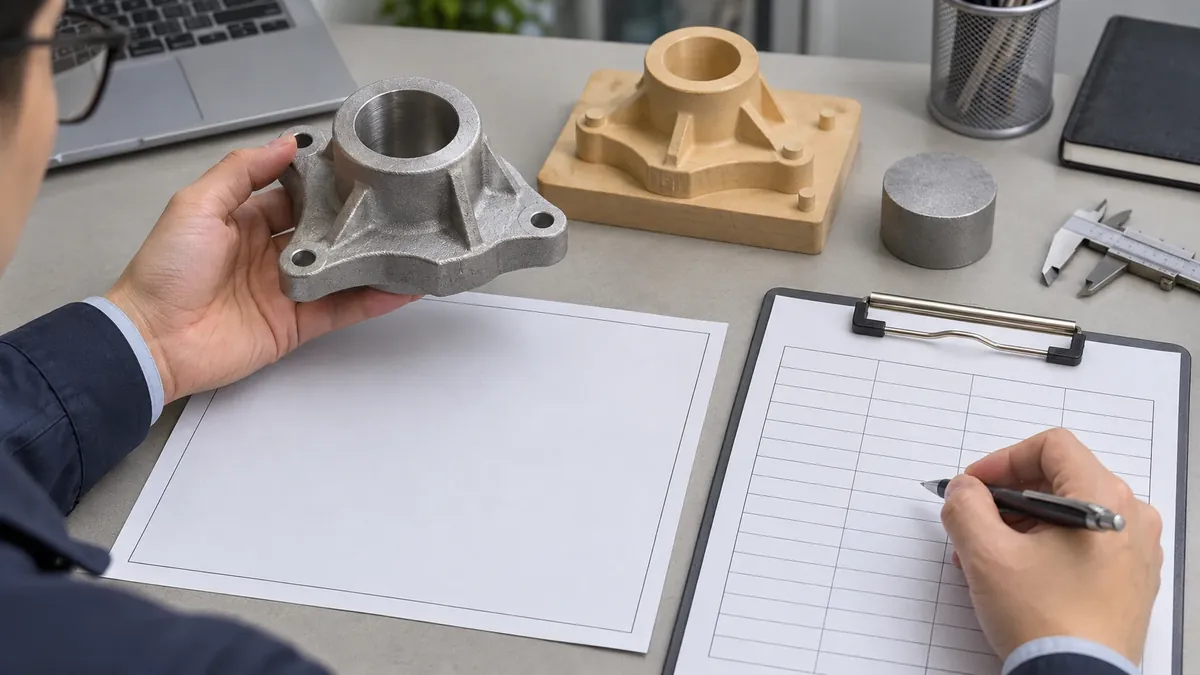
Technical references
Technical background: Referencia técnica principal. Consult the source in its stated scope; it does not establish Koitor-specific capability or acceptance.
Preguntas frecuentes
Is investment casting a type of alloy?
No. Investment casting describes a pattern and mold route. The alloy must be specified separately.
Does investment casting always produce a smoother or more accurate part?
No universal result follows from the route name. Actual surface and dimensional outcomes depend on the part, material, foundry process, tooling, and any secondary operations.
Is an as-cast component ready to assemble?
Not necessarily. Some features may require machining, finishing, or other operations. Confirm the final interface requirements and supplier scope.
Does the casting route establish the price or lead time?
No. Those depend on the actual part, tooling, material, order quantity, operations, supplier capacity, and commercial terms. Obtain a part-specific quotation.
Work with Koitor Hardware
For a bathroom or home-storage hardware project involving a separately sourced casting, share the controlled drawing or sample, assembly interface, required finish, quantity range, and the open supplier questions. Koitor can discuss the confirmed hardware product scope; the responsible foundry must confirm its own route and capability.
How should a buyer evaluate samples and first articles?
A casting sample should be reviewed against the same drawing revision and scope used to request the quotation. Buyers can identify dimensions and interfaces that are critical to the next assembly, note which surfaces are visible, and ask the supplier to distinguish as-cast features from machined features. If a sample has been machined or finished, the buyer should understand which operations were applied and whether the quotation includes them.
A visual sample is helpful for understanding shape and appearance but cannot, by itself, establish alloy identity, internal soundness, dimensional conformity on unmeasured features, or future lot consistency. If the order requires material documentation or specific inspection evidence, state that requirement before production and agree on its scope. The foundry should identify the records it can provide and the features it will inspect. The buyer should not assume an informal sample approval covers requirements that were never reviewed.
For a custom hardware assembly, the casting may need to mate with a formed or welded part. Review the interface as a complete assembly: hole locations, fastening, contact surfaces, clearances, finish, and sequence. A part that looks acceptable alone may still need evaluation with its mating component. If the buyer changes a mating part after sample approval, confirm whether the casting interface remains acceptable.
Tie any sample approval to a part number or drawing revision and state which characteristics were accepted. If the foundry changes pattern, material, secondary process, or finish, the buyer can decide whether renewed approval is needed. The change-control requirement depends on the commercial agreement; there is no universal rule in the casting method name.
What belongs in a comparable casting quotation?
Ask each foundry to identify the material, tooling or pattern basis, expected as-cast condition, secondary operations, inspection scope, packaging, and commercial assumptions. Confirm whether the quotation covers a finished part or a casting blank and whether machining, trimming, heat treatment, or surface finishing is included. A quote that omits these distinctions cannot be compared reliably with one that includes them. Where tooling is separately charged, record ownership and revision terms in the commercial agreement.
How should a buyer document assumptions?
When the foundry’s quotation depends on an assumption, ask for it in writing before approving the route. Examples include the supplied alloy, an existing pattern, an agreed machining allowance, or the exclusion of finishing. The buyer can then decide whether the assumption fits the purchase and whether another supplier is quoting equivalent work. A short list of inclusions and exclusions is often more useful than a broad statement that a particular casting method is cheaper or more precise.
Discuss a Metal Hardware Product Scope
Share the drawing or sample and identify the component interfaces, finish, quantity, and assembly requirements that need coordination with suppliers.
OEM / MARCA BLANCA
Convierte esta guía de abastecimiento en un resumen del producto
Indícanos el producto que deseas, el tamaño, el acabado, la cantidad del pedido y los requisitos de embalaje. Tu equipo recibirá un análisis práctico de la viabilidad de fabricación antes de recibir el presupuesto.


 English
 Español
 Português
 Français
 Deutsch
 العربية