
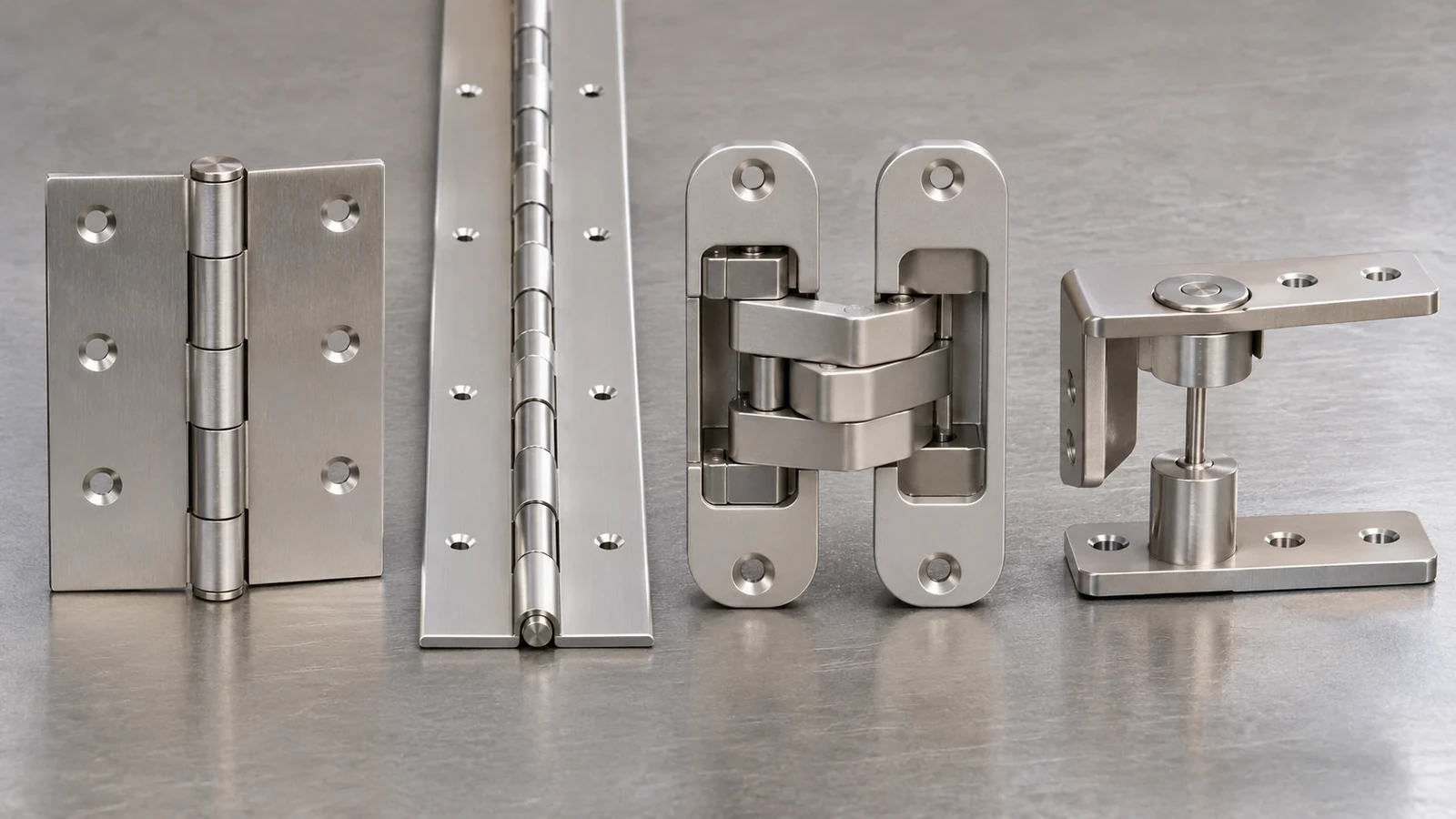
Types of hinges are easier to identify when buyers separate the base architecture from mounting, motion, retention, and closing options. A butt hinge, continuous hinge, concealed cabinet hinge, lift-off hinge, pivot hinge, strap hinge, or barrel hinge describes a different construction or mounting idea, while features such as a removable pin, spring, bearing, damper, or restrictor may cross those categories. Before ordering, identify the actual mating leaves or bodies, panel and frame geometry, swing path, installation, finish, and any required function. A hinge name alone does not prove compatibility, security, cycle life, load capacity, or code compliance.
What problem do hinge types help a buyer solve?
A product developer or importer may need to identify a purchased hinge for a cabinet, storage lid, access panel, rack door, or other movable part. Supplier catalogs can show many terms and feature labels that appear to describe the same idea. A buyer may see “concealed,” “lift-off,” “soft-close,” “continuous,” or “spring” and assume these are mutually exclusive types. They are not all describing the same classification axis.
A types of hinges guide helps the buyer determine what physical hinge is proposed and how it mounts. It does not replace a detailed product drawing or model-specific instruction. The buyer should first identify what moves relative to what: a door leaf against a frame, a lid against a panel, a removable panel around a pin, or a component that rotates about a pivot. Then the buyer can decide which mounting and operating features matter.
This article is an identification and sourcing guide. It does not specify hinge count, load rating, screw size, fire rating, security rating, cycle life, or a universal opening angle. Those values depend on the exact hinge, panel, frame, fasteners, geometry, application, and applicable technical documentation.
For a quotation, make the following distinctions visible:
- Base architecture: butt, continuous, concealed-cup, lift-off, pivot, strap, barrel, or another defined construction.
- Mounting arrangement: surface-mounted, recessed, cup-mounted, embedded, fixed to a frame, or another named interface.
- Motion: pivot axis, swing direction, opening path, and clearance.
- Options: bearing, removable pin, spring assist, damping, stop, restrictor, or other feature.
- Mating identity: which leaf, pin, body, cup, plate, or half belongs to which moving and fixed member.
- Use conditions: panel material, thickness, weight as established by the design, environment, finish, access, and service expectations.
How should buyers organize hinge categories?
The best starting point is a two-axis or multi-axis map rather than a single ranked list. One axis describes the hinge’s physical architecture. Another describes mounting. A third records operating or service features. The same family may appear with different options, and one feature can be available across several families.
| Hinge family or feature | What identifies it | Buyer should confirm | It does not automatically mean |
|---|---|---|---|
| Butt hinge | Two leaves join around a knuckle and pin, typically at an edge | Leaf shape, knuckle arrangement, pin, handing or orientation where relevant | A universal door rating or interchangeability |
| Continuous hinge | A long hinge body extends along a significant part of the edge | Length, mounting, cut-end treatment, panel interface, supplier model | Uniform load distribution or suitability at any length |
| Concealed-cup hinge | A cup or body is recessed in a panel and connects to a mounting plate or frame | Cup geometry, overlay/inset arrangement, plate, adjustment, panel preparation | A universal cup dimension, opening angle, or soft-close feature |
| Lift-off hinge | Mating hinge parts can separate along an intended lift direction | Which half is on each member, pin or barrel form, orientation, retention | Any lift-off half fitting any other half |
| Pivot hinge | Rotation occurs around a pivot arrangement that may be separate from edge leaves | Pivot location, top/bottom interfaces, swing envelope, supports | A standard butt-hinge replacement |
| Strap hinge | Extended arms or straps connect hinge rotation to a surface | Strap length, fixing pattern, exposed appearance, mating frame | A particular load rating or security level |
| Barrel hinge | Cylindrical bodies or barrels form the rotation interface | Body dimensions, mounting method, alignment, retention, opening path | Universal suitability for any panel |
| Removable pin | Pin can be removed in a defined hinge assembly | Pin direction, retention, access, matching leaf and knuckle geometry | Compatibility with another brand’s hinge half |
| Spring or self-closing option | A mechanism provides a defined closing action | Supplier adjustment, force, installation, range, maintenance | A specific speed, child-safety function, or code approval |
| Damper or soft-close option | A mechanism controls part of the closing motion | Model-specific range, panel, temperature, assembly and instructions | Silent operation or universal damping performance |
El ASSA ABLOY hinge guide describes door-hinge categories such as butt, bearing, lift-off, and concealed hinges. Rockler’s cabinet-hinge selection guide discusses cabinet construction, inset and overlay relationships, and common cabinet forms. TDC Hinges’ hinge type guide shows other visible families such as butt, strap, piano, and barrel forms. These supplier and maker sources help identify categories; their ratings and recommendations are model- and application-specific and should not be generalized to unrelated storage products.
A classification chart is useful only when the buyer uses the supplier’s exact product drawing or catalog number to resolve ambiguities. A family name is a starting point, not a complete purchase specification.
Which common hinge architectures should a buyer recognize?
Butt hinges use leaves connected around a knuckle and pin. They are common on doors and panels, but leaf dimensions, knuckle arrangement, pin retention, material, finish, handing, and mounting all vary. Buyers should specify the matching leaf pair and the panel/frame interface. Do not assume a similar-looking butt hinge has the same dimensions or fixing pattern.
Continuous hinges extend along much or all of a panel edge. Catalogs may call them piano or continuous hinges, depending on product context. The actual length, leaf width, knuckle geometry, mounting, end treatment, and panel construction matter. A long hinge does not automatically distribute force evenly or establish a maximum door size. The model instructions and system design control.
Concealed-cup hinges use a recessed cup and a mounting plate or related mechanism. They are common in cabinet applications, where the door and cabinet construction affect the hinge choice. Overlay, inset, frame geometry, cup preparation, adjustment, and clearance all need to be defined. A concealed-cup hinge is not the same as every hidden pivot or concealed door hinge. Confirm the supplier’s model and installation drawing.
Lift-off hinges are designed so a member can be removed by separating the intended hinge halves along a particular direction. The male/female components or mating parts must match. Orientation and retention details matter. The existing lift-off hinge mating-pair guide covers the specific question of which half is fixed to which member; this overview remains at the broader taxonomy level.
Pivot hinges rotate around a pivot point or pivot assembly rather than relying only on a conventional leaf-and-knuckle arrangement. The pivot location and support geometry determine the movement. The buyer should identify top and bottom interfaces, alignment, clearances, and the moving member’s envelope. A pivot label does not identify a direct replacement for a butt hinge.
Strap hinges have extended leaves or arms that connect the rotating member to a surface. Their visible design may be important for rustic or utility applications, but appearance does not establish a security or load rating. Specify strap dimensions, hole pattern, material, finish, and how the mating member is supported.
Barrel hinges use a cylindrical or barrel-like rotation interface. Exact dimensions, attachment, retention, orientation, and clearance differ by model. A barrel hinge may look compact, yet the drawing is needed to understand how it connects to the panel and frame.
Some buyers will also encounter spring hinges, self-closing hinges, friction hinges, detent hinges, glass hinges, or specialized panel hinges. These labels may describe an option, an operating mechanism, or an application family rather than a mutually exclusive base architecture. Record both the base structure and the desired option.
How do mounting, motion, and service features differ?
Mounting describes how the hinge attaches to the panel or frame. Motion describes how the assembly opens, closes, slides, pivots, or separates. Service features describe whether it can be adjusted, removed, held open, damped, or restricted. These categories are related but should not be collapsed.
A concealed hinge may still have an adjustable mounting plate. A butt hinge may use a removable pin. A cabinet hinge may include a soft-close option, but not every hinge with a similar silhouette has that feature. A pivot system may use a spring or stop from a separate component. A continuous hinge can be supplied with different materials or finishes. Buyers should specify each relevant function separately and verify the exact model.
For motion, identify the moving member, fixed member, axis or pivot, swing direction, and nearby obstacles. A product image cannot show whether a door clears a shelf, cabinet side, frame return, wall, or adjacent accessory. Use the product’s actual assembly dimensions and test the motion path in a representative sample or design review.
For a removable design, identify how the hinge separates and what prevents unintended disengagement if retention matters. For adjustment, specify which direction can be adjusted and what final alignment must be achieved. For damping or self-closing, identify the actual expected action and the manufacturer’s limits; avoid vague requirements such as “silent” or “smooth” without an agreed review method.
A feature name also does not establish service life. If repeated cycles matter, request the supplier’s applicable evidence, product model, setup, and scope. A cycle test on one hinge configuration does not automatically qualify a different panel, size, fastener, or assembly.

What interfaces should be specified before ordering?
A hinge quotation should identify the moving part, fixed part, and all mating surfaces. For a cabinet door, these may include the door edge, frame or side panel, cup or recess, mounting plate, screw locations, and clearance to nearby parts. For a storage lid or access panel, the construction may differ; do not copy a cabinet assumption to another product.
The drawing or RFQ may need to show:
- Hinge model, architecture, and intended pair or component set.
- Door, lid, panel, and frame material, thickness, and revision.
- Mounting face, hole pattern, recess, cup, plate, or pivot dimensions.
- Mating leaf or half identity, orientation, and handing if applicable.
- Opening path, swing direction, required clearance, and stop position.
- Required removable pin, adjustment, spring, damping, detent, or restrictor feature.
- Finish, visible faces, corrosion environment, and cleaning requirements.
- Fastener type and who supplies or installs it.
- Sample, fit-check, and motion-review requirements.
- Any performance claim and the evidence that supports that exact configuration.
Do not populate these fields with generic values copied from a catalog unless the selected model and design call for them. For replacement parts, record the old model number, dimensions, hinge half, pin orientation, and corner profile. A photograph is useful, but it may not show a hidden recess or the exact mating geometry. The related hinge-radius identification guide explains why a replacement leaf’s corner shape should be measured separately.
Check the hinge and mounting fasteners as a complete interface. Screw length, head type, clearance, substrate, finish, and tool access can affect installation. The hinge manufacturer’s instructions and responsible design control those details. Do not infer a safe screw or anchor from the hinge family name.
How should buyers compare hinge quotations?
Ask each supplier to quote the same architecture and the same set of functions. If one quote describes a concealed cup hinge and another a surface-mounted pivot, their prices do not represent equivalent options. If one includes a mounting plate, screws, and a damper while another includes only the hinge body, the line items also differ.
A comparable quotation should state:
- Hinge manufacturer, model, or controlled product drawing.
- Base architecture and mounting mode.
- Included components: leaves, plates, pins, screws, cover caps, damper, or other parts.
- Door/frame dimensions and preparation assumptions.
- Opening direction, motion, adjustment, and clearance requirements.
- Material and finish, including the agreed appearance reference.
- Any load, cycle, corrosion, safety, or code claim with its source and test scope.
- Installation instructions and maintenance requirements.
- Sample and first-article review plan.
- Packaging and part identification, especially for paired or handed components.
- Approved alternatives and change-notification rules.
When a supplier uses a generic term such as “heavy duty,” “security,” “soft close,” or “long life,” ask what exact model and evidence support it. Do not assume a rating or regulatory status from the category. The hinge type guide intentionally avoids copying model-specific values from supplier pages because those values do not apply automatically to a home-storage or bathroom panel.
For a repeat order, preserve the hinge model and panel geometry as a controlled baseline. A new supplier, finish, fastener, panel thickness, recess, or moving member can change the fit or behavior. Require review when the configuration changes rather than relying on a prior sample with different parts.
What mistakes should buyers avoid?
Treating options as base types. Concealed, soft-close, removable-pin, spring, bearing, and continuous may describe different axes. State the architecture and each needed option.
Assuming matching names mean matching parts. Similar labels can hide different leaf sizes, knuckles, pins, cups, plates, or fixing patterns. Request a drawing or exact model.
Ignoring the mating pair. A lift-off hinge or multi-part concealed hinge may use specific halves or plates. Identify which part attaches to which member.
Choosing from a photo alone. Photos rarely show the recess, pivot, fastener, clearances, or backside geometry. Obtain dimensions and sample fit.
Copying a cabinet instruction to a different product. A cabinet door, storage lid, thin panel, and metal access door may have different construction and fixing assumptions.
Using a type name as a performance claim. “Heavy duty,” “security,” “fire rated,” or “soft close” needs model-specific documentation and applicable scope.
Forgetting the motion envelope. A hinge may fit at rest but collide during opening or closing. Review the complete swing path and adjacent components.
Assuming every feature is interchangeable. A damper, spring, stop, pin, and restrictor can be model-specific. Confirm compatibility with the selected hinge.
Changing finish or supplier without rechecking fit. Process and geometry changes can affect visible surfaces, dimensions, or operation. Keep sample approval tied to the part revision.
Treating a hinge test as a whole-product approval. A hinge result does not automatically rate the panel, fasteners, mounting substrate, or complete product.
What should go into a hinge-selection checklist?
Before sending an RFQ or approving a sample, record:
- Product and moving-member function.
- Hinge base architecture and mounting arrangement.
- Model, drawing, and revision.
- Door, lid, panel, or frame material and thickness.
- Leaf, cup, plate, pin, pivot, and fastener interfaces.
- Which half or component attaches to each member.
- Swing direction, opening path, clearance, and stop.
- Required options: removable pin, bearing, adjustment, spring, damper, detent, or restrictor.
- Finish, cosmetic faces, environment, and cleaning.
- Sample fit and motion-review method.
- Required evidence and exact claim scope.
- Packaging, model identification, and paired-part control.
- Substitution and change-approval rules.
The sample should be mounted to representative panels or a defined fixture when the interface matters. Record which panel and fasteners were used. A bench demonstration can verify basic movement, but it does not establish service life, security, fire performance, or capacity unless the test was designed and approved to demonstrate that exact property.
For a product family, do not assume a hinge is shared across every size because the panels look similar. Record which hinge model belongs to each door, lid, or frame revision. Keep distinct products or sizes separate until the supplier confirms compatibility.

How can an OEM factory coordinate hinge details?
Koitor Hardware is a family-owned custom metal hardware manufacturer focused on bathroom and home-storage products. For a product that includes a hinged lid, cabinet-like panel, access cover, or storage door, a project review can cover the metal part, mounting geometry, fasteners, finish, sample, and assembly. The approved company profile does not state that Koitor manufactures every hinge family or provides accredited hinge testing.
The buyer should identify which supplier owns the hinge and which party makes the panel or frame. Attach the assembly drawing, proposed hinge model, moving path, and sample when possible. If the hinge is purchased, keep its product data and instructions with the metal-part drawing. If a hinge feature or finish changes, decide whether the sample and claims need reapproval.
A custom metal hardware manufacturer can discuss whether a proposed mounting location, hole, bracket, cover, or panel feature is visible and manufacturable. The hinge maker’s documentation and the responsible product engineer should confirm model-specific ratings, compatibility, and installation requirements. Avoid assigning those claims to a metal factory without evidence.
For a project that uses lift-off hinges, the dedicated mating-half guide provides a focused identification step. For broader custom storage hardware, see the OEM home-storage hardware page o send the drawing and hinge sample to Koitor.
Preguntas frecuentes
How do I compare types of hinges before ordering?
Compare common families such as butt, continuous, concealed-cup, lift-off, pivot, strap, and barrel hinges by their actual mating interfaces and operating features. Spring, bearing, removable-pin, damper, and restrictor features may cross those base categories. Confirm the exact product drawing and model.
Is a concealed hinge the same as a soft-close hinge?
No. Concealed describes a mounting or appearance arrangement. Soft-close describes a closing feature. A particular concealed hinge may include a damper, but the feature must be confirmed for the model.
Are all lift-off hinge halves interchangeable?
No. Mating halves may differ in geometry, orientation, pin, and retention. Confirm the part numbers and which half belongs on the moving and fixed members.
Does a continuous hinge distribute load evenly along a door?
Not as a universal conclusion. The result depends on the model, length, panel, mounting, fasteners, installation, and load. Use the supplier’s model-specific evidence and design basis.
Can I choose a hinge by door thickness alone?
No. Door thickness is one input. The hinge architecture, mounting, overlay or inset, opening path, panel material, fasteners, clearance, finish, and model instructions also matter.
Does a “security hinge” label establish a security rating?
No. Ask for the exact model and applicable evidence or standard. A category label does not independently establish a security result.
What should be checked before replacing a hinge?
Record the model if available, each leaf or half, corner radius, pin or barrel, hole pattern, panel thickness, mounting orientation, and movement. Compare an exact drawing and sample rather than relying only on a photograph.
Can Koitor supply every hinge type in this guide?
This article does not make that claim. Koitor’s approved scope is custom metal bathroom and home-storage hardware manufacturing and project coordination. The specific hinge source and model should be confirmed for each project.
Trabaja con Koitor Hardware
Need a hinge interface reviewed with a custom metal panel?
Share the panel and frame drawing, exact hinge model or sample, mounting preparation, swing path, finish target, and the function you need. Koitor can review the custom metal-part and assembly scope while the hinge supplier confirms model-specific instructions and ratings.
OEM / MARCA BLANCA
Convierte esta guía de abastecimiento en un resumen del producto
Indícanos el producto que deseas, el tamaño, el acabado, la cantidad del pedido y los requisitos de embalaje. Tu equipo recibirá un análisis práctico de la viabilidad de fabricación antes de recibir el presupuesto.


 English
 Español
 Português
 Français
 Deutsch
 العربية