

A dish drying rack rust proof claim is a system claim. It covers the wire or tube rack, the drip tray, and the feet or fasteners that stay in rinse water, not only the shiny mid-span wires in a catalog photograph.
Before a dish drying rack rust proof line is used, the acceptance standard should name the sites that actually rust first: weld nuggets, cut ends, tray contact points, and drain-path dead zones. A mid-span visual pass, or a salt-spray run that never looks at those sites, does not support a product-level dish drying rack rust proof line. This page is about those observation points on a freestanding counter rack with a tray. It is not a rust-removal tutorial, and it is not about dishwasher interior racks.
Should rust-proof dish-rack acceptance name nuggets, cut ends, tray contacts and dead zones?
Yes, if the listing will use rust-proof or rust-free language. Those four site types are where standing rinse water, soap film, and tight geometry usually show the first stain, while open wires still look clean.
A freestanding dish rack lives in a wet-dry cycle that a hanging shower caddy does not repeat in the same way. Plates drip into slots for hours. The tray holds a shallow pool until someone empties it. The rack sits in that pool at a few contact points. If the acceptance standard only says “no rust on the product,” inspectors will naturally look at easy faces. The claim file should force the harder faces onto the list.
Naming the sites also stops a false split between the rack and the tray. Buyers sometimes approve a stainless rack and then accept a leftover coated-steel tray, or a tray with an undrained corner, because the tray was treated as packaging. Shoppers do not split the complaint that way. They photograph rust in the tray and say the rust-proof rack failed.
Drainage geometry still matters, because a tray that cannot shed water keeps those contacts wet. Koitor’s kitchen dish rack drainage approval guidance covers slope, outlet, and board fit as a drainage decision. This article uses that geometry only as a corrosion input: if water stands, the standing zone is an acceptance point for any rust-proof wording.
The same rule applies to salt-spray evidence, if the project uses it. ASTM B117 et ISO 9227:2022 define test environments; they do not set dish-rack hours or a pass/fail table. If a report is going to support listing language, the specimen should include the assembled rack and tray, or the file should say plainly which sites a panel coupon cannot represent. Hours still do not convert into years of kitchen use.
How do weld nuggets and cut ends fail on a standing dish rack?
Weld nuggets and cut ends fail first because they are edges, crevices, and heat-affected spots sitting under repeated drips. On a dish rack those features are not rare cosmetics. They are everywhere plates and cups rest.
Most counter racks are resistance-welded wire grids with handle welds, rim welds, and sometimes welded feet or tray stops. Each crossing is a nugget. If powder, vinyl, or plating is thin on the shoulder of that nugget, a brown ring can form while the drawn wire still looks coated. The visual standard should tell inspectors to look at crossings in the plate slots and at handle attachments, not only at the front rim.
Cut ends are concentrated in the plate-support combs and in trimmed wire tips. Those tips are wet, then dry, then wet again, often with food film. An unsealed or thinly coated end is a raw annulus.
If the design uses vinyl dip, the dip may build in the mid-span and pull thin or leave a pinhole at the tip. If the design is powder, the cut end is a sharp edge that is easy to under-coat. If the design is chrome on steel, plates can wear the end back to substrate.
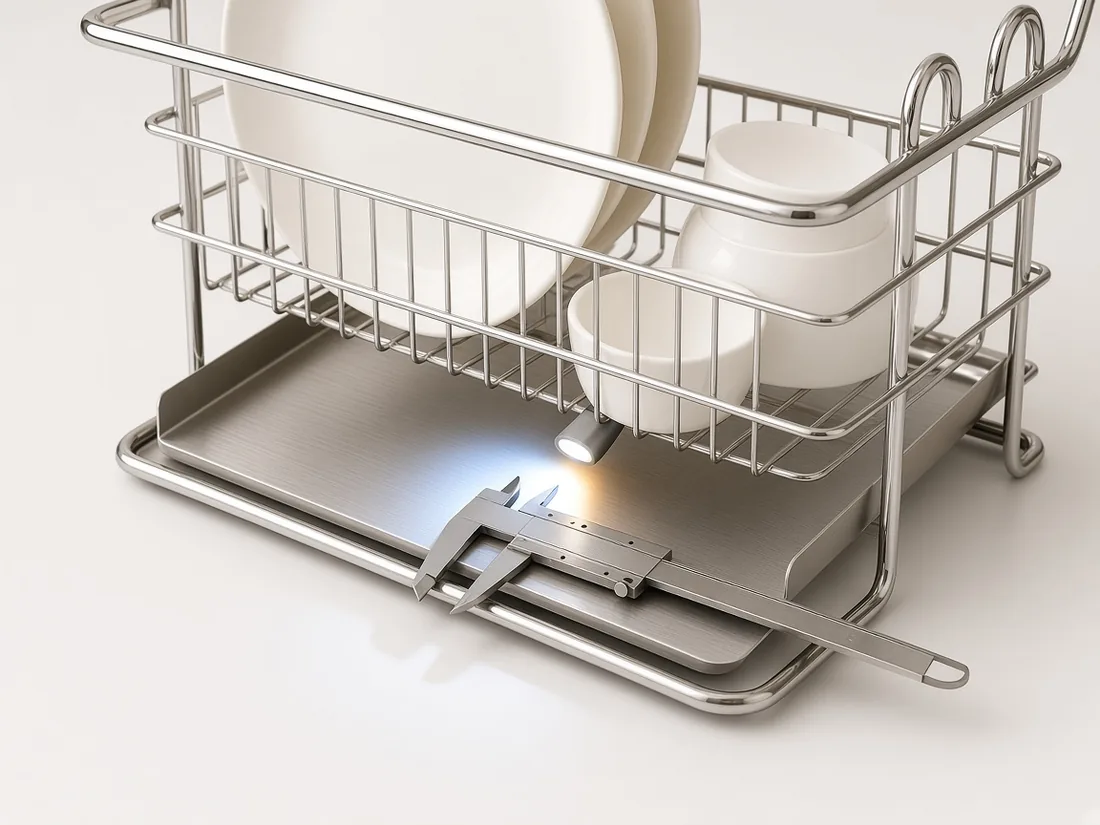
Handle ends and rail trims deserve their own line. A buyer who photographs only the plate comb can miss a rusting handle stub that sits in a splash zone. Include both families of ends in the golden-sample photo set, with a scale or a ruler in the frame so later lots can be compared, without treating that ruler as a certified measurement device.
Stainless racks are not exempt. A correct grade can still stain at tinted welds or from free iron left by carbon-steel tools. ASTM A380 et ASTM A967/A967M, together with industry notes such as the British Stainless Steel Association’s guidance on iron contamination and rust staining, explain why stainless can show rust marks after fabrication. Those references support a process question. They do not, by themselves, justify rust-proof artwork on a welded rack.
Do not write a single “good weld” sentence that mixes appearance, size, and corrosion. The visual standard can describe allowed nugget appearance and burrs. Any dimensional check of a slot or a handle uses agreed tools and datums in a measurement clause. Any lot sampling uses a separate ISO 2859-1 plan. Keep those three topics apart so a rust stain at a cut end is not argued as a slot-width issue.
What should buyers specify at the drip tray and drain path?
Specify the tray as a wet part in the same claim, then name how it meets the rack and how water leaves it. The usual rust sites are the rack-to-tray contact lines, rolled or sheared tray edges, the outlet, and any flat corner that holds a puddle.
Contact lines stay wet longer than open grid wires. A wire foot, a frame runner, or a plastic pad that traps a ring of water can print a rust or stain mark on both the rack and the tray.
The acceptance standard should say whether contact is metal-to-metal, whether pads are part of the SKU, and how an inspector looks at the witness marks after a wet hold. If pads can be omitted in packing, the claim must still consider the metal contact that shoppers may create.
Tray edges need an explicit finish rule. A rolled hem can hide an uncoated interior edge. A sheared edge can be a raw cut. Either can rust or, on coated aluminum, show edge corrosion. Koitor’s page on aluminum filiform corrosion at coating cut edges is relevant when the tray is coated aluminum. The same edge logic applies to coated steel trays, except the shopper will usually see red rust rather than filiform filaments.
The drain path should be described in words and in a simple photograph of a wet tray, not only in a drawing slope number. If water remains in a corner after the agreed pour-off or hold time used in sample approval, that corner is a dead zone. It belongs on the rust observation list even if the drainage design was already approved for drying performance. The two approvals can share photos, but they answer different questions.
Tray material should be written beside rack material. A 304 rack with a carbon-steel tray is a mixed system. A rust-proof line on the “dish drying rack” will be read as covering the tray. Either upgrade the tray construction, exclude the tray in wording that shoppers will actually see (which is hard on a combined SKU), or drop rust-proof language for the set.
Removable trays also need a reassembly note. If the tray can be inserted backwards or tilted so the outlet sits uphill, the dead zone moves. Instructions and a poka-yoke shape are packaging and design issues, but they affect whether the rust-proof claim is being used in the intended wet geometry. Record the intended orientation in the acceptance standard.
Cup wells, utensil cylinders, and bottle rings are extra standing-water features when they are part of the same SKU. They are not the same buyer question as a dedicated utensil-cylinder fit article, but they are rust sites if rinse water sits in a closed cup. If the rust-proof title covers the whole rack, those wells belong on the observation list and in the wet-hold photographs.
Packaging can create later rust complaints even when the factory sample was clean. Coating-to-coating rub in a carton, a tray edge that cuts a vinyl tip, or a loose rack that abrades a plated slot can expose metal that then rusts in the first week of use. The acceptance standard should say whether packed-appearance checks look at those same named sites after a shipping simulation the project has actually agreed, without inventing drop-test numbers here.
Return samples are useful evidence, but only if the photograph shows the site. A shopper photo of “rusty rack” that does not show whether the stain is a nugget, a cut end, a tray corner, or a foot ring cannot close a corrective action. The aftersales brief can reuse the same four site names so retailer tickets map back to the standard, rather than to a generic rust code.
Retail photography should not become a substitute standard. Soft box lighting on a dry, empty rack hides dead zones and wet contacts. If a listing image is used internally as the “looks good” reference, keep it separate from the wet-hold acceptance photos. The claim is about the wet product, not the dry hero shot.
Spare trays sold later must keep the same system logic. A replacement tray with a different edge finish, a shallower slope, or a different contact height can re-create a dead zone under an old rust-proof title. If replacement trays are offered, freeze their interface to the original rack and run the same contact and drain-path checks before the spare SKU inherits the parent claim.
Food-acid and bleach cleaners are environment limits, not hidden defects, when they are outside the agreed use. The acceptance standard can exclude chemically damaged films if the listing also states the intended cleaner family. That exclusion should not be used to dismiss a rusted nugget on a rack that was only exposed to ordinary rinse water.
First-article and bulk lots should use the same named sites, even if the sample was approved in a hurry. A golden sample that was judged only on the front rim will not teach a new inspector where to look on lot 20. Keep the site list, the wet-hold method, and the photograph views in the standard that travels with the SKU, so the rust-proof wording, if it remains, is still tied to those views.
If a program sells both a rack-only SKU and a rack-with-tray set, split the claim files. A rust-proof line written for the set cannot be copied onto the rack-only listing if shoppers will place that rack on an unapproved cutting board or a steel sink grid that becomes the new contact surface. State the intended companion surface, or keep the wording narrower.
How should different finishes be judged at those points, and how should measurement stay separate from sampling?
Judge each finish at the named sites, not by a mid-span color chip. Then write thickness or other metrology in one clause and lot sampling in another. Do not turn those into a single “inspect to AQL with a thickness gauge at the nugget” sentence.
| Finish system | What to look at on nuggets and cut ends | What to look at on the tray and drain path | Wording caution |
|---|---|---|---|
| Powder-coated steel | Thin film or holidays on nugget shoulders and sharp cut ends; any chip down to steel | Contact wear, rolled-edge coverage, and puddles at dead corners | Rust-proof lines are rarely supportable once steel can be exposed; prefer rust resistant while the film is intact, if anything |
| Vinyl or dip-coated steel | Pinholes or thin tips at wire ends; tears at tight crossings; trapped moisture under a lifted lip | Soft-film cuts from plate edges, and tray contact abrasion | Do not treat a thick mid-span dip as proof of tip coverage |
| Chrome on steel | Wear-through in plate slots and missed plating on cut ends | Tray-edge plating and contact rub marks | A bright face is not a rust-proof basis; name the steel substrate in the brief |
| Stainless rack, possibly with a mixed tray | Weld tint, iron contamination stains, and any dissimilar fastener | Whether the tray metal and finish are inside the same claim | Grade names do not authorize rust-proof artwork; a steel tray can void a stainless claim |
| Aluminum rack or tray | Coating cut-edge attack rather than red rust; galvanic marks at steel screws | Standing-water staining and edge corrosion in dead zones | Avoid “will not rust” as a synonym for rust proof |
For powder and similar films, uncured powder thickness practices such as ASTM D7378-16 (reapproved 2024) and cured dry-film practices such as ASTM D7091-22 can be cited as measurement methods when they fit the substrate and film. The project still has to name the locations: tray lip, nugget shoulder, cut end, and a mid-span for comparison. Those locations are not a sampling plan.
Vinyl dip is often poorly served by a magnetic gauge if the film is thick or soft. If the parties use a gauge, agree the method and its limits in the measurement clause, or use a visual and cut-end photograph standard instead. Do not invent a thickness number in this article or on the carton.
Lot sampling, if used, should cite ISO 2859-1:2026 or another agreed edition, with inspection level and AQL chosen by the parties. Visual rust at named sites can be one characteristic. Film-thickness nonconformities can be another. They should not share one unexplained AQL line with a caliper datum for slot pitch or tray length.
Koitor’s vinyl versus powder coated wire shelving guide can help when a buyer is choosing a film family for wet storage. It does not replace a dish-rack acceptance list. The dish rack still needs nugget, end, contact, and dead-zone observations in its own standard.
If salt-spray evidence is part of the project, keep report reading aligned with Koitor’s salt spray test report interpretation page, and add one dish-rack-specific requirement: the evaluated area must include the named sites or the report cannot carry a rust-proof title.

What should a dish-rack rust-proof acceptance checklist include?
The items below are specific to a freestanding dish drying rack with a drip tray. They would be the wrong list for a hanging shower caddy or a towel-bar bracket.
- State that the claim, if used, covers the rack, the tray, and any feet or fasteners that remain in rinse water.
- Put weld nuggets in plate slots and at handle or rim joints on the visual list, with golden-sample photographs.
- Put cut ends in the plate comb and on handle or rail trims on the same list, including vinyl-tip or plating-coverage checks where those finishes are used.
- Name rack-to-tray contact points, pad presence or absence, and how witnesses are reviewed after a wet hold.
- Name drain-path dead zones and the intended tray orientation, and photograph a wet tray after the agreed sample-approval hold.
- Write rack metal and tray metal side by side, and refuse a product-level rust-proof line if the tray is a weaker, undocumented construction.
- Keep film-thickness methods and datums in a measurement clause, and keep ISO 2859-1 sampling in a separate clause.
- If a salt-spray report is used, require an assembled or otherwise representative specimen and an evaluation that includes the named sites, without converting hours into years.
How can Koitor review a rack-and-tray acceptance brief?
Koitor Hardware is a family-owned custom metal hardware factory that produces kitchen and home storage racks, including wire dish-drying constructions, for overseas importers and private-label buyers. A review of a rust-proof brief is a review of named sites and system parts. It is not a declaration that a Koitor dish rack is rust-proof.
The useful package is the rack and tray as they will be sold, the intended listing sentence, and a photo list of nuggets, cut ends, contacts, and the drain path. If the tray can be reversed, include that. Koitor can then mark which sites are not yet described and whether the wording is stronger than the system. Drainage questions can be reviewed alongside the drainage-design page cited above, without treating slope approval as rust approval.
MOQ can start from about 100 pcs depending on the product. Samples usually take 5–7 working days after details are confirmed. Bulk production usually takes 4–6 weeks depending on product, order quantity, finish, and packaging. Those figures are planning ranges, not a rust performance rating.
Foire aux questions
Can a stainless rack with a coated-steel tray still use a rust-proof title?
Usually not at the product level, because shoppers treat the tray as part of the rack. Either bring the tray into a supportable construction, or drop rust-proof wording for the set.
Is a mid-span salt-spray panel enough for a dish-rack rust-proof claim?
No. The first stains are often at nuggets, cut ends, and tray contacts. If those sites were not in the specimen or the evaluation, the report does not speak for the listed product. The method also does not convert hours into years of kitchen use.
Does this acceptance list apply to a dishwasher interior rack?
No. Dishwasher racks are a different product, with different heat, detergent, and coating systems. This page is limited to a countertop or sink-side dish drying rack with a drip tray.
Should vinyl-dip tips be judged by the same thickness gauge used on powder?
Not automatically. Soft or thick dip films may need a visual and photograph standard, or a method the parties have agreed and limited in writing. Put that decision in the measurement clause, not inside the AQL line.
If drainage was already approved, can rust observation of dead zones be skipped?
No. Drainage approval asks whether water leaves the tray. Rust acceptance asks whether remaining wet zones are still in the claim. A tray can drain well enough for use and still have a corner that must be inspected if rust-proof wording is used.
Collaborez avec Koitor Hardware
Need a dish drying rack rust proof acceptance list reviewed?
Send Koitor the rack and tray sample or drawing, the intended rust-proof wording, and the observation points you want in the standard. The team can review whether welds, cut ends, contacts and drain paths are actually covered. This review is not a rust-proof certification.
Fabrication pour compte de tiers / Marque de distributeur
Transformez ce guide d'approvisionnement en cahier des charges
Indiquez-nous le produit souhaité, ses dimensions, sa finition, la quantité commandée et vos exigences en matière d'emballage. Votre équipe recevra une analyse pratique de la faisabilité de la fabrication avant l'établissement du devis.


 English
 Español
 Português
 Français
 Deutsch
 العربية