
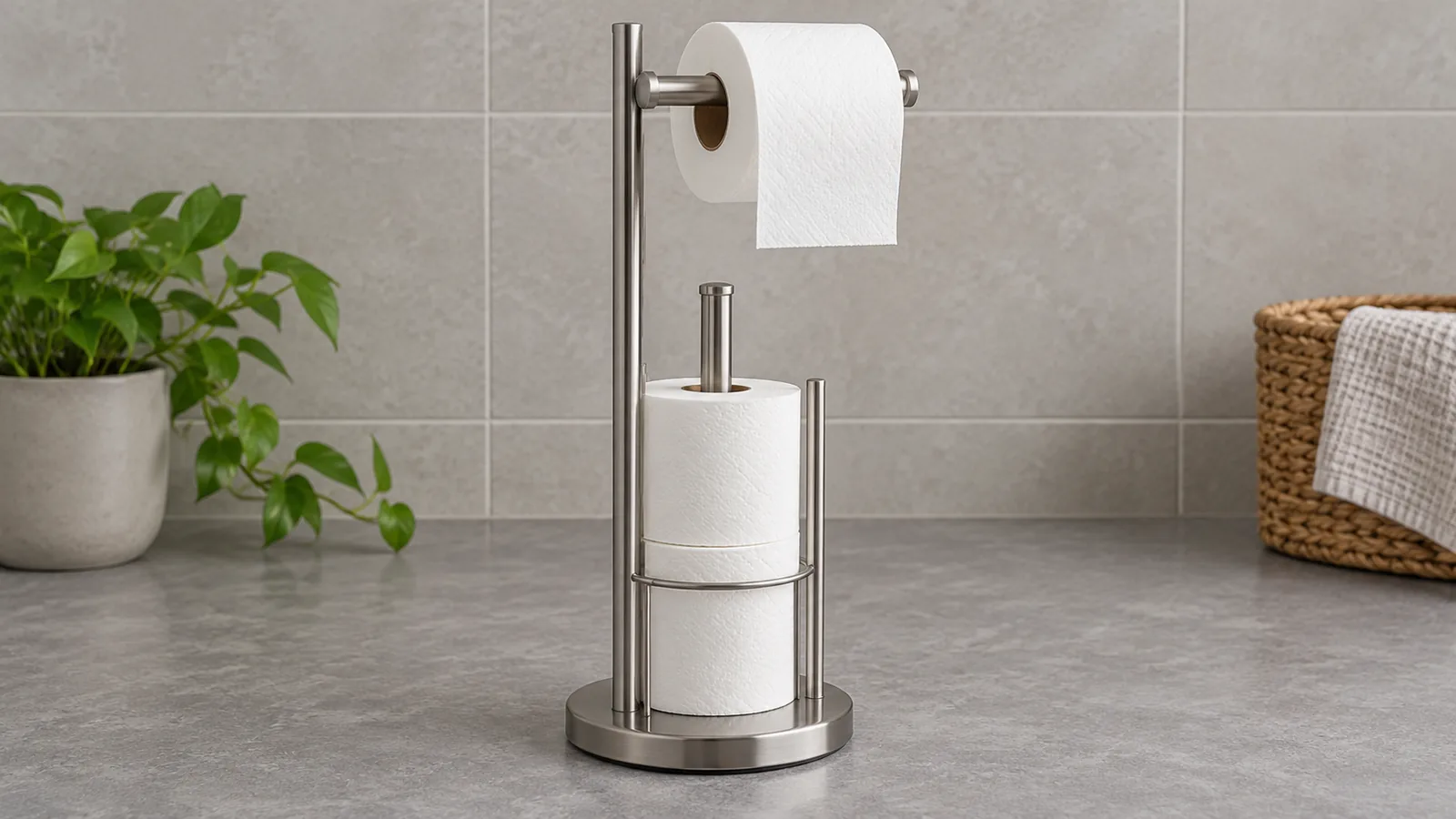
A freestanding toilet paper holder with storage should be approved against the exact roll set, not just a phrase such as “fits jumbo rolls.” The importer should state whether the capacity includes the roll in use, record the width and outer diameter of representative rolls, and review loading and retrieval on the physical sample. Product pages show different reserve arrangements and model-specific capacities; their values apply to the named SKU only. This guide focuses on importer RFQ and sample approval and does not claim that Koitor currently offers or tests a particular reserve-roll stand.
What does “with storage” mean in an importer’s SKU?
Start by describing the whole shipped product. A freestanding holder may dispense one roll while also storing reserves, or it may store several rolls in a closed body that feeds the next roll forward. A listing term such as “with storage” does not establish which arrangement the buyer is sourcing, how many rolls the unit holds, or whether paper rolls are included in the retail pack.
Separate the product into three functions in the brief:
- Dispensing: how the active roll is positioned and replaced.
- Reserve storage: how spare rolls are carried, oriented and kept accessible.
- Pack-out: which metal parts, assembly items, instructions and other components ship with the unit.
This prevents a quotation from treating a reserve post as an optional extra when the buyer expects an integrated frame, or assuming that the displayed paper rolls ship with the product. For a freestanding toilet paper holder with storage, the quote should identify the active-roll support and every reserve position separately, so the buyer capacity expectation is explicit. If the active roll and reserve rolls use different supports, list them separately in the drawing or component schedule. If the buyer expects the same finish across visible parts, identify which parts are included in that finish requirement.
Also define whether the requested product is an open freestanding stand, a freestanding enclosed stocker, a wall-mounted holder with a reserve chamber, or another design. Similar product names can describe different structures and uses. A buyer who sends only a retail keyword may receive a quote for a different architecture.
The distinction matters for search and product data too. “Reserve,” “storage,” “stocker,” and “jumbo” are not precise engineering specifications. Use those terms as labels, then attach the details that make the SKU reproducible: a drawing revision, target roll samples, stated capacity, included parts and the wording approved for packaging and listings.
Which roll measurements and capacities should the buyer define?
Record the roll envelope that the approved product is intended to handle. “Standard” and “jumbo” can vary by market, retailer and paper product, so the buyer should provide representative rolls or a written envelope rather than assume that the label has a single universal dimension.
For each target roll, record the outer diameter and width. If the design uses a spindle or center post, also record the core opening and the direction the roll is loaded. If a wrapper, sleeve or compressed pack remains on the roll during storage, say so; a bare roll and a wrapped roll may not occupy the same space. The sample review should use the actual selected rolls, not a similar-looking substitute.
Capacity needs its own definition. State the number of additional reserve rolls separately from the active dispensing roll. Then ask the supplier to confirm whether any advertised total includes the active roll, whether all reserve positions can be filled at once, and whether the product still works in that state. This removes ambiguity from the product page, carton copy and internal SKU data.
Current product pages illustrate why model-specific details are useful. Umbra’s official Cappa page describes a freestanding dispenser and reserve stand, states a capacity of up to three jumbo rolls, and lists overall product dimensions. Yamazaki Home’s Tower Toilet Paper Stocker describes a different enclosed storage and feed arrangement and lists its own capacity and roll envelope. These are examples for reading product specifications, not suggested dimensions or capacity targets for another design.
| Published model example | What the page specifies | What an importer should still confirm for a different SKU |
|---|---|---|
| Umbra Cappa holder and reserve | The page says it holds up to three jumbo rolls and dispenses one; it also lists overall dimensions of 7.69 × 4.92 × 20.59 inches. | Whether the buyer’s requested reserve count is additional to the active roll; the target roll width and diameter; and whether the approved sample matches the quoted version. |
| Yamazaki Home Tower Toilet Paper Stocker | This enclosed stocker lists capacity for up to eight rolls and a model-specific roll envelope, alongside overall dimensions. | Whether a closed stocker suits the assortment, how the selected rolls feed and refill, and how the importer’s own target roll set fits. |
A page’s overall height, width and depth do not automatically reveal the maximum roll diameter or width inside the reserve space. Ask for the actual usable opening or a sample check when those dimensions decide whether the SKU fits the intended rolls. Do not copy another brand’s capacity or envelope into the purchase specification.
How should buyers compare reserve-storage architectures?
Compare designs by how they store and release a reserve roll, then decide what the selected SKU needs to do. An open post or cage makes the stored rolls visible; an enclosed body can conceal them and may use a guided feed path. Neither arrangement is universally better. The right choice depends on the buyer’s product brief, target roll set, appearance requirements, refill method and pack-out plan.
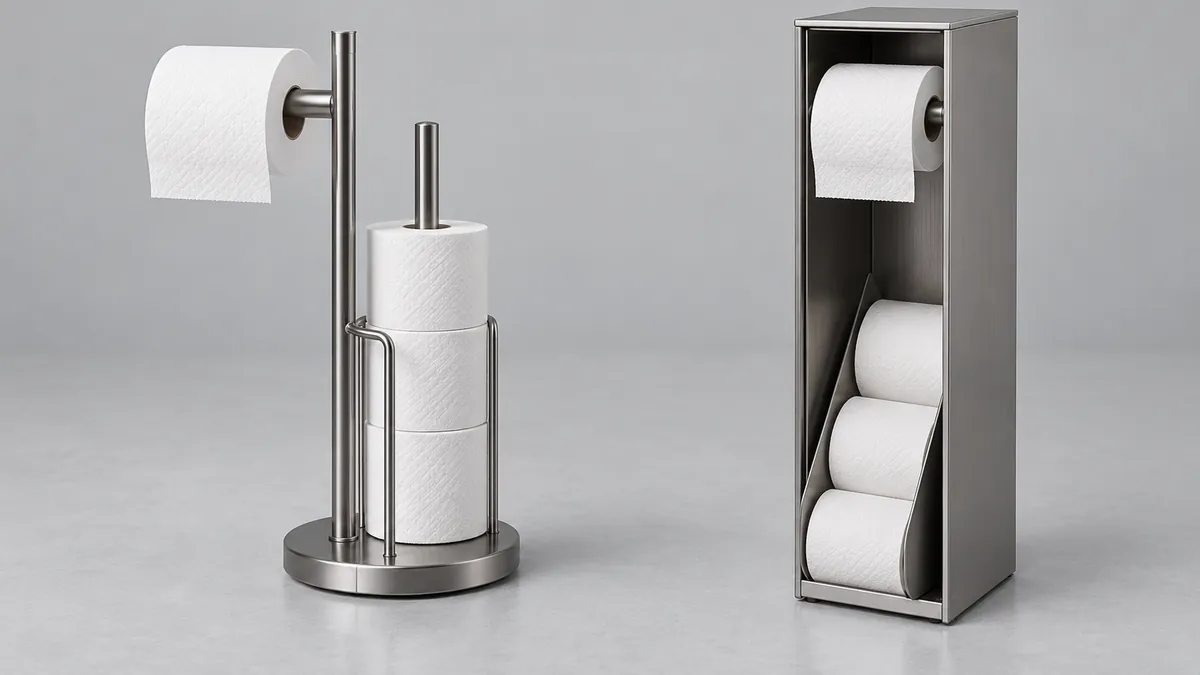
Concept illustration: storage arrangements differ by design; it does not depict a current Koitor product.
For an open frame, check the space between rails and posts, the path for lifting a roll in or out, and whether any retaining feature interferes with the selected roll envelope. For an enclosed stocker, check the access opening, interior clearance, cover or lid movement and the path by which the next roll is presented. If the product includes a separate active-roll arm, review that interface independently from reserve storage.
Ask which parts are fixed and which can be removed for assembly, cleaning or pack-out. An enclosed form may need a clearer plan for access and protection; an open form may require a specification for visible joints and exposed edges. These are design questions for the selected drawing and sample, not claims about every product in either category.
If the product will be offered in more than one finish, size or reserve capacity, identify the differences that change the drawing, bill of materials, assembly, label or carton. A color-only change may not alter the storage envelope, while a different reserve count or housing can affect the entire unit. Have the supplier list each variant instead of assuming the same sample or artwork covers all versions.
How can the sample confirm roll fit and refill access?
Use a production-intent sample with the buyer’s selected paper rolls. A catalog photo can communicate the broad idea, but it cannot confirm the clear space around each roll, the loading path, or whether the declared capacity can be used in the intended configuration. Record what was checked and which sample revision was approved.
A practical review can follow this sequence:
- Place the active roll on the dispensing position and record whether it loads and replaces as expected for the chosen design.
- Place each reserve roll in the intended storage position using the actual roll set, including the largest target envelope.
- Fill all declared positions and verify that the product still permits the stated loading and removal sequence.
- Remove and replace reserve rolls without changing the product configuration or forcing the paper into the frame.
- Check the visible parts and finish against the approved sample and drawing; list any pieces that remain loose for shipment.
- Photograph the reviewed configuration and retain the roll brand or sample description with the sample-approval record.
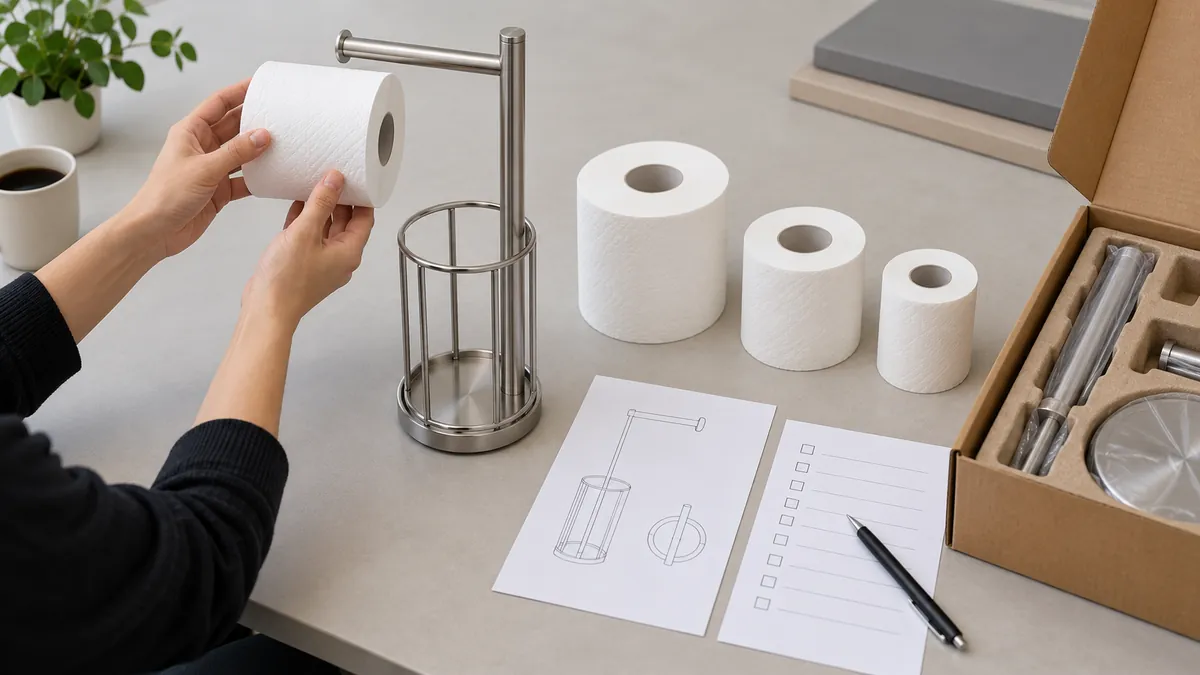
Concept illustration only. The actual roll set, product configuration and pack-out must be selected and approved for each project.
This review demonstrates fit only for the samples and configuration checked. It does not establish compatibility with every brand, a load rating, long-term durability or a performance guarantee. If the buyer changes the paper specification or the supplier changes the storage frame, repeat the relevant fit review and update the approval record.
Keep stability questions separate. The position and footprint of a freestanding unit can be a distinct product-design concern, but this article does not set a stability method or rating. For that separate question, see Koitor’s freestanding toilet-paper-holder stability design guide.
How should the BOM, package and product listing stay aligned?
Use one approved configuration record to connect the drawing, BOM, sample, packaging and product copy. The buyer should be able to trace each advertised capacity and each supplied component back to a specific SKU and revision. If a roll is only shown as a scale reference and is not included, say so in the product data and packaging artwork.
A supplier-facing BOM can list the frame, active-roll holder, reserve-support parts, base, fasteners or assembly pieces, finish, instruction sheet and packaging components. Mark each part as included, optional, buyer-supplied or excluded. If a version has a cover, tray, lid or added shelf, identify it as its own component and verify that the approved artwork depicts the same configuration. Do not let a stock image imply an accessory or roll count that the buyer has not approved.
For a metal design, ask the manufacturer to review the drawing and sample for the construction that matters to the chosen form: wire or tube geometry, sheet shape, joint locations, visible edges, surface finish, assembly access and protection in transit. The actual manufacturing route depends on the product drawing and the confirmed supplier scope. Do not infer a material grade, coating process or factory capability from a generic product image.
The product listing should state a defined capacity and the roll envelope that was actually approved. Avoid broad phrases such as “fits all jumbo rolls” unless the buyer has evidence for that exact claim. If a marketing team needs a shorter phrase, preserve the underlying limit in product data so the copy can be reviewed against the sample and target rolls.
Private-label artwork also needs change control. If the storage count, roll size, finish, included parts or assembly state changes, route the updated SKU and artwork through the buyer’s normal approval process. The private-label bathroom accessories page is a relevant starting point for packaging and product-development scope. Koitor’s custom tissue-holder manufacturing page covers the adjacent product category; it does not confirm that a particular freestanding reserve design is a current item.
Which sourcing mistakes create avoidable ambiguity?
The first mistake is treating a capacity phrase as self-explanatory. A listing that says “three rolls” may leave the active roll and reserve count unclear. The importer should put the intended count in the RFQ and require the supplier to match it on the sample, BOM and product data.
The second is using a generic size label instead of a measured target. “Jumbo” does not tell a factory which outside diameter or width to use for checking the frame. Share the chosen rolls or their dimensions, then record which specimens passed the sample review. This is more useful than copying another supplier’s dimensions.
A third mistake is approving a sample with a convenient substitute roll. If the chosen retail product is larger, wrapped, or shaped differently from the sample used, the approval may not cover the intended assortment. Keep the target rolls with the reviewed product record, or document their source and dimensions so the check can be repeated.
A fourth is mixing storage and dispensing. A reserve post may fit spare rolls while the active roll arm uses a different interface. Review each function separately and confirm how the parts are assembled. If the buyer wants an enclosed feed design, ask the supplier to show the loading and refill path on the selected sample instead of assuming the word “stocker” defines it.
A fifth is letting the photograph, instructions and carton list describe different products. The sample might show a reserve sleeve, the artwork might suggest a different count, and the BOM might omit the part. A side-by-side revision review is a small administrative step that can prevent a mismatch from reaching the importer’s product page or purchase order.
Finally, do not turn a sample fit check into a broad performance statement. One reviewed sample and one roll set support only the specific configuration and observations recorded. They do not prove universal compatibility, product durability, safety or a load value. If a commercial claim requires evidence beyond fit and pack completeness, assign that claim to the responsible product team and define the appropriate evidence before publication.
Buyer checklist before requesting a quotation
Before asking a factory or supplier for a quote, prepare a concise specification package:
- Product architecture: open stand, enclosed stocker or another defined layout.
- Active-roll position: orientation and the buyer’s expected replacement method.
- Reserve count: additional rolls stated separately from the active roll.
- Target roll set: brand or sample description, outer diameter, width and core opening where relevant.
- Storage envelope: any critical clear opening, spacing or internal clearance from the buyer’s drawing.
- Refill path: how the reserve positions are loaded and retrieved on the chosen design.
- Drawing and revision: overall dimensions, critical features and any finish or appearance reference.
- BOM: frame, roll supports, base, optional components, assembly parts and clearly excluded items.
- Sample approval: which target rolls were reviewed, which positions were filled, and what the buyer accepted.
- Pack-out: assembled or knock-down state, protective materials, instructions, labels and whether paper rolls are excluded.
- Listing and artwork: approved capacity language and any stated roll-size limits that match the reviewed configuration.
- Change control: who must reapprove a change to the drawing, roll envelope, reserve count, finish, BOM or retail copy.
When the project involves a metal bathroom accessory, send the supplier enough information to assess the actual work package. Koitor is a family-owned custom metal hardware factory focused on bathroom and home-storage hardware; the exact product form, components and manufacturing fit still need confirmation for each project. Drawings or a physical sample help define that review.
Foire aux questions
Does “three-roll capacity” mean three spare rolls plus the roll being dispensed?
Not necessarily. The buyer should define “reserve capacity” separately from the active roll and ask the supplier to confirm the total configuration on the sample and in the product data. A model-specific product page may use a capacity phrase that needs clarification for a different SKU.
Should an importer specify “jumbo compatible” in the RFQ?
Use the phrase only as a category label, then add the actual target roll envelope or sample. A fit statement should be tied to the roll set and model that were reviewed, not applied to every roll marketed as jumbo.
Can one sample prove a freestanding toilet paper holder with storage fits every toilet-paper brand?
No. A sample review can record fit for the selected rolls and configuration. If the buyer intends to support a broader assortment, define that roll range and review representative samples that cover it.
Are overall product dimensions enough to specify reserve-roll fit?
No. Overall height, width and depth describe the outside envelope. The usable space around a stored roll, access opening and refill path may need separate dimensions or a direct sample check.
Review a Bathroom Hardware Project
This guide does not confirm a specific freestanding reserve-roll holder in Koitor’s current range. If your concept may fit our custom metal bathroom-hardware scope, share the drawing or sample and ask for a project-fit review before requesting a quotation.
Fabrication pour compte de tiers / Marque de distributeur
Transformez ce guide d'approvisionnement en cahier des charges
Indiquez-nous le produit souhaité, ses dimensions, sa finition, la quantité commandée et vos exigences en matière d'emballage. Votre équipe recevra une analyse pratique de la faisabilité de la fabrication avant l'établissement du devis.


 English
 Español
 Português
 Français
 Deutsch
 العربية