
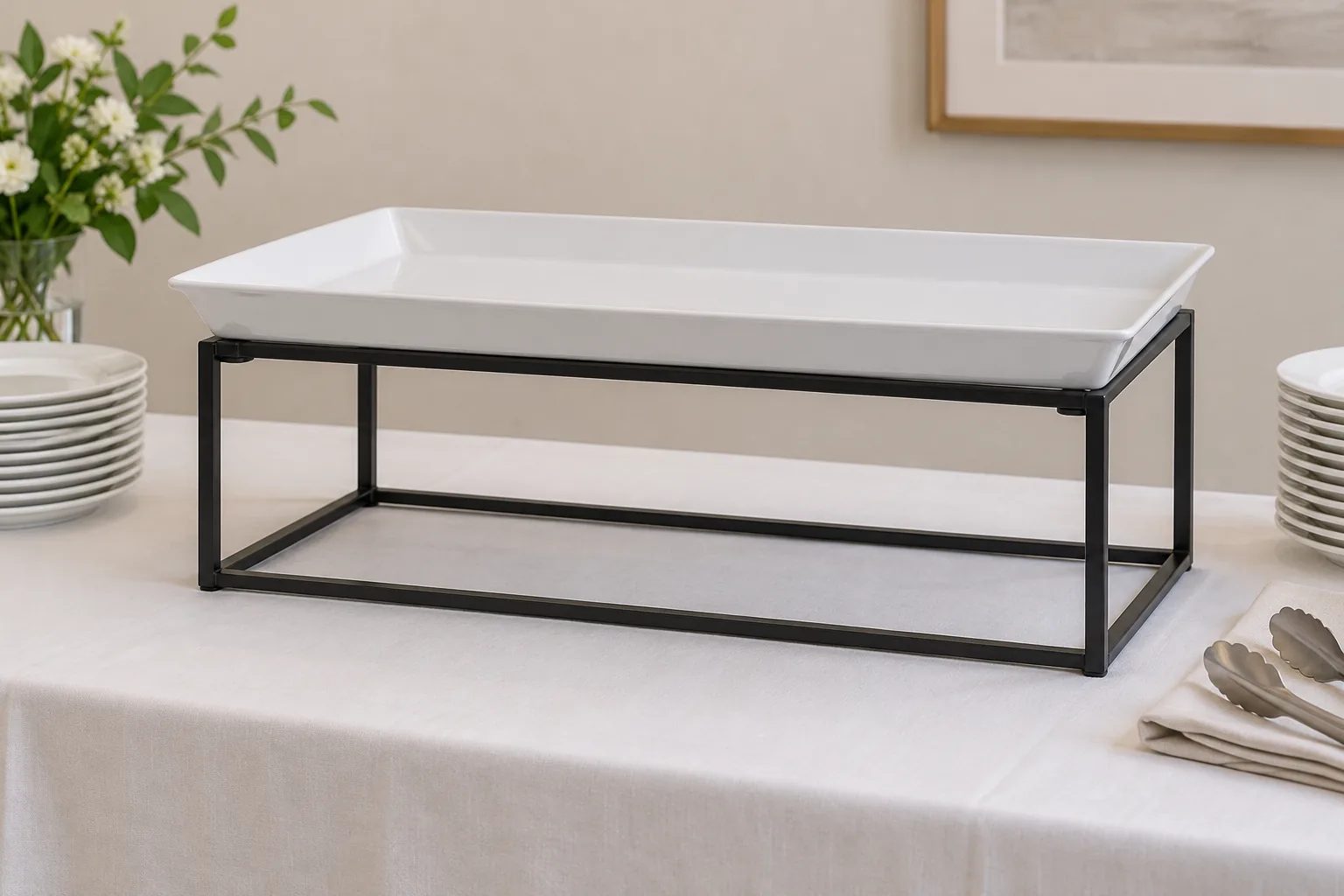
A metal buffet riser frame specification should identify the exact tray or top it supports, the contact and locating features, the assembled footprint, and the clearance needed for service. Importers should approve the frame and top together because similar outside dimensions do not guarantee the same bearing surface, retention, or hand access. A published model may be paired with a named top, but that fit remains specific to those products. The guide below covers non-heated display arrangements; it does not establish a load rating, food-contact status, or suitability for hot service.
Is the purchase a frame only or a complete riser set?
Begin by defining what the buyer is ordering. A complete riser set may include a metal frame and removable top. A frame-only item may be expected to fit a tray, board, platter, glass, or other surface sourced elsewhere. The RFQ should name all components and list who supplies each one.
This distinction changes the approval evidence. If the top is sold as part of the set, request the current combined drawing and sample. If the importer supplies a third-party top, provide its physical sample or technical drawing and identify the material, thickness, outside dimensions, underside geometry, and any edge treatment that affects the contact point. Do not assume a frame fits simply because its overall length is similar to the top’s catalog name.
Cal-Mil’s published buffet-riser range illustrates model-specific pairing: a metal frame is listed with a particular top size. Another product family presents a different frame shape and height. Those manufacturer listings support the need to specify an exact frame/top combination. They do not establish compatibility with a different supplier’s tray or prove that a named nominal size equals every listed dimension. Request current drawings with units shown clearly and check apparent unit conversions rather than repeating an inconsistent figure.
| Purchase configuration | Buyer supplies | Sample approval focus |
|---|---|---|
| Frame and top as one set | Intended serving layout and quantity | Combined dimensions, contact, assembly and access |
| Frame only, top sourced separately | Top drawing/sample and material data | Actual top-to-frame interface and supplier ownership |
| Multiple interchangeable tops | Every intended top and revision | Fit repeatability, changeover and exception list |
| Modular display family | Layout, intended combinations and sequence | Each combination, not just one representative pair |
A modular assortment can be useful, but “modular” is not a substitute for a compatibility matrix. Identify which tops, frames, heights and arrangements have actually been checked. Keep untested combinations out of product claims and sales materials.
Which tray-to-frame dimensions should be captured?
Record the top’s outside length and width, thickness, edge profile, underside shape, and the actual regions that touch or rest on the frame. Measure the frame’s supporting rails, perimeter, contact pads or ledges, and any locating feature. The buyer needs functional dimensions as well as the external envelope.
If the top has a rim, lip or non-flat underside, note whether it clears the frame and whether it can sit in the intended position. If locating features prevent lateral movement, show their position and clearance on the drawing. If the design relies only on gravity and contact, say so; do not invent a retaining feature. Check the combined top and frame from above and below to see whether any contact is concentrated on a corner or a small area.
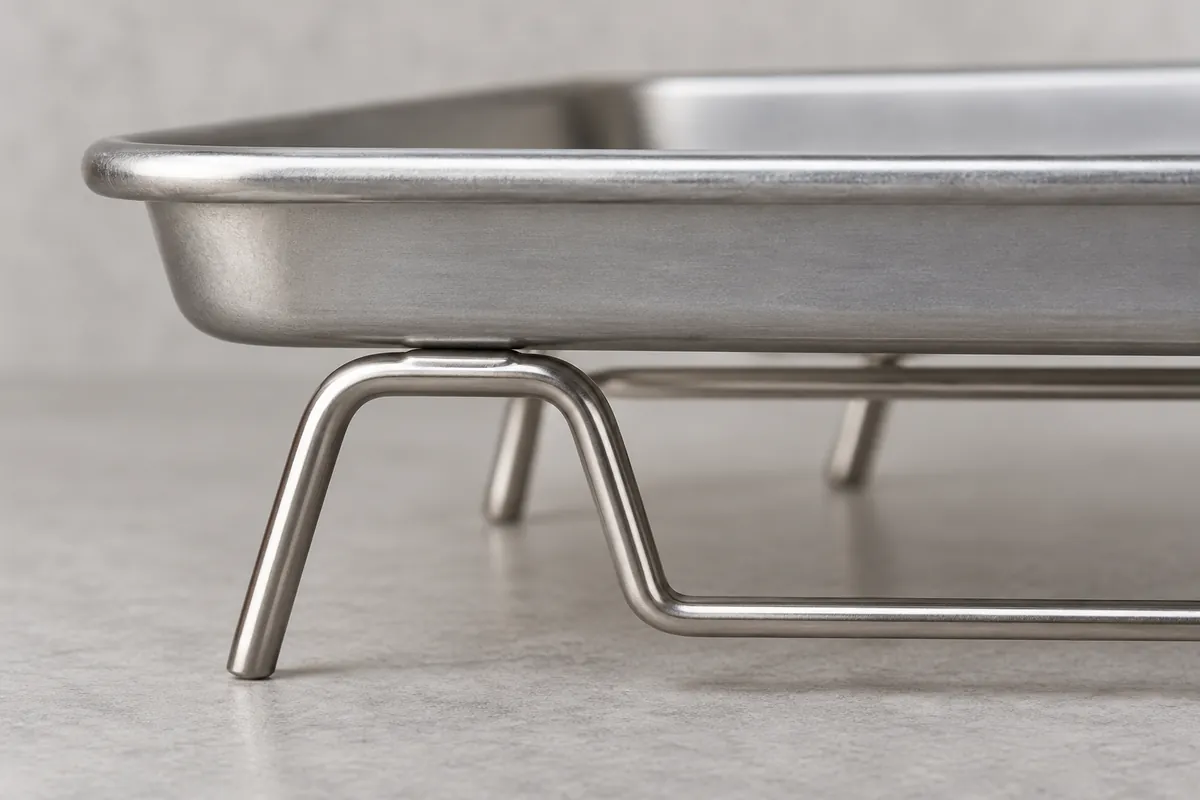
Use actual tolerance information from the suppliers. A top’s outside dimension can vary with material, cutting or finishing. A metal frame can vary with forming, weld placement, coating and assembly. The buyer should define which interface dimensions are critical and how they are inspected, especially when the frame and top come from different vendors.
Do not use a catalog title as a substitute for a drawing. Ask for overall dimensions, usable support span, clear opening, rail locations, height, contact points, assembly method and top references. If the supplier cannot provide every tolerance, the buyer can identify the most important dimensions and review physical samples before approving production.
How do service clearance and layout affect the choice?
A riser can fit a tray but still be awkward in a real serving layout. Measure the occupied footprint, including outward rails, feet, handles, clips and any protrusions. Then add the access space needed for staff to place or remove the top, reach the serving area, and clean around the assembly.
Consider how a user approaches the display. Is the top lifted straight up, slid from one side, or placed onto the frame before the frame goes on the table? If the arrangement is part of a buffet line, adjacent trays, sneeze guards, wall edges, signage, utensils, and staff movement can constrain the usable space. These are buyer-specific layout questions; a single studio image cannot show the exact venue.
Record the assembled height and the top’s working elevation. This helps assess whether hands and utensils can reach the displayed items without contacting the frame or neighboring products. Do not assume that greater height improves access or presentation for every use. A buyer may prefer lower risers for stability, clearance or sightline reasons, while another layout may value vertical separation. The actual service plan should determine the relevant dimensions.
Use a sample mock-up or a measured layout to check:
- Space for staff to place, remove and replace the top.
- Reach to the intended serving area from the user side.
- Clearances to nearby trays, signage, wall surfaces or equipment.
- Whether adjacent frames collide when arranged as a set.
- Whether a removable top can be lifted without first moving another item.
- Which orientation is shown in packaging and merchandising images.
What should the buyer review about structure and finish?
The frame’s structure needs to match the way it supports the top. Review the number and location of rails or supports, the joints, cross-members, feet, and any assembly connection. For a fabricated metal component, drawing review may consider bending, punching, welding, grinding, polishing, coating or other finishing steps as appropriate to the chosen design. These process terms describe possible engineering considerations; they do not certify a particular design or its performance.
Inspect the sample for rocking on the agreed surface, contact at the intended supports, alignment of joints, exposed edges and finish consistency. If the frame is supplied flat-packed, check the fasteners, assembly order and repeatability. Record whether tools are required and whether parts can be confused during assembly. Keep the accepted sample and identify its drawing revision.
A stability or load requirement must be defined by the buyer and qualified supplier for the actual frame, top, support arrangement and use. Do not infer safe load from metal thickness alone or from the appearance of a welded joint. If a project needs a test, agree on the configuration, method, duration and acceptance rule before relying on the result. No test data or load threshold is assumed in this guide.
Also confirm product-care instructions with the responsible supplier. A published care note for one model should not be applied to another metal, coating, top material or assembly. Avoid unsupported statements about dishwasher use, food contact, hot-food service, heat resistance, corrosion performance or commercial cleaning chemicals. The relevant data belongs to the exact product and intended use.
How should importers approve the paired sample?
Use a reference top and frame with component identifiers. Measure both components separately and then measure the combined assembly. Check top seating, alignment, movement under the intended handling, removal, assembly, and service access. If buyers expect multiple top styles, repeat the review with each one.
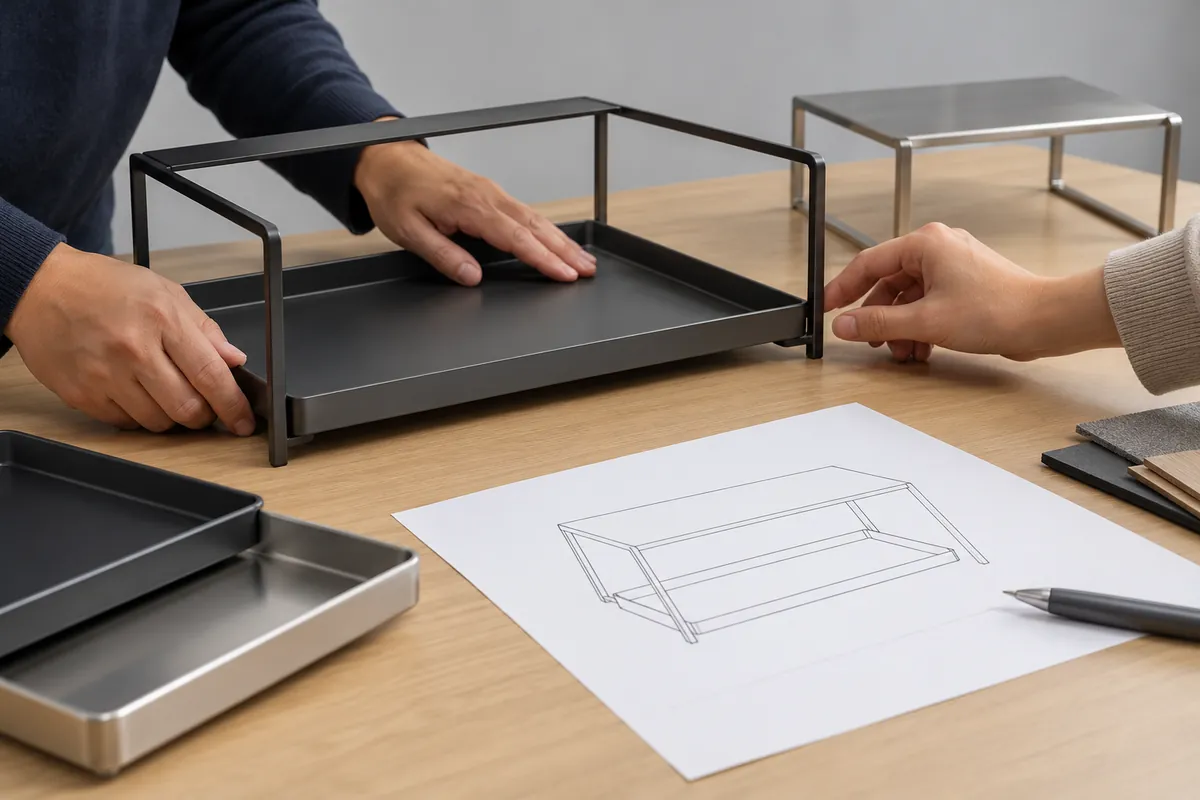
A reproducible paired-sample sequence is:
- Confirm the frame and top identifiers, drawings and revisions.
- Inspect component dimensions, contact surfaces and visible finish.
- Assemble the frame using the supplied hardware and instructions.
- Place the intended top in each specified orientation.
- Confirm the locating or supporting features engage as drawn.
- Mock up the intended service layout and check access.
- Observe the assembly using an agreed handling or stability method.
- Record any movement, interference, cosmetic issue or exception.
- Review packaging and recheck visible surfaces after unpacking.
- Sign off the exact pair, not a generic product family.
If a buyer requires a loaded demonstration, define the actual top, contents, placement and method. Do not use food or a photo prop as an informal substitute for a defined test. A demonstration can show an observed configuration, but broader performance claims need appropriate product evidence.
What belongs in the specification and quotation?
An effective RFQ gives suppliers enough information to quote the same product. Include: A metal buffet riser frame specification should keep the approved top and frame drawing revisions together.
| RFQ item | Avis des acheteurs |
|---|---|
| Frame concept | Sketch, overall envelope, height, assembly and orientation |
| Top or tray | Supplier, model, sample, material, dimensions and underside |
| Interface | Support span, contact areas, locating features and clearances |
| Use layout | Counter/buffet arrangement, adjacent equipment and access direction |
| Structure | Critical rails, joints, feet and serviceability considerations |
| Finish | Visible faces, reference color/surface, cosmetic acceptance and care data |
| Testing | Any required method, exact configuration and acceptance owner |
| Complete pack | Top, frame, fasteners, instructions, pads and replacement components |
| Commercial plan | Target quantity, trial order, repeat forecast if known, packaging and label needs |
Separate the metal frame from third-party tops, glass, wood, stone, plastic or other surfaces in the bill of materials. The component supplier responsible for a top should provide its material and use data. Koitor’s approved company facts support metal hardware manufacturing knowledge, not the manufacture or certification of every possible surface material.
For private-label programs, give authorized artwork and packaging instructions. Confirm carton count, separation of components, protective materials and any assembly sheet. A sharp rail, exposed fastener, or finish-to-finish contact may need attention in the packed sample. Do not presume that heavier packaging is always better; review the actual product, shipping configuration and buyer requirements.
Which mistakes create poor compatibility or avoidable cost?
One mistake is pairing by nominal dimensions alone. A frame may have the same stated length as a tray but a smaller contact span, misaligned support rails or a conflicting lip. Compare drawings and physical samples at the interface.
Another is reviewing only the empty frame. The actual top can change the assembled footprint, height and interaction. Approve the pair and record the reference components.
A third is assuming one successful top proves that several tops fit. Differences in underside shape, material, edge treatment and thickness can alter seating. Test every combination included in the assortment or state which model is approved.
A fourth is leaving stability or load claims vague. “Strong enough for buffet use” is not a measurable criterion. Define the exact top, contents, support placement and test required. If the buyer has no protocol, avoid an unsupported numeric claim and agree on what evidence is appropriate.
A fifth is forgetting assembly and service access. A frame that fits a drawing may not be practical to assemble next to a wall or to clean under in a service layout. Mock up the real access path before final approval.
A sixth is assuming a component’s care guidance applies to the entire set. A metal frame, coating and removable top may have different care limits. The supplier of each component should provide current instructions for its item, and the importer should align the combined product copy accordingly.
What can Koitor contribute to a metal-frame project?
Koitor Hardware is a family-owned custom metal hardware manufacturer with experience in bathroom and home-storage hardware. The documented process knowledge includes metal forming, punching, bending, welding, grinding, finishing, powder coating, assembly, packaging and sample development. Buyers can use that background to discuss whether a drawing for a metal support frame merits a bounded feasibility review. It does not mean Koitor currently offers a buffet-riser frame, makes a paired tray, has tested a load for this design, or supplies a food-contact-certified product.
Provide the frame sketch, actual top, desired finish, intended service arrangement, target quantities, packing needs and any test requirements. Mark which dimensions are critical and which may be revised after sample feedback. If the top is purchased separately, identify its manufacturer and keep responsibility for its claims with that supplier.
Buyers can learn about Koitor’s core metal-hardware positioning on the OEM home-storage page and the custom metal storage-rack page. Those pages are background on the factory’s documented category, not evidence that it has this adjacent SKU. Send project information through the contact page.
What should the buyer retain after approval?
The metal buffet riser frame specification should identify the exact top, support dimensions and service arrangement retained in the approval record. Keep the signed frame and top drawings, the physical sample identifiers, photographs of contact points, any layout mock-up, and the written acceptance notes. A useful record states what was checked, which items were absent, and which use cases remain outside scope. That is essential if the buyer changes a top vendor or modifies the frame after the first order.
The approval record should include:
- Exact frame and top models, suppliers and revisions.
- Overall and functional dimensions with units.
- Support and contact geometry.
- Assembly hardware and installation sequence.
- Service layout, top removal path and clearance.
- Finish, edges, visible faces and care information.
- Agreed handling, stability or load review method, if applicable.
- Packaging configuration and inspection after unpacking.
- Components or claims not verified.
- Change-control conditions for top, frame, finish or fasteners.
A buffet riser is best treated as a paired system, even when the components arrive in separate cartons. Clear responsibility and repeatable sample evidence help the importer compare quotes, control private-label copy and manage reorders without relying on a product-family assumption.
Foire aux questions
Can any tray sit on a metal buffet riser frame if the sizes match?
No. The underside, edge profile, thickness, support span, contact points and any locating feature also matter. Check the actual tray and frame together.
Does a published frame-and-top pairing prove compatibility with another brand’s top?
No. It documents the named model combination only. A different top requires its own fit review and approval.
Can a buyer use a load shown in a supplier photo as a rated capacity?
No. A photo is not a defined test report. Request evidence for the exact configuration and intended claim, or agree a project-specific method.
Does metal construction mean the frame is suitable for hot food or a dishwasher?
Not automatically. Material, finish, top, assembly and care limits must be verified for the exact product and environment.
Collaborez avec Koitor Hardware
Reviewing a Metal Buffet Riser Frame?
Share the intended tray, frame drawing, service layout, finish reference, pack scope and sample criteria for a bounded metal-component feasibility discussion.
Fabrication pour compte de tiers / Marque de distributeur
Transformez ce guide d'approvisionnement en cahier des charges
Indiquez-nous le produit souhaité, ses dimensions, sa finition, la quantité commandée et vos exigences en matière d'emballage. Votre équipe recevra une analyse pratique de la faisabilité de la fabrication avant l'établissement du devis.


 English
 Español
 Português
 Français
 Deutsch
 العربية