

Phillips vs JIS is not a safe shorthand for “always incompatible” or “always interchangeable.” Phillips commonly names a cross-tip driver and recess family, while JIS refers to a Japanese Industrial Standard or a supplier’s specific declaration about a product. A maker may state that a particular driver geometry meets a named standard or works with specified fasteners, but that statement does not automatically apply to every driver and screw sold under broad labels. Buyers should identify the actual tool, mating fastener, designation, and scope of the supplier’s evidence.
What Do Phillips and JIS Describe?
Phillips is commonly used in everyday buying language for cross-tip drivers and screw recesses. JIS is a standards designation associated with Japanese Industrial Standards; in a product claim, it may appear as part of the maker’s statement about a particular driver, screw, or compatibility. The terms do not always describe the same type of thing, so a buyer should first establish whether a document is naming a shape, a standard, or a maker’s compatibility claim.
That distinction is important because product terminology has accumulated over time and is often simplified in consumer discussions. A supplier’s product page may use a familiar label while also referencing a standard, a particular tip geometry, or a compatibility statement for its own model. The buyer should record what the source actually says instead of extending it to a whole category.
TEKTON’s article about JIS and Phillips identifies its subject as a comparison of tip geometry and compatibility. It states that its own Phillips tips are made to ISO 8764-1 and are compatible with JIS screws, and it describes JIS as a standard rather than a separate tip type. That is a maker-authored statement about the products and interpretation covered by the page. It is not an independent certification for every driver, every fastener, or every product carrying “Phillips” in a title. (TEKTON: JIS vs Phillips)
The article also makes broader assertions about how the standards relate. This guide does not treat those statements as a universal or current normative conclusion, because the research pack did not include full current ASME, ISO, or JIS standards or a complete dimensional review. A buyer making a standards-based requirement should consult the current standard text and responsible manufacturer documentation, rather than use a blog article as the complete technical authority.
| Label in a document | Possible meaning | Buyer should confirm |
|---|---|---|
| Phillips | Common cross-tip product or recess label | Exact tool model, size, referenced geometry, and mating fastener |
| JIS | Japanese standard reference or product compatibility claim | Which standard, edition, product, and interface the statement covers |
| Cross-tip | General description of a cross-shaped engagement | Whether a more specific profile or designation is required |
| JIS compatible | Maker’s claim for an identified product | The exact product and supplier evidence behind that claim |
| Phillips/JIS | Often compressed shorthand | Whether the buyer is comparing names, standards, or a particular pair of products |
Why Do Blanket Compatibility Claims Create Risk?
In a Phillips vs JIS review, a universal claim hides the product details that determine the actual fit. The important question is not “Can any Phillips tool fit any JIS screw?” It is “What does the maker state about this particular tool and mating fastener, and what evidence supports the intended application?” A compatible product claim must be read within its declared scope.
One maker’s documentation may state that a particular tip is produced to one named standard and compatible with fasteners associated with another. That statement should not be generalized to all brands, sizes, worn tools, damaged recesses, or unverified screws. Similarly, a forum anecdote does not establish that every Japanese-origin screw follows one profile or that every cross-tip tool will fail. The correct response to conflicting generalizations is to identify the actual item and verify its intended pairing.
The product-specific statement from TEKTON’s own product pages is more useful than an untethered blanket. The supplier describes its own Phillips tips as made to ISO 8764-1 and compatible with JIS screws. This identifies an actual maker, a product family, a stated standard, and a stated compatibility scope. It still remains a manufacturer’s declaration; the source reviewed for this article does not provide a third-party test report for every fastener or assembly. (TEKTON product example)
For a buyer, the risk is usually a specification or kit mismatch. If procurement selects a tool by a broad label but assembly instructions identify another fastener, the kit may contain the wrong item, a supplier may quote an unintended alternative, or a receiving reviewer may be unable to judge what “compatible” means. These are plausible process risks, not a claim about how often a particular failure occurs.
A useful procurement rule in any Phillips vs JIS sourcing decision is to keep three records separate:
- The fastener requirement: the actual screw, recess, size, and any controlling drawing or product data.
- The driver requirement: the tip, size, and model of the tool being supplied or recommended.
- The compatibility statement: the maker, exact products, standard reference, conditions, and limitations covered by the claim.
Keeping the records separate makes a supplier’s answer easier to verify. It also means a tool change can be reviewed without silently changing the fastener description.
How Should Buyers Interpret a Maker’s Compatibility Statement?
Treat a compatibility statement as bounded evidence. Read the full source page and identify who makes the claim, which product it covers, which fastener it names, and which standard or condition is referenced. If a statement is attached to a specific driver line, it cannot automatically authorize a different model or another supplier’s screws.
A maker’s product page can be a useful first-party source for its own product. For example, a page may state that the driver tip follows a referenced standard and is intended to engage a certain fastener category. This allows the buyer to ask a concrete follow-up: does that declaration cover the exact tool model, the required size, and the fastener in this order? If the supplier’s answer changes the scope, ask for the revised product data or a controlled sample review.
Avoid translating words such as “compatible,” “fits,” or “meets” into a performance guarantee. A fit statement does not automatically prove torque capacity, resistance to wear, fastener quality, joint strength, or durability. A standard reference is also not a substitute for confirming the actual product’s designation and condition. If the product has a specialized cross-recess variant, security feature, or size convention, capture it in the drawing or approved bill of materials rather than relying on a category name.
The buyer can use a short evidence matrix:
| Review question | Evidence to request | What not to infer |
|---|---|---|
| Which driver is covered? | Maker and model or item number | That all Phillips drivers share the claim |
| Which screw is covered? | Fastener designation or referenced product | That every JIS-labelled screw is identical |
| What does the standard reference mean? | Standard number and applicable edition, when required | That a blog summary replaces the standard |
| What does “compatible” mean here? | Maker’s stated scope and any documented conditions | That fit proves torque or joint performance |
| Has the product changed? | Current revision, sample identification, or updated declaration | That an old claim applies to a new product |
If the claim matters contractually, reference it in the RFQ or approved specification with the product and revision identified. Ask the supplier to declare any substitution before order release. For a requirement tied to a formal standard, obtain the current authoritative standard or a responsible certification statement where applicable. This article does not provide a standards interpretation or determine whether a particular product conforms.
What Should an Importer Record in a Hardware Kit Specification?
A kit can include the product, fasteners, a driver, anchors, washers, assembly instructions, and spare parts. Each item has an owner and a description. A clear specification identifies the interface and supplied contents so that purchasing, receiving, assembly, and customer support use a consistent baseline.
When a fastener is part of a metal storage or bathroom hardware product, record the actual screw or fastener designation rather than only saying “cross head.” Identify which component it joins, whether it arrives installed or packed separately, and whether the driver is included. If the buyer is not prescribing the driver model, ask the supplier to state what is intended for the specified fastener and what evidence underlies that recommendation.
A bill of materials can capture at least:
- Product code and controlled revision.
- Fastener location, quantity, and supplier part number.
- Recess or drive designation as supplied by the responsible maker.
- Driver tip type and size, if included or required.
- Any cited standard, edition, or compatibility statement.
- The source or record where the maker’s statement was reviewed.
- Sample or approval reference.
- Packaging arrangement, including loose or preassembled parts.
- Any buyer decision that remains open before release.
The same information should appear consistently across the BOM, purchase description, packaging list, and assembly instructions. If the product is private label, avoid shortening the description during artwork preparation in a way that removes the distinguishing profile or model. If a supplier uses a different naming convention, preserve the supplier’s exact terminology alongside the buyer’s plain-language description.
This is not busywork. It reduces the chance that one department interprets “JIS” as a special tip, another as a standard reference, and a third as a broad country-of-origin description. The record should make the actual fastener and driver identifiable even after an order is repeated months later.
For supplier review, ask whether the fastener is supplied by the product manufacturer, sourced from a sub-supplier, or specified by the buyer. If a sub-supplier’s claim is passed through, keep the original statement or product data in the project file. Do not treat a quotation note as proof of a standard unless it identifies what is being claimed. The buyer can then compare alternatives on a like-for-like basis without assuming the profiles are interchangeable.
How Can Buyers Review the Actual Tool and Fastener?
A sample review should answer a narrow question: does the physical tool and fastener correspond to the documented pair? First identify each item and its manufacturer. Then compare the tip and recess with the specification. If the maker provides a compatibility statement, check that the model and size match that statement. Keep the review within the actual supplier’s instructions and do not improvise with an unapproved tool.
A useful sequence is:
- Match the driver model and size to the supplier’s document.
- Match the fastener part number or drawing note to the BOM.
- Check that the claimed pair is the same driver and fastener covered by the maker’s declaration.
- Record whether the sample is new, previously assembled, worn, or otherwise not representative.
- Note the approved revision and any discrepancy requiring clarification.
- Confirm the final packaging contents and instructions reflect the approved decision.
A visual check may help detect that a part is plainly different from a photograph, but images are not precise profile measurements. A hand-fit check can also be misleading if a fastener or driver is damaged, incorrectly sized, contaminated, or made outside the referenced specification. Do not turn a casual fit check into a torque test or durability conclusion.
If a buyer requires formal verification, define the method with the responsible engineering or quality team. The relevant method may depend on the applicable product specification, standard, or manufacturer instructions. This article intentionally does not provide dimensions, test forces, tool settings, or acceptance thresholds. The project’s controlled documentation should define those details.
The supplier should also clarify how it handles revisions. A change in tool model, fastener source, size, profile, or packaging can affect the compatibility statement or assembly kit. The buyer should decide which changes require review and how approval will be recorded. For repeat orders, compare the incoming product against the same controlled baseline rather than relying on a historic email or a remembered sample.
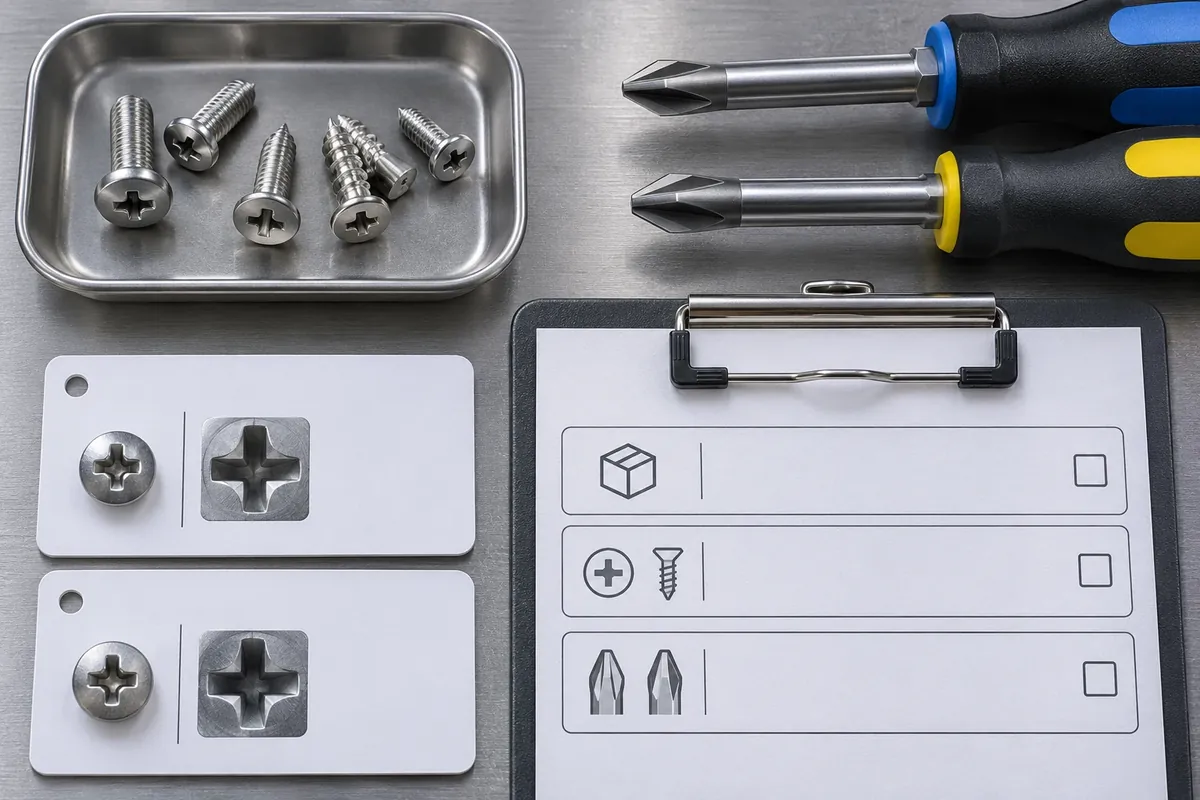
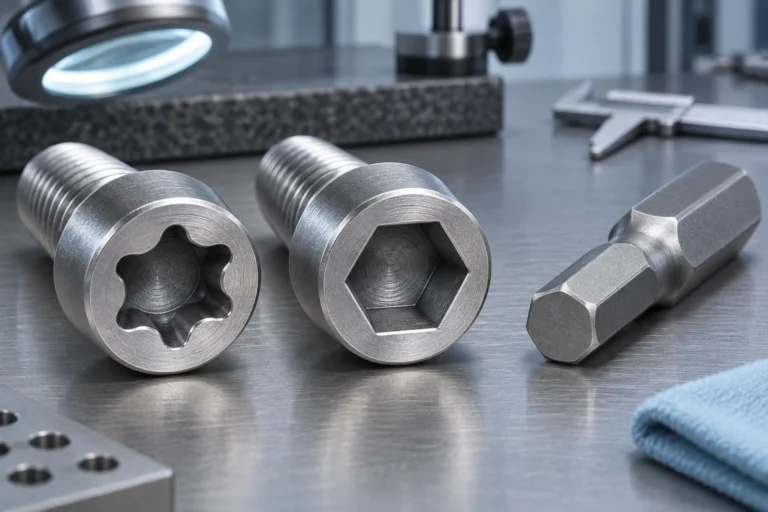
The images here are generic illustrations of profile review and documentation. They do not represent a Koitor fastener, a verified tool-and-screw pairing, or a test outcome.

What Should Change When a Claim Is Unclear?
If a supplier says “Phillips compatible with JIS” without identifying the tool or screw, ask for the exact product data and scope. If a quotation says only “JIS screw,” ask whether it refers to a fastener made to a specified standard, a maker’s compatibility description, or an internal product label. If a package includes a driver, verify that the tip size and fastener are identified together.
Keep the follow-up factual and limited:
- “Which driver model and tip size does this declaration cover?”
- “Which fastener part number or controlled drawing does it cover?”
- “Which standard and edition are referenced in the current product data?”
- “Does the claim apply to this exact ordered pair, or is another confirmation required?”
- “What change would require the buyer to reapprove the sample or kit?”
These questions avoid asking a supplier to prove a broad statement that may not be testable as written. They also give both sides a clear basis for deciding whether to accept the current documentation, request a sample, or revise the specification. If no reliable answer is available, leave the item open rather than treating the label as verified.
A change request should state the proposed replacement, reason, and impact on the drawing, BOM, assembly instructions, package contents, and any buyer requirement. Approval should identify the new baseline. The supplier can then confirm whether it accepts the revised scope and whether its documentation applies to the replacement. This change-control approach is relevant even when the new part appears visually similar.
A related live guide compares Phillips and Pozidriv screws in a hardware kit. That article covers a different cross-tip distinction; use it for that question, while the present article focuses on how to read a JIS compatibility statement without turning it into an unsupported universal rule.
A practical record can include a short source note alongside the product data: who made the declaration, when it was reviewed, which item number it covers, and whether it refers to the driver or the fastener. This does not turn a marketing statement into a conformity certificate. It simply preserves the context so a later buyer can determine whether the claim still applies to a replacement model or revised order. When a supplier changes a component, compare the new part number and supporting documentation with the approved baseline rather than carrying over an old note automatically.
For receiving teams, make the inspection question answerable from the order paperwork. If a carton contains a driver and multiple fastener sizes, the packing list or kit map should identify each pairing. A receiver can then check the delivered contents against an agreed description without being asked to infer a standard from appearance. If a discrepancy is found, record the item and revision, photograph the relevant interfaces where useful, and request clarification from the responsible supplier. Do not mark a substitute accepted until the buyer’s approval process is complete.
This approach also keeps standards references in their proper place. A standard can define requirements for the products within its scope, but a brief statement such as “JIS compatible” might not identify the exact edition, size, driver, or fastener. If those details matter to a contract, request them before order placement. Where the available product statement is incomplete, record the limitation and ask for more specific evidence instead of interpreting the wording beyond what the source supports.
Buyer Checklist Before Approving a Cross-Tip Fastener
- Identify whether each label refers to a tip profile, fastener recess, standard, or maker’s compatibility claim.
- Record the exact driver manufacturer, model, and size.
- Record the exact fastener part number, size, and drawing or BOM revision.
- Keep the physical tool and mating screw references together.
- Capture the standard number and edition where a standards requirement applies.
- Read compatibility claims within the scope of the maker’s named products.
- Do not convert one maker’s statement into a universal category rule.
- Confirm what the retail or installation kit actually contains.
- Reconcile the BOM, sample, package list, and instructions.
- Route profile, size, supplier, and tool changes for buyer review.
- Use qualified engineering guidance for formal test or acceptance requirements.
- Retain the evidence path and sample identifier for repeat orders.
Foire aux questions
Is JIS a separate cross-tip shape?
The research source reviewed for this article describes JIS as a standard designation rather than a distinct tip type. Because this is a standards-related topic and the full current normative texts were not reviewed, buyers should check the applicable standard and exact product documentation for a formal requirement.
Are Phillips drivers always incompatible with JIS screws?
No universal rule is established here. TEKTON states compatibility for its own declared tip geometry and product scope. That statement should not be generalized to every brand or fastener.
Does a maker’s compatibility claim prove a driver will fit every screw?
No. Read the claim for the exact model, size, fastener, and stated conditions. The wording does not automatically apply to all products in a category.
Does a fit claim prove torque performance?
No. Compatibility wording alone does not establish torque capacity, joint strength, wear, or service life. Those require separate requirements and appropriate evidence.
What should an importer do if the supplier uses “Phillips/JIS” as one label?
Ask the supplier to identify whether the phrase means a tool profile, a referenced standard, or a compatibility claim. Record the actual fastener and driver products separately.
Sources and Scope
- TEKTON, JIS vs Phillips: Understanding Tip Geometry, Myths, and Fastener Compatibility — used for the maker’s stated interpretation and product-specific compatibility example; its broader standard comparisons are not adopted as independent conclusions.
- TEKTON, Phillips/Slotted/Torx/Square Screwdriver Set — used only to identify a specific maker’s own product declaration.
- Koitor’s live internal link is a related cross-tip buyer guide and navigation path; it is not evidence of tool manufacturing or universal compatibility.
- Full current ASME, ISO, and JIS standard texts were not reviewed for this article. No dimensions, conformity verdict, or legal/standards advice is provided.
Reviewing Fasteners for a Custom Hardware Kit?
Share the controlled drawing, sample, and kit requirements. Koitor can review product scope within its confirmed bathroom and home-storage hardware capabilities; the fastener specification should be confirmed by the responsible supplier.
Fabrication pour compte de tiers / Marque de distributeur
Transformez ce guide d'approvisionnement en cahier des charges
Indiquez-nous le produit souhaité, ses dimensions, sa finition, la quantité commandée et vos exigences en matière d'emballage. Votre équipe recevra une analyse pratique de la faisabilité de la fabrication avant l'établissement du devis.

 English
 Español
 Português
 Français
 Deutsch
 العربية