
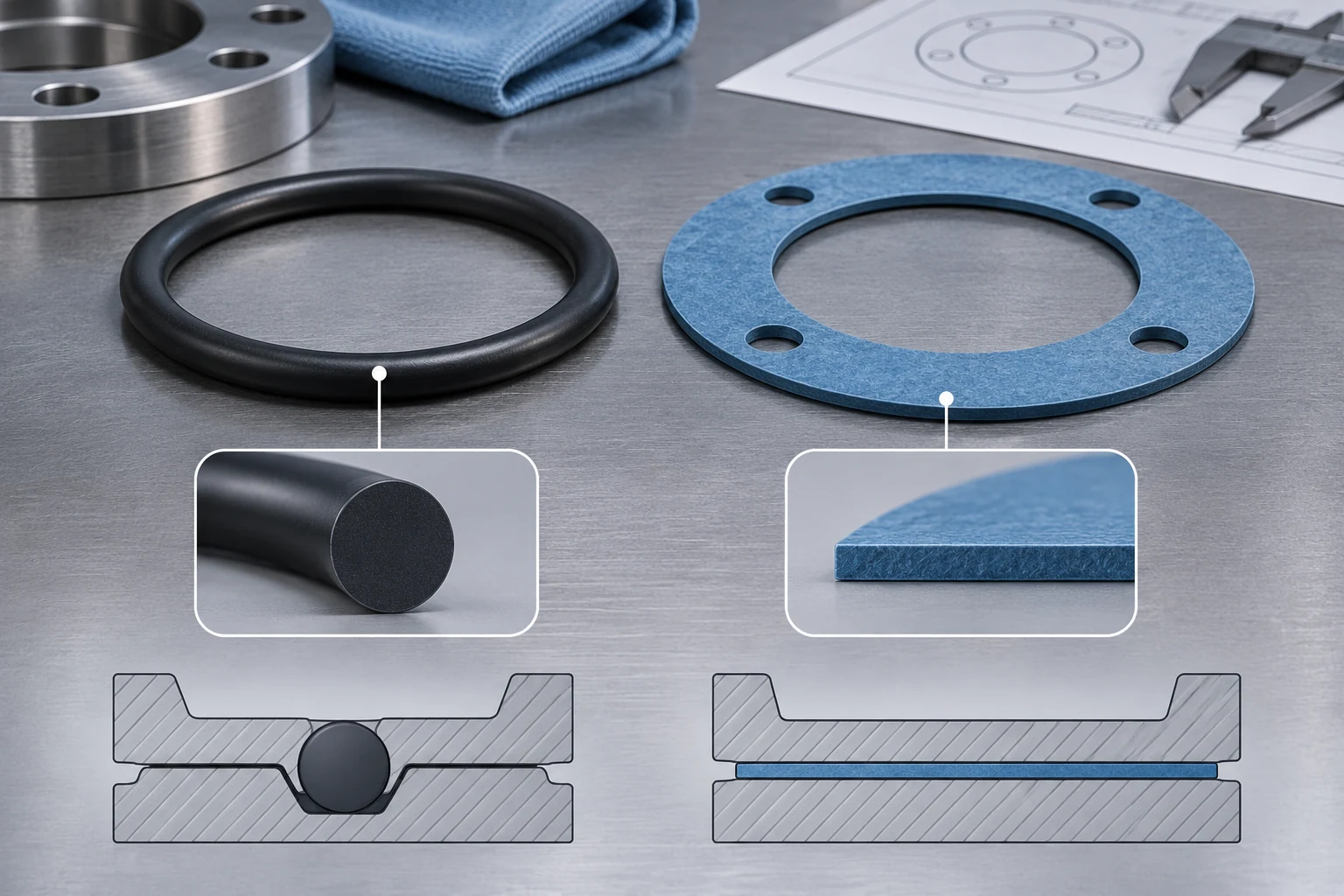
O ring vs gasket is a comparison of common seal constructions, not a universal ranking of which part seals better. A conventional O-ring has a round cross-section and is typically seated in a designed groove or mating space; a flat gasket has a broad, usually flat profile that follows a surface outline. A gasket can be ring-shaped in plan view and still differ from an O-ring in cross-section and compression arrangement. Buyers should identify the actual part geometry, material, mating surfaces, movement, and supplier evidence before treating two seals as alternatives.
What Is the Difference Between an O-Ring and a Gasket?
In a conventional comparison, an O-ring is a seal with a round cross-section arranged around a path, while a flat gasket is a sheet-like or profile-cut seal compressed between surfaces. The difference is about construction and how the seal sits in its mating space, not simply whether the outer outline is circular.
An O-ring commonly occupies a groove or gland designed around its section and the adjacent component. It may be used in static applications with little relative motion or in dynamic applications where movement occurs, depending on the actual design. A flat gasket commonly follows the shape of the interface and is compressed between broader mating surfaces. It can be circular, rectangular, irregular, or include holes and cutouts that match the assembly.
Apple Rubber’s published overview describes O-rings as round-section components sitting in a groove and gaskets as flat seals between surfaces. It also notes that O-rings can be designed for both static and dynamic uses. This guide uses those points only as general construction context. Apple Rubber’s broad statements about pressure or temperature winners are not adopted because a seal’s suitability depends on the specified application and actual design. (Apple Rubber: O-Ring vs Gasket)
| Review point | Conventional O-ring | Flat gasket | Buyer confirmation |
|---|---|---|---|
| Cross-section | Typically round | Typically flat or profile-cut | What section does the actual part have? |
| Mating space | Often designed around a groove or gland | Often follows a broader interface outline | Which surfaces and features locate the seal? |
| Outline | Often a closed loop, which may not be circular | Can be a loop or complex cut shape | Does the drawing distinguish outline from section? |
| Compression arrangement | Depends on groove and joint design | Depends on the interface and fastening design | Which controlled drawing describes the arrangement? |
| Matériau | Varies by supplier and application | Varies by supplier and application | What material or compound is approved? |
| Use condition | Static or dynamic designs exist | Application-specific | Is there relative motion or another condition to assess? |
Names overlap in real product descriptions. A component may be called a “gasket” because of its sealing function even if it uses an O-ring section, such as an O-ring face seal. Conversely, a flat gasket may form a ring in outline but remain flat in cross-section. Use the drawing, section view, and supplier’s part identification to resolve ambiguous terminology.
Why Does a Ring-Shaped Outline Not Identify the Seal Type?
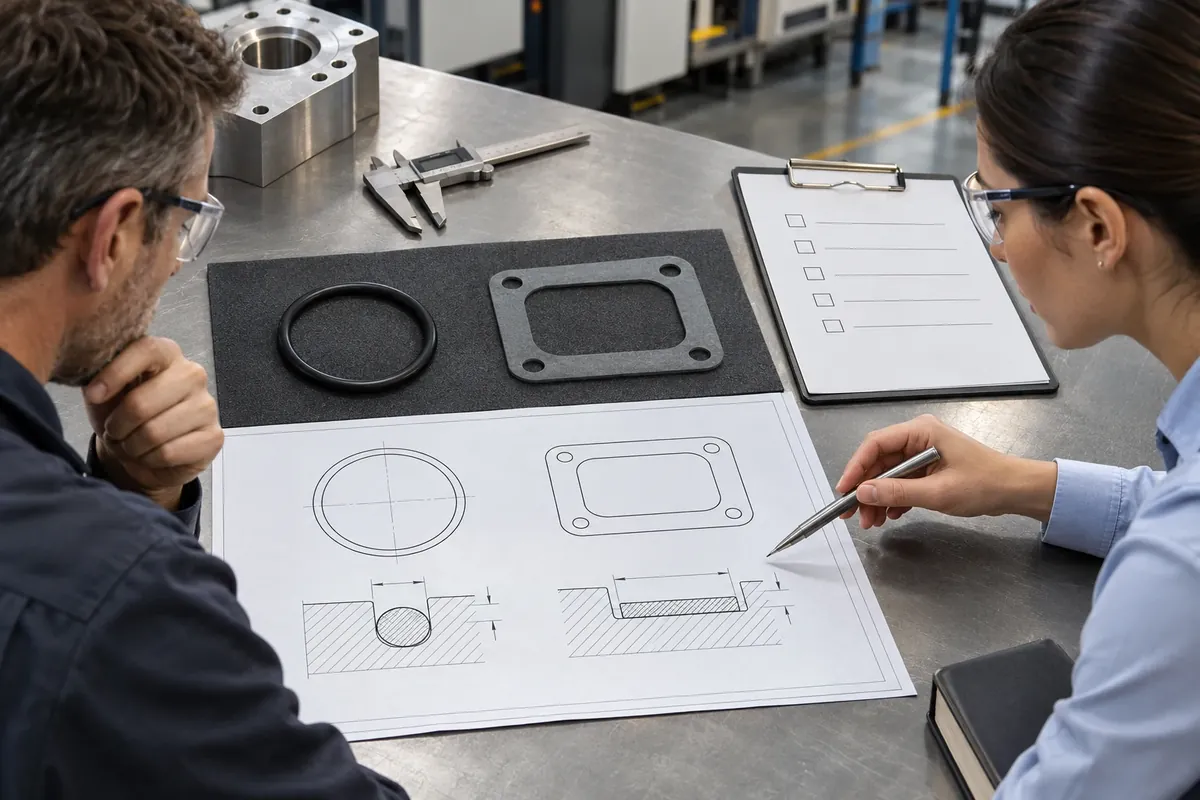
A plan view shows an outline. It does not necessarily show the cross-section or the mating space. Both an O-ring and a flat gasket can have a circular outline. The buyer must look at a section view or product description to determine whether the part has a round cross-section, a flat profile, or another construction.
Consider a generic dispenser assembly as a hypothetical example. A sealing part could sit between a housing and a mating cover. The outline might be circular in either design, but the component could be a round-section O-ring positioned in a groove or a flat ring gasket cut from sheet. These alternatives may require different locating features, dimensions, materials, and assembly space. The example does not describe a confirmed Koitor product or a validated seal design.
In an o ring vs gasket review, a product rendering may show where a ring sits, but it can obscure whether the seal is round-section or flat. A buyer should ask for the relevant section view, dimensional drawing, or supplier part reference. If the seal is purchased as a component, identify who supplies it and who confirms its dimensions and suitability. Do not assume that a part with the same outside diameter or similar outline can replace the approved seal.
A drawing can separate four concepts:
- Outline: the seal’s path when viewed from above.
- Cross-section: the material shape through the seal body.
- Mating space: the groove, recess, flange, or interface that receives it.
- Compression condition: the design relationship between the seal and mating surfaces.
These are related but not interchangeable fields. A supplier may understand an outline from a top view but still need a section or interface dimension to identify the construction. The buyer should share the mating components or controlled assembly drawing when a seal’s location and compression arrangement matter.
The part name should follow the approved design documentation. If a supplier uses “gasket” as a general functional term, ask whether the supplied item is an O-ring, flat gasket, or another profile. Record the supplier’s own part number alongside the buyer’s description. This prevents a purchasing shorthand from silently changing the part construction on a repeat order.
How Do Mating Space and Component Geometry Affect Sourcing?
Mating space determines where the seal is located and how its shape relates to the connected parts. An O-ring groove, a flat face, a perimeter channel, and an irregular gasket outline are different design contexts. The buyer should identify the actual space and the interface that must be sealed, then ask the responsible supplier to confirm the proposed component.
For a groove-based design, the drawing or supplier design data may define a location and section that correspond to the O-ring. For a flat gasket, the sheet profile may need to follow a flange, face, or assembly outline. Those are general distinctions, not instructions for designing either seal. Specific groove dimensions, compression amounts, material grades, and acceptance limits must come from the responsible engineering documentation and seal supplier.
A sourcing review can ask:
- What is the controlled drawing or assembly revision?
- Is the seal round-section, flat, molded, cut, or another specified profile?
- Which part features locate the seal?
- What material or compound is identified by the approved data?
- Does the assembly involve relative motion or other application conditions?
- Who supplies and verifies the bought-in component?
- What records are required for sample approval and repeat orders?
A mounting surface can also introduce product-specific constraints. A broad gasket may need to match a perimeter with multiple fastener holes. An O-ring design may need a defined groove. A seal might sit near a visible finish or an area that affects assembly. Those details should be described in the drawing and product specification rather than inferred from a generic “seal” callout.
Do not choose a seal based solely on outside dimensions. Two parts can share an outer diameter and differ in section, inner path, material, or locating geometry. Likewise, the same profile may not suit every joint simply because it can physically fit into the available space. A physical fit is not proof of sealing performance or product acceptance.
The buyer’s role is usually to define the product interface, use condition, supplier responsibility, and evidence required. The seal maker or responsible engineer determines whether the proposed design is technically suitable. This division helps keep the procurement request useful without transferring unverified design authority to a general product supplier.
What Information Should a Buyer Put in an RFQ?
A useful RFQ provides enough information for the seal supplier to identify the part and for the hardware buyer to compare like-for-like offers. Start with a controlled drawing or sample. If the buyer has a current seal part number, include it and clarify whether it is mandatory or a reference to an existing design. If the supplier may propose an alternative, state how the buyer will approve the change.
A seal RFQ may include:
- The assembly drawing and revision.
- The seal’s location and function in the assembly.
- A top view and section view, if available.
- The required construction, such as O-ring or flat gasket, where specified.
- The approved material or compound reference, if known.
- The mating part geometry and relevant dimensions.
- The use conditions the responsible engineering team has identified.
- Expected quantity and order pattern.
- Sample, documentation, or traceability requirements.
- Any buyer-controlled standard or specification reference.
These fields do not mean that every buyer must provide a complete seal design. If key data is unknown, say so and request a technical clarification from the responsible supplier. Do not invent pressure, temperature, chemical, or life-cycle limits. The supplier may need to ask further questions before recommending an item.
A quote in an o ring vs gasket sourcing comparison should distinguish a direct match from an offered alternative. If the seal material, section, profile, supplier source, or dimension changes, the buyer should see the deviation. Ask the supplier to identify which drawing or sample was used, what it proposes, and which technical data supports that proposal. The purchase order should not silently convert a general recommendation into an approved product design.
For a multi-component hardware kit, align the seal description across the bill of materials, drawing, assembly instruction, package list, and spare-parts record. If the seal is supplied by a sub-supplier, retain the actual component reference and identify who is responsible for the technical approval. A product buyer should not assume that the primary hardware factory manufactured every bought-in seal.
The approval record should also say whether the seal itself is part of the buyer’s product specification or simply a subcomponent selected by the supplier. If the buyer owns the part number, the OEM should reference that approved identifier and flag any sourcing issue. If the supplier proposes the seal, the buyer should review the technical description and the limits of the supplier’s responsibility before the item is added to the BOM. This distinction is especially useful when an assembly passes through several vendors or when a replacement part is purchased separately after the initial product order.
A revision table can note the reason for an approved change, the affected seal or mating feature, the new part reference, and the reviewer who accepted it. This small traceability step helps prevent an older sample or a past purchase description from being treated as current evidence. Keep the record proportionate to the order, but make the controlling revision easy to find for both purchasing and quality review.
What Evidence Should Support a Seal Decision?
The evidence depends on the product requirement. At minimum, a buyer should be able to connect the physical seal to a supplier part number, drawing revision, material description, and intended assembly. If the application has a defined performance or compliance requirement, the responsible engineering team should identify the relevant evidence and acceptance method.
A catalog page may describe a supplier’s seal families. A drawing may show the section and interface. A material declaration may identify a compound. A sample can confirm what component was supplied. Each record has a scope; none automatically proves every property the buyer might care about.
Separate evidence by question:
| Question de l'acheteur | Potential evidence | Boundary |
|---|---|---|
| What is the component shape? | Section drawing, part drawing, supplier part data | A picture alone may hide the cross-section |
| What material is supplied? | Approved material specification or supplier declaration | A generic material family name may be incomplete |
| Where does it fit? | Assembly drawing and controlled interface dimensions | Physical fit does not prove sealing performance |
| Which product was sampled? | Sample ID, supplier reference, date, revision | A sample applies only to the identified configuration |
| Does it meet an application requirement? | Project-defined technical evidence and acceptance method | A generic article or catalog does not decide the project |
For a seal made from an elastomer, material behavior over time may be relevant to a project review, but no material or compression-set requirement should be assumed from the name “O-ring” or “gasket.” The buyer should use the applicable supplier data and the project’s approved criteria. A related live Koitor guide discusses rubber compression set for mounting pads; it covers a separate material behavior and should not be treated as a seal design approval.
Be cautious with performance rankings. “Better for pressure,” “best for high temperature,” or “works in any environment” is too broad without a defined product, material, geometry, and test context. A supplier’s technical claim should be linked to the exact part and conditions it covers. This article provides no pressure rating, temperature limit, chemical compatibility, leak guarantee, installation procedure, or medical approval.
What Sourcing Mistakes Lead to Avoidable Rework?
Using only a circular outline. A top view can make an O-ring and flat ring gasket look similar. Add the section or supplier part reference so the component construction is unambiguous.
Treating “seal” as a complete specification. A shared function does not define material, cross-section, mating geometry, or application. State which attributes are controlled and ask for missing data.
Assuming all O-rings are dynamic. O-rings can be designed for static or dynamic applications. The actual use condition must be reviewed with the responsible technical source.
Assuming a gasket is always flat and noncircular. Flat gaskets can have circular or complex outlines. Conversely, a ring-shaped outline does not establish a flat cross-section.
Comparing quotations with different scopes. One supplier may quote a bought-in standard seal while another assumes a custom profile or alternate material. Normalize the technical description before comparing price or lead time.
Approving an alternate by visual fit alone. A component that appears to fit may differ in section, material, or application basis. Route changes through the project’s approval process.
Confusing a supplier recommendation with a verified Koitor capability. Koitor’s approved facts cover its custom bathroom and home-storage hardware scope; they do not establish seal manufacturing, seal design, or a particular performance claim.
These are documentation and sourcing risks, not reported customer failure rates. If the assembly has a safety-critical, regulated, fluid-control, or otherwise specialized requirement, involve the qualified technical authority for that application.

How Can a Hardware OEM Discuss a Bought-In Seal?
A custom hardware manufacturer can clarify which assembly drawing and product interface it is reviewing, identify whether a seal is supplied by the buyer or another vendor, and flag missing information within its confirmed scope. That does not mean the OEM designs or manufactures the seal. The responsible seal supplier or qualified engineer must confirm technical suitability.
When requesting a product quote, provide the hardware drawing or sample, identify the location of the seal, and explain whether the seal is already specified or still open for supplier input. If the component is sourced externally, ask who provides its part number and material documentation. If the OEM assembles or packs the component, clarify which party confirms the seal and which records accompany approval.
The discussion should separate:
- Hardware scope: the metal product, assembly interfaces, finish, and packaging requirements the OEM confirms.
- Seal scope: the seal profile, material, supplier, and technical suitability handled by the responsible party.
- Approval scope: which drawing, sample, data sheet, or change record the buyer accepts.
This separation is useful in small-batch product development because an early sample can expose a missing interface dimension or unclear BOM description. It does not make an untested sample a performance validation. Record any change and obtain buyer approval before the product specification changes.
Koitor is a family-owned custom metal hardware factory supporting drawing and sample review within its approved bathroom and home-storage scope. For a project-specific conversation, see the Informations sur le matériel de stockage domestique OEM ou contacter Koitor with the controlled assembly drawing or sample. These pages provide the commercial route; they do not claim that Koitor makes seals or validates seal performance.
Buyer Checklist Before Approving a Seal
- Distinguish the seal’s outer outline from its cross-section.
- Identify O-ring, flat gasket, or another specified construction.
- Provide the mating-space and assembly drawing revision.
- Record the component supplier and part number.
- State the approved material or compound reference where required.
- Describe whether the application is static, moving, or otherwise specified by engineering.
- Separate product requirements from supplier recommendations.
- Identify the evidence needed for sample approval.
- Align the BOM, drawing, purchase description, and package list.
- Review material, profile, source, or dimension changes before release.
- Do not infer pressure, temperature, chemical, life, or leak performance from the component name.
- Involve the responsible technical authority for specialized application requirements.
Foire aux questions
Is every ring-shaped gasket an O-ring?
No. The outer outline can be ring-shaped while the cross-section is flat. A conventional O-ring is identified by its round cross-section and its intended mating arrangement, not only by the shape seen from above.
Are O-rings only used in moving applications?
No. O-rings can be designed for static or dynamic applications. The project’s actual movement, geometry, material, and supplier documentation determine whether a specific design is suitable.
Can I replace a flat gasket with an O-ring if both have the same outline?
Do not assume they are interchangeable. The cross-section, groove, mating surfaces, material, and assembly conditions may differ. A responsible technical reviewer and supplier should confirm any proposed change.
Does the seal name establish pressure or temperature capability?
No. The name does not identify a complete design or performance rating. Verify the exact component, material, geometry, and application evidence.
Does an O-ring face seal mean that every gasket is an O-ring?
No. Supplier terminology can describe a sealing function or a particular face-seal design. Identify the actual section and part specification.
Who should approve an alternate seal?
The buyer’s responsible engineering or quality authority should approve it with the seal supplier’s applicable technical data. The hardware OEM may clarify its assembly scope but should not be presumed to validate a seal outside confirmed capability.
Sources and Scope
- Apple Rubber, O-Ring vs Gasket: Which Seal Is Best for Your Application? — used for common geometry descriptions and the note that O-rings may serve static or dynamic designs. Broad pressure and temperature winner claims are not adopted.
- Apple Rubber, Fluid Power Applications — used only as an example that an O-ring may be described in a face-seal gasket context; no hydraulic, medical, or application approval is inferred.
- This article is general sourcing education. It does not set seal dimensions, installation instructions, performance ratings, or product approval.
Reviewing a Seal Interface in a Hardware Project?
Share the controlled assembly drawing or sample and identify who supplies the seal. Koitor can discuss the confirmed metal hardware scope; seal suitability should be confirmed by the responsible technical supplier.
Fabrication pour compte de tiers / Marque de distributeur
Transformez ce guide d'approvisionnement en cahier des charges
Indiquez-nous le produit souhaité, ses dimensions, sa finition, la quantité commandée et vos exigences en matière d'emballage. Votre équipe recevra une analyse pratique de la faisabilité de la fabrication avant l'établissement du devis.
 English
 Español
 Português
 Français
 Deutsch
 العربية