
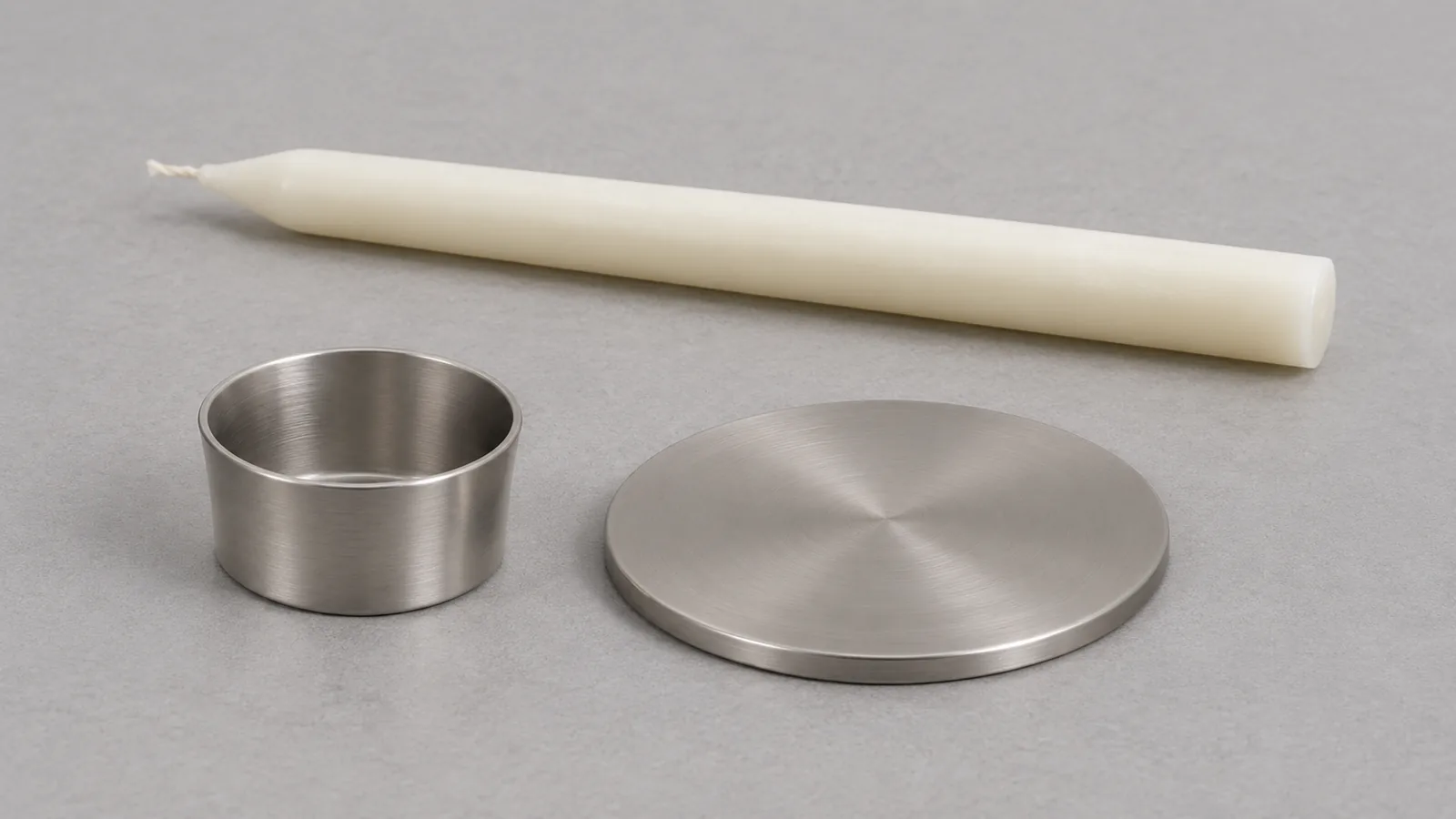
A metal candle holder quotation should identify whether the buyer is purchasing a loose cup, a cup-and-base assembly, or a complete holder prepared for a defined candle reference. Those are different purchase units, even when a catalog photograph makes them look like one product. Before approving a sample, record the candle model, cup opening, body and rim references, base, attachment, included parts, finish and evidence owner in one controlled specification. A physical fit check can answer selected geometric questions; it cannot by itself substantiate a claim about the finished assembly’s intended use.
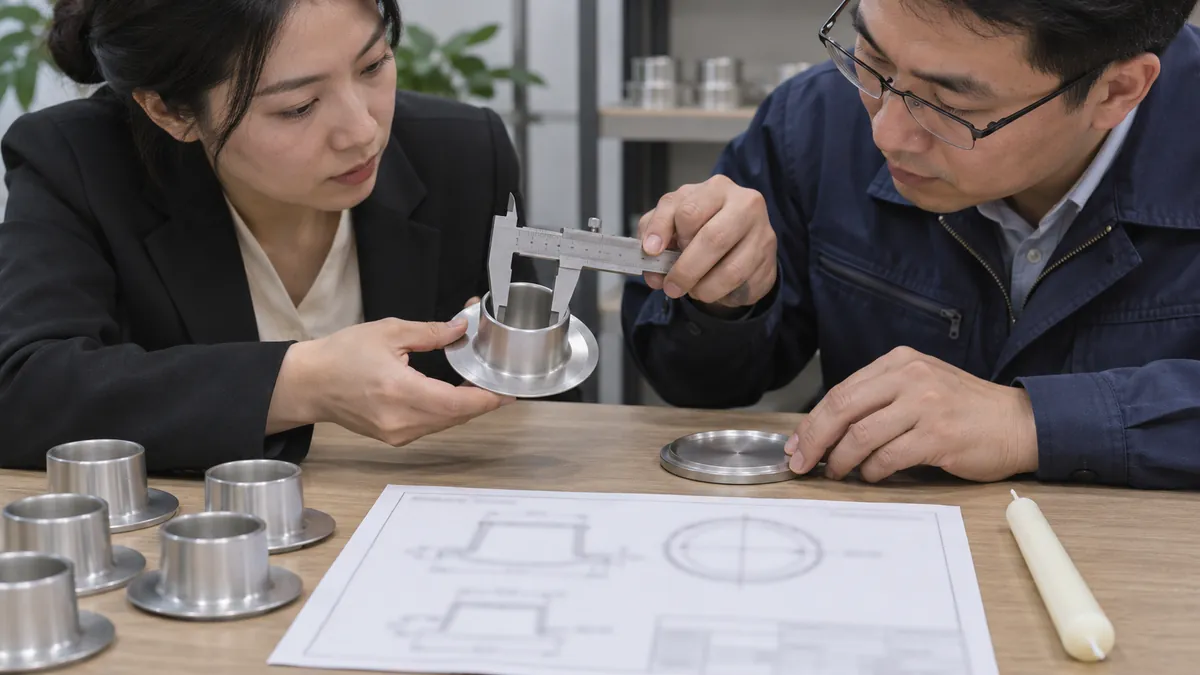
What exactly is being purchased as a metal candle holder?
The buyer should name the commercial unit first: a cup only, a cup-and-base pair, a finished holder, a set containing multiple cups, or a modular system with replaceable components. Do not rely on a product title such as “candle cup” or “candle holder” to establish scope. A supplier may quote a stamped or formed cup as one part, while a retailer sells a completed holder that includes a base, tray, fasteners, a removable insert or another component.
Catalogs illustrate why this distinction matters. One metal-forming supplier lists candle cups and trays as separate offerings and also lists a spot-welded assembly; that supports the existence of different supply units, not a universal candle-holder construction. Review the Metalcraft candle-holder category as an example of component and assembly choices. The buyer still needs a current drawing and quote from the actual supplier.
A model-specific listing may also distinguish a cup’s inside dimensions from its top diameter or offer a bottom-hole variation. The buyer should use the exact product page only to frame questions, then confirm every value against the quotation and controlled drawing. The Metalcraft C27 product listing is an example of a listing that differentiates dimensional references and a bottom-hole option. Do not transfer its values, construction or intended use to another supplier’s design.
A useful purchase-scope statement might read: “One formed metal cup, one designated base plate and the named attachment parts, supplied as one finished assembly to drawing revision C; candle reference supplied by the buyer for dimensional review only.” That sentence prevents a supplier from assuming that the base, cup or fasteners are included. It also makes exclusions visible. If the supplier is quoting a loose cup only, say so directly and keep any downstream assembly responsibility assigned to the party that will perform it.
The buyer should separate four questions in records and meetings:
- What parts are included in the price?
- Which parts are assembled before shipment?
- Which named candle or accessory is used as the fit reference?
- Which party owns any assessment needed for a finished-use claim?
A “yes” to the first three does not automatically answer the fourth. This separation is especially helpful when merchandising, sourcing and compliance teams use the same product name but mean different things by “complete.”
Which dimensions must appear in the specification?
A dimension is useful only when the drawing identifies what is measured, where the reference starts and which party confirms the acceptance range. For a cup, distinguish the inside opening, outside rim, body diameter, usable depth, wall profile and any flange or rolled edge. A single “diameter” can refer to several different features. If a buyer writes only “fits a 22 mm candle,” a supplier cannot know whether 22 mm is a nominal candle diameter, a measured range, a label value or a target that includes clearance.
Use the actual candle model or a controlled dimensional sample when the project depends on fit. Record the candle maker, model, revision or lot reference where available, and the measurement source. If the target candle can vary across supply lots, the buyer and candle supplier should define the representative range and measurement method. A metal supplier should not invent a candle tolerance or decide that an interference fit is acceptable without the responsible product engineer’s approval.
The cup drawing should state critical dimensions independently instead of compressing them into one generic size. For example, the rim opening may govern entry, the body profile may govern seating depth, and a lower feature may affect how the cup contacts its base. Label cosmetic faces, edge conditions, visible seams and any area that must remain free of marks. If the shape is rotationally symmetric, identify the axis; if it is not, include orientation references so inspection is repeatable.
The base needs its own dimension set. Specify its outside envelope, thickness reference, edge shape, hole or slot pattern, flatness reference if required, and the surface that contacts the cup or table. If a tray is included, define whether its outline is shared by multiple SKUs or is unique to one assembly. A base with a center opening, a recessed seat or an offset attachment is not interchangeable merely because its overall diameter appears similar.
| Fonctionnalité | Buyer should identify | Why the reference matters |
|---|---|---|
| Candle | Exact model or controlled sample and source of its dimensions | The cup fit depends on the selected reference, not a broad category name |
| Cup opening | Inside opening and top/rim measurement locations | Inside and outside measurements describe different interfaces |
| Cup body | Usable depth, taper or profile, and orientation datum | A candle may enter the rim but still not seat as intended |
| Base | Outside envelope, thickness reference, holes and contact face | Base compatibility depends on the actual paired geometry |
| Attachment | Welded, fastened, removable or other approved arrangement | The quote and service scope change with the joint |
| Cosmetic area | Visible face, finish direction and allowed handling marks | Review teams need a shared appearance reference |
| Complete set | Included/excluded components and pack quantity | A photograph does not define the purchased bill of materials |
Where dimensions are not yet known, mark them “to be confirmed by responsible supplier” rather than inserting a guessed number. A blank field is safer than an invented tolerance because the drawing remains an honest request for engineering input. During quotation review, compare each supplier’s proposed assumptions with the buyer’s original request and mark every deviation for written approval.
How should the cup and base be defined as a pair?
Treat the cup and base as a named pair whenever the finished product depends on their interface. The buyer should identify whether the cup is permanently attached, mechanically fastened, seated in a recess, removable, or supplied separately. These arrangements differ in assembly steps, serviceability, cleaning access, appearance and replacement logic. None should be inferred from a front-facing product photograph.
If the design uses a hole, slot, tab, flange or other feature, show it in the drawing and state which part contains it. Record the attachment hardware and whether it is included in the carton. If a fastener is hidden, the drawing should still identify its type and access direction. If the assembly is welded, mark the joint location and cosmetic expectations. The supplier may recommend a manufacturable alternative, but that recommendation is a proposed change until the buyer approves a revised drawing or sample.
An original buyer schedule can make this relationship explicit:
| Assembly record | Cup-only option | Complete-holder option |
|---|---|---|
| Purchase unit | One cup per part number | Cup, base and named joining components |
| Pairing | No base included unless written | Cup and base references are linked |
| Attachment | Not applicable or supplied by next assembler | Type, location and assembly owner are stated |
| Replacement | Cup replacement path is defined | Cup, base and fastener replacement logic is stated |
| Approval | Cup drawing and sample only | Cup, base and finished assembly are separately reviewed |
| Emballage | Individual part protection | Contact surfaces and paired components are protected |
| Use evidence | Not a finished-use approval | Evidence scope names the exact complete assembly |
The table is not a technical standard. It is a coordination tool that helps purchasing and engineering teams avoid mixing a component approval with a finished-product approval. A buyer can adapt the fields to the product’s actual geometry without treating the examples as a mandatory design.
For assemblies that include a purchased magnet, rubber insert, adhesive, decorative tray or other bought-in part, identify the responsible supplier and part revision. Do not imply that the metal-forming supplier also manufactures those parts. A complete bill of materials can show which organization supplies each item, who approves a substitution and what must be rechecked if a component changes.
If the base design is intended for more than one cup size, list every approved combination as a separate row. A shared base part number does not prove that every cup fits it. Record the exact cup revision, base revision, attachment, quantity, finish and complete-kit configuration together. When one component changes, the buyer can then identify which assemblies require renewed review.
How can buyers compare quotations fairly?
A comparable quote requires a common scope. Send every candidate supplier the same drawing revision, representative sample, target quantities, finish description, packaging level and list of included parts. Ask the supplier to state assumptions beside the price rather than burying them in a message. One quote may include a formed cup only, while another includes base fabrication, joining, finishing and packing. The lower headline number may therefore describe less work.
Ask suppliers to separate one-time and recurring items when applicable. Possible quote lines include tooling or fixture work, sample preparation, part price, assembly, finish, inspection and packaging. Do not assume that a charge applies or that a particular process is available; ask the actual supplier to confirm. If the supplier does not use a requested line item, the buyer can compare the full delivered scope using a clearly stated alternative.
Quantity should be compared at the same level. State the quantity per SKU, total order quantity, number of colors or finishes, sample quantity and whether any parts are common across variants. If a supplier proposes a minimum quantity, determine whether it applies to each cup, each base, each color, each complete set or the combined order. “MOQ 500” is ambiguous unless the unit and variant level are specified.
A quote-comparison sheet can include:
- Supplier name and quote date.
- Drawing and sample revision acknowledged.
- Purchase unit and included bill of materials.
- Cup, base and attachment assumptions.
- Finish description and cosmetic faces.
- Tooling, sample or setup items, if any.
- Unit price by agreed quantity tier.
- Separate quantity basis for each variant.
- Assembly and packaging scope.
- Inspection documents or samples included.
- Lead-time basis and named start event.
- Exclusions and buyer-supplied components.
- Validity date and change-control route.
Ask each supplier to identify exceptions in writing. “We can follow your drawing” is less useful than a marked drawing or a line-by-line confirmation that identifies dimensions, finish, attachment and packaging. If a supplier suggests a different cup depth or base attachment, evaluate the change as a design proposal. It should not silently become the new baseline because it appears in the quotation.
For a small trial order, distinguish price flexibility from design readiness. A flexible production arrangement may help a buyer test an assortment, but it does not eliminate the need for a clear drawing, sample approval, stable component list and packaging definition. Koitor’s approved company positioning includes small-batch customization and direct drawing/sample communication for its confirmed bathroom and home-storage hardware scope. Candle-holder production itself is not confirmed; any such inquiry would first require a feasibility review. The general OEM home-storage hardware page describes the relevant factory context without establishing a current candle-holder SKU.
What should a sample approval record contain?
A sample approval should name the exact components and revisions being approved. Keep the approval record attached to the sample photos, drawing and quote. A note that says “approved” without identifying the cup, base and attachment may be impossible to interpret after a sample round or supplier change.
For dimensional fit, identify the exact candle reference, who supplied it, whether it is a physical sample or drawing-based reference, and which features were compared. Record the measured locations and actual results rather than writing only “fits.” If the buyer is comparing several candles, list each model separately. A fit result for one item should not be generalized to every candle with the same nominal label.
For assembly review, record whether the cup is joined to the base, how the parts are oriented and whether any visible joint or fastener is part of the approved version. Photograph both the finished appearance and any interface that will later be hidden. A buyer may need a separate “component-only” sample and “complete assembly” sample if a supplier cannot provide both at the same time.
The approval should distinguish at least three checkpoints:
- Quotation scope: the supplier and buyer agree what is included and who supplies each item.
- Geometric sample review: the named parts match the approved drawing and reference parts within buyer-approved criteria.
- Intended-use evidence: the party responsible for the finished product determines what additional evidence or review is needed before a use claim is released.
Passing one checkpoint does not imply passing the others. A sample can match the drawing while the purchase order omits the base. A complete sample can fit a selected candle while the retailer’s planned claim remains unsupported. Do not use a photograph of a physically assembled sample as proof of any claim beyond what the image actually shows.
Use a controlled approval note with fields for the buyer, supplier, sample date, drawing revision, cup part number, base part number, attachment, finish, included fasteners, reference candle, review scope, deviations and open actions. If a field is not applicable, state that rather than leaving a blank that may later be interpreted as agreement. Attach images with captions that identify the viewpoint, not a conclusion that was not tested.
A change after approval should be treated as a new review event. A change in cup opening, body depth, base diameter, attachment point, finish, supplier-provided insert or candle reference may affect the prior record. The buyer should define which changes require a new sample, dimensional review or separate evidence assessment. Do not assume that a supplier’s “same as last time” note resolves a changed component or material source.
How should intended-use evidence be handled?
The article’s procurement tables help define what is being purchased; they do not establish that a metal cup-and-base assembly is appropriate for a specific candle use. The buyer should identify the intended market, product claim and evidence owner before approving packaging or public-facing copy. A cup sample, finish card, drawing, product image or supplier quotation is not a substitute for an assessment of the exact finished configuration when such evidence is required.
Keep geometric inspection separate from any use-related evaluation. A caliper can document dimensions; a sample review can record fit; a drawing can show the attachment. None alone establishes a performance, safety, temperature, stability, flame-clearance or lifetime result. If the project needs such a conclusion, the responsible product owner should define the question, select an appropriate qualified evaluator and confirm that the exact assembly and use conditions are within the evaluation scope. This article does not provide a burn procedure or a pass criterion.
The evidence request should identify the assembly revision and all components that may change the result. That may include the cup, base, attachment, surface finish, any insert, the named candle and the packaging or instructions associated with the claim. The reviewer should also identify the intended use conditions and the exact statement that marketing proposes to make. Broad wording such as “safe for all candles” needs more support than a narrow description that simply identifies the included metal parts.
Avoid circular approval. A supplier should not be asked to certify a claim merely because a buyer placed it in the purchase order, and a buyer should not treat a supplier’s drawing acknowledgment as a claim approval. Assign each decision to a named party with appropriate authority. If evidence is incomplete, hold the claim or narrow it to what is substantiated. Do not imply that a metal material alone settles the suitability of the complete product.
This boundary also affects imagery. A staged photograph can suggest that a candle is approved for a particular holder even when the caption says otherwise. Keep product photography consistent with the authorized use and avoid visual scenes that communicate a stronger claim than the written evidence. The generated images for this article show an unlit reference candle and separate components; they are conceptual sourcing illustrations, not proof of any Koitor product or finished-use approval.
How do material, finish and cosmetic requirements enter the brief?
Describe material and finish as supplier-confirmed requirements, not assumptions based on appearance. If a buyer has a specified material grade or finish, cite the controlled specification or sample that defines it. If the buyer has not selected one, ask the supplier to identify feasible options, relevant trade-offs and any limitations that affect the cup, base or joining method. Do not infer a material from a photograph or claim that a finish creates a certain level of protection.
The cup and base may be made from different materials or finished through different processes. Record the material and finish for each component, not just “metal holder, satin finish.” Identify whether the visible inside and outside surfaces should match, which surfaces are cosmetic, how edges should appear, and whether the attachment joint will remain visible. If a finish is applied after joining, ask the supplier how the final assembly will be inspected and which areas are included in the approved appearance sample. The supplier should confirm the actual manufacturing route.
For color, distinguish a target sample from a color name. Terms such as “black,” “brushed,” “antique” or “warm silver” may describe a broad family rather than one controlled appearance. Keep an approved physical coupon or other documented color reference and identify its revision. If the buyer expects multiple colors, assign separate identifiers and state which parts receive each finish. A display image on a screen is not the same as a retained physical reference.
Cosmetic requirements should be practical and observable. Buyers can specify visible-face scratches, edge condition, weld appearance, color consistency, fingerprints or handling marks if these matter to retail acceptance. Set acceptance language with the supplier before bulk production. Do not insert a defect limit or inspection tolerance that has not been agreed. If the buyer needs a specific inspection method, identify it and confirm feasibility instead of leaving “premium quality” as the only criterion.
The approved sample should be protected as a controlled reference. Record who owns it, how it is stored, how revisions are marked and what happens if the sample is damaged or replaced. When a new sample is approved, retain the earlier version with a superseded status so that teams can explain which design was used for a prior purchase order. A physical reference is useful only when the buyer and supplier can identify the exact version being compared.
How should buyers plan variants and reorders?
Plan variants around the component relationships, not only around the finished-product photograph. A range may include different candle sizes, cup shapes, bases, colors, attachment methods or packaging units. Each variant should have a unique SKU or documented configuration code that ties the parts together. If two variants share one base or one finish, show that relationship in the bill of materials and confirm it with the supplier.
A variant matrix can make these dependencies visible:
| Variant field | Example of a controlled entry |
|---|---|
| Finished SKU | Buyer-assigned code and revision |
| Cup | Part number, drawing revision and dimensional reference |
| Base | Part number, revision and approved pairing |
| Attachment | Method and included parts |
| Candle reference | Named model or “not specified” |
| Finish | Physical sample reference and revision |
| Pack unit | Cup only, one holder or multi-piece set |
| Claims | Exact approved wording and evidence owner |
| Reorder change | New sample or evidence review required? |
This matrix helps buyers see that a color change can affect more than the finish name. It may change the supplier, component source, quotation assumption, production route or appearance review. A new candle reference may require a new dimensional fit record. A base supplied by another party may require the interface and assembly record to be reopened.
For reorders, compare the new order against the prior approved bill of materials, drawing revision, finish sample and packaging instructions. Ask the supplier to declare any change in material source, tool, finish supplier, assembly method or purchased component. The appropriate reviewer can then decide whether the change is administrative or requires a sample. Do not accept an undocumented substitution solely because the overall shape appears similar.
Small-batch planning can reduce exposure when a buyer is testing assortment demand, but it does not make uncertain details disappear. Separate the first-order learning goals from the requirements that must already be fixed. For example, the buyer may test packaging presentation in a pilot while keeping the cup/base geometry, approved finish and part identity controlled. The buyer should not postpone a decision that affects whether the supplier can quote the requested scope accurately.
A reorder record should include the finished SKU and every component revision, pack quantity, target finish, approved sample location, inspection criteria and buyer contact responsible for change approval. If the retailer updates a label, photography or user instructions, include those changes in the release review. This prevents the purchase order from remaining technically unchanged while the retail claim has evolved beyond its prior evidence.
What packaging and identification details matter?
Packaging should protect the parts and preserve identification from the production line through receiving. The buyer should state whether each cup is packed individually, nested, paired with a base or assembled before packing. If polished or colored surfaces are visible, describe how parts should be separated so that they do not rub against one another in transit. The actual packaging material and arrangement should be confirmed with the supplier and evaluated against the buyer’s handling requirements.
Nested cups can reduce pack volume, but contact between parts may mark visible surfaces. A base packed in the same inner bag may scratch the cup or become difficult to count. A fastener package may be separated from its assembly unless the supplier uses a clear kit-control method. These are design questions for the actual package; a generic instruction such as “pack safely” does not say what the buyer expects.
Define the package unit at each level: one cup, one complete holder, one retail set, inner carton and master carton. Record the quantities and the identification method for each level. The buyer should specify whether package labels identify the finished SKU, component codes, drawing revision, finish, purchase order or lot. Do not print a compatibility statement on a label unless the evidence and responsible approval are recorded.
Ask for a packaging sample or photographs of the approved arrangement when retail presentation or surface protection is important. If the buyer intends to ship a multi-component set, a simple count sheet can help receiving confirm that cups, bases and fasteners match the expected ratio. When parts are supplied separately, make the receiving and final-assembly responsibility explicit.
After a packaging change, confirm that the product and its instructions still match. An image, insert or label may imply that parts are assembled or intended for a specific candle even when the carton contains only a cup. Keep marketing assets aligned with the actual purchase unit and the authorized scope.
What mistakes create avoidable sourcing ambiguity?
The first mistake is using “holder” as if it defined every included part. One supplier may understand it as a cup; another may include the base and fastener; a third may include a tray or multi-cup unit. A drawing, bill of materials and quotation line should all describe the same purchase unit.
The second mistake is specifying only a nominal candle diameter. The buyer should identify whether the number refers to a label, measured body, maximum range, wick-side end, taper or a particular model. The cup opening, rim and depth are separate references. If the buyer wants multiple candles to fit, each should be listed and reviewed separately rather than being summarized as “universal.”
The third mistake is assuming that a catalog photograph defines the actual design. An image may omit a bottom hole, show a separate tray, hide a joint or present one color that is unavailable in the selected finish. Ask for the model-specific drawing or written confirmation. Use marketing images to identify the question, not to replace controlled product data.
The fourth mistake is treating a successful sample fit as approval of every claim. Fit, quote scope, finish, packaging and intended-use evidence are separate decisions. A buyer can approve the first without approving the rest. The approval form should make the boundaries explicit so a later team does not overread “sample accepted.”
The fifth mistake is allowing a supplier’s proposed change to enter the bulk order without a revision record. A different cup depth, base attachment, coating or purchased insert may seem minor but alter the approved configuration. Mark the change, document the reason and ask the responsible reviewer whether another sample or evidence review is needed.
The sixth mistake is comparing prices without normalizing quantities and exclusions. A quote that omits the base or packaging cannot be compared directly with a complete-set quote. A supplier’s MOQ may apply to each color, part or finished SKU rather than the total project. Ask the supplier to state the quantity basis.
The seventh mistake is using broad quality language with no inspection reference. “Good finish,” “strong assembly” and “premium product” may mean different things to different teams. Convert them into observable requirements, approved samples and named acceptance records. Do not invent numeric criteria where the buyer and supplier have not agreed on them.
The eighth mistake is extending one model’s information to another. A product page from one supplier can show that a component option exists; it does not establish a universal dimension or suitable material for another design. Keep examples attributed to the named source and confirm the actual project details independently.
What should the buyer send with an RFQ?
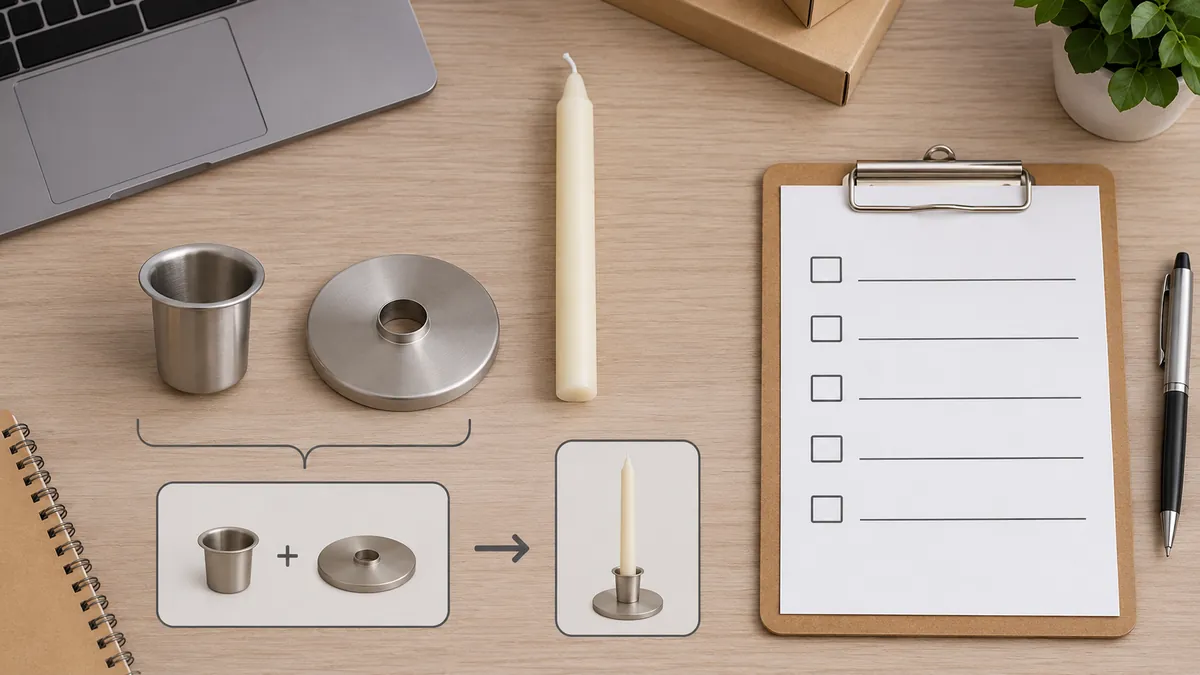
A practical RFQ package should let the supplier identify the requested product, quote the same scope and flag unresolved engineering details. Include the following:
- Product name and purchase unit: cup, cup-and-base assembly, complete holder or multi-piece set.
- Two-dimensional drawing and, if available, a three-dimensional file with revision identifiers.
- Exact candle reference, model or representative physical sample, including the source of dimensional data.
- Cup inside opening, rim, body and depth references with measurement locations.
- Base envelope, interface, holes, slots, attachment and included/excluded hardware.
- Material and finish requirements for each component, or a request for feasible options.
- Cosmetic faces and appearance reference sample.
- Target quantity by finished SKU, cup, base, color and packaging unit.
- Sample quantity, requested sample scope and approval owner.
- Packaging arrangement, protection requirements and labeling fields.
- Any required third-party or intended-use assessment, with the responsible party identified.
- Target market and proposed product wording, if the product will be marketed for a defined use.
- Target delivery destination and quote currency, if relevant to the request.
- Questions the supplier must answer or list as exceptions.
Ask the supplier to return a marked drawing, an included-parts list, a quote with quantity basis, sample plan, packaging description and explicit assumptions. If any critical dimension or component has not been finalized, label it “open” and agree on who will resolve it and when. An RFQ can invite technical recommendations, but it should distinguish recommendations from approved changes.
For a custom metal component inquiry, a buyer may share a drawing, physical sample, target finish, quantity and intended application with a suitable manufacturer. Koitor Hardware is a family-owned custom metal hardware factory focused on bathroom and home storage hardware; it has not confirmed a current candle-holder SKU or specific candle-use testing. A new adjacent-product request therefore needs an initial feasibility and scope review before anyone promises production or suitability. Buyers can use the contact page to start that discussion.
Keep the exact metal candle holder description consistent across the RFQ, approved sample, carton label and reorder record.
Foire aux questions
Is a candle cup the same thing as a complete candle holder?
No. A cup may be one component, while a complete holder may also include a base, tray, attachment parts or multiple cups. Put the purchase unit and included parts in the quote.
Which candle measurement should the buyer provide?
Provide the exact candle model or a controlled sample and state the source of the dimensional data. Clarify whether the reference is a measured body range, nominal label or another supplier-defined value; do not use one generic diameter for several different candles.
Does an unlit sample fit check approve the finished product for candle use?
No. A fit check documents only the geometric interaction reviewed. It does not establish performance or suitability for an intended-use claim. The responsible product owner must define and obtain any additional evidence required for the exact assembly.
Can a buyer use one base across multiple cup sizes?
Only if each cup/base combination is documented and approved. List the paired part numbers and revisions in a configuration matrix rather than assuming that a visually similar base fits every cup.
Should the metal supplier choose the candle-use acceptance criteria?
The buyer should identify the qualified party responsible for any intended-use assessment. The supplier can provide component information and discuss manufacturing feasibility, but a drawing or sample approval should not be treated as a broader performance conclusion.
What should change when the buyer reorders?
Compare the new order with the approved drawing, cup and base revisions, finish sample, included parts and packaging unit. Record substitutions and determine whether the change requires a new sample or another review.
Collaborez avec Koitor Hardware
Discuss a Custom Metal Hardware Concept
Share your drawing, reference sample, component scope, finish and target order quantity. Koitor can review whether an adjacent metal concept fits its confirmed production scope before quotation.
Fabrication pour compte de tiers / Marque de distributeur
Transformez ce guide d'approvisionnement en cahier des charges
Indiquez-nous le produit souhaité, ses dimensions, sa finition, la quantité commandée et vos exigences en matière d'emballage. Votre équipe recevra une analyse pratique de la faisabilité de la fabrication avant l'établissement du devis.


 English
 Español
 Português
 Français
 Deutsch
 العربية