

Torx vs hex is a comparison of two common internal fastener drive profiles: Torx uses a six-lobed hexalobular recess, while internal hex uses a six-sided socket. The outside shape of a screw head and the shank that fits into a bit holder are separate features. A Torx driver bit can have a hexagonal shank, so both descriptions can correctly apply to different ends of the same tool. For procurement, identify the engagement profile, size or designation, mating fastener, and application instead of using “hex” by itself.
What Does Torx vs Hex Mean on a Fastener?
In this comparison, “Torx” refers to a six-lobed internal drive profile, while “hex” refers to an internal six-flat-sided socket. Both are located in the fastener recess where the driver tip engages. They are distinct interface geometries and should be specified by their actual designation and mating tool.
A fastener may have a pan, button, flat, flange, or other exterior head form while using an internal drive. The outside head outline does not tell a buyer whether the recess is Torx or hex. Likewise, the word “hex” may refer to an external hex head, an internal hex socket, or a hexagonal shank on a driver bit. The context and location matter.
TOPURA describes the TORX system as a six-pointed star-shaped, or hexalobular, drive design. That description helps name the profile, but the source’s comparative performance claims are not used here. Buyers should not infer a torque rating, stripping resistance, or joint strength from the profile name alone. Those properties depend on the exact fastener, material, tool, installation process, and design context. (TOPURA: TORX)
| Term used in a specification | Where to look | What it describes | What it does not establish |
|---|---|---|---|
| Torx or hexalobular | Recess inside the screw head | Six-lobed engagement profile | Fastener head outline, grade, or complete performance |
| Internal hex | Recess inside the screw head | Six-sided internal socket | External hex head or bit-holder shank |
| External hex | Outside perimeter of a fastener head | Six-sided exterior head form | Internal drive profile |
| Hex shank | Driver-bit end held by a compatible tool or holder | Tool connection shape | Engagement profile at the bit tip |
| Torx bit | Driver tip and mating recess | A Torx-style engagement end | Whether the opposite end is also Torx |
Why Does “Hex” Create Confusion in a Buyer’s Kit?
“Hex” is a shape word used in more than one place. In a hardware kit, it may describe the external head of a bolt, the internal socket in a screw, a hex key, or the shank of a replaceable bit. If a purchase order says only “hex screw,” the buyer and supplier may not be discussing the same interface.
A useful way to remove ambiguity is to describe the part from the engagement point outward:
- Name the fastener interface. State internal Torx, internal hex, or external hex head as applicable.
- Identify the relevant designation. Include the size or series supplied on the controlled drawing or specification. Do not infer equivalence from a visual resemblance.
- Name the mating tool separately. Specify a matching driver profile and any holder connection required by the kit.
- Confirm the actual application. Identify which product or assembly uses the fastener and whether it is supplied loose, preassembled, or packed with a tool.
- Control the record. Tie the part description to the drawing revision, bill of materials, sample, and package contents.
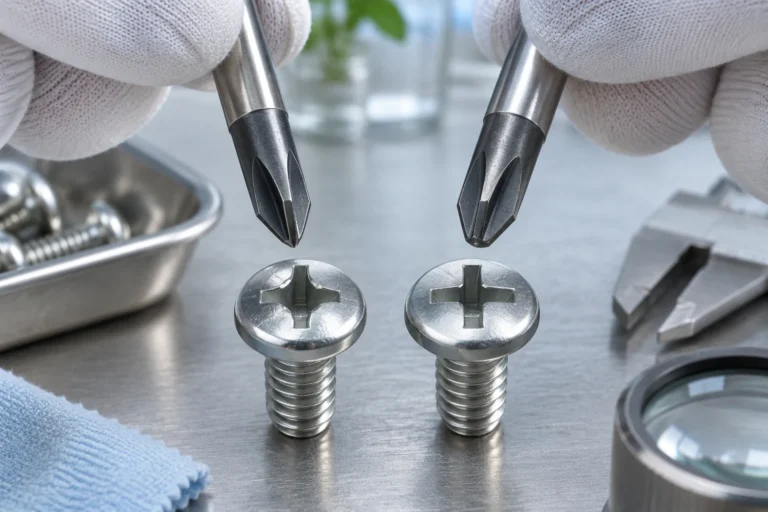
This interface-first method is more reliable than relying on a photograph or a broad label. A photograph can help identify a likely recess, but perspective, lighting, wear, finish, and image scale can make close visual identification uncertain. If the supplier is expected to provide a fastener, a drawing callout or a sample with a confirmed description gives both parties a shared reference.
The same principle applies to the driver bit. A catalog entry may describe the tip profile and the shank form separately. Wiha’s catalog, for example, lists Torx power bits with a quarter-inch hex drive. In that description, Torx names the working end that engages the screw, while hex describes the connection end held by a compatible tool or holder. The two terms are not contradictory because they refer to different interfaces. (Wiha Torx Catalog)
How Can a Torx Bit Have a Hex Shank?
A driver bit has at least two ends to consider: the working tip that contacts the fastener and the shank that connects to the driver, holder, or machine. A bit can therefore have a Torx-shaped working tip and a hexagonal shank. “Torx” and “hex” describe different locations on the same component.
This matters in retail kits, assembly packs, and procurement documents. A supplier may offer a set of Torx bits with a standard hex connection, or a screw with an internal hex socket and a separate hex key. If the buyer writes only “hex,” the package description can be interpreted as a hex fastener, a hex key, or a bit shank. Separate the mating interface from the tool connection.
Use a simple two-interface note:
| Component | Engagement end | Connection end | Useful record |
|---|---|---|---|
| Internal-drive fastener | Torx or internal hex recess | Not applicable | Fastener designation and drawing reference |
| Driver bit | Torx or hex tip matching fastener | Hexagonal shank or another holder interface | Tip profile, size, shank form, length if specified |
| Complete kit | Fastener profile and size | Supplied tool and holder arrangement | Item list, quantity, packaging, and intended assembly |
Do not infer that any hex shank fits every holder. Verify the holder and bit connection specification. Similarly, a matching profile family does not by itself confirm that two pieces are compatible: the size, exact version, engagement depth, condition, and manufacturer guidance still matter. Avoid mixing a fastener with a visually similar driver unless the responsible supplier or tool maker confirms the match.
This distinction also prevents category confusion when a buyer sees a hex-shaped exterior head. An external hex bolt may be driven by a wrench or socket around its perimeter. That is different from an internal hex recess engaged by a hex key or bit. A Torx recess can appear inside a round, button, countersunk, or other head form, depending on the fastener design. State the interface explicitly.
What Should Importers Specify for Hardware Fasteners?
For an imported bathroom or home-storage product, fasteners can affect assembly, service, replacement, and package completeness. The specification should identify what the product needs without implying that one profile is universally superior. A supplier needs an unambiguous part description, and the importer needs a way to verify that the received item matches the approved scope.
At minimum, consider recording:
- The fastener type and location in the assembly.
- The internal drive profile or external head form.
- The supplier’s exact size or product designation.
- The material or finish only where it is part of the approved requirement.
- The mating tool, if the tool is supplied or required for installation.
- Quantity per product and spare-part quantity, if any.
- Whether the fastener is loose, installed, bagged separately, or included in a kit.
- The bill-of-materials revision and sample reference.
- Any specified inspection or fit evidence.
- The package insert or instruction wording that identifies the part.
These are specification prompts, not a claim that every item applies to every order. The contract, drawing, product risk, market, and assembly process determine which fields are necessary. If the buyer specifies a profile for consumer familiarity, serviceability, an existing tool ecosystem, or another reason, document that rationale. If profile choice remains open, ask the supplier to propose an option and confirm the complete fastener-tool pairing before approval.
The fastener description should match the receiving and assembly records. A package label saying “hex key” is not enough if the product actually includes an internal Torx screw, and a generic “driver bit” line does not identify the working profile. In a private-label product, reconcile the product drawing, BOM, assembly instructions, spare-part list, carton or polybag label, and any customer-facing manual. This reduces the chance that purchasing, inspection, and assembly teams each use a different shorthand.
A supplier comparison should focus on the delivered assembly requirements rather than claims about the drive’s universal strength. Where a buyer must select between drive types, evaluate the real interface, available replacement tools, assembly access, supplier confirmation, and any application-specific requirement. Ask for evidence that identifies the actual part, not a broad statement about all Torx or all hex screws.
What Does the Drive Profile Not Tell You?
The profile name does not establish fastener material, coating, dimensions, thread, strength class, corrosion behavior, installation torque, or suitability for an application. These properties must be specified and verified separately where relevant. A drive comparison is only one part of a fastener decision.
It also does not tell you whether a sample represents every production lot, whether the driver bit is new or worn, whether the correct size is being used, or whether a fastener has already been damaged. A damaged or contaminated recess can be difficult to identify and may complicate assembly. Toolstation’s screwdriver guidance notes that an incorrectly sized driver and excessive torque can damage a hex socket. That illustrates why interface fit and installation control matter; it is not a universal performance comparison between Torx and hex. (Toolstation: Screwdriver Buying Guide)
Avoid transferring broad supplier claims into a buyer specification without product-specific evidence. A profile may have design characteristics described by its owner or fastener maker, but that is not proof that a particular assembly will meet a load or life target. If a joint is safety-critical or has a regulated requirement, use the responsible engineering and compliance process rather than choosing a drive from a general blog comparison.
Similarly, this guide does not offer a size conversion chart or a substitution instruction. A nominally similar tool may not be the correct fit. Consult the fastener and tool maker’s current technical information and the actual product specification. If a buyer wants to change a fastener profile after sample approval, evaluate the drawing, assembly access, tool supply, package contents, and validation requirements before revising the approved product.
How Should a Buyer Review a Fastener Sample or Kit?
A sample review should confirm that the item can be identified and matched to the purchase documents. First compare the recess or exterior head against the drawing callout. Then compare the driver tip and holder connection against the kit list. Check whether the actual package contains the number and type of fasteners and tools expected.
A practical review sequence is:
- Lay out the included items. Separate screws, keys, bits, holders, washers, anchors, and other components.
- Compare descriptions with the BOM. Confirm that every description identifies the correct interface and size.
- Check the engagement carefully. Use the specified matching tool and the maker’s guidance. Do not force a close-looking profile or use this article as an operating procedure.
- Inspect package identification. Confirm that labels, assembly instructions, and spare-part information use consistent names.
- Record the outcome. Link observations to the sample identifier, drawing revision, supplier, date, and requested correction if any.
The purpose of the sample is to reconcile documentation and physical contents, not to create an undocumented performance test. If the assembly requires a measured installation parameter or formal validation, define that requirement and use an appropriate controlled method. A casual hand check cannot establish joint strength, durability, or a certified property.
For product teams, the sample record can be brief but should eliminate guesswork. A picture with a ruler may help with identification, but a picture is not a substitute for the component specification. Keep the purchase description and packaging content list aligned so the next order can be compared with the approved baseline. If the supplier proposes an alternate fastener or tool, treat it as a change for review rather than silently mapping it to the old label.
This is the type of detail that matters in a custom hardware RFQ. Koitor’s approved role is a family-owned custom metal hardware factory supporting drawing or sample review within its confirmed bathroom and home-storage scope. That does not imply that Koitor manufactures a particular screw, bit, or tool. For product development, describe the assembly context, drawing, fastener responsibility, and required package contents so the relevant supplier can confirm its actual scope.
For a related cross-recess comparison, see the live guide to Phillips vs Pozidriv screws in a hardware kit. It addresses a different pair of drive systems and does not replace the specific fastener callout required for a Torx or hex application.

A recurring review issue is that purchase documents compress several distinct fields into one short description. A line such as “M4 hex screw” could communicate a thread size and a drive impression but still leave the internal recess, head form, length, material, finish, and supplied tool unclear. The exact fields vary by project, but buyers should check whether the fastener can be identified from the complete record without relying on a verbal explanation. If the supplier uses an internal part number, connect that number to a drawing or controlled specification.
The same discipline helps when comparing quotations. Two suppliers may use the same shorthand while quoting different configurations. Before comparing price or lead time, align the product definition: fastener style, drive profile, relevant dimensions, finish if specified, pack quantity, and whether the driver is included. If a quotation has an exception, record it explicitly rather than treating the supplier’s default as equivalent to the buyer’s request. This is particularly useful for products sold through distributors, where a missing tool or inconsistent spare part can create downstream questions even if the main metal product itself is unchanged.
A buyer may also need to distinguish a fastener supplied by the hardware manufacturer from one specified by a project installer or regional distributor. Responsibility can be divided: one party designs the assembly, another purchases the screw, and another packs the installation kit. The drawing and BOM should identify who owns each decision. If the supplier is permitted to source an equivalent fastener, define what “equivalent” means for the project and require review of the proposed part before it becomes the production baseline. Do not rely on a shared profile name to infer material, finish, or fit.
The sample record is a useful point to close these gaps. Note the sample identifier, date, revision, actual fastener description, tool included, and any buyer comments. If the sample uses a different drive profile from the drawing, do not silently accept the physical sample as an amendment. Ask whether the drawing, BOM, or package specification should change, and obtain the agreed revision before order release. A clear record reduces ambiguity between engineering approval and purchasing execution.
When reviewing labels or instructions, keep the wording at the level the user needs. The packaging list can name “Torx driver bit” for a Torx working tip and separately state “hex shank” if the holder interface matters. For an internal hex screw, describe it as an internal-hex fastener and identify its matching key or bit. If the part includes a tamper-resistant feature or a proprietary drive variation, use the supplier’s exact designation and confirm any special tool requirement; do not collapse it into the ordinary Torx or hex label. This article does not define a complete family of variants or provide a size table.
For teams using multiple product families, a small controlled vocabulary can prevent shorthand from drifting across buyers and factories. Define how internal drive, external head, tool tip, bit shank, and holder connection are named in the BOM template. Keep the vocabulary descriptive rather than promotional, and let the drawing or approved supplier data control technical specifics. The Torx vs hex distinction is just one example of why an interface location should be named explicitly. The same discipline applies to thread, anchor, washer, and mounting interfaces elsewhere in a hardware kit.
Buyer Checklist Before Approving a Fastener Specification
- Name internal Torx, internal hex, or external hex head explicitly.
- Give the supplier designation or controlled drawing reference.
- Record the matching driver tip separately from its shank or holder connection.
- Confirm whether the tool is included in the product package.
- Check quantities, spare parts, and packaging instructions against the BOM.
- Tie the approved sample to the drawing revision and supplier response.
- Use current manufacturer documentation for compatibility and application guidance.
- Route profile, size, or tool changes through documented buyer approval.
- Keep assembly instructions and labels consistent with the actual components.
- Define any separate material, finish, or performance requirement independently.

Foire aux questions
Is Torx the same as hex?
No. In the common internal-drive comparison, Torx uses a six-lobed hexalobular recess and internal hex uses a six-sided socket. The terms refer to different engagement profiles.
Can a Torx bit have a hex shank?
Yes. The bit’s tip can have a Torx profile while its shank is hexagonal to fit a compatible holder. Identify the working tip and connection end separately.
Is an external hex head the same as an internal hex socket?
No. An external hex head has six outer flats; an internal hex socket is a six-sided recess inside the fastener head. They use different engagement locations and generally different tool forms.
Does Torx guarantee a stronger fastener joint?
No. The drive name alone does not establish joint strength, installation torque, material, or service life. Define and verify the actual fastener and assembly requirement.
Can buyers substitute a Torx driver for an internal hex screw?
Do not assume the profiles are interchangeable. Confirm the exact fastener and driver designation with the responsible manufacturer and use the specified matching tool.
What should appear in a private-label hardware kit list?
List the fastener interface and size, mating driver profile, holder connection if relevant, quantity, packaging arrangement, and the drawing or BOM revision that controls the assembly.
Sources and Scope
- TOPURA, TORX — used for the six-lobed hexalobular profile name. Its comparative performance statements are not adopted.
- Toolstation, Screwdriver Buying Guide — used for the bounded note about correctly sizing the driver and possible hex socket damage from incorrect sizing or excessive torque.
- Wiha, TORX Catalog — used only as a nomenclature example of Torx working tips supplied with hex drive shanks; no size conversion or general fit claim is made.
- Koitor internal links serve as navigation to related buyer content and manufacturer scope; they are not evidence that Koitor makes the fasteners or tools discussed.
Reviewing Fasteners for a Custom Hardware Kit?
Share the controlled drawing, sample, and kit requirements. Koitor can review product scope within its confirmed bathroom and home-storage hardware capabilities; fastener specifications should be confirmed by the responsible supplier.
Fabrication pour compte de tiers / Marque de distributeur
Transformez ce guide d'approvisionnement en cahier des charges
Indiquez-nous le produit souhaité, ses dimensions, sa finition, la quantité commandée et vos exigences en matière d'emballage. Votre équipe recevra une analyse pratique de la faisabilité de la fabrication avant l'établissement du devis.

 English
 Español
 Português
 Français
 Deutsch
 العربية